

Personal Selling Strategies: The 2026 Practitioner's Playbook
You've probably read a dozen articles that tell you to "build rapport" and "handle objections" without giving you a single word to actually say. That's not a strategy - it's a fortune cookie.
What follows is different: nine personal selling strategies backed by research, with copy/paste scripts, benchmarks by industry, and the frameworks top closers actually use.
The Short Version
If you only take three things from this article:
- Use SPIN to structure every discovery call. It's backed by 35,000 sales calls of research and lifts close rates by 20%. (If you want a ready-to-run guide, grab a discovery call guide.)
- Follow up at least 5 times. 80% of sales require 5+ follow-ups, and 92% of reps quit after 4. The money is sitting right there. (Use these sales follow-up templates to make touch #5 automatic.)
- Fix your contact data before you fix your pitch. The best talk track in the world doesn't matter if the email bounces or the phone number's disconnected. (Start with data enrichment and verification.)
Why Personal Selling Still Wins
80% of B2B sales interactions are now virtual - phone, video, email. That hasn't made personal selling less important. It's made it harder to do well, which means the reps who do it well win disproportionately.
Hybrid selling models drive up to 50% higher revenue growth compared to purely traditional or purely digital approaches. Salespeople using a personal selling approach are 50% more likely to make the sale at about a third of the cost of traditional methods. And Gartner predicts that by 2030, 75% of B2B buyers will prefer sales experiences that prioritize human interaction over AI. The pendulum is swinging back toward the rep who can ask the right question at the right moment.
Here's the thing: nearly 70% of the buyer's journey is complete before a prospect talks to sales. That means the window you get is smaller and higher-stakes than ever. You can't waste it on generic pitches.
The 7-Step Sales Process
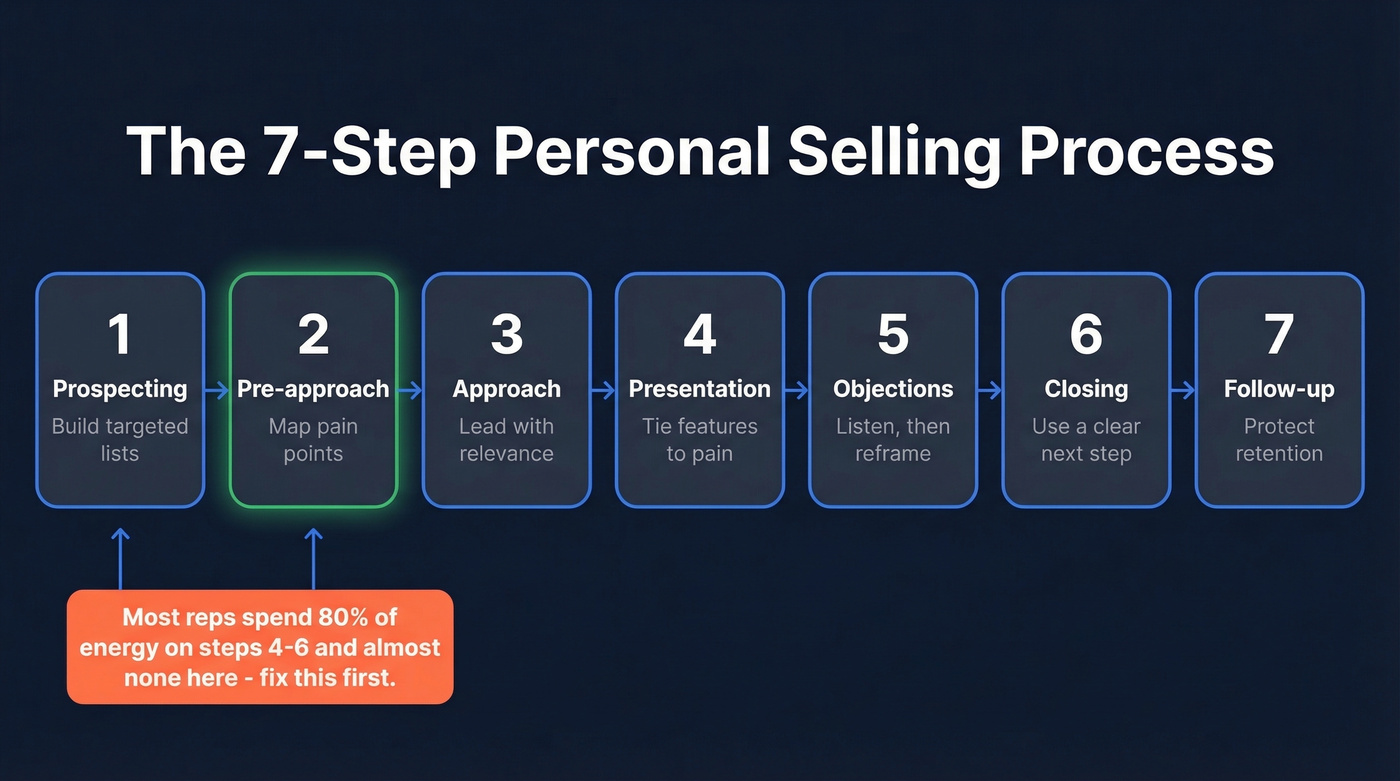
Before getting into specific strategies, here's the foundational process most personal selling follows:
| Step | What Happens | Key Action |
|---|---|---|
| Prospecting | Find potential buyers | Build targeted lists |
| Pre-approach | Research the prospect | Map pain points |
| Approach | Make first contact | Lead with relevance |
| Presentation | Show the solution | Tie features to pain |
| Objections | Address concerns | Listen, then reframe |
| Closing | Ask for the deal | Use a clear next step |
| Follow-up | Nurture post-sale | Protect retention |
The mistake most reps make is spending 80% of their energy on steps 4-6 and almost none on steps 1-2. The strategies below fix that imbalance. (If you want more ideas for step 1, use these sales prospecting techniques.)

Steps 1 and 2 - prospecting and pre-approach - make or break your personal selling strategy. Prospeo gives you 300M+ profiles with 30+ filters (buyer intent, technographics, job changes, funding) so you walk into every call with the right person and the right context. 98% email accuracy means your outreach actually lands.
Stop perfecting your pitch for prospects you can't reach.
9 Strategies That Actually Move Deals
1. Structure Discovery With SPIN
If you only adopt one framework, make it SPIN. Neil Rackham developed it from studying 35,000 sales calls across 20+ countries over 12 years. Reps who follow the SPIN question sequence see a 20% lift in close rates - that's not theory, it's the largest empirical sales study ever conducted.
(If you want a printable version, use a discovery call script PDF.)
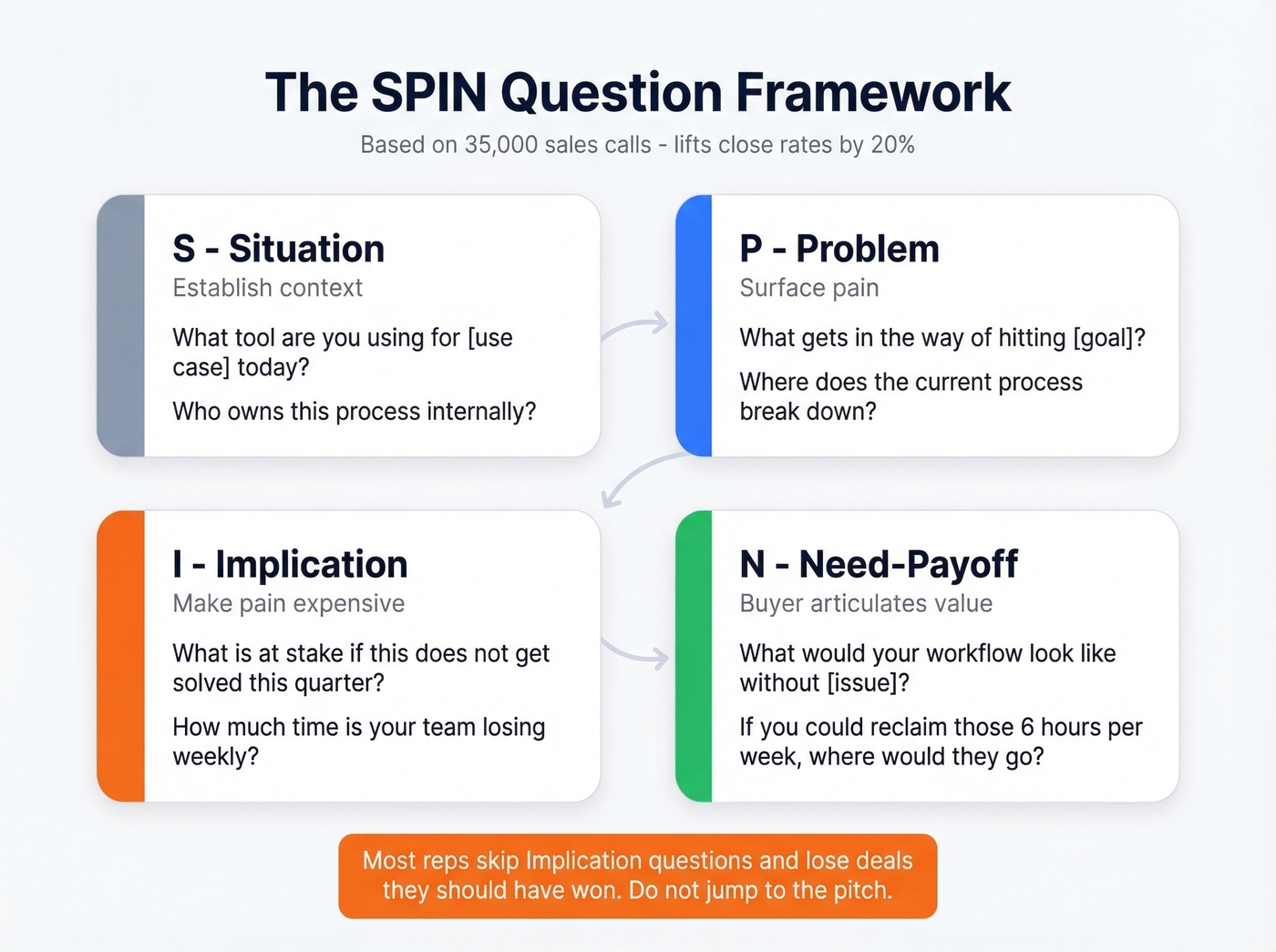
SPIN works because it forces you to build urgency before pitching. The sequence matters: Situation questions establish context, Problem questions surface pain, Implication questions make that pain feel expensive, and Need-Payoff questions get the buyer to articulate the value of solving it themselves. Successful discovery calls typically involve 11-14 engaging questions. Fewer than that, and you're not going deep enough.
In our experience, reps who skip Implication questions lose deals they should've won. They surface the pain, then jump straight to the pitch - and the buyer nods politely and ghosts. The real power is in Implication and Need-Payoff, where the buyer convinces themselves.
Situation - Establish context:
- "What tool are you using for [use case] today?"
- "Who owns this process internally?"
- "How does your team currently measure success here?"
Problem - Surface pain:
- "What gets in the way of hitting [goal]?"
- "Where does the current process break down?"
- "What's the biggest friction point for your team?"
Implication - Make pain expensive:
- "What's at stake if this doesn't get solved this quarter?"
- "How much time is your team losing to [issue] weekly?"
- "What happens downstream when [problem] occurs?"
Need-Payoff - Buyer articulates value:
- "What would your workflow look like without [issue]?"
- "If you could reclaim those 6 hours/week, where would they go?"
- "How would solving this impact your team's number?"
2. Use Challenger for Complex Deals
Challenger is SPIN's complement, not its competitor. Use SPIN for discovery, Challenger for the pitch.
CEB's research across 6,000+ sales reps found that the highest performers don't just respond to buyer needs - they reshape how buyers think about their problems. The Challenger framework has three moves: Teach the buyer something they didn't know about their business, Tailor the message to each stakeholder's priorities, and Take Control of the commercial conversation. This works best when the status quo is your biggest competitor - when the buyer's default is "do nothing."
Xerox implemented Challenger and reported a 17% increase in sales and $65M in contract value. That's a single case study, but it illustrates the upside of commercial teaching.
The practical move: before your next presentation, ask yourself what insight you're bringing that the buyer couldn't find on their own. If the answer is nothing, you're a brochure with legs. (For more on packaging insights, build sales battle cards.)
3. Multi-Thread Every Large Deal
A typical B2B purchase involves 7.4 decision-makers. If you're only talking to one of them, you're not selling - you're hoping.
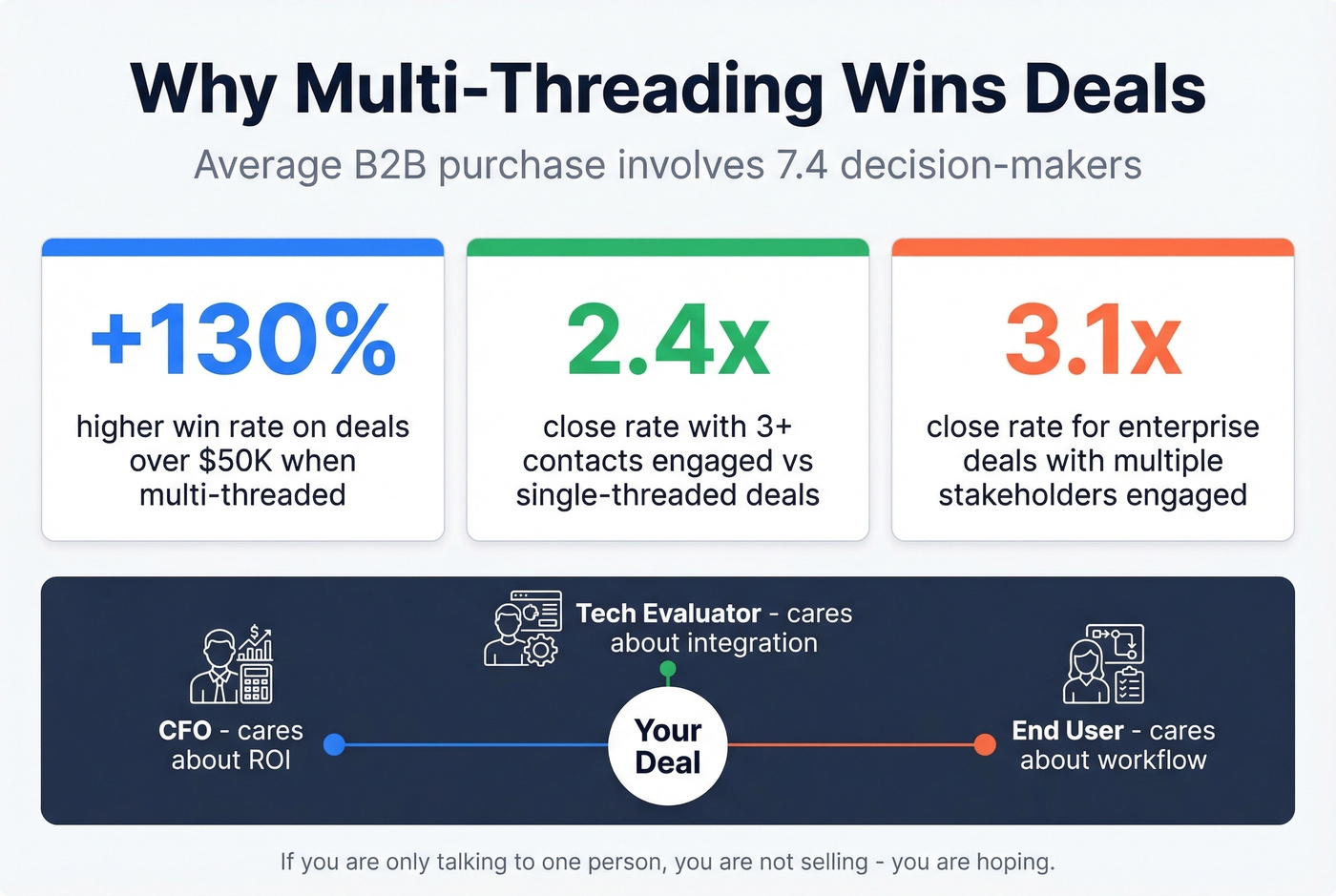
The data is stark. For deals over $50K, multi-threading boosts win rates by 130%. Deals with 3+ contacts engaged close at 2.4x the rate of single-threaded deals. For enterprise opportunities, that jumps to 3.1x.
Multi-threading isn't just about hedging against your champion leaving. It's about building consensus across the buying committee before the internal meeting you're not invited to. Map the org chart, identify the economic buyer, the technical evaluator, and the end users, then build separate value narratives for each. The CFO cares about ROI. The end user cares about workflow friction. Each of these one-on-one sales conversations needs its own angle. (If you're selling bigger tickets, use an enterprise B2B sales process.)
To multi-thread effectively, you need verified contact info for the entire buying committee - not just whoever filled out the form. Prospeo's 30+ search filters let you pull emails and direct dials for multiple stakeholders in minutes, so you're not stuck waiting for your single contact to make introductions that never happen.
4. Follow Up Like the Math Says To
Following up 5+ times isn't desperate. It's math.
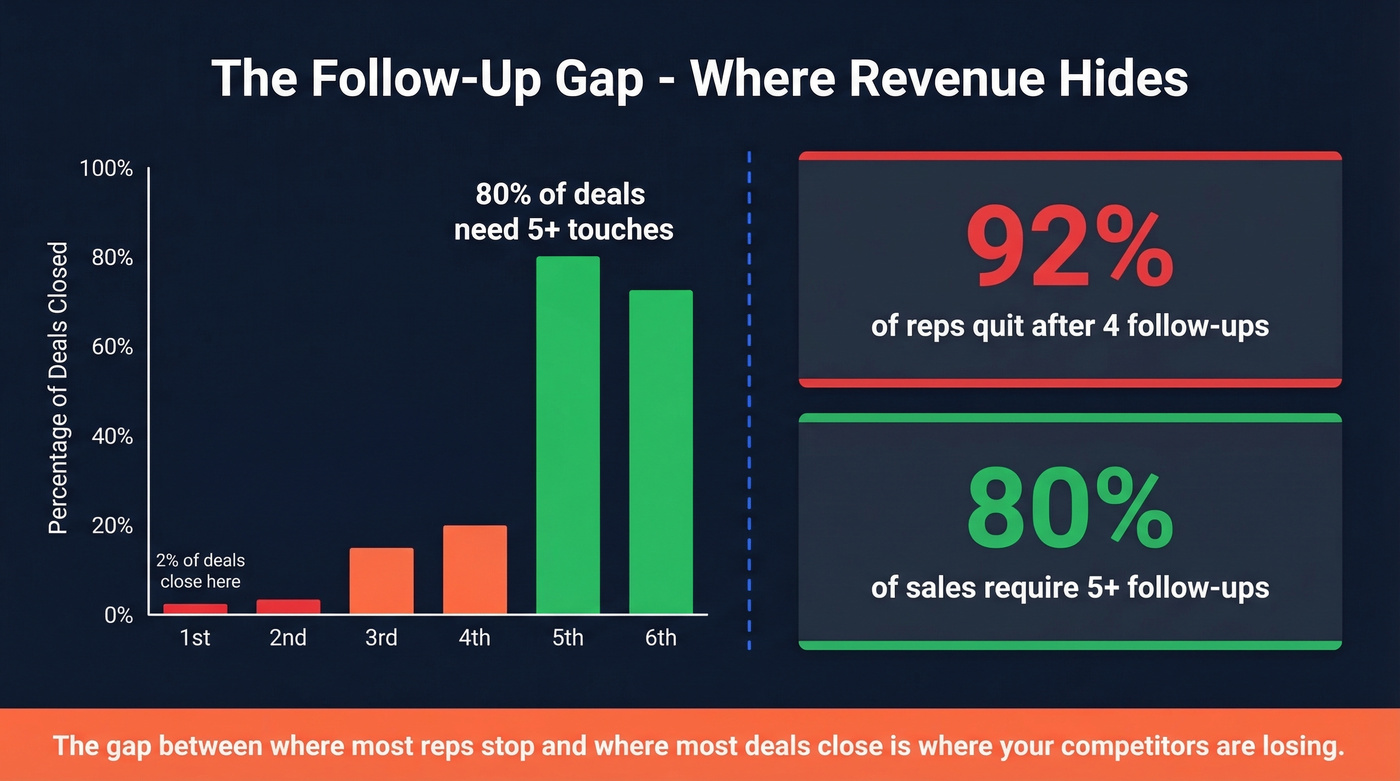
80% of sales require 5+ follow-ups, but 92% of reps quit after 4 attempts. Only 2% of deals close on the first contact. Meanwhile, 35-50% of sales go to the vendor that responds first.
Read those numbers again. The gap between "most reps stop" and "most deals close" is where revenue hides. We've seen teams add a 5th and 6th touch to their sequences and see pipeline velocity jump almost immediately - not because the messaging changed, but because they simply stayed in the conversation longer than competitors did. (If you want to benchmark this, track your follow-up email reply rate.)
The fix is mechanical, not motivational. Build follow-up cadences into your sequencer with pre-written touches. Don't rely on willpower to send email #6 when you're already working 40 other deals.
5. Personalize With Data, Not Guesswork
You spent 45 minutes on a discovery call, asked great questions - then the prospect ghosted. You check your CRM: the email bounced, the phone was disconnected. You never had a real prospect. You had bad data.
This is the most underrated personal selling strategy: fix your data before you fix your pitch. Advanced personalization drives 18% response rates vs 9% for generic outreach. Multi-field personalization lifts reply rates by 142%. But only about 5% of senders personalize every email - partly because personalization is hard, and partly because most reps are working from stale, unverified contact lists. (If you're diagnosing deliverability, start with email bounce rate.)
Snyk's 50 AEs saw bounce rates drop from 35-40% to under 5% after switching to Prospeo, with AE-sourced pipeline up 180% and 200+ new opportunities per month. That kind of improvement comes from combining real-time verification with a 7-day data refresh cycle versus the 6-week industry norm.
6. Don't Skip Social Selling
Here's a hot take: social selling isn't a "nice to have" anymore - it's table stakes for anyone selling deals above $25K. Reps with high Social Selling Index scores generate 45% more opportunities and are 51% more likely to hit quota. 78% of businesses using social selling outperform those that don't.
Social proof in personal selling goes beyond sharing case studies, though you should absolutely do that. It means being visible in the spaces where your buyers research. Share insights on industry trends. Comment on prospects' posts before you cold-call them. Reference a mutual connection or a relevant customer win in your outreach.
The best social sellers treat their online presence as a pre-approach tool - warming up the conversation before the first email ever lands. (To systematize this, build a personalized outreach workflow.)
7. Win One-on-One Conversations
Your VP asks why your close rate is 18% when the team average is 30%. The top rep asks twice as many questions and talks half as much.
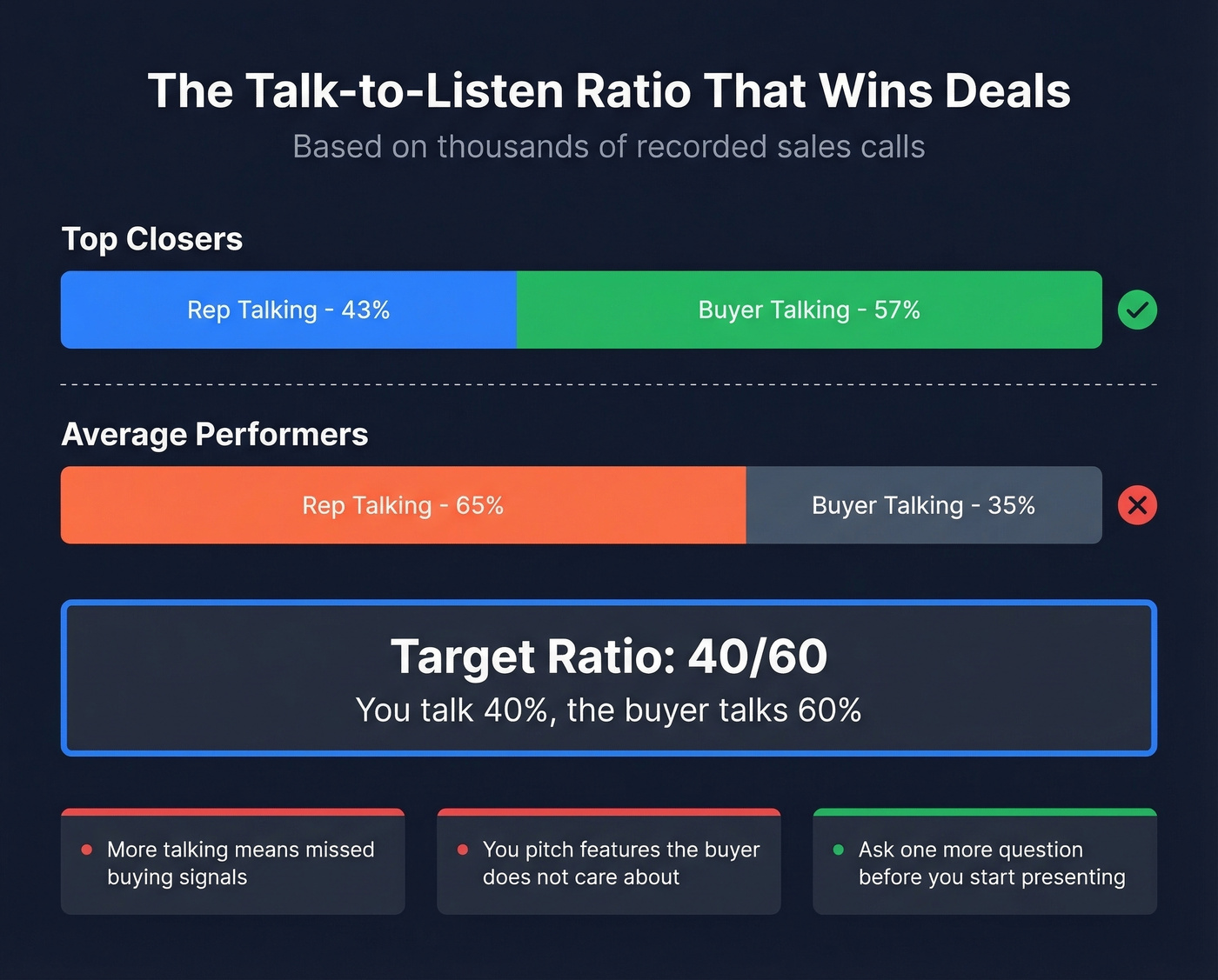
Gong's data shows top closers speak only 43% of the time during sales calls. Average performers? 65%. The recommendation is a 40/60 talk-to-listen ratio - you talk 40%, the buyer talks 60%.
This isn't soft advice. It's behavioral data from thousands of recorded calls. When you talk more, you miss buying signals, you pitch features the buyer doesn't care about, and you lose the consultative positioning that wins complex deals. In one-on-one sales settings, every extra minute you spend talking is a minute the buyer isn't revealing what would actually get them to sign.
The fix: ask one more question before you start presenting. Then ask another one. (If you want more scripts, use these talk track examples.)
8. Build a Consultative Playbook
Organizations that invest in full sales enablement see 49% higher win rates on forecasted deals. That's not because playbooks are magic - it's because they force consistency across the team.
The best playbooks don't tell reps what to say word-for-word. They give reps a decision framework so they can adapt to each conversation without reinventing the wheel. A strong consultative playbook includes defined stages with clear exit criteria, discovery call guides with SPIN questions mapped by persona, an objection repository with tested responses, value messaging tailored by persona and industry, and templates for each deal stage. Build it once, iterate quarterly, and make it the first thing new hires open. (If you're standardizing stages, start with sales process optimization.)
When every rep follows the same consultative approach, coaching becomes about refinement rather than reinvention.
9. Use AI to Compress Research Time
Research eats up to 6 hours per week per rep. That's 6 hours not spent selling. AI tools are compressing that dramatically - in-flow suggestions from AI coaching improve outcome quality by 15%.
The biggest unlock isn't AI writing your emails. It's AI telling you who to call. Intent data helps reps prioritize accounts showing active buying signals before picking up the phone. Layer buyer intent with job role and company growth signals, then pair that with verified contact data to reach the right person at the right account at the right time. (To operationalize this, use a lead scoring model.)
Use AI for account prioritization, talking-point generation, and competitive intel. Keep the human touch for the actual conversation. That's where one-on-one sales conversations still beat everything else.
Multi-threading a deal with 7+ stakeholders requires verified contact data for the entire buying committee - not just one champion. Prospeo delivers emails and direct dials for decision-makers across any org, refreshed every 7 days. Teams using Prospeo book 35% more meetings than Apollo users.
Get the whole buying committee's contact info in minutes, not weeks.
Objection-Handling Scripts
Most objections fall into four categories: Budget, Authority, Need, and Timing. Before you respond, make one distinction: is this an objection - a real reason they won't buy - or an obstruction, which is just an excuse to end the conversation? Obstructions get pattern interrupts. Objections get value reframes.
| Category | Objection | Script |
|---|---|---|
| Budget | "It's too expensive." | "Let's talk about the outcomes that would make this feel worthwhile. What would solving [problem] save you per quarter?" |
| Budget | "We don't have budget." | "Many teams shift funds when they see the ROI. Can we map the potential impact in 15 minutes?" |
| Authority | "I need to check with my boss." | "Totally fair. What questions will they have? Let's prep you with answers so this moves forward." |
| Need | "Not interested." | "If you give me 30 seconds, I'll share why I reached out - you can tell me if it's worth continuing." |
| Need | "We use a competitor." | "What made you choose them? [Listen.] Here's where we differ on [specific differentiator]." |
| Timing | "I don't have time right now." | "I get it. I have a 2-minute version - want that instead, or should I send a one-pager you can read when it fits?" |
| Timing | "Call me next quarter." | "Happy to. Before I go - what's changing next quarter that makes this a better conversation then?" |
The last column isn't a script to memorize. It's a structure to internalize. The pattern: acknowledge, ask a question, reframe around value. Never push harder - redirect smarter.
Benchmark Your Pipeline
Personal selling strategies don't exist in a vacuum. You need to know what "good" looks like for your industry. Here are stage-by-stage conversion benchmarks across three verticals:
| Industry | Lead to MQL | MQL to SQL | SQL to Opp | SQL to Closed |
|---|---|---|---|---|
| B2B SaaS | 39% | 38% | 42% | 37% |
| Cybersecurity | 24% | 40% | 43% | 46% |
| Higher Ed | 45% | 46% | 61% | 66% |
If your SQL-to-Closed rate is below 37% in SaaS, your selling technique needs work - specifically in the presentation-through-closing stages. If your Lead-to-MQL conversion is low, the problem is upstream: targeting and messaging, not closing technique.
Track these alongside customer acquisition cost and average sales cycle length. Those two metrics tell you whether your approach is efficient, not just effective. Use all three as baselines, not targets - your numbers should improve as you implement the strategies above, particularly SPIN and multi-threading. (For more benchmarks, see sales conversion rate.)
5 Mistakes That Kill Deals
1. Talking more than listening. Top closers speak 43% of the time. If you're above 55%, you're leaving deals on the table. Record your next three calls and check.
2. Leading with features instead of outcomes. Nobody cares about your platform's architecture. They care about what changes for them.
3. Focusing on price instead of value. When you negotiate on price, you've already lost the value conversation. Reframe to ROI before discounting.
4. Overpromising. Only 5% of B2B buyers say salespeople exceed expectations. Set realistic timelines, be honest about limitations, and you'll stand out from 95% of the field.
5. Working from bad data. We've watched reps blame their pitch when the real problem was a 40% bounce rate. Bad emails, disconnected numbers, outdated titles - these don't just waste time. They destroy your credibility when you reference the wrong role or company in a personalized message. Clean your data weekly, not quarterly.
FAQ
What are the most effective personal selling techniques?
Start with SPIN Selling for discovery and Challenger for the pitch. Layer in multi-threading for any deal over $50K, and build a follow-up cadence of at least 5 touches. These four techniques, backed by the largest empirical sales studies available, cover the full deal cycle from first contact to close.
Which selling framework should I learn first?
SPIN Selling. It's backed by 35,000 sales calls of research, it's immediately actionable - you can use the questions on your next call - and it increases close rates by 20%. Layer Challenger on top once you're comfortable with SPIN.
How do I measure selling effectiveness?
Track stage-by-stage funnel conversion rates from Lead through MQL through SQL to Closed, and benchmark against your industry. In B2B SaaS, a healthy SQL-to-Closed rate is around 37%. Also monitor your talk-to-listen ratio - top closers speak only 43% of the time. Both metrics are leading indicators of rep skill.
How do one-on-one conversations differ from group demos?
In one-on-one sales, you can tailor every question and value statement to a single stakeholder's priorities, which makes SPIN far more effective. Group demos require broader messaging that appeals to multiple roles simultaneously. Whenever possible, run individual discovery calls with each decision-maker before bringing the group together - this gives you conversational depth with the consensus-building power of a committee presentation.
What tools help improve personal selling results?
Verified contact data is the foundation - you can't sell to someone you can't reach. Beyond that, pair a CRM with a call-recording tool like Gong for coaching insights and a sequencer for automated follow-ups. The consensus on r/sales is that most reps underinvest in data quality and overinvest in outreach tooling, which is exactly backwards.