

Prospecting in Sales Examples: Scripts, Templates & Cadences You Can Steal
84% of sales reps missed quota last year. Not because they lacked effort - because they ran the same playbook into a market that stopped responding to it. Most guides define terms you already know. This one gives you real prospecting in sales examples - scripts you can copy, cadences you can schedule, and a scoring model you can implement this week.
What You Need (Quick Version)
Three things separate reps who book meetings in 2026 from those who don't:
- Signal-based targeting over volume. Stop spraying 500 contacts a week. Start with the 50 who are actually in-market. (If you need a framework, start with sales prospecting techniques.)
- Ultra-short emails, under 60 words. Cold email performance is declining for a lot of teams, and the simplest pattern that still works is shorter, trigger-based emails with a soft CTA. (Steal proven prospecting email subject lines to lift opens.)
- Multi-channel cadences. Email-only averages ~3% response rates. Add phone and social, and that climbs to 15%+.
Your data quality matters more than your copywriting. Verify before you send. (Use an email deliverability guide to avoid silent inboxing.)
Why Sales Prospecting Changed in 2026
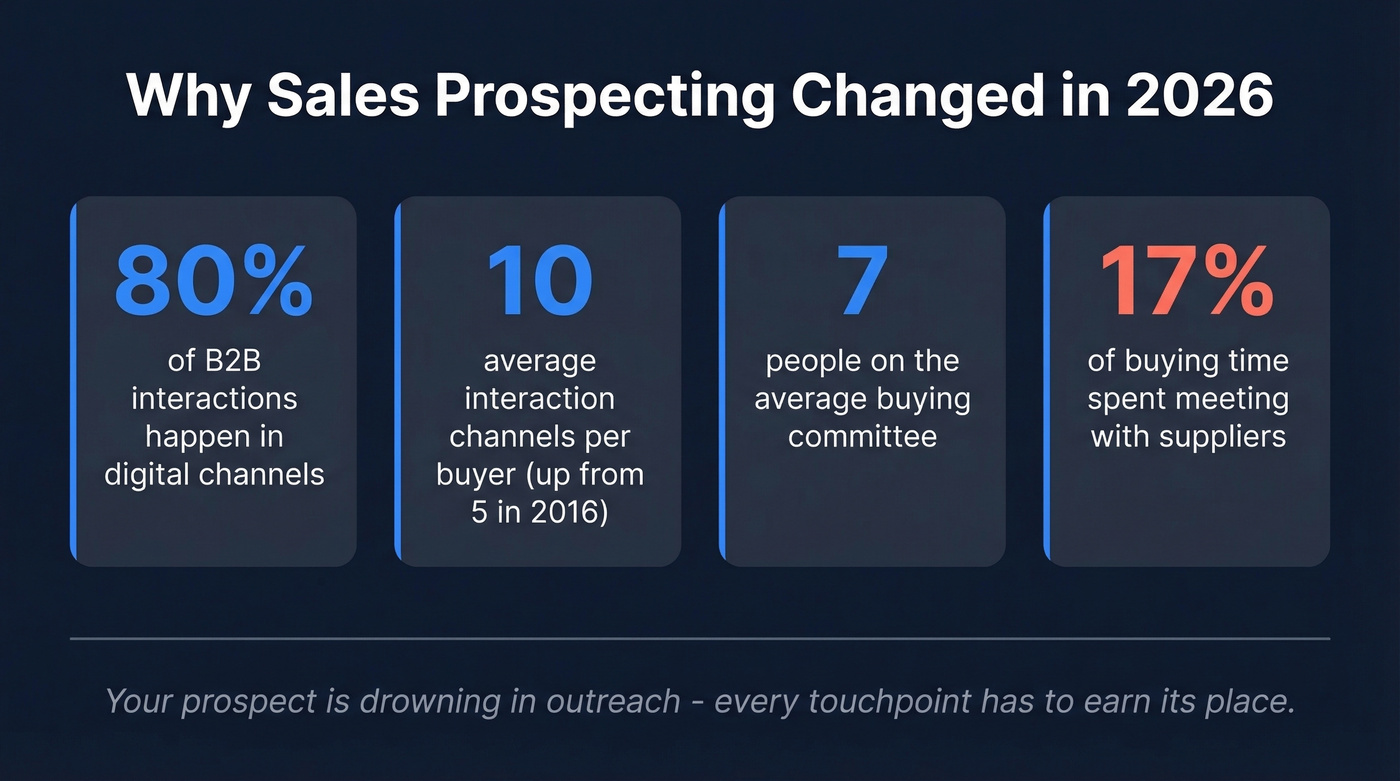
The buyer you're targeting doesn't sit in a conference room waiting for your call. 80% of B2B interactions now happen in digital channels. Buyers use an average of 10 interaction channels - up from 5 in 2016 - and the typical mid-market deal involves a 7-person buying committee. Your prospect is drowning in outreach from every direction, and they spend only 17% of their buying time actually meeting with suppliers. Every touchpoint has to earn its place.
As Collin Stewart put it, "Predictable Revenue was never meant to be about brute-force outreach - it was about focus." We started optimizing for calendar slots instead of customers, and the market punished us for it.
Here's my hot take: most teams don't have a prospecting problem - they have a targeting problem. If you're reaching the right 50 accounts at the right time, mediocre copy will outperform brilliant copy sent to the wrong list. Intent data, job changes, funding rounds, tech stack signals - these tell you when to reach out, not just who to reach out to. (If you want a repeatable system, see identifying buying signals.) Every template below assumes you've done the targeting work first.
Cold Email Prospecting Examples
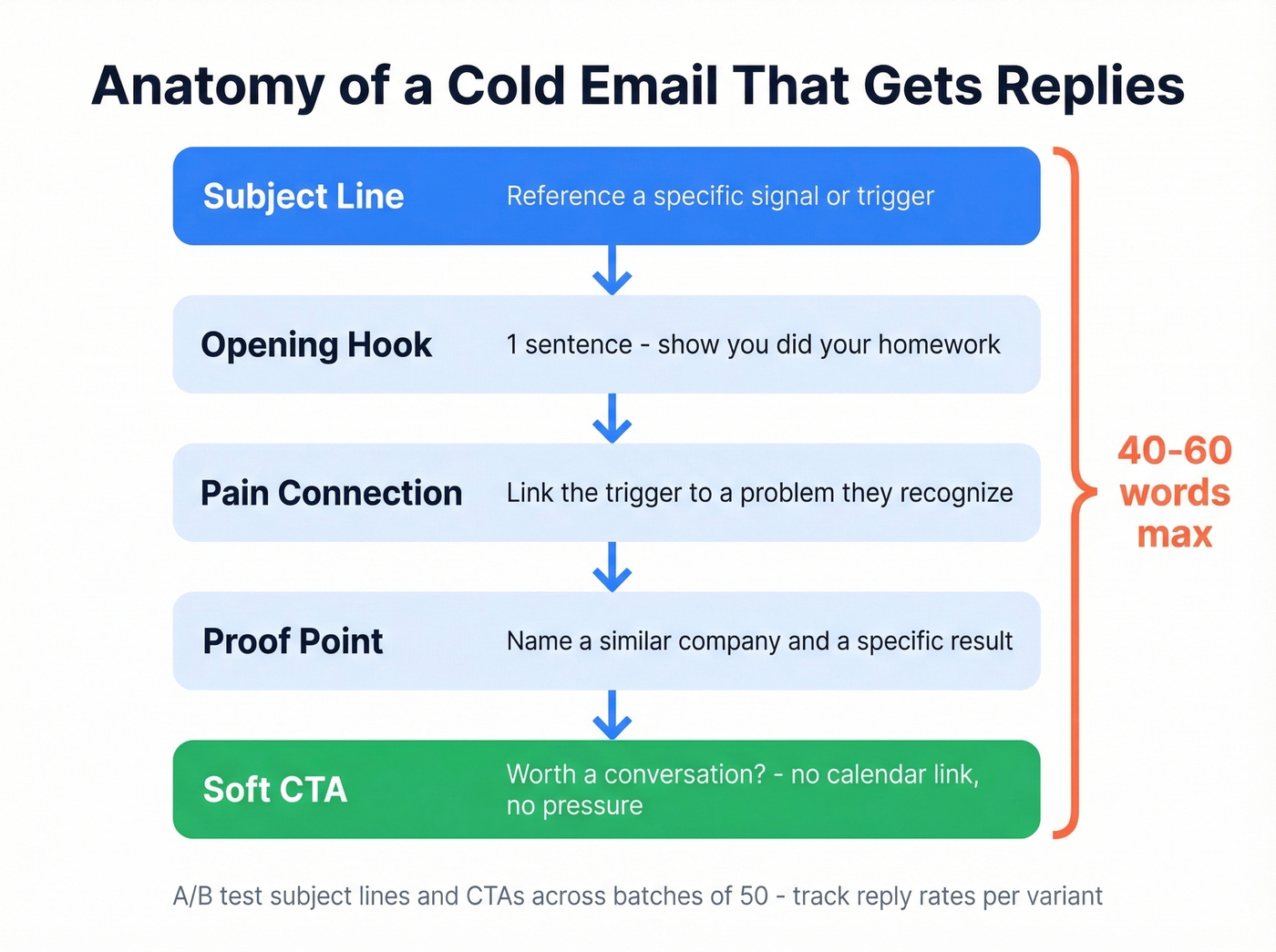
The consensus on r/copywriting is blunt: "Most of what worked last year is dead now." What's working? Absurdly short emails - 40-60 words max - with a specific trigger and a soft CTA. A/B test subject lines and CTAs across batches of 50, and track reply rates per variant. Here are three templates you can steal. (For more variations, pull from cold email follow-up templates.)
The 47-Word Email
Subject: Quick idea re: {signal}
Hey {first name},
Noticed you're hiring for {role} - usually means {pain point} is on the radar.
We help companies like {competitor 1} and {competitor 2} with {coolest feature} - typically see {specific result}.
Worth a conversation?
{Your name}
Why it works: It opens with a trigger the prospect recognizes, connects that trigger to a pain point, and closes with the lowest-friction CTA possible. No meeting link. No calendar pressure. Just a question. (If you want to tighten the CTA, use these email call to action rules.)
The Specific Observation Email
Subject: Your {metric} dropped - here's why
Hi {first name},
I was looking at {company}'s {public metric - traffic, job postings, review scores} and noticed {specific observation with numbers}.
We ran into the same pattern with {similar company} - turned out it was {diagnosis}. After {fix}, they saw {quantified result} in {timeframe}.
Would a 10-minute breakdown be useful?
This one uses a specific observation, a diagnosis, an outcome, and a CTA - all with concrete numbers. The prospect thinks "this person actually looked at my business" - because you did. SaaS cadences using this format see 18-25% reply rates.
The Breakup Email
Subject: Closing the loop
Hi {first name},
I've reached out a couple of times about {pain point}. Totally get it if the timing's off.
I put together a quick {checklist/one-pager} on {topic} - figured it might be useful regardless. Here's the link: {resource}
If things change, I'm around.
Low pressure, high value. You're giving something away and closing gracefully. 43% of buyers say 5+ touches is acceptable - this is your final one, and it leaves the door open.
Cold Call Scripts That Work
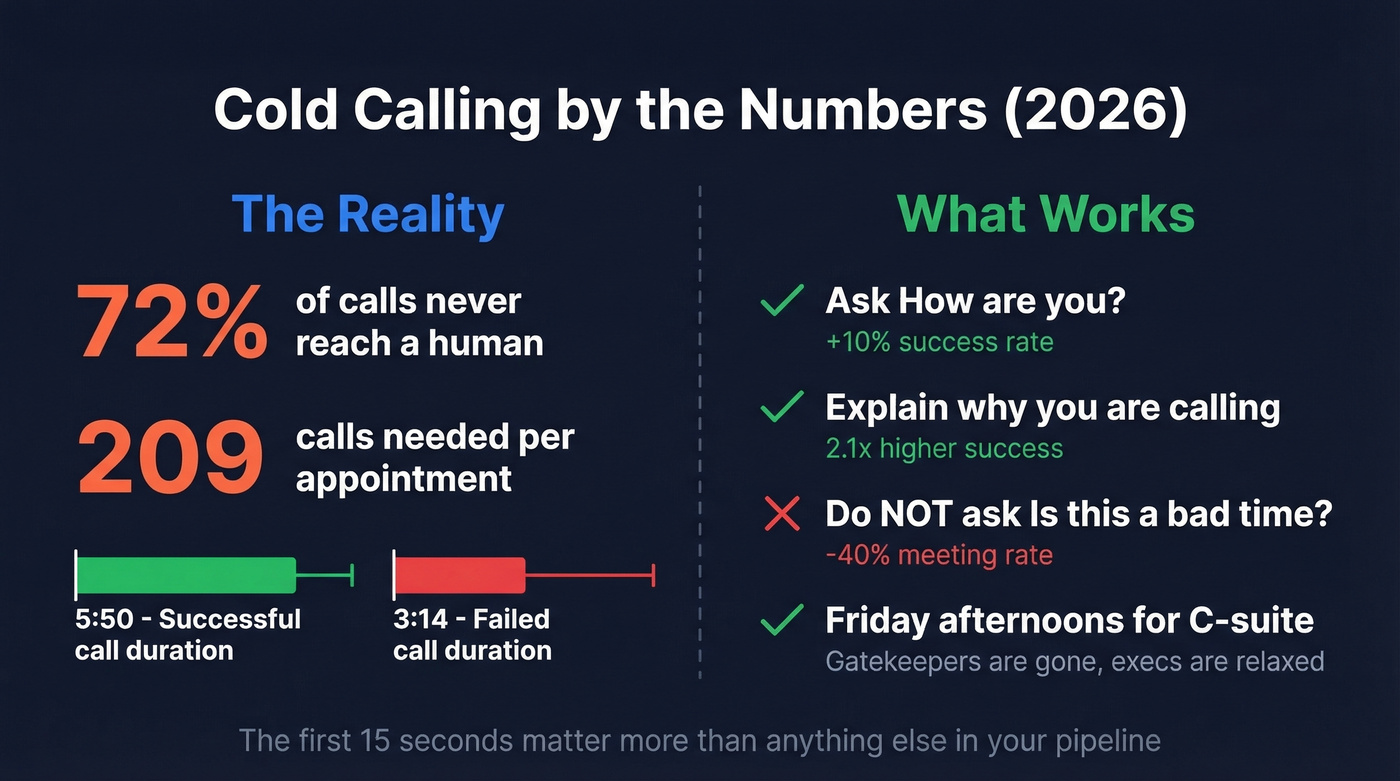
Here's the thing about cold calling in 2026: 72% of calls don't reach a human. The Bridge Group puts it at 209 calls per appointment. So when someone actually picks up, your first 15 seconds matter more than anything else in your pipeline. Successful cold calls average 5:50 in duration. Failed ones? 3:14. The difference is almost always the opener. (If you’re rebuilding your motion, start with a cold calling system.)
The Permission-Based Opener
"Hi {first name}, this is {your full name} calling from {company}. Appreciate I caught you out of the blue here - you got a minute?"
Then pivot to value: "We do {coolest feature} for other companies in your space like {biggest competitors}."
Gong's research shows that simply asking "How are you?" increases success rates by 10%. But asking "Is this a bad time?" decreases meeting chances by 40%. Permission-based framing threads the needle - it's respectful without being self-defeating. Explaining why you're calling boosts success rates by 2.1x, so always lead with the trigger that prompted your outreach.
Handling "I Don't Have Time"
"Totally understand - you're busy. In three minutes, I can share how we help {similar companies} with {specific outcome}. Does that sound fair? If not, when's a better time this week?"
The goal here isn't the pitch. It's the callback appointment.
The Voicemail Script
80% of calls go to voicemail. Have a script ready:
"Hey {first name}, this is {your name} from {company}. Just sent you a quick email about {signal}. Take a look when you get a chance - my number is {number}."
Keep it under 20 seconds. The voicemail's only job is to drive the prospect back to your email.
Getting Past the Gatekeeper
"Hi, I'm hoping you can help me. I need to speak with {prospect name} about {specific business topic}. Could you transfer me, or is there a better time to reach them?"
Friday afternoons are gold for C-suite calls. Gatekeepers are gone, and executives are winding down - more likely to pick up and more relaxed when they do.
Multithreading the Account
With a 7-person buying committee on the average mid-market deal, calling one person is a losing strategy. Reach out to 2-3 stakeholders in the same account simultaneously - the economic buyer, the end user, and the internal champion. If one thread stalls, the others keep the deal alive. We've found that multithreaded accounts close at nearly double the rate of single-threaded ones. (This is the core of account-based selling best practices.)

Every template above assumes clean data. Bad emails kill cadences before your copy gets a chance. Prospeo verifies emails through a 5-step process - 98% accuracy, 7-day refresh, and bounce rates under 4% for teams like Snyk and Meritt.
Stop perfecting scripts that bounce. Fix the data first.
LinkedIn Prospecting Examples
Connection requests cap at 300 characters. That's roughly two sentences. Every word has to earn its spot.
Connection Request Templates
Shared context: "Hi {first name} - saw your comment on {post topic} in {group}. Interesting take on {specific point}. Would love to connect and swap notes."
Event-based: "Hi {first name} - noticed we both attended {event/webinar}. {Speaker}'s point about {topic} stuck with me. Let's connect."
Direct value: "Hi {first name} - I work with {similar companies} on {outcome}. Thought it'd be worth connecting - I share a lot of {relevant content type} here."
Mentioning a commonality lifts InMail acceptance by 46%. Connection requests work the same way.
The 4-Touch LinkedIn Sequence
Touch 1 - Connection request: Don't sell. Use one of the templates above. Get accepted first.
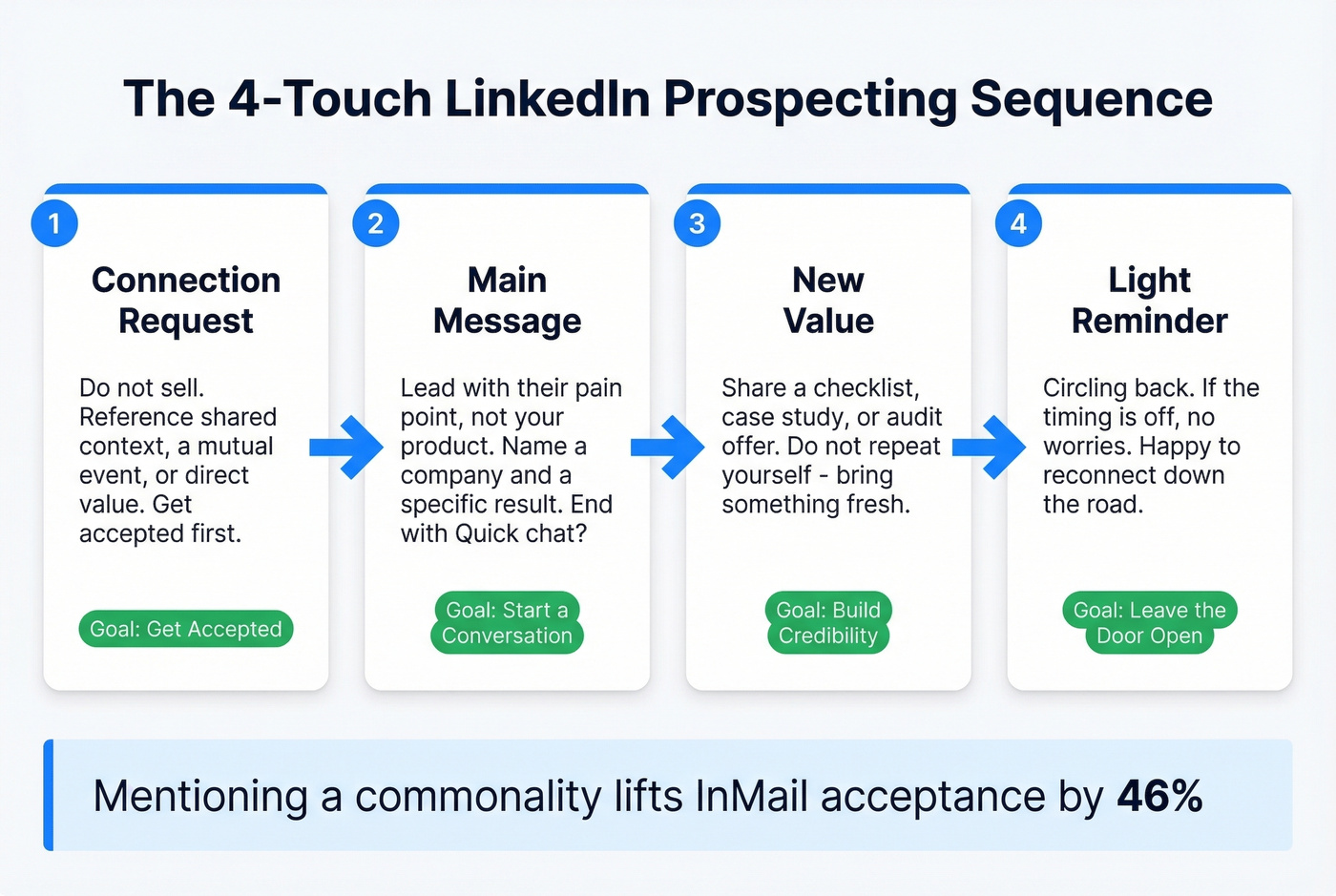
Touch 2 - Main message: Lead with their pain point, not your product. "Following {company}'s expansion into {market}. Teams at that stage usually hit {specific challenge}. We helped {similar company} solve that - saw {result}. Quick chat?"
Touch 3 - New value: Share a checklist, case study, or audit offer. Don't repeat yourself.
Touch 4 - Light reminder: "Hey {first name} - circling back. If the timing's off, no worries. Happy to reconnect down the road."
Multi-Channel Cadence Examples
Single-channel outreach is a losing bet. Email-only gets you ~3% response rates. Stack channels - email, phone, social - and you're looking at 15%+ response rates. Here are two cadences you can implement today, followed by a side-by-side comparison. (If you need more options, grab these sales follow-up templates.)
The Standard 5-Touch Cadence
| Day | Channel | Action |
|---|---|---|
| 1 | Personalized trigger email (47-word template) | |
| 3 | Phone | Reference the email; leave voicemail pointing back to it |
| 7 | New value - case study or insight | |
| 10 | Phone | Second call attempt |
| 14 | Breakup email with resource |
The Intent-Triggered Burst Cadence
| Day | Channel | Action |
|---|---|---|
| 1 | Within 24 hours of intent signal | |
| 2 | Phone | Reference the signal directly |
| 4 | Related content or case study | |
| 6 | Social | LinkedIn engagement or DM |
| 7 | Phone/Email | Final touch, then pause until new trigger |
Side-by-Side Comparison
| Dimension | Standard 5-Touch | Intent-Triggered Burst |
|---|---|---|
| Duration | 14 days | 7 days |
| Best for | Cold outbound lists | Accounts showing buying signals |
| First touch | 47-word trigger email | Signal-specific email within 24 hrs |
| Social included | No | Yes, Day 6 LinkedIn DM |
| Expected lift | Baseline response rate | 2-3x over standard cadence |
| Template refs | 47-word + breakup email | Observation email + value share |
| Winner | Reliable default | Best when signals are fresh |
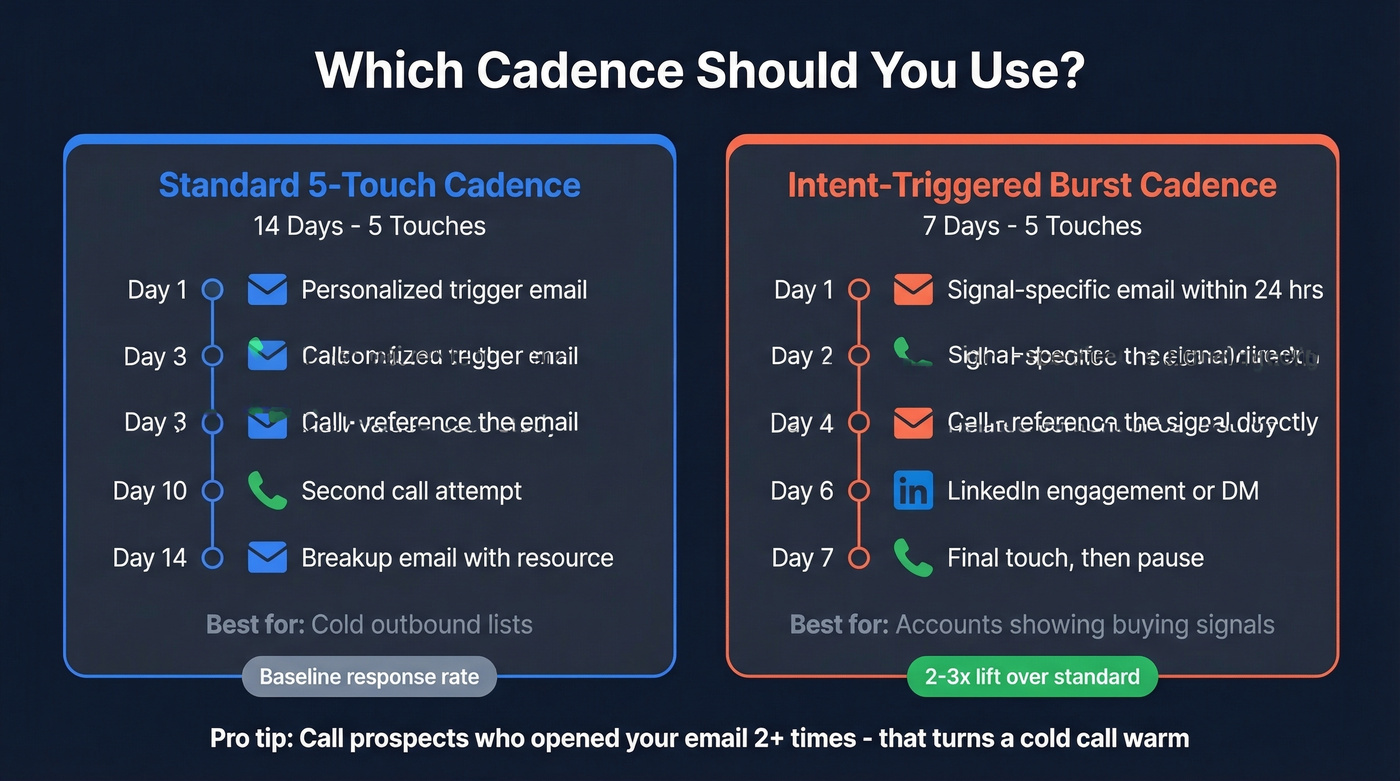
Pro tip: Prioritize calling prospects who've opened your email 2+ times. That behavioral signal turns a cold call into a warm one.
Intent-led outreach drives 2-3x lift in response rates when the first touch lands within 24 hours of the signal. The compressed timeline works because the prospect is actively researching - you're showing up when they're already thinking about the problem. We've found the intent-triggered burst cadence works best for mid-market SaaS deals where buying cycles run 30-90 days.
Space touches 2-3 days apart. Send initial emails Tuesday through Thursday mornings. Never more than 2 touches in any 24-hour period. (For timing benchmarks, see best time to send cold emails.)
How to Prioritize Your Prospect List
Not every prospect deserves the same cadence. Use a signal-weighted scoring model to decide who gets your attention first. (If you want to formalize this, use a lead scoring model.)
| Signal | Score |
|---|---|
| New VP/Director hired (90 days) | 20 |
| Visited pricing page or webinar | 20 |
| Relevant job postings live | 15 |
| Uses complementary tech | 15 |
| Funding or expansion news | 15 |
| Contract renewal window | 15 |
Accounts scoring 65+ get your best cadence first. Everyone else goes into a nurture track. Refresh your ICP scoring quarterly - signals decay fast. (Start from an ideal customer profile template if your ICP is fuzzy.)
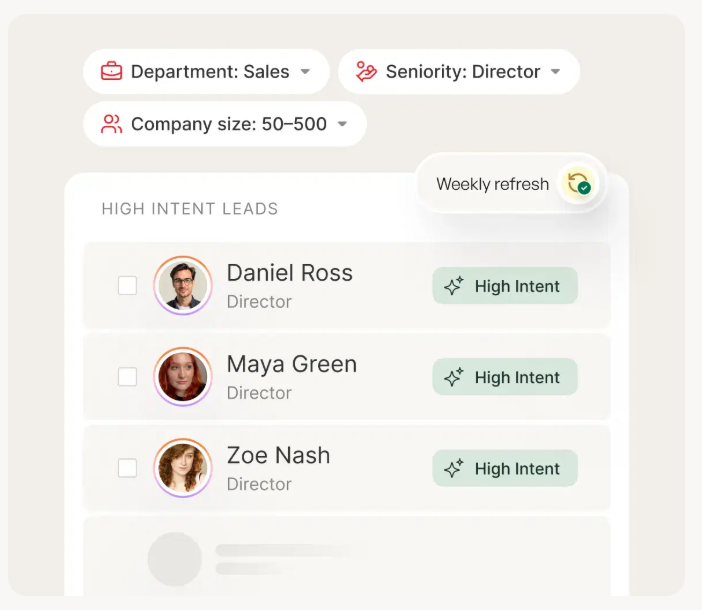
Here's what a filtered list looks like in practice: SaaS companies, Series B+, hired a VP of Sales in the last 90 days, using HubSpot, showing intent on "sales engagement" topics. That's five constraints. The result is a list of maybe 30-40 accounts - and every one of them is worth your A-cadence.
Prospeo's 30+ search filters make building these signal-scored lists practical. Layer buyer intent across 15,000 Bombora topics with job change signals, technographics, and headcount growth, then export a verified list directly into your sequencer.
Data Quality: The Prospecting Multiplier
Every template and cadence above is worthless if your data is bad. Reps lose 27.3% of their selling time to bad contact data. B2B data decays roughly 2.1% per month - that's 22.5% of your list going stale every year. (If you’re fixing your stack, compare data enrichment services first.)
Let's be honest: this is where most teams quietly bleed pipeline without realizing it.
The guardrails are non-negotiable. Bounce rate above 5%? Pause everything. Spam complaint rate above 0.2%? Pause everything. Hard bounces above 3% on a single batch - stop, clean, relaunch. Some teams run even tighter thresholds at 2% bounce and 0.01% complaint rates, and if your data source is good enough, you should too. (Use these email bounce rate benchmarks to set your thresholds.)
Prospeo runs a 5-step verification process with a 7-day refresh cycle, delivering 98% email accuracy across 143M+ verified addresses. Snyk's team of 50 AEs saw bounce rates drop from 35-40% to under 5% after switching, generating 200+ new opportunities per month and an 180% jump in AE-sourced pipeline. When your data is clean, every other lever in this article works harder.
Multithreading a 7-person buying committee means you need direct dials, not generic info@ addresses. Prospeo gives you 125M+ verified mobiles with a 30% pickup rate and 30+ filters to find the exact stakeholders - by intent, job change, or tech stack.
Build signal-based prospect lists in minutes, not hours.
Mistakes That Kill Your Prospecting
Untargeted lists. Emails sent to large, unsegmented lists receive 67% fewer replies than smaller, targeted groups. If you aren't filtering by ICP signals, you're burning your domain reputation for nothing.
No personalization. Epsilon research shows personalized emails achieve 14% higher open rates and 10% higher click-through rates. The 47-word template above takes 90 seconds to customize. There's no excuse. (If you want to improve the writing itself, use this email copywriting playbook.)
Single-channel outreach. 3% response rate with email only vs. 15%+ with multi-channel. We've seen teams double their pipeline just by adding phone touches to an existing email cadence.
Giving up too early. Most reps stop at two touches. The breakup email exists for a reason - use it.
Ignoring compliance. GDPR fines run up to 4% of global annual revenue or EUR 20M, whichever is higher. If you're prospecting into EMEA without proper consent workflows, skip the templates and fix that first.
FAQ
What's the best prospecting method in 2026?
Multi-channel cadences combining email, phone, and social consistently outperform single-channel approaches - email-only averages ~3% response rates while adding phone and social pushes that to 15%+. Layer signal-based targeting on top for the biggest lift.
How many touches does it take to book a meeting?
Most B2B deals require 5-12 touchpoints across multiple channels. 43% of buyers who accept meetings say five or more contacts is acceptable. Vary channels and add new value with each touch - repeating the same email four times isn't a cadence, it's spam.
How do you keep prospecting data accurate?
B2B contact data decays roughly 2.1% per month - about 22.5% annually. Use a provider with frequent refresh cycles and verify emails before launching any cadence. A 7-day refresh cycle and 98% email accuracy are the benchmarks to aim for; keep bounce rates below 5% and spam complaints under 0.2%.
What are the best prospecting examples for beginners?
Start with the 47-word trigger email and the permission-based cold call opener from this guide - both are simple, repeatable, and proven. Pair them in a 5-touch multi-channel cadence, track reply rates per variant, and iterate weekly based on real data rather than gut feel.