

How to Map Every Sales Call (With Data, Templates, and Benchmarks)
It's 9 AM. You've got 40 dials queued up, a coffee going cold, and a CRM full of contacts you half-remember researching last week. Most of those calls will go nowhere - cold calling converts at 9.38% compared to 25.56% for referrals. The gap isn't talent. It's preparation. Sales call mapping closes that gap.
Quick version: A call map is a flexible conversation framework, not a script. Build one per call type. Aim for 57% talk / 43% listen, 15-16 questions, and 53% more time on next steps. And verify your contact data before you build the call list - bad numbers and stale records kill connect rates before your map ever gets used.
What Is Sales Call Mapping?
Sales call mapping is the practice of building a planned conversational route - talking points, questions, transitions, and detours - for a specific type of sales call. Think of it as a flexible roadmap rather than turn-by-turn directions. If you're looking for geographic territory routing with tools like Badger Maps or Salesforce Maps, that's a different discipline entirely. A lot of online discussions mix these up - we're talking about conversation design here.
A script is word-for-word text you read aloud. A call map is a flexible framework - topics, questions, transitions, fallback responses. Scripts make you sound like a robot. Maps keep you on track while letting you sound human. (If you need examples, start with these sales call scripts and adapt them into a map.)
Why Sales Call Mapping Works
Gong analyzed 326,000 sales calls (10+ minutes) in its 2025 talk-to-listen update and found clear patterns separating won deals from lost ones:
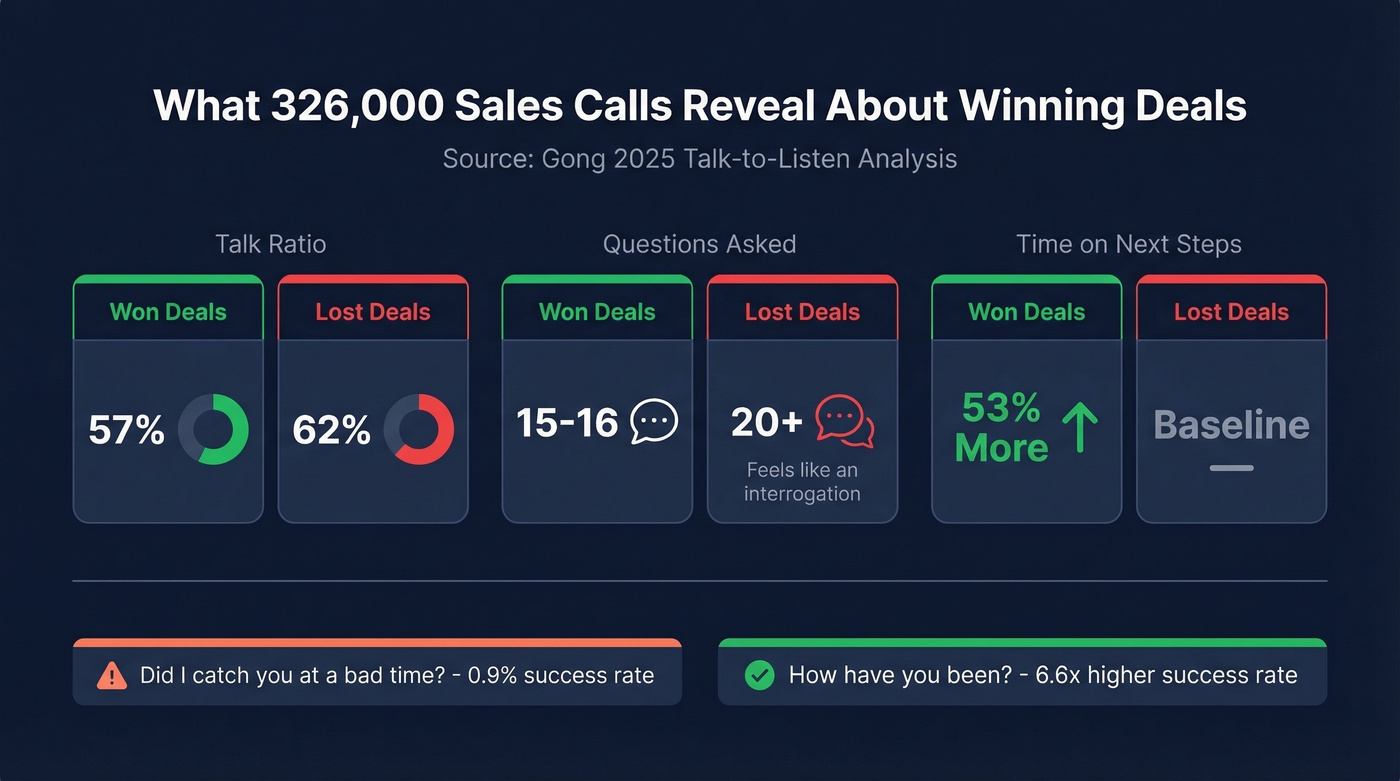
| Metric | Won Deals | Lost Deals |
|---|---|---|
| Talk ratio | 57% talk | 62% talk |
| Questions asked | 15-16 | ~20 |
| Next-steps time | 53% more | Baseline |
The question count is counterintuitive. More questions doesn't mean better discovery - past 16, it starts to feel like an interrogation. And the opener matters enormously: "Did I catch you at a bad time?" drops booking rates by 40% (0.9% success), while "How've you been?" produces a 6.6x higher success rate (>10% success). (For more data-backed options, see these best sales openers.)
Here's the thing: mapped calls with intentional structure outperform improvised ones not because reps follow them perfectly, but because the map forces you to think about pacing, question quality, and next steps before you pick up the phone. If you're trying to improve your sales call structure, mapping is the fastest way to make it repeatable.

Every call map dies when you dial a dead number. Prospeo gives you 125M+ verified mobile numbers with a 30% pickup rate and 98% email accuracy - refreshed every 7 days, not every 6 weeks. Stop burning call blocks on stale data.
More live conversations. More chances to use the map you built.
How to Build a Sales Call Map
Here's a timeboxed discovery call map built from those 326K-call benchmarks and practitioner frameworks. One concept worth stealing from Reprise's framework: plot your call map on two axes - time on the X-axis, impact on the Y-axis. It forces you to front-load high-impact moments and cut filler. Adapt the timing below to your average call length - this assumes 45 minutes. (If you want a checklist version, use this pre call planning guide.)
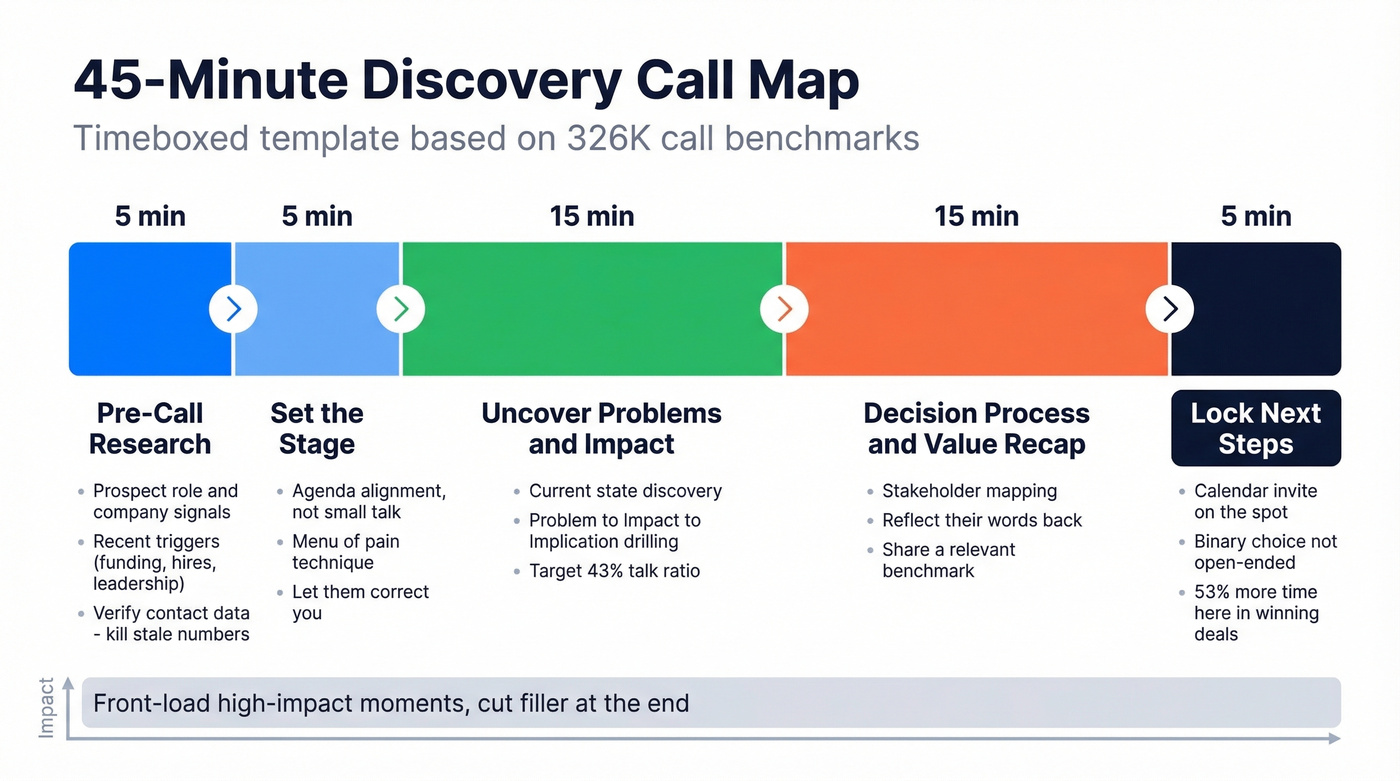
Pre-Call Research (5 Min)
Five minutes of focused research beats thirty minutes of winging it. Look up the prospect's role, company pain signals, recent triggers such as funding rounds, leadership changes, or hiring surges, and any previous touchpoints in your CRM. (Here’s a deeper system for cold call research.)
The upstream problem nobody talks about enough: stale contact data. Job changes, role shifts, and outdated records mean you can burn a call block dialing the wrong person or the wrong number. Use a verified data platform like Prospeo to pull confirmed emails and direct dials before you build your call list - fewer bounces and fewer dead ends means more live conversations and more chances to actually use the map you built. (Benchmarks and fixes: connect rate.)
Set the Stage (5 Min)
Open with agenda alignment, not small talk. Tell the prospect what you'd like to cover, how long it'll take, and what they'll walk away with.
Then deploy the "menu of pain" technique: offer three persona-specific pains and ask which resonates most. The trick from UserGems' playbook - make one option slightly wrong. When the prospect corrects you, they reveal their real pain faster than any open-ended question would: "Most VPs of Sales we talk to are dealing with either rep ramp time, pipeline coverage ratios, or forecasting accuracy. Which one's keeping you up at night - or is it something else entirely?"
Uncover Problems and Impact (15 Min)
This is the core of your map. Start by establishing the prospect's current state - how they handle the problem today, what tools they use, what the workflow looks like. Then shift to Problem → Impact → Implication drilling. When a prospect names a pain, ask "So what?" - not literally, but in spirit. What does that problem cost them? Who else feels it?
SPIN works well for complex sales cycles, MEDDIC for enterprise deals with multiple stakeholders, and BANT when you need faster qualification. Pick one and build your question branches around it. Your talk ratio target here is around 43% - let the prospect do most of the talking. (To tighten your delivery, these phone sales skills help a lot.)
Decision Process + Value Recap (15 Min)
Shift to stakeholder mapping. Who else needs to sign off? What's the evaluation process? Then recap current state versus desired state - reflect their words back so they feel heard. Don't just extract information. Share a relevant benchmark or a pattern you've seen with similar companies. Discovery calls that feel like interrogations don't generate second meetings.
Bonus: Deals are 127% more likely to close when video is used at any point in the sales process. If you can share a quick screen or send a personalized video recap after the call, do it. (Template ideas: video follow up after cold call.)
Lock Next Steps (5 Min)
Never end a call without a concrete next meeting on the calendar. Not "let's circle back next week" - an actual calendar invite with a clear agenda. Data from Gong shows sellers in the fastest-closing deals spent 53% more time discussing next steps in the first meeting.
Try this: "Based on what you've shared, I think the logical next step is [specific action] with [specific people]. Does Thursday at 2 work, or is Friday better?" Binary choice, not open-ended. (More frameworks: how to end a sales call.)
Cold Call Adjustments
Cold calls flip the ratio. You're aiming for roughly 55% talk / 45% listen - you're selling the meeting, not running full discovery. Keep it under five minutes. (If you want a full system, use this cold call framework.)
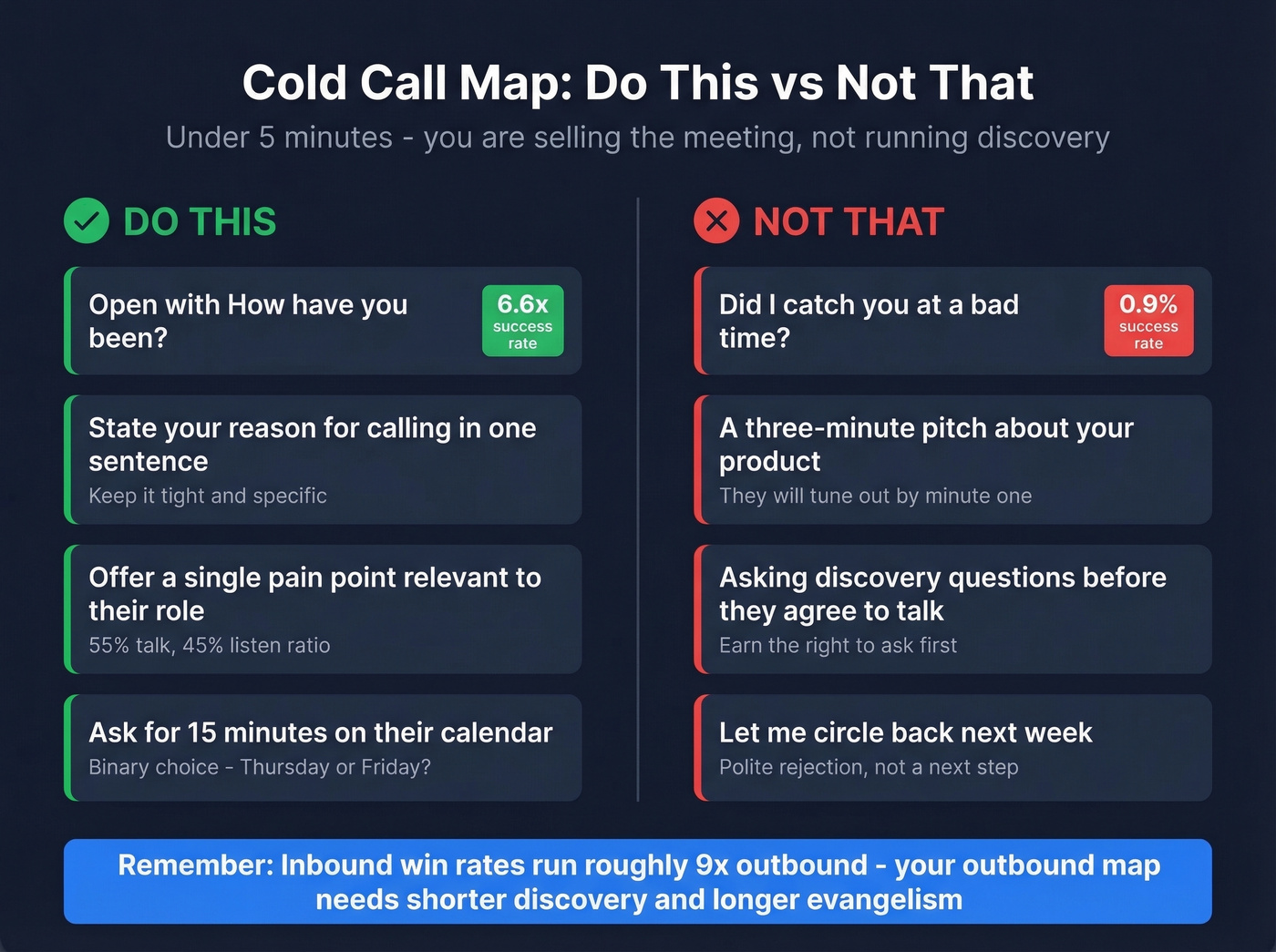
Do this: Open with "How've you been?" (6.6x higher success rate). State your reason for calling in one sentence. Offer a single pain point relevant to their role. Ask for 15 minutes on their calendar.
Not that: "Did I catch you at a bad time?" (0.9% success). A three-minute pitch. Asking discovery questions before they've agreed to talk.
For gatekeepers and "I don't have time" objections, build micro-scripts into your map as branching paths - Zendesk's cold calling library has solid templates. And remember: in Reprise's analysis, inbound win rates run roughly 9x outbound. Your outbound map needs shorter discovery and longer evangelism to compensate. (Common rebuttals: how to respond to 'I don't have time'.)
Mistakes That Kill Your Call Mapping Sales Process
- Too detailed. If your map reads like a legal contract, reps won't use it.
- Seller-focused. Organize around the prospect's decision journey, not your pitch sequence.
- No success metrics. If you can't measure talk ratio, next-step conversion, and questions asked, you can't improve. (Start with the right sales call tracking metrics.)
- Built by non-callers. The best maps come from reps who actually dial, not enablement teams working in a vacuum.
- Pitching too early. Jumping to your solution before understanding the problem kills trust.
- Accepting surface answers. "We need better data" isn't a pain - it's a symptom. Drill deeper.
- Vague next steps. "Let's reconnect soon" is a polite rejection, not a next step.
- Never iterating. Record your calls, review them with peers, and update your map quarterly. Teams that run regular film reviews and peer scorecards build better maps, faster, than teams that set-and-forget. (If you need the legal + tooling side, see sales call recording.)
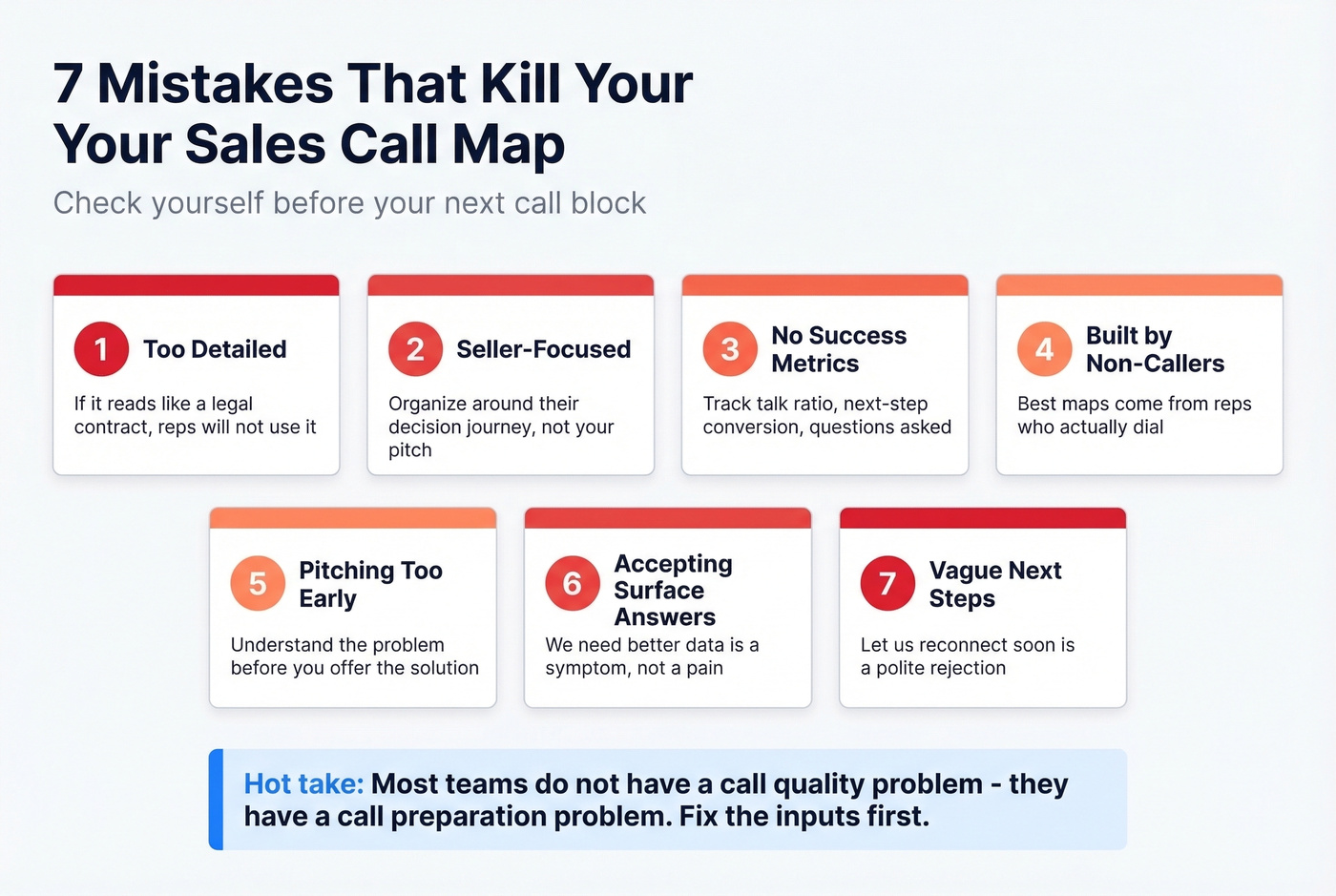
Hot take: Most sales teams don't have a call quality problem - they have a call preparation problem. If your reps spend zero minutes on pre-call research, no framework in the world will save you. Fix the inputs first.
Pre-call research in 5 minutes only works if your contact data is already clean. Prospeo's 300M+ profiles with 30+ filters - including job changes, funding rounds, and hiring surges - give you the trigger signals your call map needs before you pick up the phone.
Research-ready prospects at $0.01 per email. No contracts.
FAQ
What's the difference between a call map and a sales script?
A script is word-for-word text you read aloud. A call map is a flexible framework of topics, questions, and transitions that adapts in real time. Maps keep you on track without sounding robotic.
How many questions should I ask on a sales call?
Analysis of 326K calls found won deals averaged 15-16 questions. Past 20, it feels like an interrogation and correlates with lost deals. Quality over quantity - every question should advance understanding.
How does call mapping fit into the broader sales process?
Call mapping plugs into every stage of the sales process - from cold outreach to closing calls. Each call type gets its own map tailored to the conversation's goal, whether that's booking a meeting, running discovery, or negotiating terms. The result is a repeatable system where every dial has a purpose.
How do I make sure I'm calling the right number?
Stale CRM data is a major call-blocker. Verify emails and direct dials before your call session using a platform with weekly data refreshes - fewer dead numbers means more live conversations per hour.