

The Best Sales Tools in 2026: What's Worth Your Money (and What Isn't)
It's Monday morning. Your first sequence fires 2,000 emails. By noon, 340 have bounced, your domain reputation is tanking, and your SDR lead is asking which of your nine subscriptions was supposed to prevent this. The sales tools market now has over 11,000 solutions, and somehow your stack still can't deliver a clean email to a VP of Engineering.
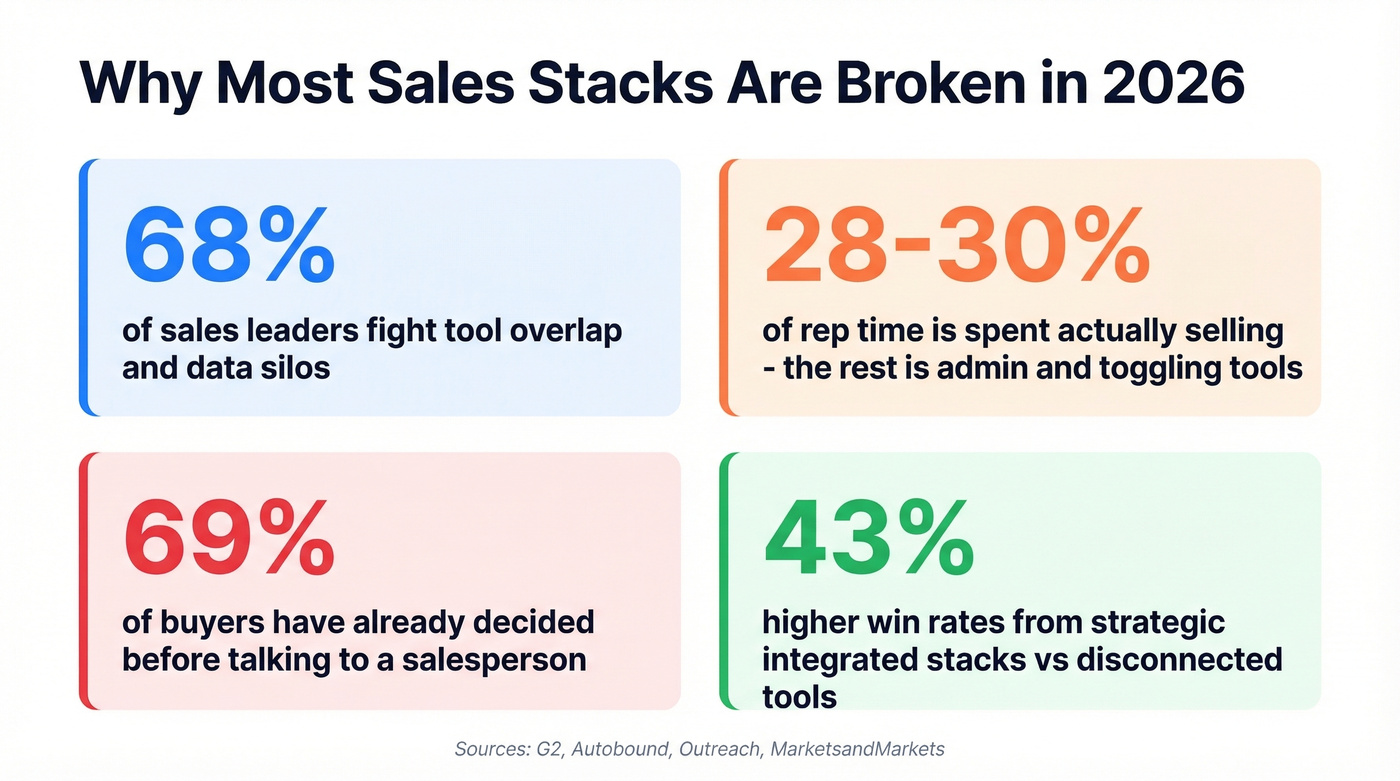
Here's the uncomfortable math: 68% of sales leaders are fighting tool overlap, data silos, and integration headaches. Reps spend 28-30% of their time actually selling - the rest goes to admin, data entry, and toggling between platforms that were supposed to make them faster. And by the time you reach a prospect, 69% of buyers have already made their decision before engaging a salesperson. Good software exists. The problem is most teams buy too many tools, integrate too few, and never audit what's actually working.
Every tool here has real pricing, an honest take on who it's for, and a clear signal on when to skip it.
Our Picks (TL;DR)
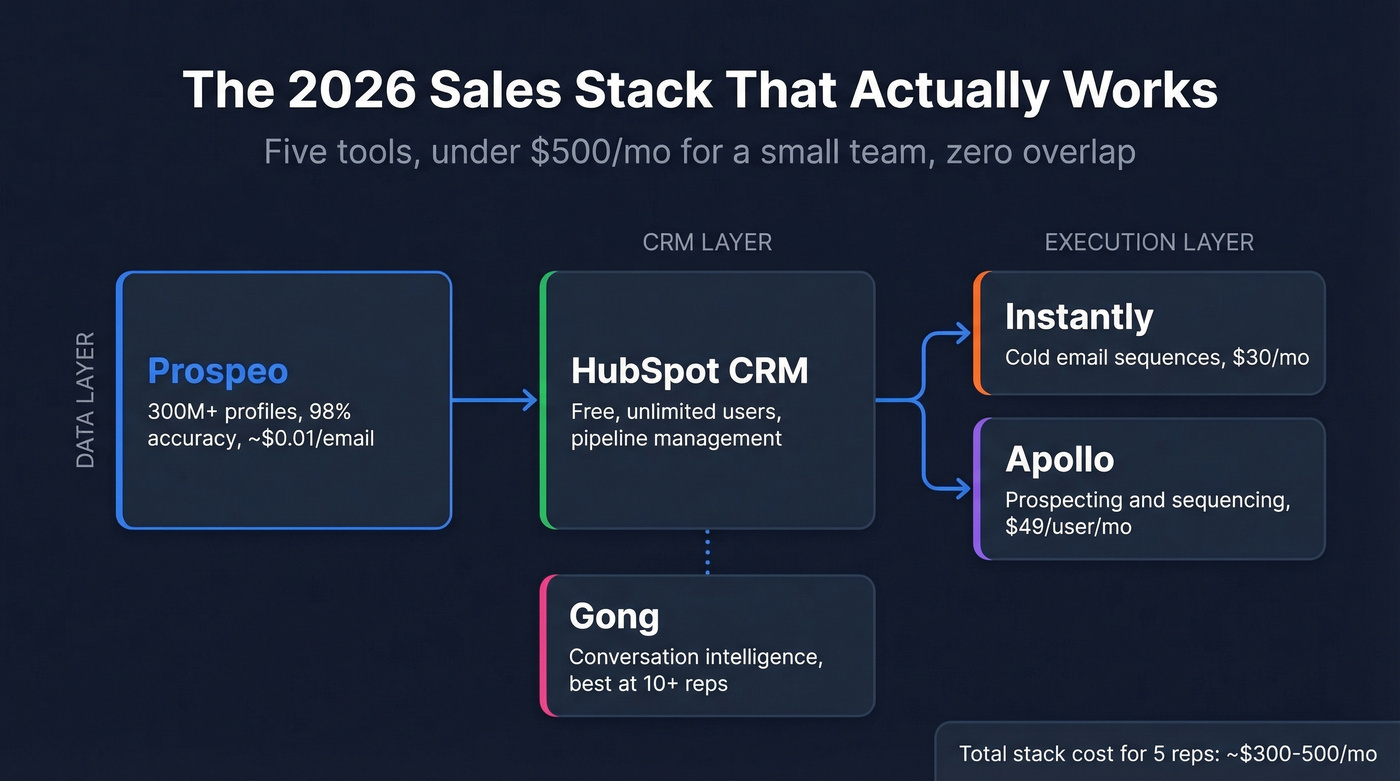
If you're short on time, here's where to start. These five cover the core of any sales stack, and none require a $30K annual commitment.
| Tool | Best For | Starting Price |
|---|---|---|
| Prospeo | Verified B2B data | Free; ~$0.01/email |
| HubSpot CRM | Free CRM foundation | Free; Sales Hub from $50/mo |
| Apollo | Startup prospecting | Free; $49/user/mo |
| Gong | Conversation intelligence | $5K platform + $1,440/user/yr |
| Instantly | Budget cold outreach | $30/mo |
Prospeo is the pick if your #1 problem is data quality - 98% verified email accuracy, 300M+ professional profiles, 143M+ verified emails, 125M+ verified mobiles, and a 7-day refresh cycle that makes most competitors look stale. The free tier gives you 75 verified emails a month to test it.
HubSpot CRM is the obvious starting CRM for any team under 50 reps - free, unlimited users, and enough pipeline management to get you through Series B. Apollo is the budget prospecting workhorse with 275M+ contacts and a useful free tier, though bounce rates run higher than premium providers. Gong is the conversation intelligence standard once you hit 10+ reps; the ROI math doesn't work below that. And Instantly gets cold email campaigns running at $30/mo, which is hard to beat for early-stage teams.
How to Pick Without Wasting Money
Before you demo anything, run through these five filters. They'll save you from the most common stack mistakes we see.
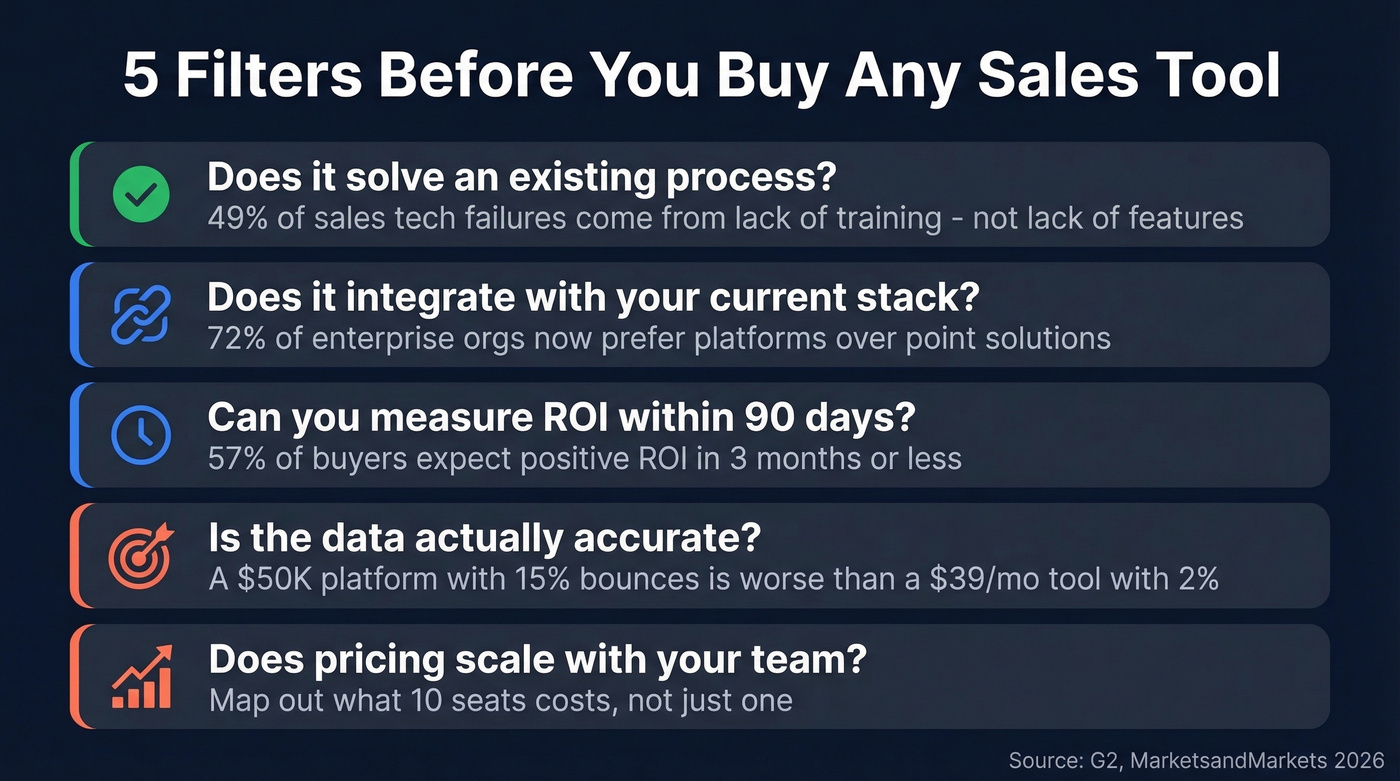
Does it solve a process you already have? 49% of sales tech adoption failures come from lack of training, and 33% from lack of integration. If you're buying software to create a process rather than improve one, you're paying for shelfware.
Does it integrate with what you already use? Integrations are the #1 reason buyers choose sales software, per G2's research. If the tool doesn't natively connect to your CRM and sequencer, the data rots in a silo. This matters more than ever: 72% of enterprise sales organizations now prefer platform approaches over fragmented point solutions, and strategic stacks deliver 43% higher win rates and 37% faster sales cycles versus disconnected setups.
Can you measure ROI within 90 days? 57% of buyers expect positive ROI within three months. If the vendor's implementation timeline is "3-6 months before you see value," that's a red flag for any team that isn't enterprise.
Is the data actually good? Your CRM is only as useful as what's in it. A $50K data platform with 15% bounce rates is worse than a $39/mo tool with 2% bounces. (If you're troubleshooting bounces, start with bounce rate benchmarks and a proper email deliverability guide.)
Does the pricing scale with you? Credit systems, per-seat fees, and platform charges stack up fast. Map out what 10 seats costs, not just one. If you’re building a stack plan, a simple 30-60-90 day plan helps you audit tools on schedule.
Categories Worth Knowing
CRM
HubSpot CRM is the default starting point for any team that doesn't already have Salesforce entrenched. The free plan is genuinely free - unlimited users, contact management, deal tracking, email logging, and basic reporting. You don't hit a paywall until you need sequences, custom reporting, or forecasting, at which point Sales Hub starts at $50/month.
The real strength is the ecosystem. HubSpot's marketplace has integrations for nearly every tool on this list, and the learning curve is shallow enough that reps actually use it. We've seen teams migrate off Salesforce to HubSpot specifically because adoption was dying - reps weren't logging activities, and the data was garbage. HubSpot's UX solves that problem for most SMB and mid-market teams. (If you want more options, see examples of a CRM and contact management software.)
The tradeoff: once you're deep into HubSpot's ecosystem with Marketing Hub, Service Hub, and Operations Hub, the bundled pricing gets expensive fast. A full Enterprise suite can rival Salesforce costs. But for CRM alone, it's the best free option on the market.
Salesforce starts at $25/user/mo for entry-level plans, but let's be honest - most teams end up on higher tiers once they need custom objects, advanced automation, and proper reporting. Add implementation costs ($10K-$65K is common) and you're looking at a serious investment. It's the right choice for orgs with 100+ reps, complex sales processes, and a dedicated RevOps team. For everyone else, it's overkill.
Pipedrive is the lightweight alternative starting around $15/user/mo. Clean UI, visual pipeline, fast setup. Built for small teams that want simplicity over deep configurability. Skip it if you need marketing automation or complex workflows.
Zoho CRM deserves a mention as a budget option: entry tiers start around $15/user/mo, and Zoho CRM Plus starts at $57/user/mo. The feature-to-price ratio is hard to beat for cost-conscious teams, even if the UI isn't as polished as HubSpot or Pipedrive.
Sales Intelligence & Prospecting Data
This is where your stack lives or dies. The best CRM in the world is useless if the data inside it bounces. (If you’re comparing providers, start with sales prospecting databases and B2B company data.)
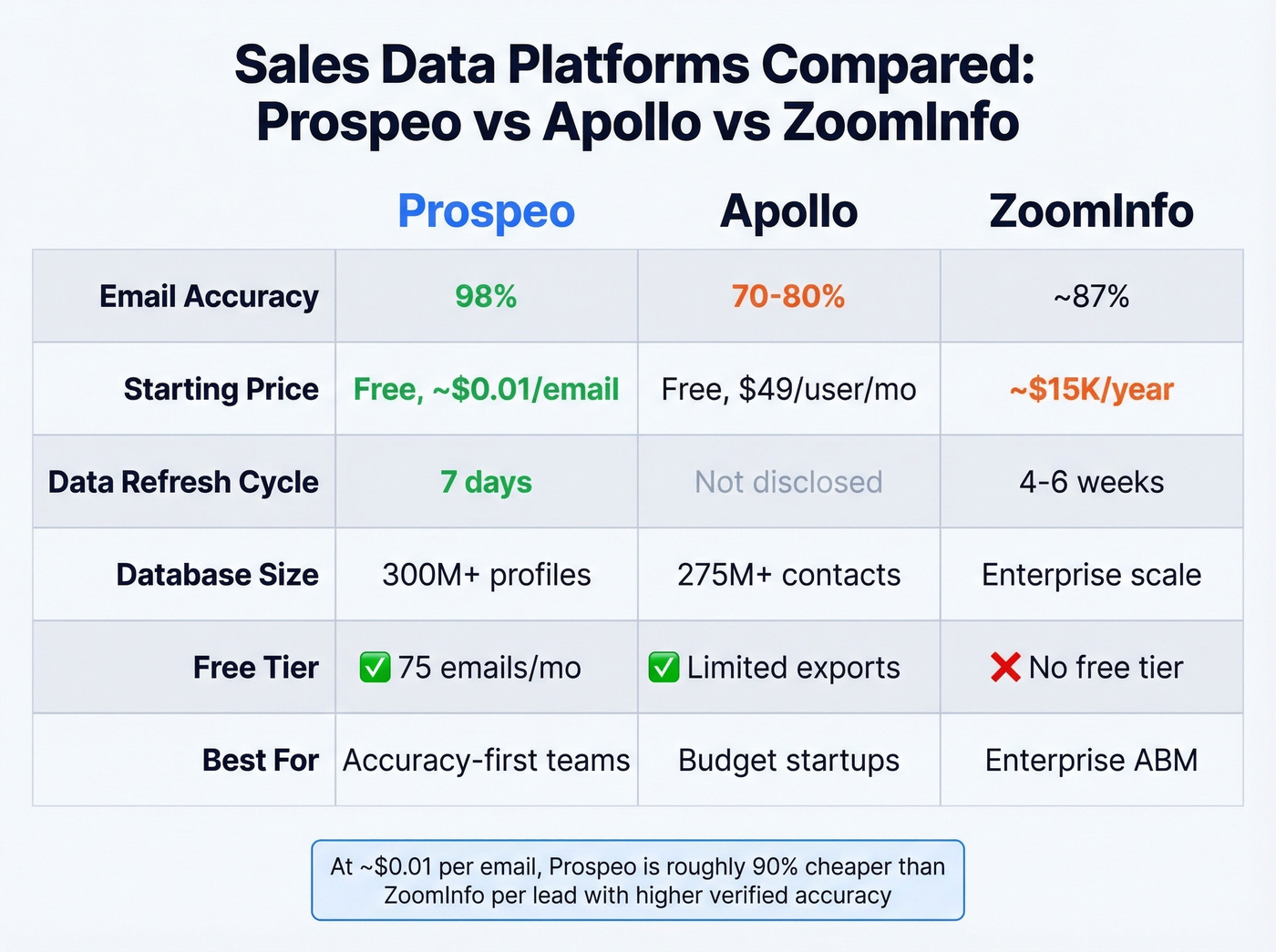
The platform runs a proprietary 5-step verification process with catch-all handling, spam-trap removal, and honeypot filtering. That's the reason Snyk took their bounce rate from 35-40% down to under 5% and saw AE-sourced pipeline jump 180%. Meritt tripled pipeline from $100K to $300K/week after switching, with bounce rates dropping from 35% to under 4%. The database includes 30+ search filters covering buyer intent (15,000 topics via Bombora), technographics, job changes, headcount growth, funding, and revenue. At roughly $0.01 per email versus ZoomInfo's ~$1 per lead, it's 90% cheaper with higher accuracy. You can go from search to verified export in minutes, then push directly to HubSpot, Salesforce, Instantly, Lemlist, or Clay.


You just read that 68% of sales leaders fight tool overlap and data silos. The fix isn't adding another tool - it's replacing bad data at the source. Prospeo gives you 300M+ profiles, 98% email accuracy, and a 7-day refresh cycle for ~$0.01/email. Snyk cut bounce rates from 35% to under 5%. Meritt tripled pipeline to $300K/week.
Stop paying for nine tools when your data is the problem.
Here's how the top three data platforms compare on the metrics that actually matter:
| Email Accuracy | 98% | ~70-80% | ~87% |
| Starting Price | Free; ~$0.01/email | Free; $49/user/mo | ~$15K/yr |
| Data Refresh | 7 days | Not disclosed | 4-6 weeks |
| Free Tier | 75 emails/mo | Limited exports | No |
| Best For | Accuracy-first teams | Budget startups | Enterprise ABM |
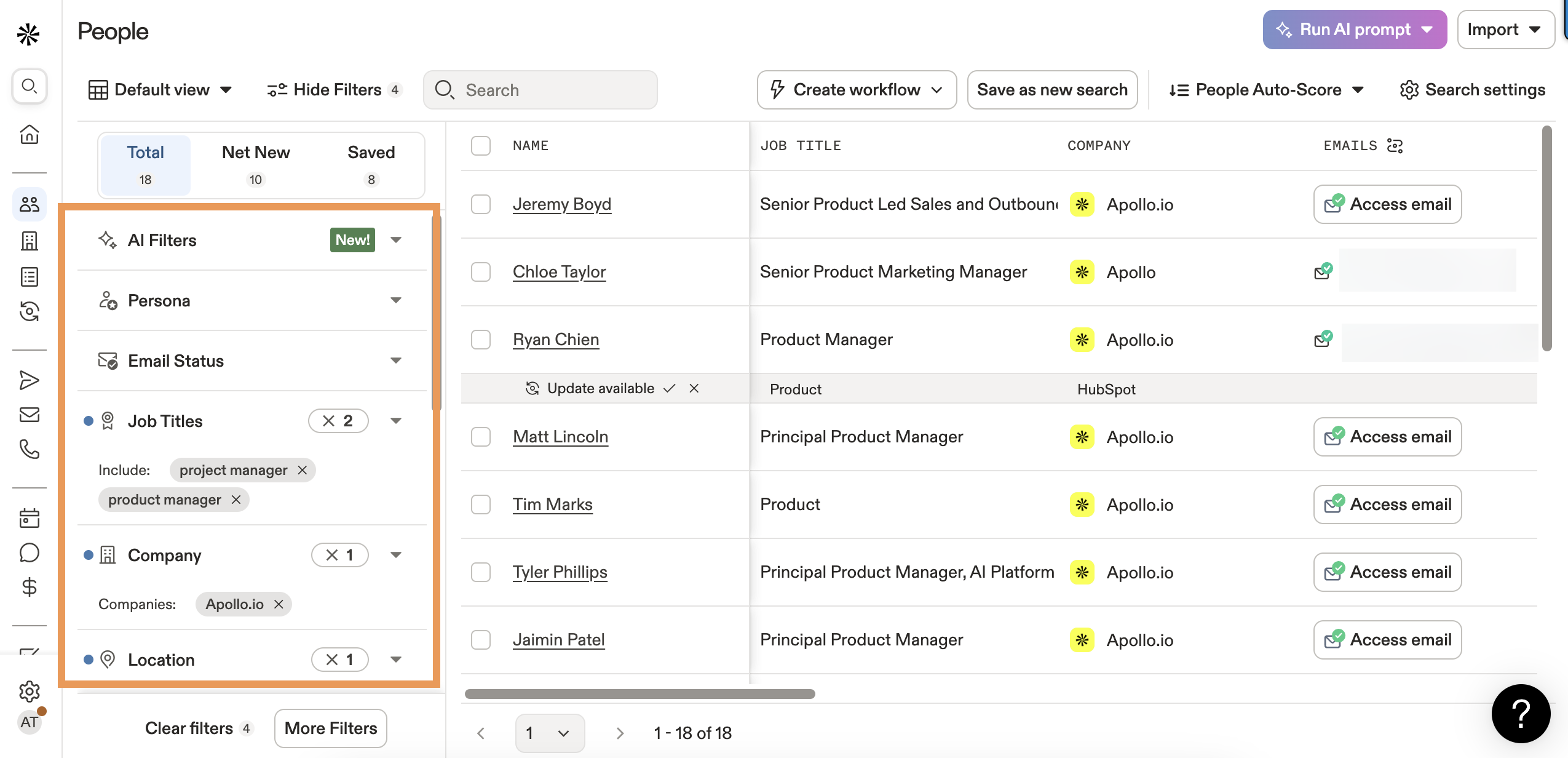
Apollo is the obvious budget pick for startups. The free tier gives you access to a 275M+ contact database with limited exports. Paid plans start at $49/user/mo. The database is massive and the UI is intuitive, with 65+ search filters and built-in sequencing. Among prospecting platforms, Apollo stands out for combining data access with outreach in a single product.
The catch: email bounce rates on Apollo data can reach 15-20% if you don't verify before sending. That's fine for early prospecting when you're testing ICP hypotheses, but it'll hurt your domain reputation at scale. Worth noting: Apollo experienced data breaches in 2018 and 2021, which is a concern for security-conscious teams. For most startups, Apollo is the right first tool. Just verify the emails before you send.
ZoomInfo starts at ~$15K/year for Professional with 5,000 annual credits and up to 3 users. Advanced runs ~$25K, Elite ~$40K. Add intent data, mobile numbers, and extra seats, and you're easily at $20K-$40K+ with add-ons. The most common complaint? Pricing that's "absolutely insane for small teams," paired with complex credit systems and auto-renewal clauses with narrow cancellation windows.
If you're a 200+ rep org running ABM and intent from one platform, ZoomInfo earns its price. For teams under 20 reps, it rarely makes sense.
Look - ZoomInfo is still the most complete all-in-one GTM platform. But most teams don't need all-in-one. They need accurate data and a platform that doesn't require a six-figure commitment to get started. If your average deal size is under $15K, you almost certainly don't need ZoomInfo-level infrastructure.
Cognism is the play for European prospecting. Phone-verified mobile numbers via Diamond Data cover up to 87% of target contacts, with compliance checks against 13 global DNC lists and Bombora intent data. Custom pricing typically starts around $1K+/mo for small teams. Cognism wins over ZoomInfo on EMEA coverage and mobile verification; ZoomInfo still wins on US database depth.
LinkedIn Sales Navigator runs $99/user/mo and remains one of the most widely used prospecting platforms in B2B. The advanced search filters, InMail credits, and account tracking are useful for relationship-driven selling. It's not a data export tool - you can't bulk-pull emails or phone numbers - but for identifying and warming prospects within the LinkedIn ecosystem, nothing else comes close.
Lusha runs on credits - Pro at ~$22/user/mo annually, Premium at ~$52/user/mo. One credit per verified email, five credits per direct dial. The credits burn faster than you'd expect, and they expire. Accuracy runs around 60-65% based on community feedback. It's a quick-hit tool for individual reps, not a team-wide data solution.
Kaspr sits in similar territory - $49/user/mo with a free plan available. Quick phone number lookups from professional profiles. Good for individual SDRs who need a number right now. Not a database replacement.
Email & Data Verification
Your CRM data isn't exempt from the garbage-in-garbage-out rule. If you're not verifying emails before they hit a sequence, you're gambling with your domain reputation. (If you need a deeper playbook, see how to check if an email exists and spam trap removal.)
Hunter.io offers a free tier with 25 searches/mo and paid plans from $34/mo. It's a solid, simple email finder for individual lookups. The finding rate has gotten worse over time according to community feedback, and it doesn't offer the same depth of verification or mobile numbers as dedicated data platforms. If you’re shopping around, compare Hunter alternatives.
Sales Engagement
The average B2B buyer needs 8+ touchpoints before responding. Manual outreach caps an SDR at 50-60 prospects per day. Engagement platforms push that to 200+ with personalization, and teams using them see 3.5x higher response rates versus generic outreach. This is where the right techniques and tooling separate a rep who books 5 meetings a week from one who books 20. (For the fundamentals, see sales prospecting techniques and sequence management.)
Instantly is the budget king at $30/mo. It handles email warmup, multiple sending accounts, campaign management, and basic analytics. For early-stage teams running cold email as their primary channel, it's the fastest path to volume. The limitation is channel depth - it's email-first, not multi-channel. Pair it with a verified data source and you've got a functional outbound engine for under $100/mo.
Use Instantly if you're a founder or small team running cold email. Skip it if you need multi-channel sequences with calls, social touches, and advanced branching logic.
Lemlist starts at ~$32/user/mo and adds multi-channel sequencing with email plus social touches. The personalization features - custom images, dynamic landing pages - are differentiated in ways that actually move reply rates. It's the step up from Instantly when you need more than email.
Outreach runs ~$100/user/mo and is the enterprise standard. The feature set is deep: multi-channel sequences, AI-assisted email writing, deal intelligence, and pipeline management. But the UX complaints are real. One Reddit user put it bluntly: "SalesLoft was bad then I started using Outreach and it's so much worse" - citing Gmail sync issues, sent emails that can't be viewed, and a UI where the Snooze button sits dangerously close to Schedule, causing lost drafts. If your org can absorb the learning curve and has admin support, Outreach is powerful. For a 10-person team, it's overkill with rough edges.
Salesloft runs ~$125/user/mo. Clari merged with Salesloft in late 2025, bringing engagement and revenue intelligence under one umbrella. The combined platform could be compelling, but right now it's early days. Expect integration growing pains through 2026.
Conversation Intelligence
Teams using conversation intelligence close deals 11 days faster on average and see a 10 percentage point improvement in win rates on deals over $50K. That's real money - but only if you have enough reps to justify the platform cost.
Gong is the standard. $5,000 platform fee plus $1,440/user/year. It records calls, analyzes conversations, surfaces coaching insights, and tracks deal risk signals. The AI catches patterns that managers miss and gives reps specific, actionable feedback.
Here's the thing: Gong's ROI math works beautifully at 10+ reps. Below that, the platform fee eats your budget. A 5-rep team pays $5K + $7,200 = $12,200/year. That's $2,440/rep for call recording and coaching. At 20 reps, it's $1,690/rep - much easier to justify. We've seen teams buy Gong too early and cancel within a year because the per-rep cost didn't pencil out.

Clari runs $1,200-$1,500/user/year and focuses more on revenue intelligence and forecasting than call analysis. The Salesloft merger positions it as a combined engagement + forecasting platform. Worth watching, but give it 6-12 months to stabilize. (If forecasting is a priority, compare sales forecasting solutions.)
Chorus costs $1,200-$1,560/user/year and is often bundled with ZoomInfo. Development has stagnated since the ZoomInfo acquisition in 2022. Unless you're already deep in the ZoomInfo ecosystem, there are better options.
AI & Automation
Clay is the most interesting tool in this category. It connects to 100+ data providers, lets you build enrichment workflows with AI, and automates the research that used to take SDRs hours. Free tier gives you 100 searches/mo; paid plans start at $134/mo and scale with credits. (If you’re doing enrichment at scale, see data enrichment services.)
The use case is specific: if you're enriching leads from multiple sources, personalizing at scale, or building custom scoring models, Clay is powerful. LivePerson used AI-driven research tools to cut prospect research from 20 minutes to 2 minutes. But Clay has a learning curve. This isn't a plug-and-play tool; it's a workflow builder that rewards technical users.
100% of teams using AI SDR tools report saving time, with 40% saving four to seven hours per week. General-purpose LLMs like ChatGPT and Claude are useful for ad-hoc research and email drafting, but they're productivity aids - not purpose-built sales software. The key is knowing where dedicated AI features deliver versus where they're hype.
Zapier and Make aren't sales-specific, but they're the glue that holds stacks together. Zapier starts free with 100 tasks/mo and paid plans from ~$20/mo. Make starts free with more complex workflow capabilities. If your tools don't natively integrate, these fill the gap.
Enablement, Scheduling & E-Signatures
Every deal that stalls because someone can't find the proposal or schedule the call is a deal your competitor closes instead.
Highspot is the enterprise enablement platform - content management, training, and analytics. Custom pricing; mid-market deployments often land around $40-$60/user/mo. Calendly eliminates scheduling back-and-forth: the free tier works fine for individuals, and paid plans start around $10/user/mo. DocuSign handles e-signatures from $10/mo. These operational tools don't generate pipeline, but they prevent it from leaking.
Every sales tool on this list depends on one thing: reaching real people at real addresses. Prospeo's proprietary 5-step verification, spam-trap removal, and catch-all handling deliver 98% accuracy - compared to 87% from ZoomInfo and 79% from Apollo. That's the difference between a sequence that books meetings and one that tanks your domain.
Test it free - 75 emails and 100 Chrome extension credits, no card required.
What Your Stack Actually Costs
Let's do the math that most "best tools" articles skip.
| Stack Tier | Tools | Monthly Cost |
|---|---|---|
| SMB (10 reps) | HubSpot Sales Hub + Prospeo + Lemlist + Gong | ~$250/user/mo |
| Enterprise (50+ reps) | Salesforce + ZoomInfo + Outreach + Gong + Clari | $434+/user/mo |
The solo stack is remarkable: a free CRM, verified prospecting data, and a cold email platform for $30/mo.
The SMB stack gets more interesting. HubSpot Sales Hub at $50/month, a data platform for verified emails and mobiles, Lemlist at $32/user/mo, and Gong at $120/user/mo amortized lands around $250/user/mo. That's a complete stack with CRM, verified data, multi-channel outreach, and conversation intelligence.
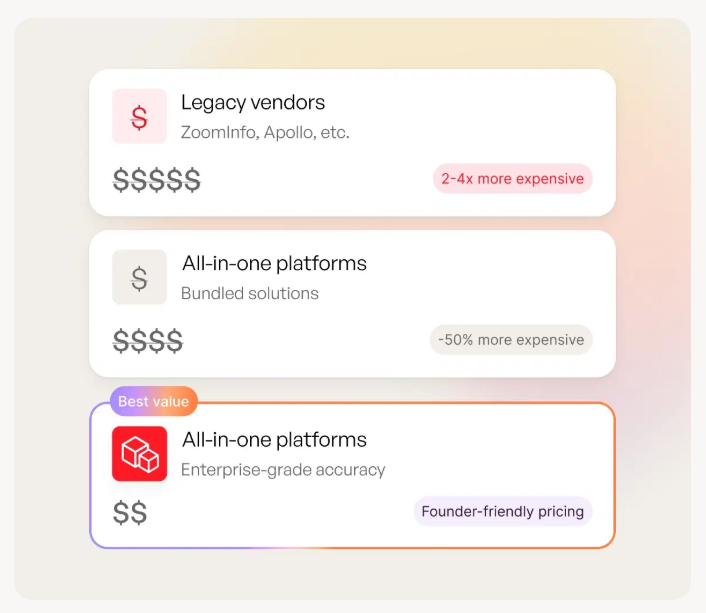
The enterprise stack is where costs explode. A common enterprise bundle lands around $434/user/mo across revenue intelligence, engagement, and data tooling. For 50 reps, that's $260K+/year. And I've seen teams spending $4,200/month across nine subscriptions where three haven't been logged into in 60 days. A 10-person team using a startup-tier stack at ~$100/mo total versus an enterprise stack at $434/user/mo is the difference between $1,200/year and $52,000/year. The expensive stack isn't 40x better.
Master Pricing Table
If a vendor won't tell you what their product costs, they're planning to charge you based on how desperate you look in the demo.
| Tool | Category | Starting Price | Enterprise Range | Free Tier? |
|---|---|---|---|---|
| Prospeo | Data / Verification | ~$0.01/email | Custom | Yes (75/mo) |
| HubSpot CRM | CRM | Free | $150/user/mo | Yes |
| Apollo | Prospecting | $49/user/mo | $119/user/mo | Yes |
| Gong | Conversation Intel | $5K + $1,440/user/yr | $50K+ platform | No |
| Instantly | Engagement | $30/mo | ~$100/mo | No |
| Salesforce | CRM | $25/user/mo | ~$150-$200/user/mo | No |
| ZoomInfo | Data / Intel | ~$15K/yr | $40K+/yr | No |
| Cognism | Data (EMEA) | ~$1K/mo | ~$2.5K+/mo | No |
| Outreach | Engagement | ~$100/user/mo | Custom | No |
| Clari | Revenue Intel | ~$100/user/mo | Custom | No |
| Clay | AI Enrichment | $134/mo | $800+/mo | Yes (100/mo) |
| Lemlist | Engagement | $32/user/mo | ~$80/user/mo | No |
| Pipedrive | CRM | ~$15/user/mo | $99/user/mo | No |
| Zoho CRM | CRM | ~$15/user/mo | $57/user/mo (CRM Plus) | Yes |
| Lusha | Data (Credits) | $22/user/mo | Custom | Yes |
| LinkedIn Sales Nav | Prospecting | $99/user/mo | Custom | No |
| Salesloft | Engagement | ~$125/user/mo | Custom | No |
| Kaspr | Phone Data | $49/user/mo | Custom | Yes |
| Hunter.io | Email Finder | $34/mo | $349/mo | Yes (25/mo) |
| Highspot | Enablement | ~$40/user/mo | Custom | No |
| Calendly | Scheduling | ~$10/user/mo | $16/user/mo | Yes |
| DocuSign | E-Signatures | $10/mo | $40/user/mo | No |
AI in Sales: What Works and What Doesn't
The AI sales tools market hit $3B in 2025 and is growing at 13% annually. Sellers who effectively partner with AI are 3.7x more likely to meet quota, and 56% of sales professionals now use AI daily, up from 24% in 2023.
So what actually works?
AI delivers real value in data enrichment and research (turning a company name into a full prospect profile in seconds), email personalization at scale (AI drafts reviewed in 30 seconds vs. 5 minutes writing from scratch), conversation analysis via Gong-style coaching insights, and forecasting where AI hits 90-95% accuracy vs. 60-70% for manual methods.
AI falls short in fully autonomous outbound (every "AI SDR" still needs human oversight or it sends embarrassing emails), complex negotiation, and strategic account planning. The technology augments judgment. It doesn't replace it.
The practical test: does it save measurable time or improve a measurable outcome? A fully loaded SDR costs approximately $139K/year. AI doesn't replace that SDR, but it can make them 3-5x more productive. That's where the ROI lives.
Five Mistakes That Kill Your Stack
1. Buying before defining your process. Tools amplify processes - they don't create them. If your reps don't have a defined outbound workflow, no engagement platform will fix that. Map the process first, then buy.
2. Ignoring integration. 33% of adoption failures trace back to tools that don't talk to each other. Check native integrations before you sign anything.
3. Chasing AI hype without measuring outcomes. "AI-powered" is on every vendor's homepage. Ask one question: what metric does this improve, and by how much? Less than 30% of digital transformations succeed - most fail because nobody defined success upfront.
4. Skipping data verification. A 15% bounce rate doesn't just waste sends - it tells email providers you're a spammer. Verify everything before it enters a sequence. Period. (If you need a checklist, start with how to check if an email will bounce.)
5. Not auditing within 90 days. If you can't point to a specific improvement - more meetings booked, shorter cycle times, higher connect rates - after 90 days, cut the tool. Hold your stack to the same standard you'd hold a new hire.
FAQ
What are sales tools, and why do they matter?
Sales tools are software platforms that help reps find prospects, manage relationships, close deals, and analyze performance - spanning CRMs, data providers, dialers, sequencers, and e-signature apps. They matter because modern B2B buying is too complex for manual workflows; reps relying on spreadsheets lose to teams with verified data, automated sequences, and real-time coaching.
How many tools does a team actually need?
Most teams perform best with 3-5 core platforms: CRM, data/prospecting, engagement, and optionally conversation intelligence. The consolidation trend is moving orgs from 8-12 point solutions down to 4-6 integrated platforms. More subscriptions doesn't mean more productivity - it usually means more tabs and worse data hygiene.
What's the best free option to start with?
HubSpot CRM for pipeline management (free, unlimited users) paired with Prospeo's free tier (75 verified emails/month) for prospecting data. Add Instantly at $30/mo for outreach and you've got a complete stack under $100/month covering CRM, verified contacts, and cold email.
Is ZoomInfo worth the price for small teams?
For teams under 20 reps, rarely. The $15K+/year minimum, complex credit system, and auto-renewal clauses make it a poor fit for lean organizations. Apollo's free tier or a pay-per-email data provider deliver solid prospecting value at that scale, though you'll want to verify emails before sending. Save ZoomInfo for when you need the full GTM platform with intent data and workflow automation in one place.
Do AI-powered features actually improve results?
Yes, in specific areas: data enrichment, email personalization, conversation analysis, and forecasting. Teams using AI report 83% revenue growth vs. 66% without. But fully autonomous AI outbound still needs human oversight - the technology augments reps, it doesn't replace them. Expect 3-5x productivity gains, not headcount elimination.