

The Complete Guide to the SaaS SDR Role in 2026
The SDR role is the most misunderstood entry point in tech sales. You're 1,300 cold calls deep, you've booked one meeting, and your manager wants 15 this month. The AE closing your deals makes three times your OTE and works half the phones you do.
Here's the thing: only 57.3% of SDRs hit quota. That's not a failure stat - it's the reality of a role where the math is brutal and the upside is real, but only if you understand what you're signing up for.
What You Need (Quick Version)
What the role is: You're a prospecting specialist who books qualified meetings for account executives. You don't close deals. You open doors. Your entire job is creating pipeline.
What it pays: Median OTE sits at $85K in 2026, per RepVue's compensation dataset. Base is around $60K, with the rest in variable comp. Top performers clear $127K+.
Is it worth it? Yes - if you treat it as a 12-18 month apprenticeship, not a career destination. The SDRs who flame out are the ones who expected to stay forever or never planned their exit.
What Does a SaaS SDR Actually Do?
The sales development role exists because AEs shouldn't prospect. Closers close. Prospectors prospect. The hierarchy is straightforward: SDRs find and qualify leads, AEs close them. When companies blur that line, pipeline suffers and AEs spend time on work that should be handled upstream.
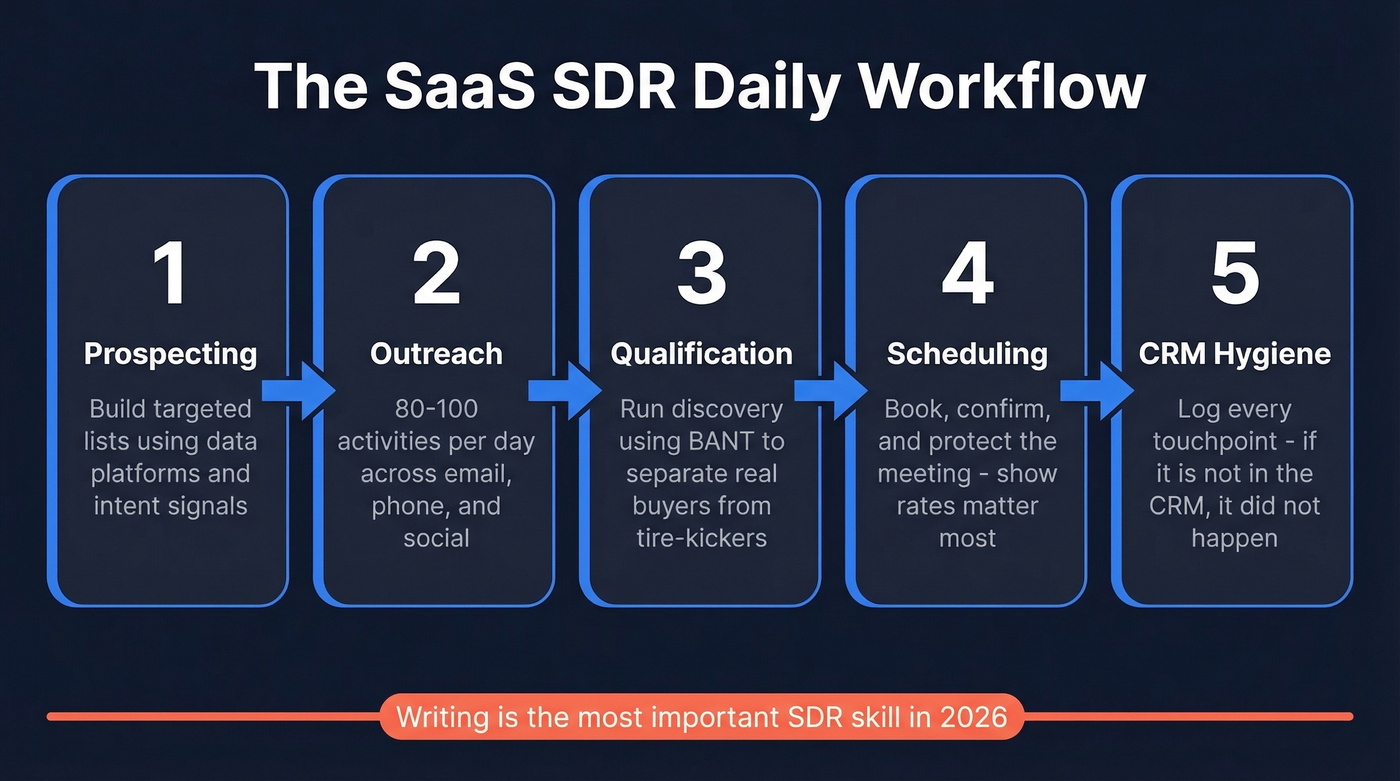
Your daily workflow breaks down into five steps:
- Prospecting - Building targeted lists using data platforms, filters, and intent signals. You're identifying the right people at the right companies. (If you want a tighter system, start with these sales prospecting techniques.)
- Outreach - Multi-channel sequences across email, phone, and social. Expect 80-100 total activities per day. Writing is the most important SDR skill in 2026 because most prospecting happens through email and social, not phone. (Use proven cold email subject line examples to lift reply rates.)
- Qualification - Running discovery against a framework like BANT to separate tire-kickers from real opportunities.
- Scheduling - Booking the meeting, confirming the meeting, making sure the meeting actually happens. Show rates matter more than booked rates. (Steal a few sales follow-up templates to reduce no-shows.)
- CRM hygiene - Logging every touchpoint in Salesforce or HubSpot. If it's not in the CRM, it didn't happen. (If you're still learning the basics, here are examples of a CRM.)
Inbound SDRs work high-intent and low-intent leads like demo requests, content downloads, and webinar signups. Outbound SDRs build their own pipeline from scratch. Outbound is harder, teaches more, and forces you to learn targeting, messaging, and discipline fast.
The SDR vs. BDR question? Functionally identical at most companies. Some orgs use "BDR" for outbound and "SDR" for inbound, others reverse it. Don't get hung up on titles - look at the job description. (If you're comparing tooling, see our roundup of SDR tools.)
Who should skip this role entirely: If you can't handle rejection on a daily basis, walk away. If you need creative autonomy or hate repetitive process work, you'll be miserable within three months. The grind rewards discipline and resilience, not inspiration. (This is where resilience in sales becomes a real skill, not a slogan.)
SaaS SDR Compensation in 2026
RepVue's 2026 benchmarks put median base at $60,000, median OTE at $85,000, and top performers at $127,955. (If you want to sanity-check offers, learn how OTE in sales is calculated.)
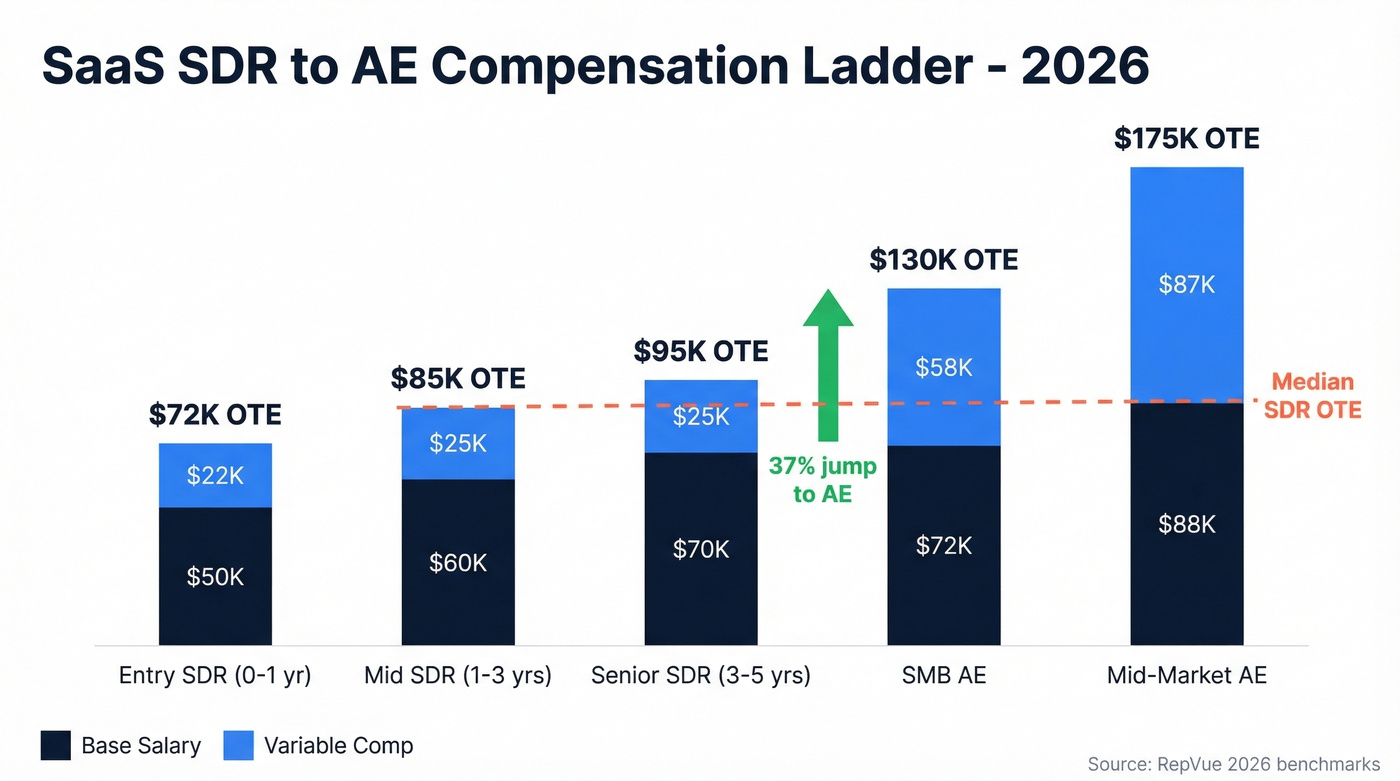
Here's how comp typically breaks down by experience level:
| Experience | Base Range | OTE Range | Base/Variable Split |
|---|---|---|---|
| Entry (0-1 yr) | $45K-$55K | $70K-$75K | 70/30 |
| Mid (1-3 yrs) | $55K-$65K | $80K-$90K | 65/35 |
| Senior (3-5+ yrs) | $65K-$75K | $90K-$100K+ | 60/40 |
The typical base/variable split runs about 68/32. Geographic outliers matter: Seattle SDRs report a median OTE of $160K, while fully remote BDR roles average closer to $66K.
A healthy quota-to-OTE ratio is 4:1 to 6:1. If your OTE is $85K, your quota should be $340K-$510K in pipeline generated. Anything above 8:1 and the math doesn't work - you'll burn out chasing an unreachable number. Plan your finances around base, and treat variable as upside.
For context on where the role sits in the broader comp hierarchy: SMB AEs earn a median OTE of $130K, mid-market AEs hit $175K, and enterprise AEs clear $265K. The SDR role is the on-ramp to those numbers. (Zoom out further with this SaaS sales guide.)
Hot take: If your company's average contract value is under $10K, you probably don't need a dedicated SDR team at all. The unit economics don't support the ramp time and management overhead. Founders or AEs should prospect directly until deal sizes justify the investment.

Your quota is 15 meetings/month and every bounced email kills momentum. Prospeo gives SDRs 98% email accuracy and 125M+ verified mobile numbers with a 30% pickup rate - at $0.01 per email. That's the data quality ZoomInfo charges 90x more for.
Hit quota with data that actually connects you to buyers.
KPIs and Pipeline Math
Here's what good looks like:
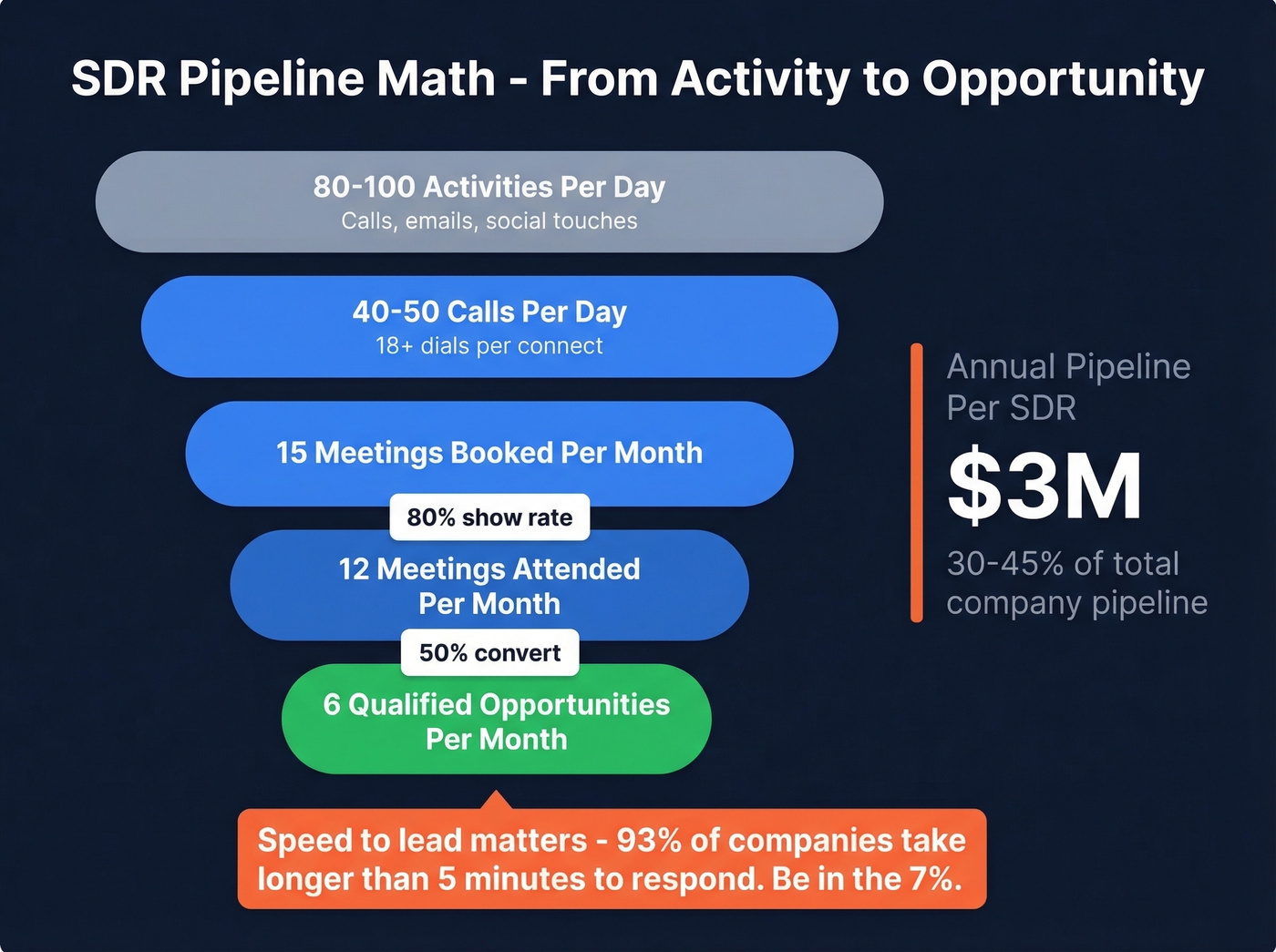
| Metric | Benchmark |
|---|---|
| Pipeline/SDR/year | ~$3M |
| Calls per day | 40-50 |
| Total activities/day | 80-100 |
| Meetings booked/month | ~15 |
| Meeting show rate | ~80% |
| Meetings attended/month | ~12 |
| Dials to connect | 18+ |
| % of pipeline from SDRs | 30-45% |
The funnel math is straightforward. You book 15 meetings, 80% show up, giving you 12 attended meetings. About half convert to a next step. That's 6 opportunities per month feeding your AE. (If you're troubleshooting, these common sales pipeline challenges usually explain the miss.)
A widely cited benchmark puts output at about $3M in pipeline per SDR per year, with SDR teams often driving 30-45% of total pipeline.
Expect to hit about 25% of quota in month one, 50% by month two, and full ramp by month three or four. Still below 50% at month four? Either the territory, the tools, or the fit is wrong. (A structured 30-60-90 day plan for sales reps helps you diagnose this fast.)
Inbound SDRs operate on different math entirely. High-intent leads like demo requests convert at 75-80%. Low-intent leads - ebook downloads, webinar attendees - convert at just 5-10%. (For more benchmarks, see sales conversion rate.)
The speed-to-lead stat that should scare every sales leader: average response time to inbound leads is 42 hours. Only 7% of companies respond within 5 minutes. If you're an SDR who consistently responds in under 5 minutes, you're already outperforming 93% of the market. That edge costs nothing.
The best teams in 2026 are already shifting KPIs from activity volume to intelligence quality - competitive insights surfaced and buying signals identified, not just dials made. (This is the core of a real competitive intelligence strategy.)
The Essential SDR Tech Stack
The average SDR team uses 12-15 tools daily, and the total stack cost runs $2,000-$5,000 per SDR per month.
| Category | Example Tools | Cost/User/Month |
|---|---|---|
| CRM | Salesforce, HubSpot | $25-$300 |
| Prospecting/Data | Prospeo, ZoomInfo, Apollo | Free-$500 |
| Sales Engagement | Outreach, Salesloft | $25-$150 |
| Dialer | Orum, Nooks, Aircall | $50-$200 |
| Enrichment | Clearbit, Lusha, Cognism | $30-$200 |
| Scheduling | Chili Piper, Calendly | $10-$30 |
| Intent/Signals | Bombora, 6sense, G2 | $500-$5,000 |
| Conversation Intel | Gong, Chorus, Clari | $100-$200 |
The prospecting/data category is where we've seen the most movement - and the most wasted budget. ZoomInfo is the default, and as one SDR on r/sales put it, it's "crazy expensive but even 10-20% better data is worth the cost when you're dialing 50 numbers a day." The problem is that most teams spend $20K-$50K/year on ZoomInfo and still deal with bounced emails and disconnected numbers. (If you're evaluating vendors, start with best sales prospecting databases.)
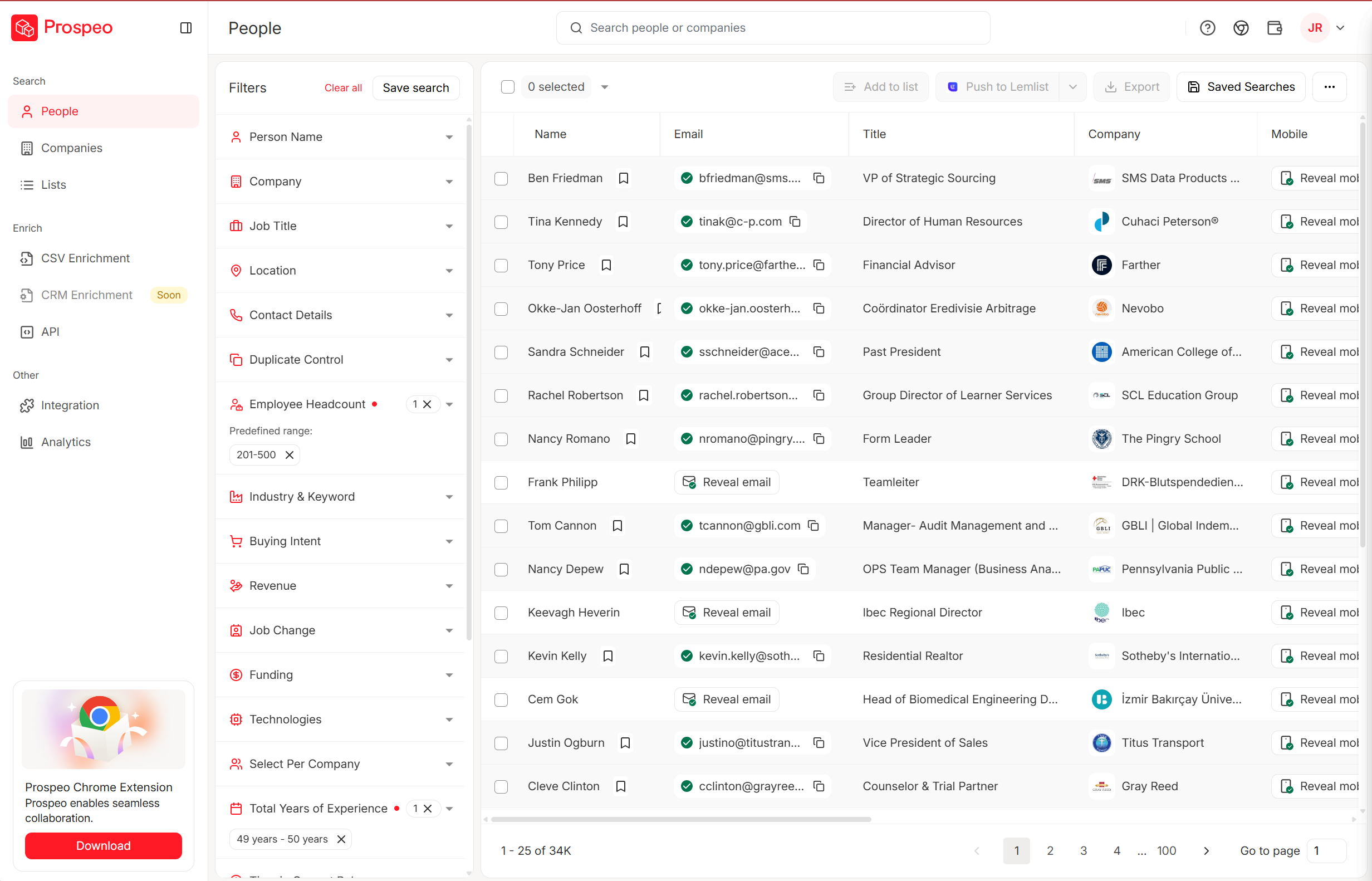
Prospeo solves the data quality problem at a fraction of that cost. It covers 300M+ professional profiles with 98% email accuracy, 143M+ verified emails, and 125M+ verified mobile numbers - all refreshed every 7 days versus the industry average of 6 weeks. At roughly $0.01 per lead with a free tier to start, a team of 5 SDRs can run it for less than one ZoomInfo seat. Native integrations with Salesforce, HubSpot, and major engagement platforms mean you're not living in CSVs. (If you need broader options, compare data enrichment services before you commit.)
On the engagement side, the consensus on r/sales is that Outreach has a customizability edge over Salesloft for sequencing, though both get the job done. One notable 2026 trend: stack consolidation. Apollo now covers data and engagement in one tool. The tradeoff is that all-in-one platforms rarely beat best-of-breed tools in any single category.
Career Path Beyond AE
The SDR-to-AE promotion is the default path, and for good reason. Mid-market AEs earn $120K-$180K OTE - a meaningful jump from the $85K median. Most SDRs make the transition in 12-18 months. High performers can do it in 10-12.
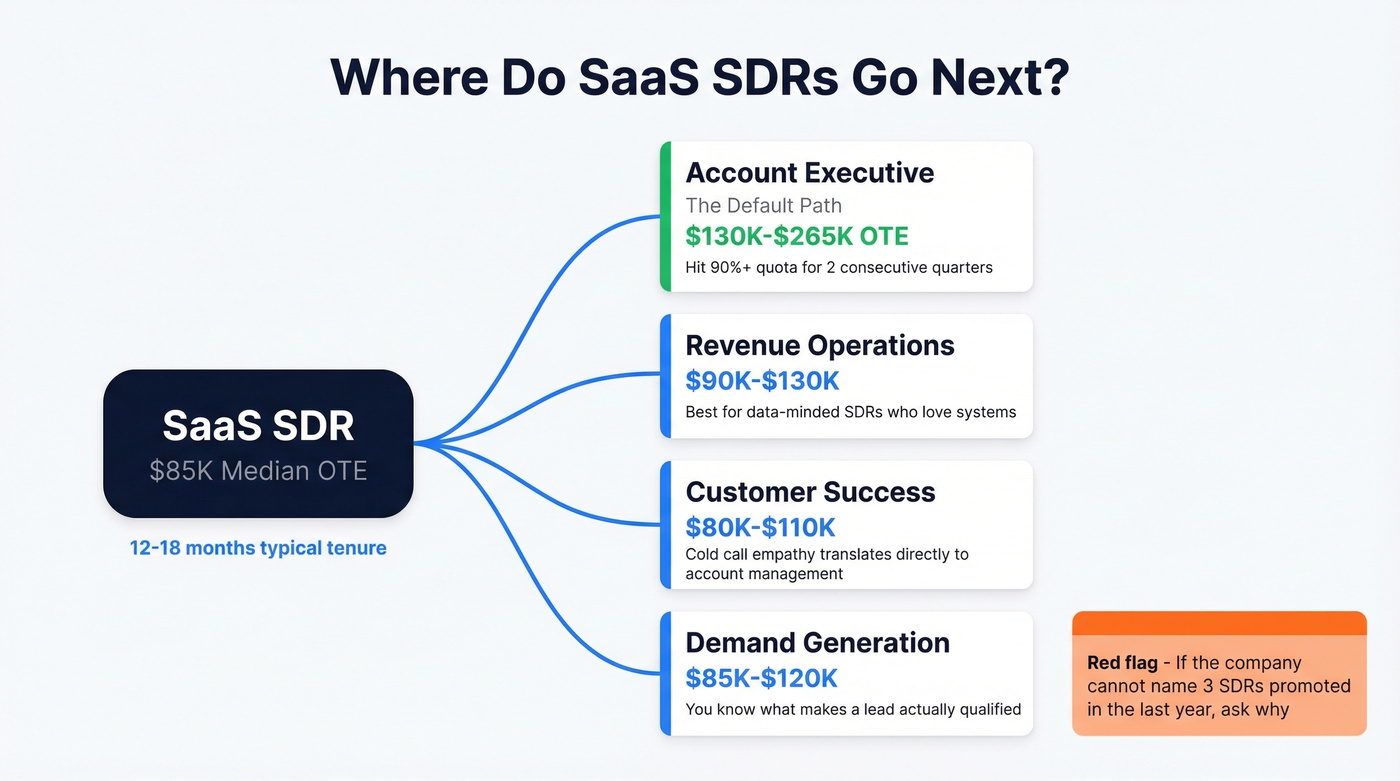
The benchmark for getting promoted: hit 90%+ quota for two consecutive quarters.
But AE isn't the only exit. Revenue Operations pays $90K-$130K total comp and loves former SDRs who can speak both data and sales. Customer Success runs $80K-$110K total comp, and the empathy from thousands of cold calls translates directly to managing accounts. Demand Generation teams value SDRs who understand what makes a lead actually qualified versus just form-filled. (If RevOps is your path, start with what a RevOps Manager actually does.)
One frustration that surfaces constantly on Reddit: companies that don't promote SDRs internally. Some orgs treat the role as a revolving door - hiring externally for AE seats while top performers stagnate. Ask about internal promotion rates during the interview process. If the company can't name three SDRs who got promoted in the last year, that's a red flag.
Let's be honest - the SDR role isn't glamorous. But the skills you build (objection handling, pipeline management, cold outreach) are the same skills that make top AEs, top RevOps leaders, and top founders. We've watched SDRs on our team go from booking meetings to running entire revenue functions in under three years.
AI and the Future of SDRs
Here's the contrarian prediction worth paying attention to: AI outbound efficiency will likely drop as channels get saturated, triggering a new wave of hiring by end of 2026. When every company's AI agent sends the same pattern-matched cold email, human differentiation becomes the competitive advantage again. SaaSiest's SDR leader roundup makes this case convincingly.
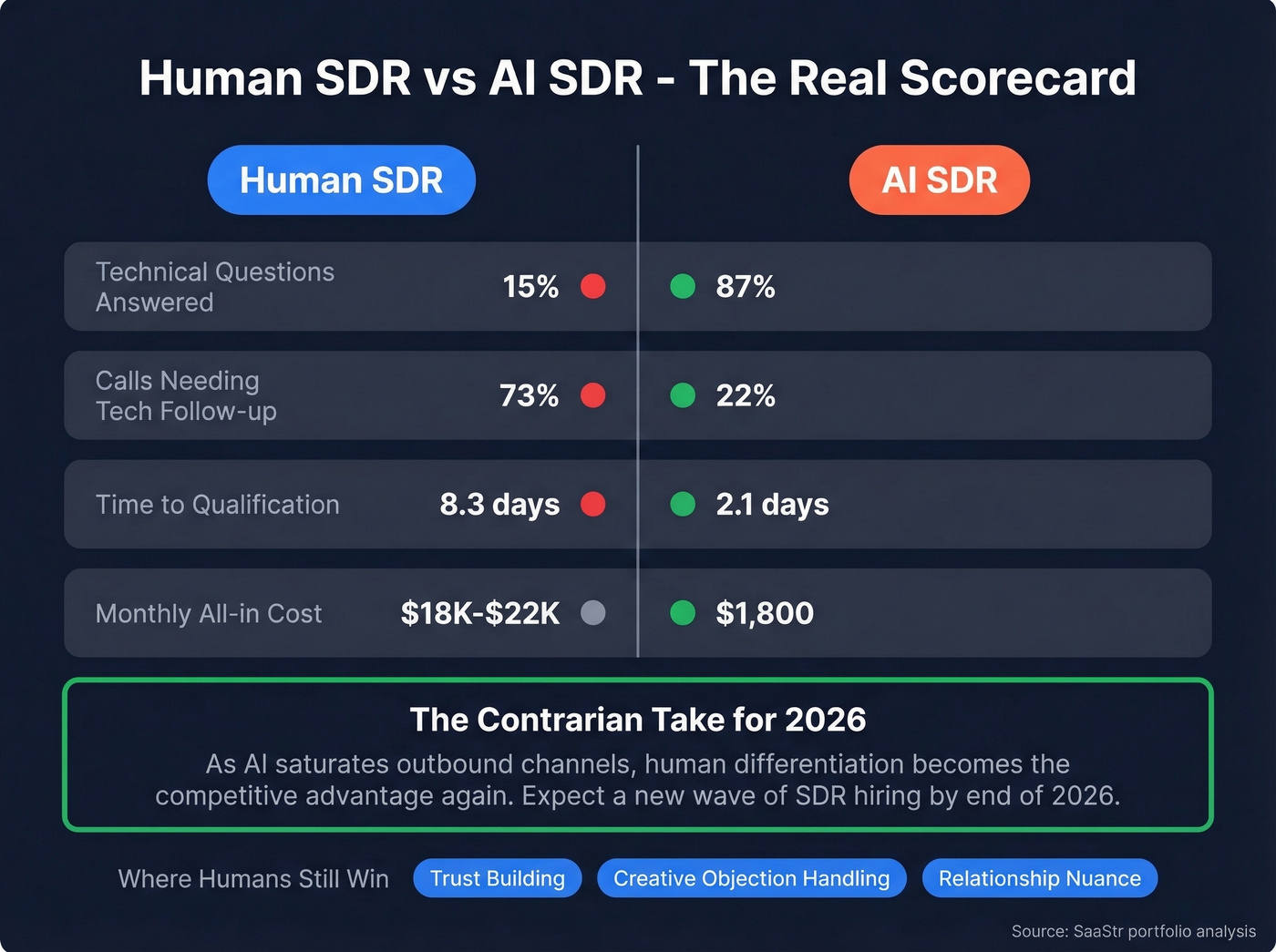
But the current data on AI capabilities is hard to ignore:
| Capability | Human SDR | AI SDR |
|---|---|---|
| Technical questions answered | 15% | 87% |
| Calls needing tech follow-up | 73% | 22% |
| Time to qualification | 8.3 days | 2.1 days |
| Technical buyer satisfaction | 6.2/10 | 8.4/10 |
Those numbers come from SaaStr's portfolio analysis. A human SDR costs $18K-$22K/month all-in. An AI-heavy outbound stack runs about $1,800/month and produces roughly 14 meetings/month. But Gartner's prediction that 95% of seller research will be AI-initiated by 2027 doesn't mean 95% of selling will be AI-driven. Research and first drafts are different from trust-building and creative objection handling.
The divide isn't human vs. AI - it's AI-equipped SDRs vs. everyone else. The role is shifting from "activity machine" to "GTM orchestrator," someone who uses AI for research, prioritization, and first drafts while bringing human judgment to conversations that matter. None of that works if your contact data is stale, though. AI-augmented workflows are only as good as the data feeding them.
FAQ
Is an SDR Role in SaaS a Good First Job?
The best entry point in tech sales, full stop. Median OTE is $85K with no degree requirement at most companies, and the 12-18 month promotion timeline to AE means you aren't stuck. Structured training, clear metrics, and rapid advancement make it hard to beat as a launchpad.
How Long Should You Stay as an SDR?
Twelve to eighteen months. Hit 90%+ quota for two consecutive quarters, then pursue AE or an alternative exit like RevOps or Customer Success. Staying longer than two years without a promotion usually means the company isn't investing in your growth.
Will AI Replace SDRs?
Not fully. AI handles research, CRM hygiene, and lead scoring well, but humans still own trust-building and complex objection handling. Expect AI-equipped reps to outperform peers by 2-3x, while purely manual prospectors fall behind. The role evolves; it doesn't disappear.
What's the Best Prospecting Tool for SDRs on a Budget?
Prospeo offers 98% email accuracy with a free tier (75 emails/month) and paid plans at roughly $0.01 per lead. With 300M+ profiles, 143M+ verified emails, 125M+ verified mobiles, and a 7-day data refresh, it delivers enterprise-grade data without the enterprise contract.
The article says SDR teams spend $2K-$5K/month per rep on tools - and still deal with bounces and disconnected numbers. Prospeo refreshes every 7 days (not 6 weeks), runs 5-step verification, and teams using it book 35% more meetings than Apollo users.
Cut your stack cost and triple your connect rate.