

How to Sell SaaS to Enterprise (and Not Waste 20 Months on a Dead Deal)
A founder on r/SaaS described an enterprise deal that dragged for 20 months and never closed. Meanwhile, their mid-market motion was humming - $30K ACV, two to six deals a month, SOC 2 in hand. Enterprise just wouldn't convert.
That's the default outcome when you move upmarket without changing how you sell. Selling SaaS to enterprise in 2026 rewards discipline over ambition, and the teams that win aren't closing harder - they're disqualifying faster, multithreading deeper, and landing smaller deals that expand into six figures.
TL;DR
- Get enterprise-ready before you prospect. SOC 2 Type II, and SSO/SAML, and SCIM provisioning are table stakes. Without them, you won't survive the security review.
- Qualify ruthlessly with MEDDIC. The goal isn't closing more deals - it's killing bad ones faster. (If you want a tighter framework, see MEDDIC.)
- Multithread every deal across 3+ departments. Deals engaging only one department close at 28%. Three-plus departments push that to 44%.
Why Enterprise SaaS Sales Are Harder in 2026
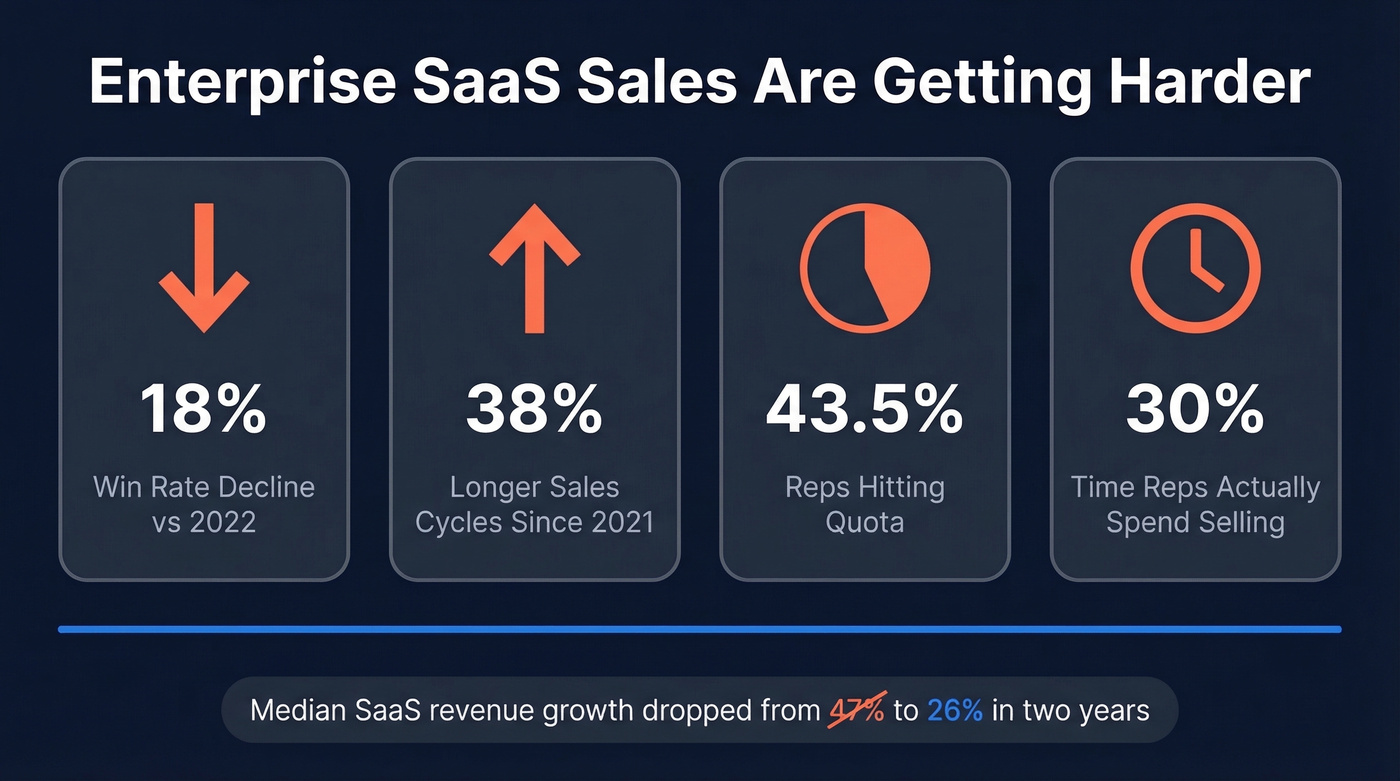
Win rates are down 18% versus 2022. Sales cycles have stretched 38% since 2021. Only 43.5% of reps hit quota, and reps spend roughly 30% of their time actually selling - the rest vanishes into admin and CRM hygiene. (This is where sales process optimization and pipeline health matter more than ever.)
| Segment | ACV | Cycle Length | CAC Payback |
|---|---|---|---|
| SMB | <$15K | Days-weeks | 8-12 months |
| Mid-Market | $15K-$100K | 1-3 months | 14-18 months |
| Enterprise | >$100K | 3-12 months | 18-24 months |
That 18-24 month CAC payback is the number that kills startups. You're funding the sales motion for nearly two years before you break even. Median SaaS revenue growth has dropped to 26%, down from 47% two years ago. If your runway can't absorb that, you're not ready for enterprise - and that's fine. (If you need to model the math, start with CAC.)
Here's the thing: if your ACV is under $50K, you probably don't need an enterprise sales motion at all. A tight mid-market playbook with strong expansion revenue will outperform a half-baked enterprise push every time. (Related: enterprise B2B sales.)
Enterprise Readiness Checklist
Before you send a single outbound email to a Fortune 500, make sure you can survive procurement. Enterprises aren't being difficult for fun - they're managing environments where 46% of licenses go unused, lines of business purchase 84% of SaaS spend, and the average enterprise adds nine net-new apps per month. Procurement teams are tightening controls because they have to.
Your minimum compliance stack:
- SOC 2 Type II is the floor for any US enterprise deal. Plan for 6-12 months to get certified.
- ISO 27001 is often expected for European and Asian buyers.
- SSO/SAML and SCIM provisioning are non-negotiable. Skip them and you'll get cut in the security review before anyone sees a demo.
- Audit logs and data residency options are increasingly expected, especially post-GDPR enforcement waves.
- If your product touches AI, ISO 42001 and EU AI Act readiness are the new frontier - fines run up to EUR35M or 7% of global annual revenue.
Skip this section if you're already SOC 2 certified and selling to mid-market. You know the drill. But if you're a seed-stage company eyeing your first enterprise logo, don't skip a single item.

Enterprise deals die in procurement when your outbound bounces. Prospeo's 98% email accuracy and 5-step verification keep your domain clean while you navigate security reviews and buying committees. At $0.01 per email, you can prospect the entire Fortune 500 without enterprise-grade pricing.
Stop burning your domain on bad data before the deal even starts.
Qualify Ruthlessly with MEDDIC
"If this project is a home run, what numbers change?"
Ask that question in your first discovery call. If the prospect can't answer, you don't have a deal. You have a conversation. (Use a structured bank of discovery questions to keep this consistent across reps.)
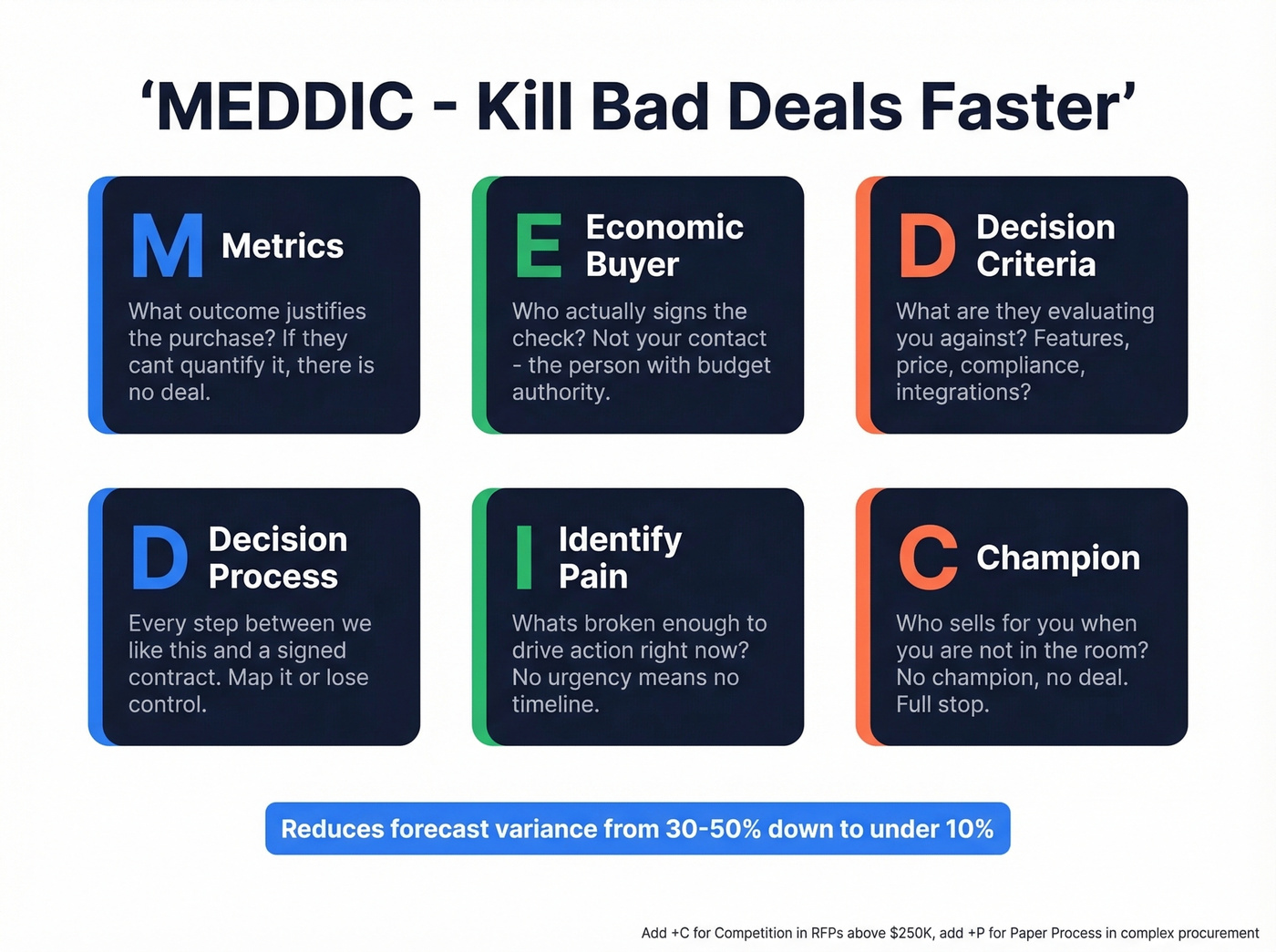
MEDDIC isn't a sales methodology - it's a qualification framework. It doesn't tell you how to sell. It tells you whether you should keep selling. The six pillars: Metrics (what outcome justifies the purchase), Economic Buyer (who signs the check), Decision Criteria (what they evaluate you against), Decision Process (steps between "we like this" and a signed contract), Identify Pain (what's broken enough to drive action), and Champion (who inside the account is selling for you when you're not in the room).
In our experience, the champion question is where 80% of dead deals reveal themselves. No champion, no deal. Full stop.
For competitive RFPs above $250K, add Competition to get MEDDICC. For complex procurement with legal gates, use MEDDPICC - the extra P covers Paper Process, which often takes longer than the evaluation itself. We've seen paper process alone add three months to deals that were "verbally closed." (More on finding the signer: MEDDPICC economic buyer.)
A well-run MEDDIC process reduces forecast variance from 30-50% down to under 10%. That alone justifies the discipline. (If you're tightening your model, pair this with sales forecasting solutions.)
Land-and-Expand: Start Small, Grow Fast
For any company under $10M ARR, land-and-expand is the highest-probability path into enterprise accounts. You're not trying to win a $500K contract on the first deal. You're trying to get through procurement once, prove value, and grow.
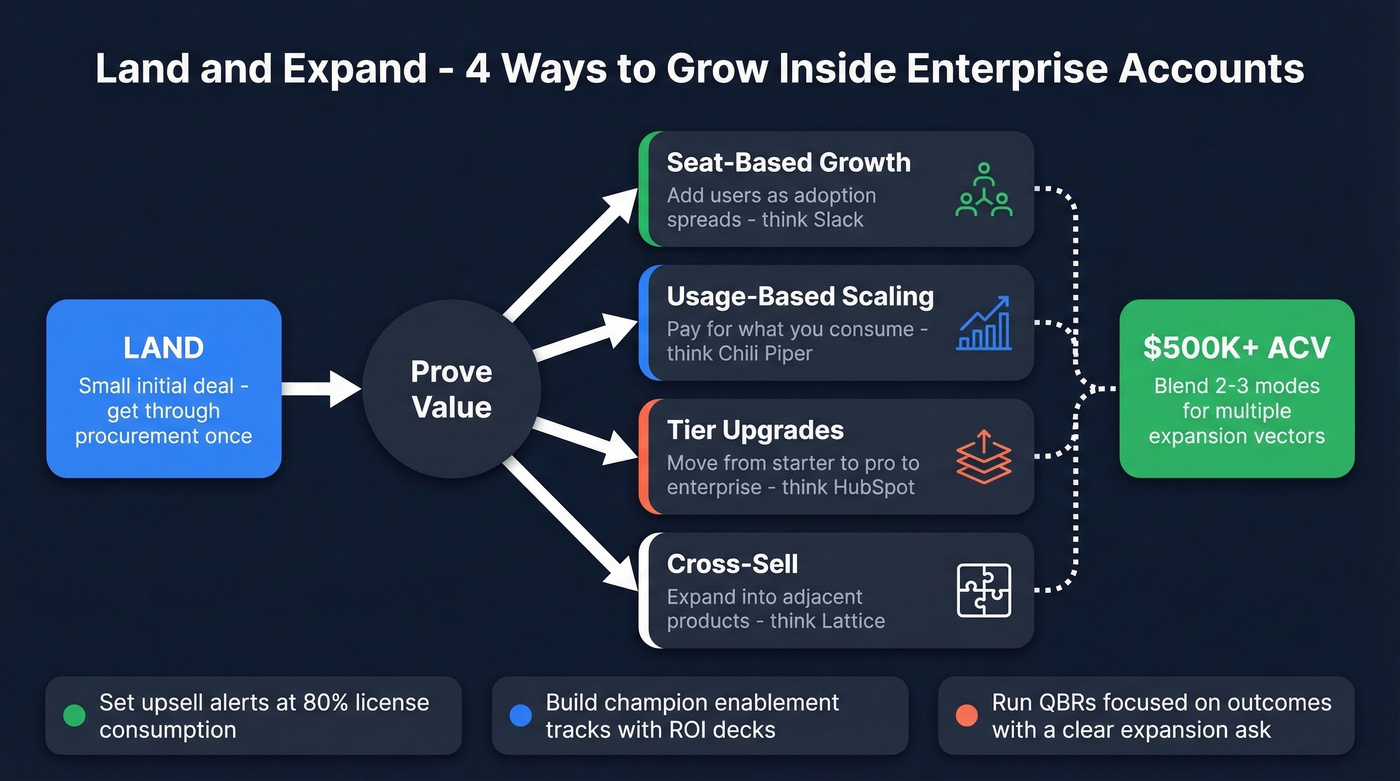
Four expansion modes work consistently: seat-based growth (Slack's classic motion), usage-based scaling (Chili Piper's consumption pricing), tier upgrades (HubSpot's playbook), and cross-sell (Lattice expanding from performance reviews into compensation and HRIS). The best enterprise SaaS companies blend two or three of these, creating multiple expansion vectors within a single account so growth doesn't depend on any one trigger. (See also: upsell vs cross-sell.)
Three tactics to accelerate expansion:
- Set trigger-based upsell alerts at 80% license consumption so your CSM reaches out before the customer asks. Reactive upselling is slower and weaker.
- Build champion enablement tracks with ROI decks your internal champion can forward to their CFO without needing you on the call.
- Run CS-led QBRs focused on outcomes - not feature updates - with a clear expansion ask in every review. If you're not asking, you're not expanding. (Helpful: QBR questions to ask.)
Multithread or Die: Navigating the Buying Committee
Your champion left the company. The deal is dead.
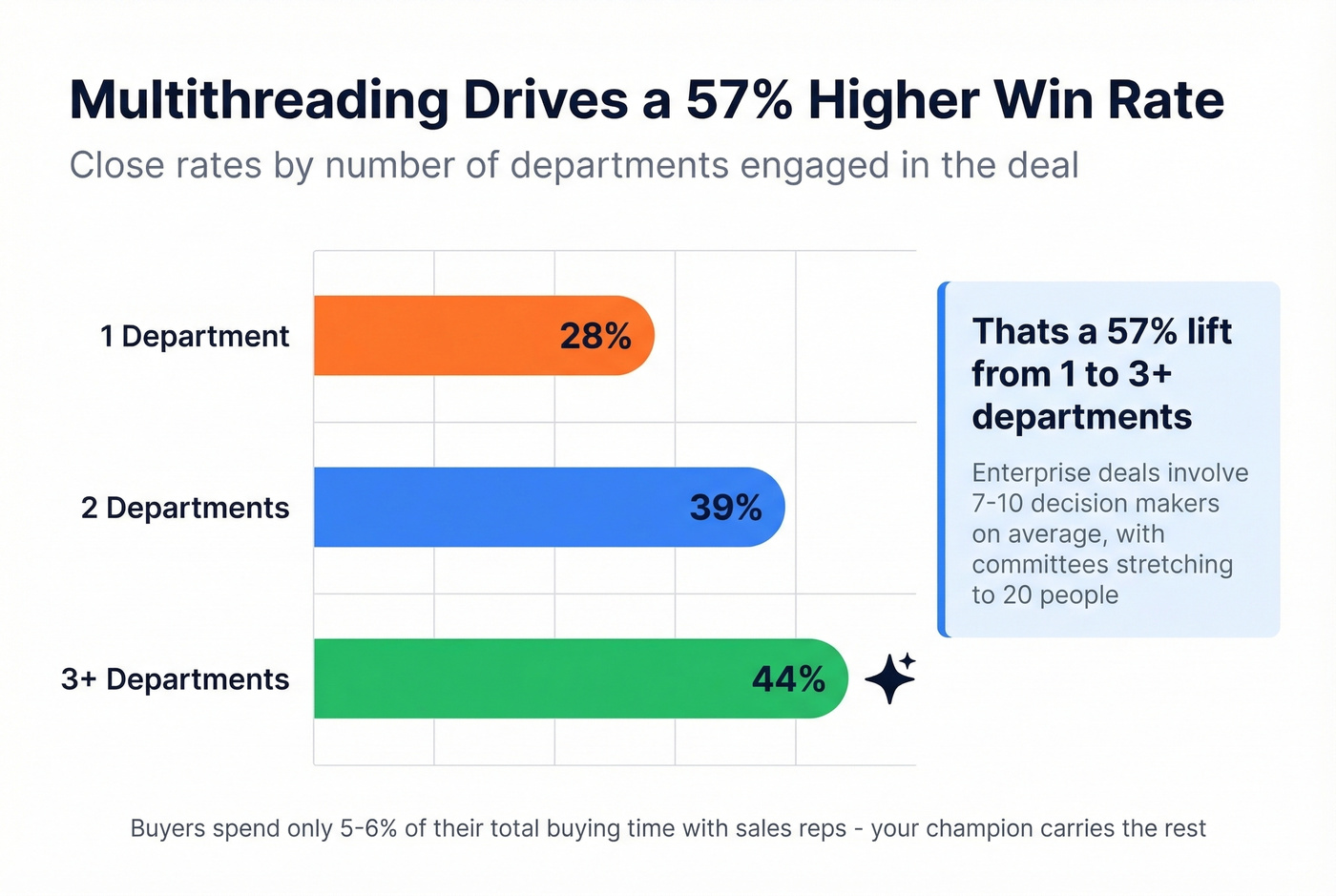
We've watched this pattern destroy more pipeline than any competitor or pricing objection ever could. Enterprise deals involve 7-10 decision-makers on average, with buying committees stretching to 20 people. Buyers spend only 5-6% of their total buying time with sales reps. Here's what the close-rate data shows:
| Departments Engaged | Win Rate |
|---|---|
| 1 | 28% |
| 2 | 39% |
| 3+ | 44% |
That's a 34% lift from multithreading. It's not optional. (This is classic account-based selling and team selling in practice.)

To multithread 15 stakeholders across an enterprise account, you need verified contact data for all of them - not "maybe" emails that bounce and burn your domain. Prospeo delivers 98% email accuracy on a 7-day refresh cycle, with 30+ search filters including buyer intent, technographics, and department headcount. When Snyk rolled out Prospeo across 50 AEs, their bounce rate dropped from 35-40% to under 5%, and AE-sourced pipeline jumped 180%. You can map an entire buying committee in minutes instead of days. (If bounces are hurting you, fix email bounce rate and follow an email deliverability guide.)
Mistakes That Kill Enterprise Deals
Scaling on one logo. Gainsight's CEO Nick Mehta has been transparent about this: after closing one $2.6M ARR enterprise deal, they hired 10 enterprise reps. They didn't close another $1M+ deal for five years. One deal isn't a motion. It's an anomaly.
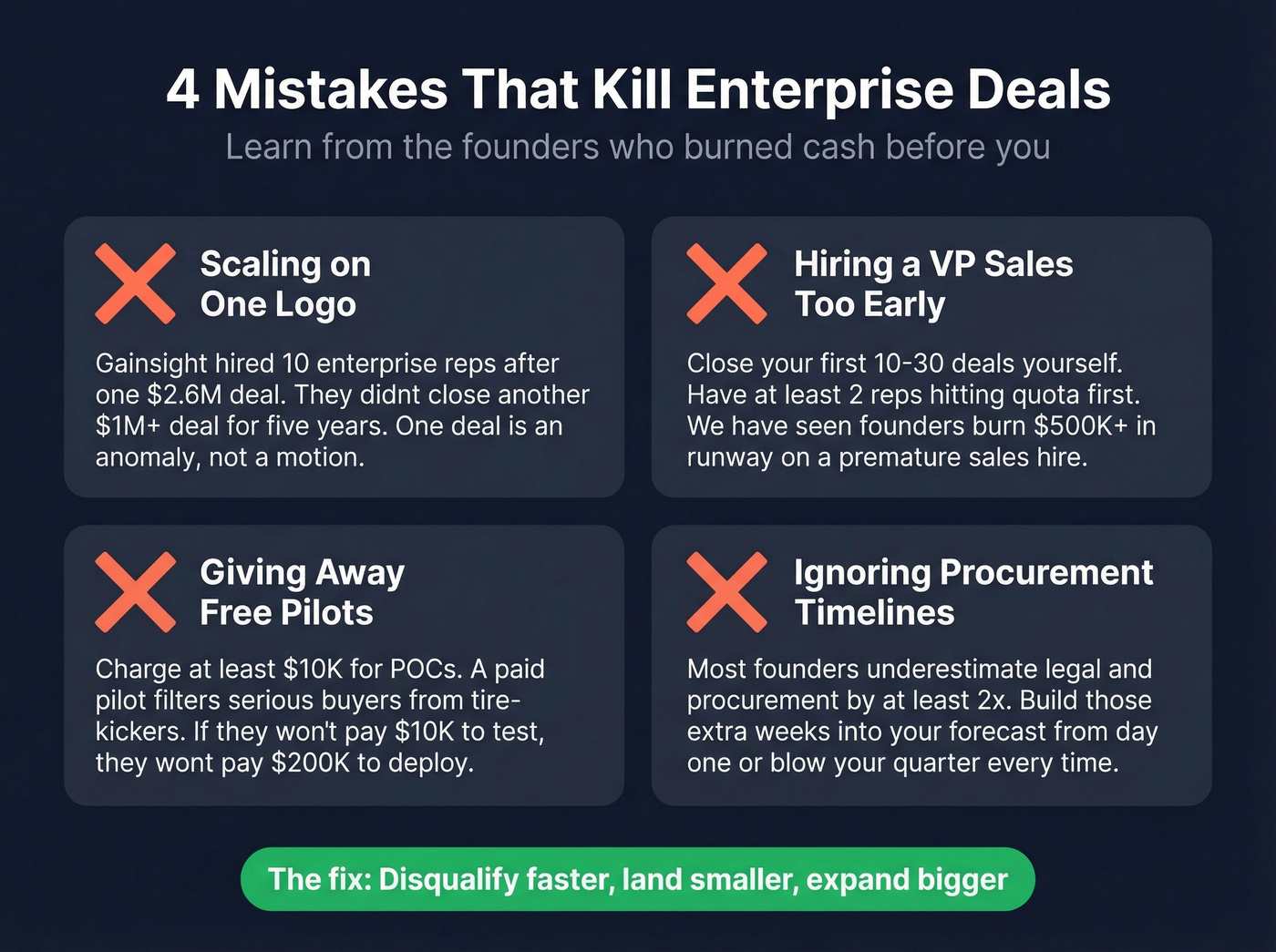
Hiring a VP of Sales too early. Jason Lemkin's rule holds: don't hire a VP of Sales until you've closed the first 10-30 deals yourself and have at least two reps hitting quota. We've watched founders burn $500K+ in runway chasing a single enterprise logo with a premature sales hire. (If you're building the function, start with sales leadership.)
Giving away free pilots. A recurring thread on r/sales: enterprise prospects demanding free POCs, then ghosting. Charge for pilots - even $10K. A paid pilot filters serious buyers from tire-kickers. If a prospect won't pay $10K to test your product, they're not going to pay $200K to deploy it. (If you need a structure, use a sales POC playbook.)
Ignoring procurement timelines. Let's be honest - most founders underestimate how long legal and procurement take by at least 2x. Build those weeks into your forecast from day one, or you'll blow your quarter every time.
Multithreading 7-10 stakeholders means you need verified emails and direct dials for every one of them. Prospeo gives you 300M+ profiles with 30+ filters - buyer intent, department headcount, technographics - so you can map the full buying committee in minutes. Snyk's 50 AEs drove 180% more pipeline after switching.
Find every decision-maker in the account before your champion leaves.
FAQ
How long does an enterprise SaaS deal take to close?
Deals over $100K typically take six months. At $500K and above, expect a year or longer. The timeline scales with buying committee size and procurement complexity, not product quality.
What's the minimum compliance needed to sell to enterprise?
SOC 2 Type II and SSO/SAML are the absolute floor for US buyers. Add ISO 27001 for international deals. Without these, most procurement teams will disqualify you before a demo.
How do you structure demos for enterprise stakeholders?
Run separate sessions for each audience. Technical evaluators need architecture and security deep-dives, while economic buyers want ROI projections and competitive benchmarks. Always tie features back to the specific pain you uncovered during MEDDIC discovery.
How do you reach all stakeholders in a buying committee?
Map the committee early - financial gatekeepers, technical evaluators, end users, executive sponsors. Then multithread across departments using verified contact data. Intent data helps you prioritize accounts actively researching your category, and tools with department-level filters let you identify the right people without guessing at org charts.