

Startup Sales Strategy: What to Do at $0, $1M, and $5M ARR
It's week three of your startup. You've got a product that works, a landing page that looks decent, and zero customers. The temptation is to keep building - one more feature, one more integration, then people will come. They won't. "Build it and they'll come" is the most expensive assumption in startup history. Your startup sales strategy starts with selling, not shipping.
Your product doesn't sell itself. No amount of advice changes that.
What You Need (Quick Version)
- Your ACV determines your sales motion - not your preference, not your board's opinion. A $3K deal and a $300K deal require completely different approaches.
- Founder-led selling isn't optional until you've got 10-25 paying customers who aren't your friends. Skip this and you're building on sand.
- Start with three tools - CRM, sequencer, prospecting data - and nothing else until $1M ARR.
Mistakes That Kill Early-Stage Sales
We've watched founders repeat these five mistakes so often they feel scripted. As one r/startups founder put it, "early sales starts messy and stays messy without intentional correction in the first month."
No clear ICP. Pick a niche - mid-market companies with fast decision cycles - and ignore everyone else until it works. Targeted selling beats spray-and-pray every time. This is the single most common failure mode we see, and it's almost always driven by fear of leaving money on the table. If you need a starting point, use an ICP scoring rubric.
Pitching features instead of outcomes. As Menlo Ventures advises, sell the product your buyer is buying, not the product you're selling. A tight elevator pitch helps keep you outcome-first.
CRM as a dumping ground. 2,000 contacts with no pipeline stages is a spreadsheet with a subscription fee. Add stages with exit criteria on day one. If you're still deciding, here are examples of a CRM with real pricing.
Vague differentiation. If you can't say why you win in one sentence, neither can your champion. Write it down today. This is also where B2B brand positioning pays off fast.
Inconsistent messaging. Document your pitch early, even if it's rough. Every call, deck, and email should tell the same story. A solid messaging framework compounds over time - a sloppy one compounds confusion.
Choose Your Motion by Deal Size
Your ACV isn't a pricing decision. It's a go-to-market architecture decision.
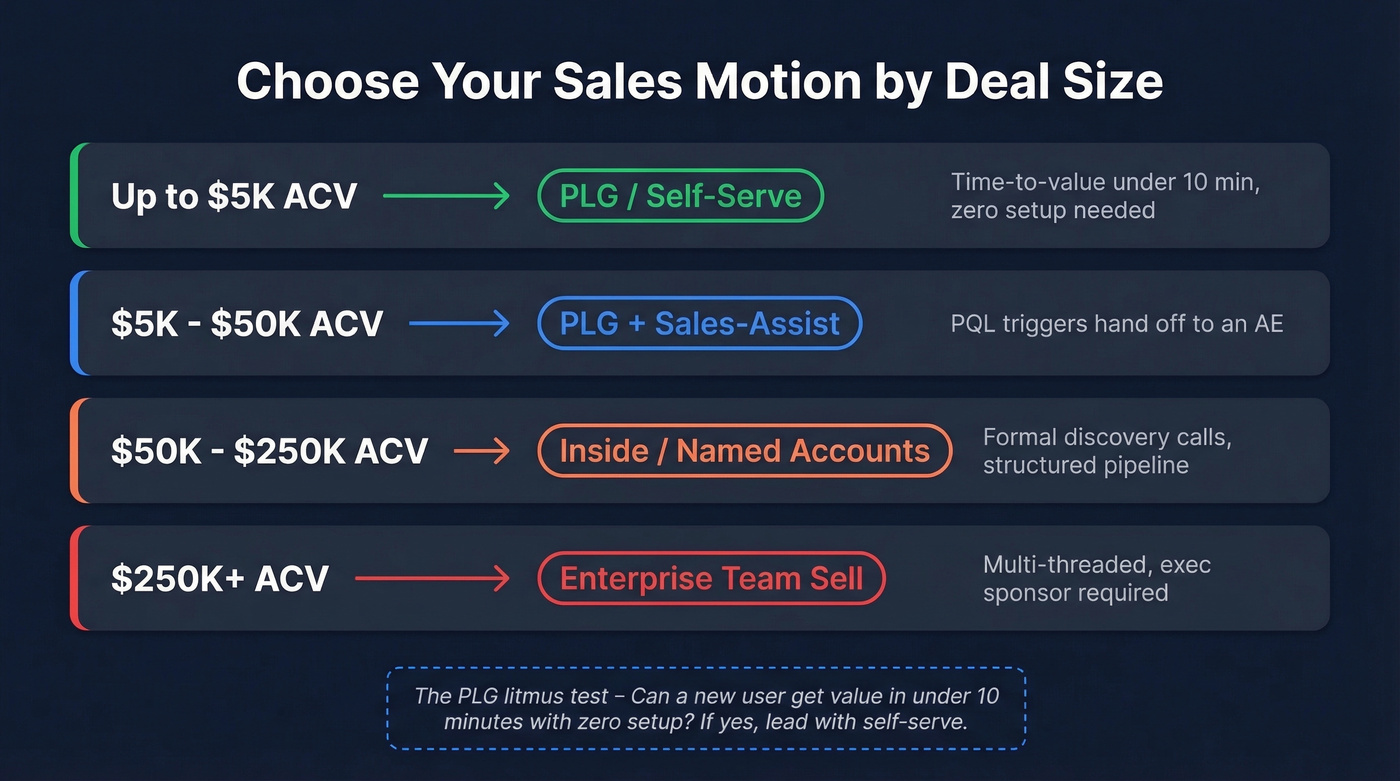
| ACV Range | Motion | Key Signal |
|---|---|---|
| ≤ $5K | PLG / self-serve | Time-to-value under 10 min |
| $5K-$50K | PLG + sales-assist | PQL triggers → AE handoff |
| $50K-$250K | Inside / named accounts | Formal discovery, pipeline |
| $250K+ | Enterprise team sell | Multi-thread, exec sponsor |
The PLG litmus test is simple: can a new user get value in under 10 minutes with zero setup? If yes, lead with self-serve. If not, you need humans in the loop.
B2B Sales by Revenue Stage
Pre-Revenue to $500K: The Discovery Grind
Founders who complete 50+ discovery calls before writing production code have a 40% higher chance of reaching $1M ARR within two years. That stat alone should reorder your calendar.
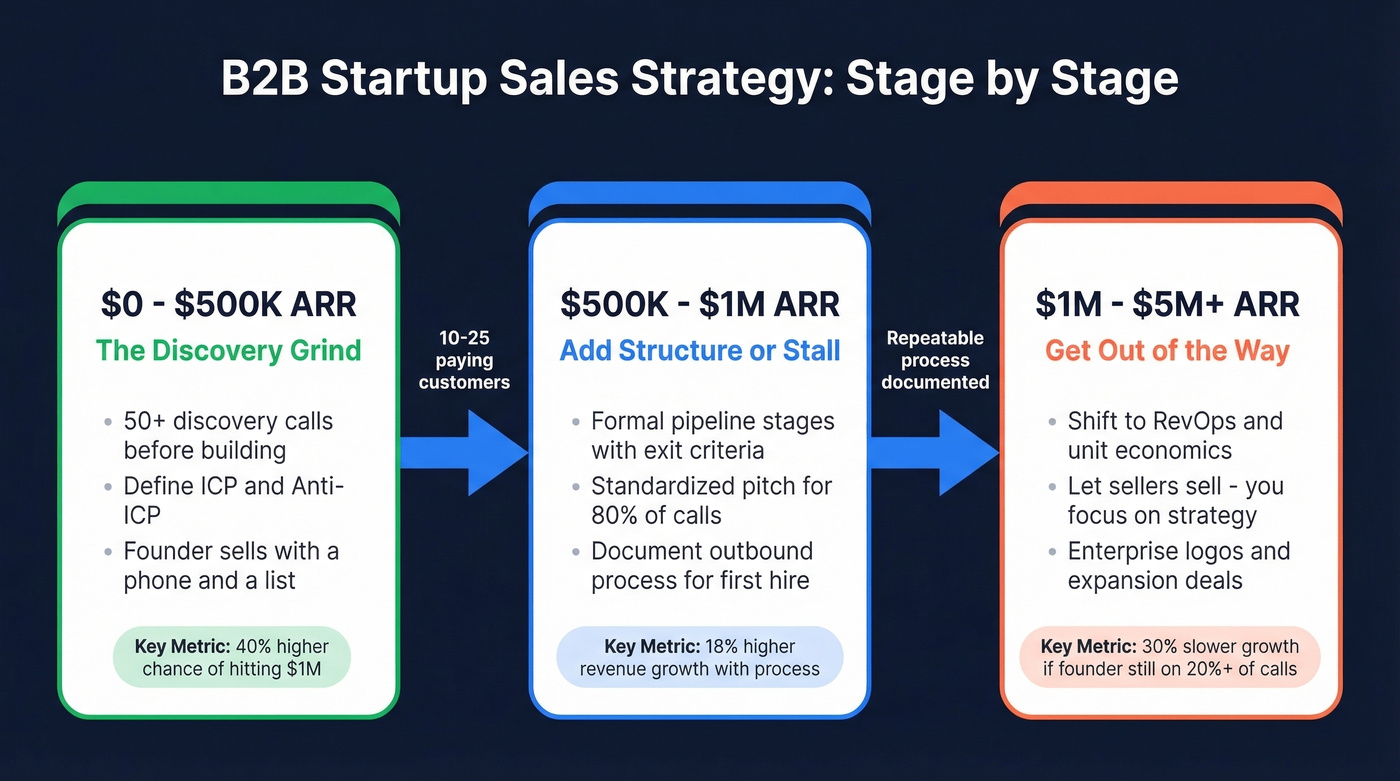
Structure every call with a POA framework - state the Purpose of the meeting, align on an Agenda, and define the Outcome you both want. This keeps discovery focused and gives you clean data to pattern-match across conversations. Define your Anti-ICP just as carefully as your ICP. Document every objection. Those objections become your playbook, your FAQ page, and your first sales hire's training manual. A simple discovery questions bank makes this repeatable.
Here's the thing: if your deal sizes are under $10K, you probably don't need a sales team at all until $500K ARR. You need a founder with a phone and a list.
$500K to $1M: Add Structure or Stall
| Do This | Not That |
|---|---|
| Formal pipeline stages with exit criteria based on buyer actions | Stages based on rep gut feeling |
| Standardized pitch for 80% of calls | Freestyling every conversation |
| Pricing that closes without a "founder discount" | Discounting to win - that's a positioning problem |
Companies with a formalized sales process see 18% higher revenue growth. A structured CRM at this stage can cut your sales cycle by roughly 22%. In our experience, the CRM-as-dumping-ground problem kills more pipelines than bad data ever will. This is also when you should formalize your outbound process - document what's working so your first hire can replicate it without shadowing you for three months. If you're tightening the system, use sales process optimization as your checklist.
$1M to $5M+: Get Out of the Way
If you're still on more than 20% of sales calls at ~$5M ARR, your company grows ~30% slower. That's not a guess - it's a pattern we've seen play out repeatedly.
Your job shifts to RevOps, unit economics, and exec sponsorship for strategic accounts. Let your sellers sell. You focus on enterprise logos, strategic partnerships, and expansion conversations. If you're still running every demo at $5M, you are the bottleneck. Founder-runs-everything doesn't survive past this stage.

Bad data torches domains and kills startup outbound before it starts. Prospeo's 98% email accuracy and 7-day refresh cycle mean your first 1,000 cold emails actually land. At $0.01/lead, it's built for founders who need enterprise-grade data without enterprise pricing.
Stop burning your domain on unverified lists. Start with data that connects.
Outbound That Works in 2026
Cold email isn't dead - lazy cold email is dead. An analysis of 11M+ emails found 61% of decision makers still prefer email as a cold outreach channel. But 20% say they've never received a single relevant cold email. That gap is your opening.
What moves the needle: custom sending domains (almost 2x the reply rate versus generic Gmail), hyper-relevant personalization tied to a real trigger, and shorter sequences. Keep emails short with a single clear CTA. Recipients spend 5-7 seconds scanning before they delete or engage. If you want a tighter system, start with a proven B2B cold email sequence.
None of this matters if your data bounces. Bad data is the #1 outbound killer. We've seen a single bad list torch a domain's reputation for months - and at the startup stage, you don't have a backup domain warming in the wings. Verify your list before you send. Every time. Track your email bounce rate like a core metric.
For SaaS companies specifically, your prospects are already drowning in vendor emails. Creative outreach and genuine relevance matter more than volume. The best sequences pair a strong trigger event with a concise, outcome-focused message that makes the prospect think "this person actually understands my problem." If you need more angles, borrow from these sales prospecting techniques.
When to Hire Your First Seller
The readiness threshold is 10-25 paying customers - and 10 customers who are all your friends don't count.
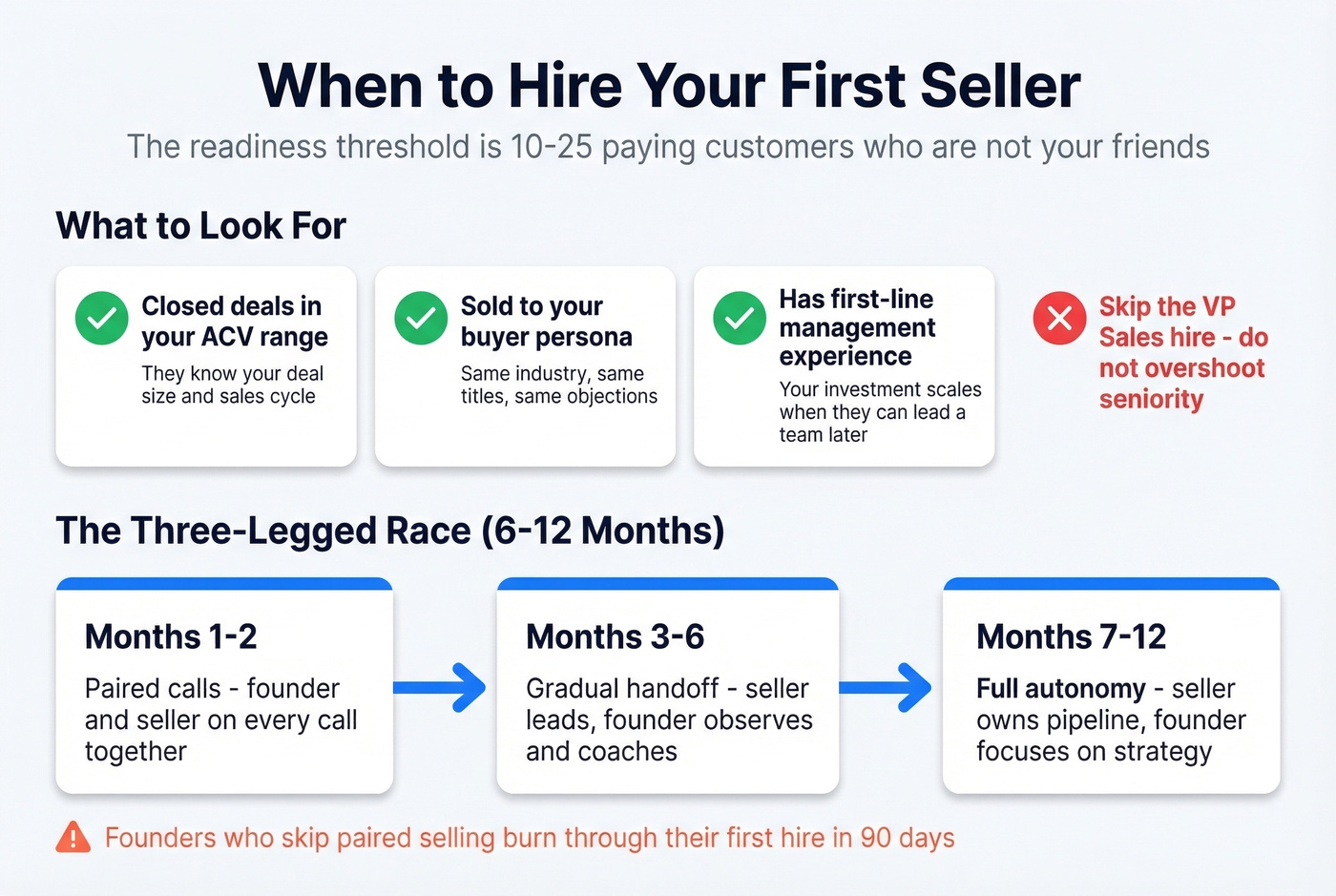
Skip the VP Sales hire. The most common mistake is overshooting seniority - bringing in a big-company executive who won't do their own "button-clicking," as First Round Review puts it. You need a seller who's closed deals in your ACV range, sold to your buyer persona, and has first-line management experience so your investment scales later. A simple 30-60-90 day plan helps you onboard without chaos.
The onboarding model that works: a "three-legged race" where you and your first seller run paired on calls, proposals, and closes for 6-12 months. I've seen founders burn through their first hire in 90 days because they skipped this phase. It's slow. It's also how you transfer the institutional knowledge that lives in your head - the objection patterns, the pricing conversations, the "when they say X they actually mean Y" instincts that no onboarding doc captures.
The Lean Sales Tech Stack
Three essentials. That's it until $1M ARR. Resist the urge to over-tool.
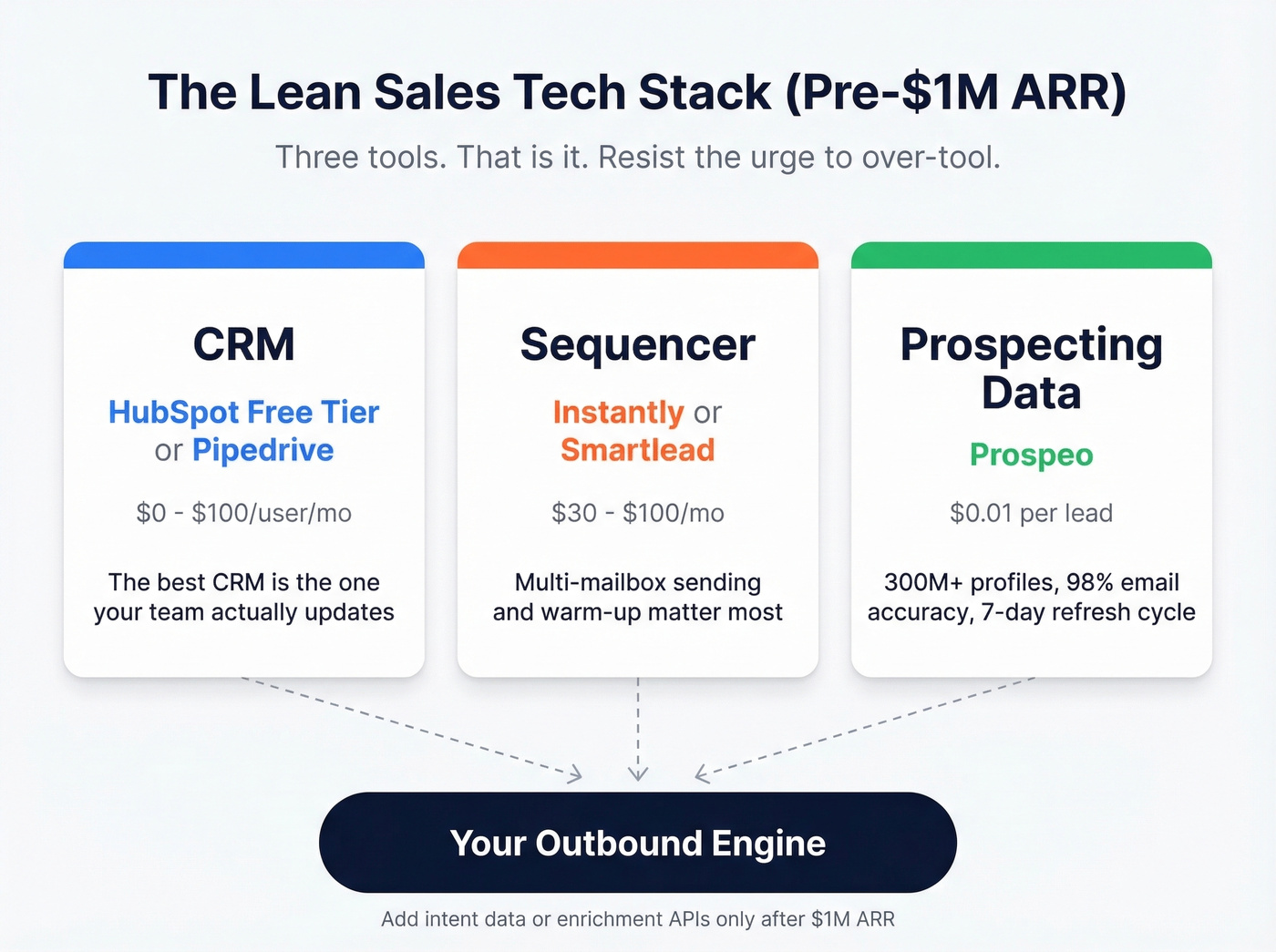
CRM: HubSpot free tier or Pipedrive (~$15-$100/user/mo depending on plan). Pick one, use it religiously. The best CRM is the one your team actually updates. If you're comparing options, start with contact management software.
Sequencer: Instantly (~$30-$80/mo) or Smartlead (~$40-$100/mo). Both handle multi-mailbox sending and warm-up, which matters more than any fancy feature when you're running lean.
Prospecting data: Prospeo - 300M+ profiles, 98% email accuracy, and a 7-day data refresh cycle at roughly $0.01 per lead. The free tier gives you 75 verified emails per month to test before you spend anything. Stack Optimize used Prospeo as their data layer and built from $0 to $1M ARR, maintaining 94%+ deliverability and under 3% bounce rates across all clients.
Once you pass $1M ARR, consider adding intent data or enrichment APIs. Until then, these three pillars are enough. If you're evaluating vendors, compare data enrichment services before you commit.

Founder-led selling needs a lean stack: CRM, sequencer, and prospecting data. Prospeo gives you 300M+ profiles with 30+ filters - buyer intent, technographics, headcount growth - so you find your ICP without the spray-and-pray. 15,000+ companies already use it to build pipeline.
Build your first sales list in minutes, not weeks. No contracts required.
2026 Benchmarks: What Good Looks Like
A Lighter Capital study of 155 B2B SaaS startups shows the market tightened significantly. These are the latest available benchmarks covering CY2023-CY2024:
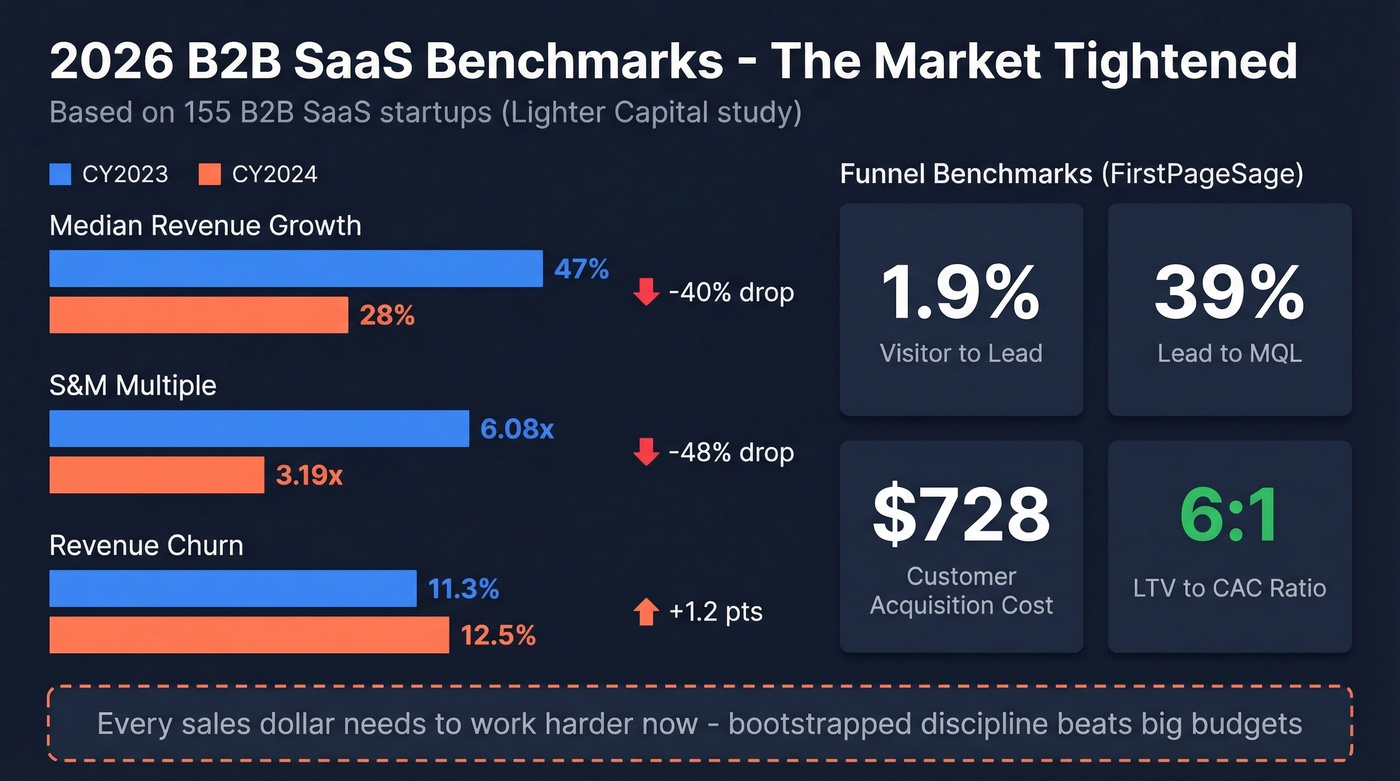
| Metric | CY2024 | CY2023 |
|---|---|---|
| Median revenue growth | 28% | 47% |
| S&M multiple | 3.19x | 6.08x |
| Revenue churn | 12.5% | 11.3% |
Sales and marketing dollars went half as far. That 3.19x S&M multiple means every dollar you spend needs to work harder - a reality that makes bootstrapped discipline more important than ever.
For funnel benchmarks, FirstPageSage reports visitor-to-lead conversion at 1.9%, lead-to-MQL at 39%, CAC at $728, and LTV:CAC at 6:1. If your numbers are significantly worse, fix your funnel before you scale your spend. Throwing more budget at a broken funnel just accelerates the burn.
FAQ
Best sales strategy for a pre-revenue startup?
Do 50+ discovery calls before building beyond your MVP. Document every objection - those become your playbook. The right startup sales strategy at this stage is pure discovery: talk to prospects, validate pain, and iterate your pitch until it converts consistently.
When should a founder stop doing sales?
After 10-25 paying customers (not friends) and a repeatable pitch. Then hire a seller and run paired calls for 6-12 months. This transition from founder-led to team-led selling is the most critical inflection point in early-stage growth.
What tools does a startup need for outbound?
Three: a CRM (HubSpot free tier works fine), a sequencer (Instantly or Smartlead), and verified prospecting data. Add more only after $1M ARR. The goal at this stage is learning, not scale.
How do I build a compliant outbound strategy?
If you're selling into the EU, GDPR compliance isn't optional. Use legitimate interest as your legal basis, include an easy opt-out in every email, and never buy scraped lists without verifiable consent. Accurate, verified contact data helps here - fewer bounces mean fewer complaints and better deliverability.
Does outbound still work during a downturn?
Yes - outbound actually becomes more effective when competitors pull back on spend. Buyers still have problems; they just scrutinize ROI more carefully. Tighten your ICP, lead with cost savings or efficiency gains, and keep your sequences running while others go quiet.