

7 ABM Challenges That Actually Kill Programs (and How to Fix Them)
A lot of teams spend six figures on an ABM platform and end up with a dashboard full of "engaged accounts" but nothing the sales team trusts as net-new pipeline. One Reddit practitioner called enterprise ABM tools "expensive reminders to sell to your ICP." Here's the thing: 70% of marketers run an active ABM program, but most ABM challenges aren't strategy failures - they're data failures dressed up in strategy clothes.
What You Need (Quick Version)
- Lean stack: CRM + verified enrichment layer + one intent signal source
- Measurement: Track target accounts moving through stages, not MQLs
- Timeline: 1-2 quarters for leading indicators, 2-4 for pipeline impact

42% of ABM teams can't identify the right buyers. Prospeo's 300M+ verified profiles with 30+ filters - intent signals, technographics, job changes, headcount growth - let you map every stakeholder on the buying committee with 98% email accuracy.
Stop personalizing outreach to contacts that bounce.
The 7 Account-Based Marketing Challenges That Matter
1. Building a Target Account List That's Actually Targeted
Start with ICP modeling - firmographic, technographic, behavioral - then map your TAM down to a target account list. Supplement static lists with trigger events: leadership changes, funding rounds, tech stack shifts. Sales validates the final list, not marketing alone. If you need a repeatable process, see target account list automation.
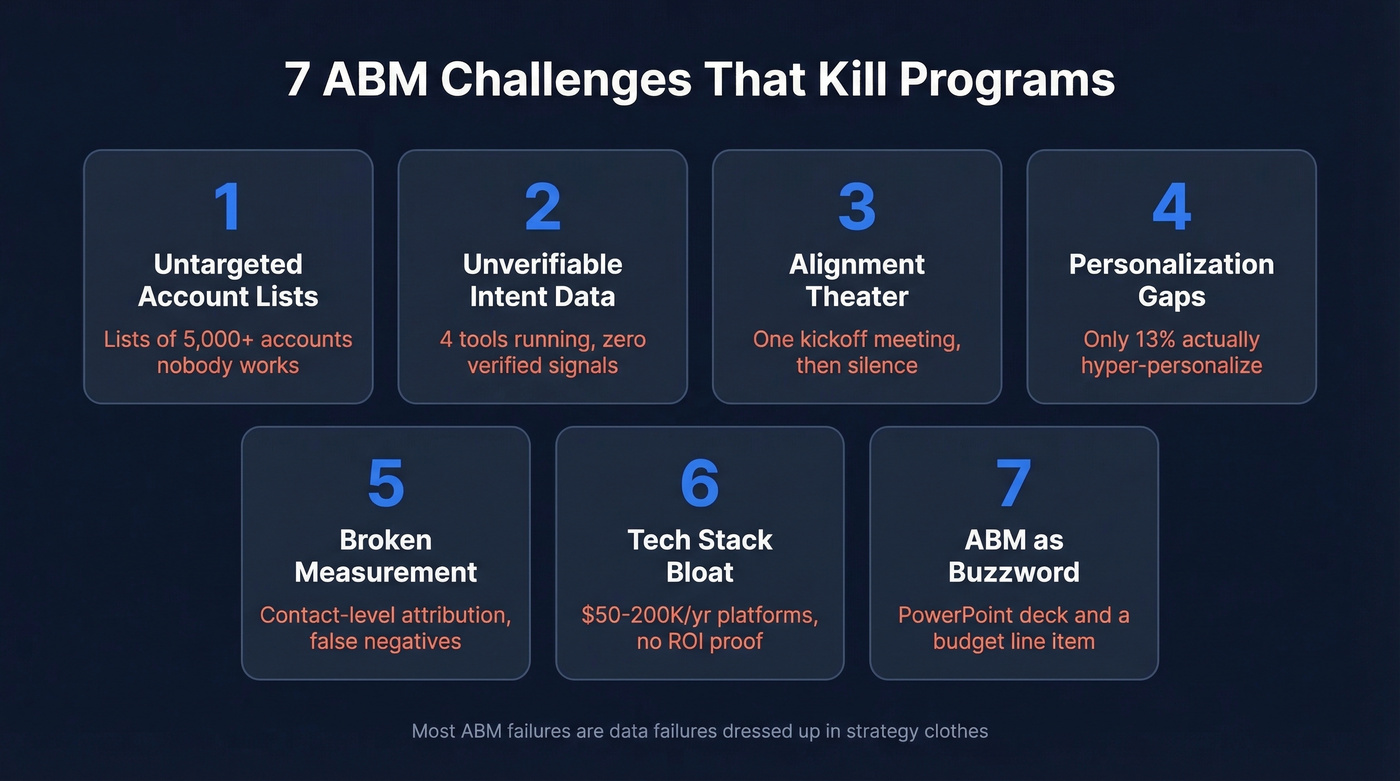
If your TAL is 5,000 accounts, it's not ABM. It's demand gen with extra steps. Your list should feel uncomfortably small, and you should never let a platform's "lookalike" algorithm pick accounts without human review. We've seen teams treat ABM like a volume play over and over again, and it's one of the most common account-based marketing mistakes out there - they end up with a bloated list that nobody on the sales side actually works. (If you're still sizing the market, use an addressable market framework.)
2. Intent Signals You Can't Verify
One marketing leader on r/b2bmarketing described running four tools simultaneously - Rb2b, Factors AI, Warmly, and G2 - and still couldn't verify whether target accounts had actually visited their site. That's the norm, not an edge case.
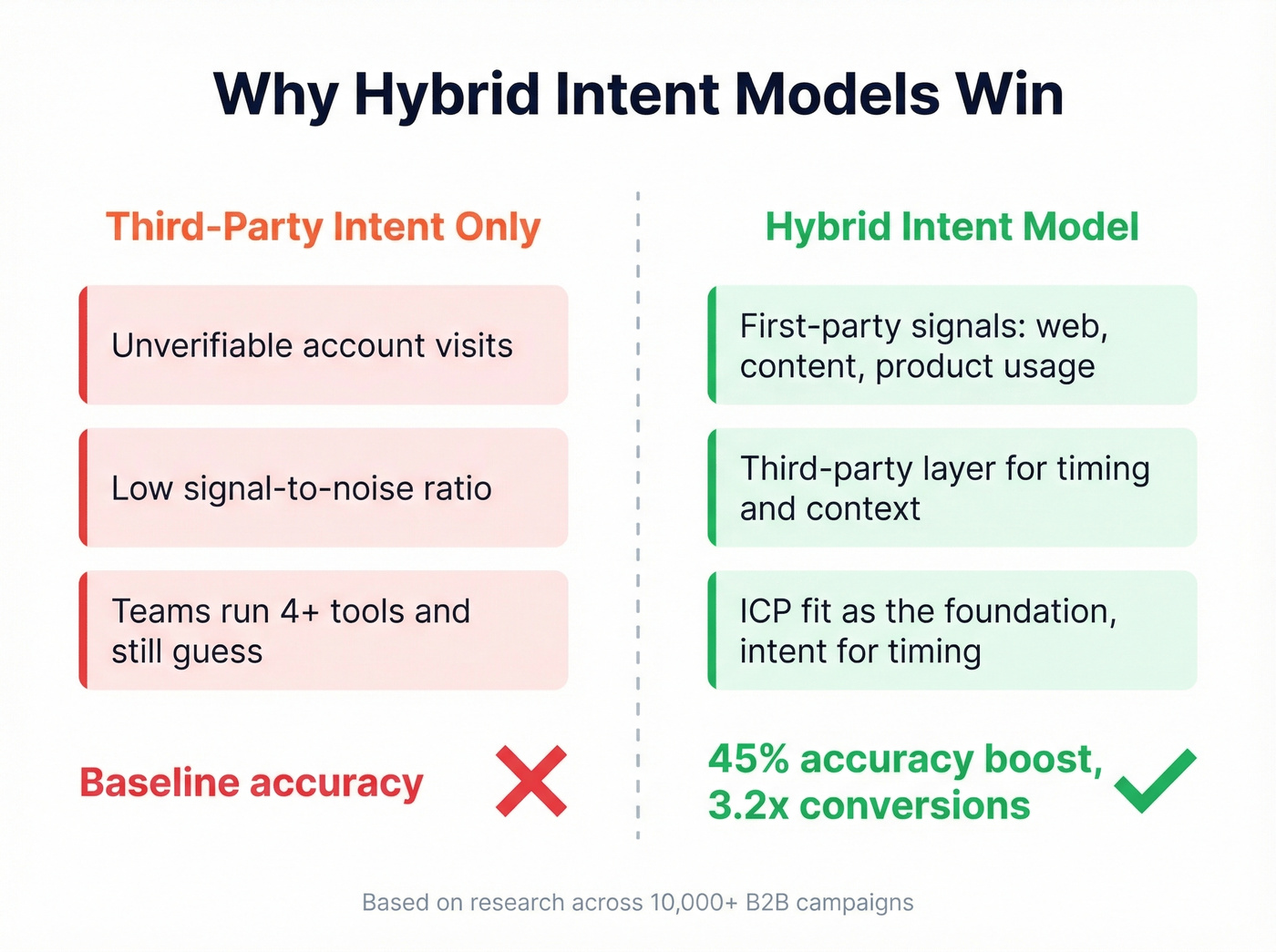
The fix is a hybrid intent model combining first-party signals (web analytics, content engagement, product usage) with third-party intent data. Research across 10,000+ B2B campaigns shows hybrid models deliver a 45% accuracy boost with 3.2x higher conversion rates. Third-party signals alone are unreliable. ICP fit is the foundation; intent helps you time the outreach. For a practical scoring approach, use identifying buying signals and intent based segmentation.
3. Sales-Marketing Alignment Theater
Everyone says they're "aligned." Then you ask how often sales and marketing review target accounts together, and the answer is "we had a kickoff meeting in January."
Aligned organizations achieve 36% higher retention and 38% higher win rates. Layering in account-based advertising pushes win rates 60% higher still. The Revenue Team model works: sales, marketing, and CS integrated around shared account-level KPIs, with SDRs assigned to account lists instead of lead pools. Yet 41% of fully synchronized ABM programs only meet quarterly - because the process is baked into daily workflows, not bolted on as a meeting. If you’re formalizing the operating cadence, a RevOps Manager playbook helps.
The real blocker is change management. Teams resist account-based adoption because it threatens existing workflows and comp models. Without genuine buy-in across both departments, alignment stays performative.
4. Personalization That Doesn't Scale
If 51% of decision-makers want high personalization and 80%+ of buying committees involve four or more stakeholders, but only 13% of teams hyper-personalize - who's actually doing this well?
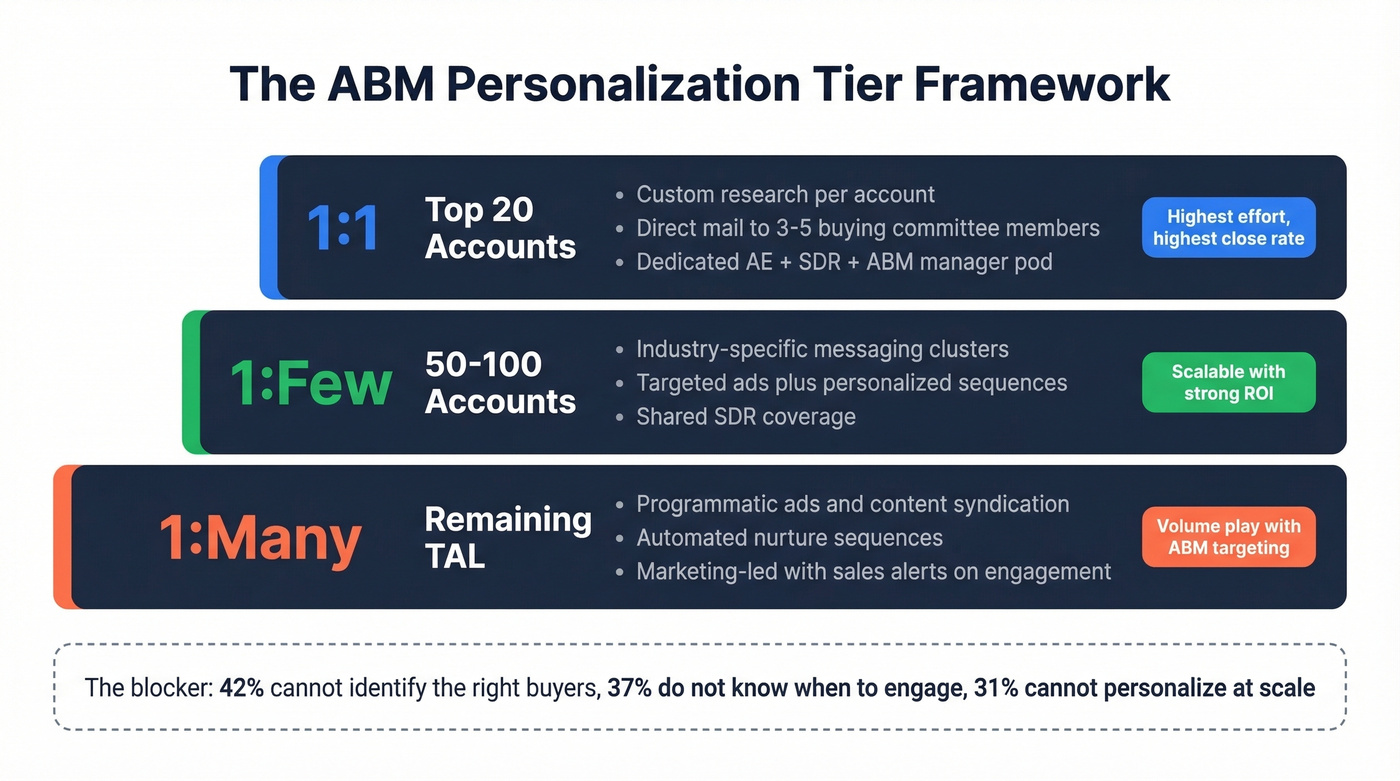
Almost nobody. The blockers: 42% can't identify the right buyers, 37% don't know when to engage, 31% can't personalize at scale. The answer is tiered plays. 1:1 for your top 20 accounts. 1:few for the next 50-100. 1:many for the rest. A well-timed direct mail piece to the right three people on the buying committee beats a personalized microsite nobody visits. Teams that skip this tiered approach try to hyper-personalize everything and end up personalizing nothing. For messaging systems that hold up across tiers, use personalized outreach and personalized drip campaigns.
5. Measurement That Proves Nothing
Contact-level attribution creates a mountain of false negatives. One person on the buying committee clicks your ad, but the deal closes through a different contact. Your dashboard says the campaign failed. It didn't - your measurement unit was wrong.
The correct unit is the account or buying group. Track accounts through stages: interested, considering, selecting, closed won. Teams doing contact-level ABM right see 74% more meetings and 118% pipeline lift, but only when measuring at the account level. If your reporting can't show you which target accounts moved stages this quarter, your measurement framework is broken regardless of how many dashboards you have. To tighten the reporting layer, map ABM to funnel metrics and monitor pipeline health.
6. Tech Stack Bloat
Enterprise ABM platforms - 6sense, Demandbase, Terminus - run $50-200K+/year. For a 500-person sales org with dedicated ABM pods, that can make sense. For everyone else, skip them.
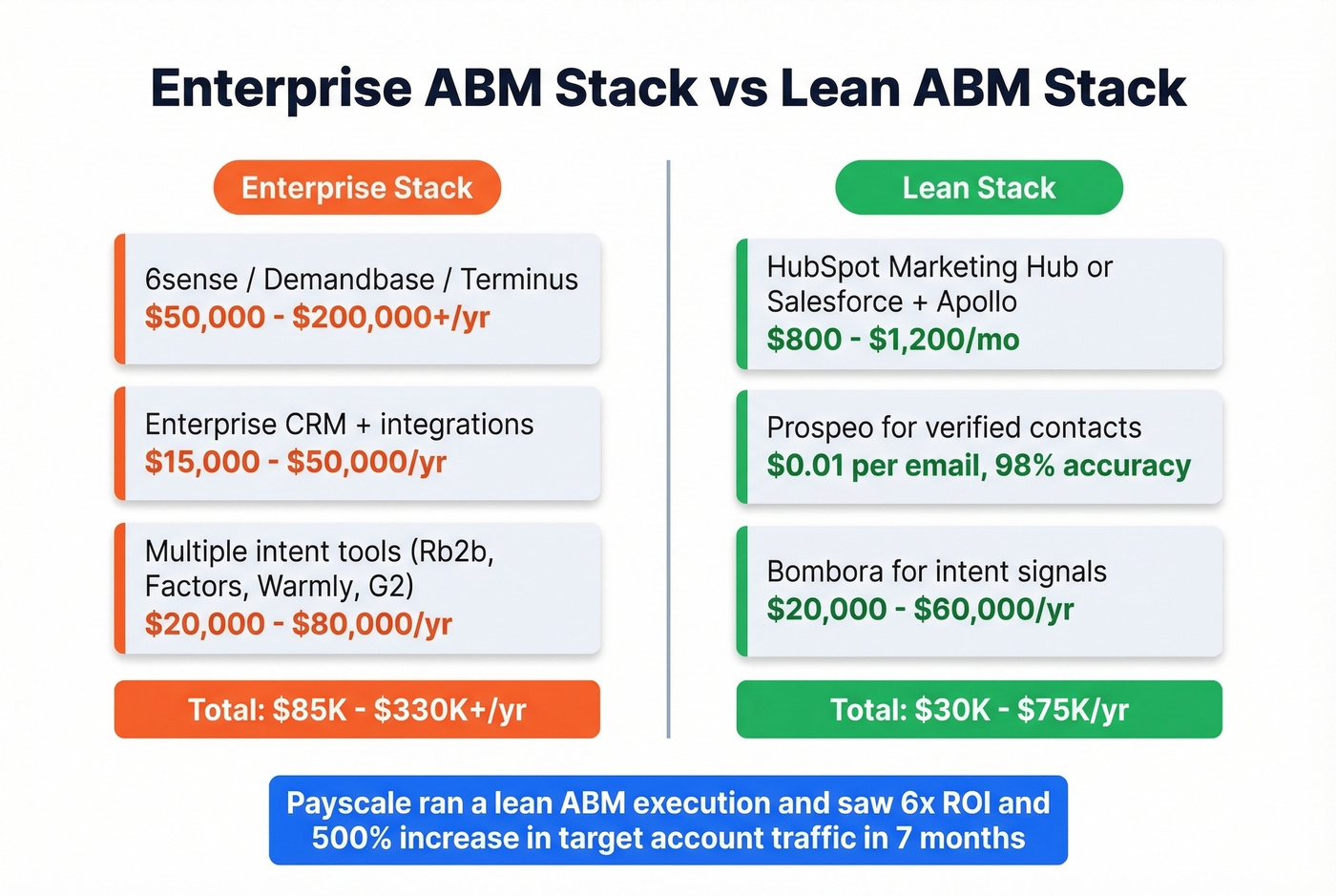
Our take: if your average deal size is under $25K, you almost certainly don't need a six-figure ABM platform. The lean alternative looks like this: HubSpot Marketing Hub ($800/mo) or Salesforce + Apollo ($49/mo) for core CRM and outbound workflows, Prospeo for verified contact data across your target accounts at roughly $0.01 per email, and Bombora ($20-60K/yr) for intent signals. Payscale ran a focused ABM execution and saw 6x ROI and a 500% increase in target account traffic within seven months. The platform didn't make the difference. The execution discipline did. If you’re evaluating vendors, start with data enrichment services and a sales prospecting database comparison.
7. The "ABM Is Just a Buzzword" Problem
The consensus on r/DigitalMarketing is blunt: ABM sounds like "the bare minimum of good B2B marketing." Narrower targeting plus tailored content - what's new?
What's operationally different is the structure. Real ABM means pod structures where an AE, SDR, and ABM manager hunt in packs. It means account-level measurement replacing MQL targets, and shared KPIs between sales and marketing. If your "ABM program" is just marketing running targeted ads while sales works their own list, you don't have ABM - you have a PowerPoint deck and a budget line item. Teams that buy the platform before defining the operating model almost always end up here. For the sales-side motion, use account-based selling best practices.
The Challenge Nobody Talks About: Data Quality
Every challenge above assumes your contact data actually works. Most teams skip this assumption and pay for it later, because bad data is invisible in dashboards until outreach starts bouncing.
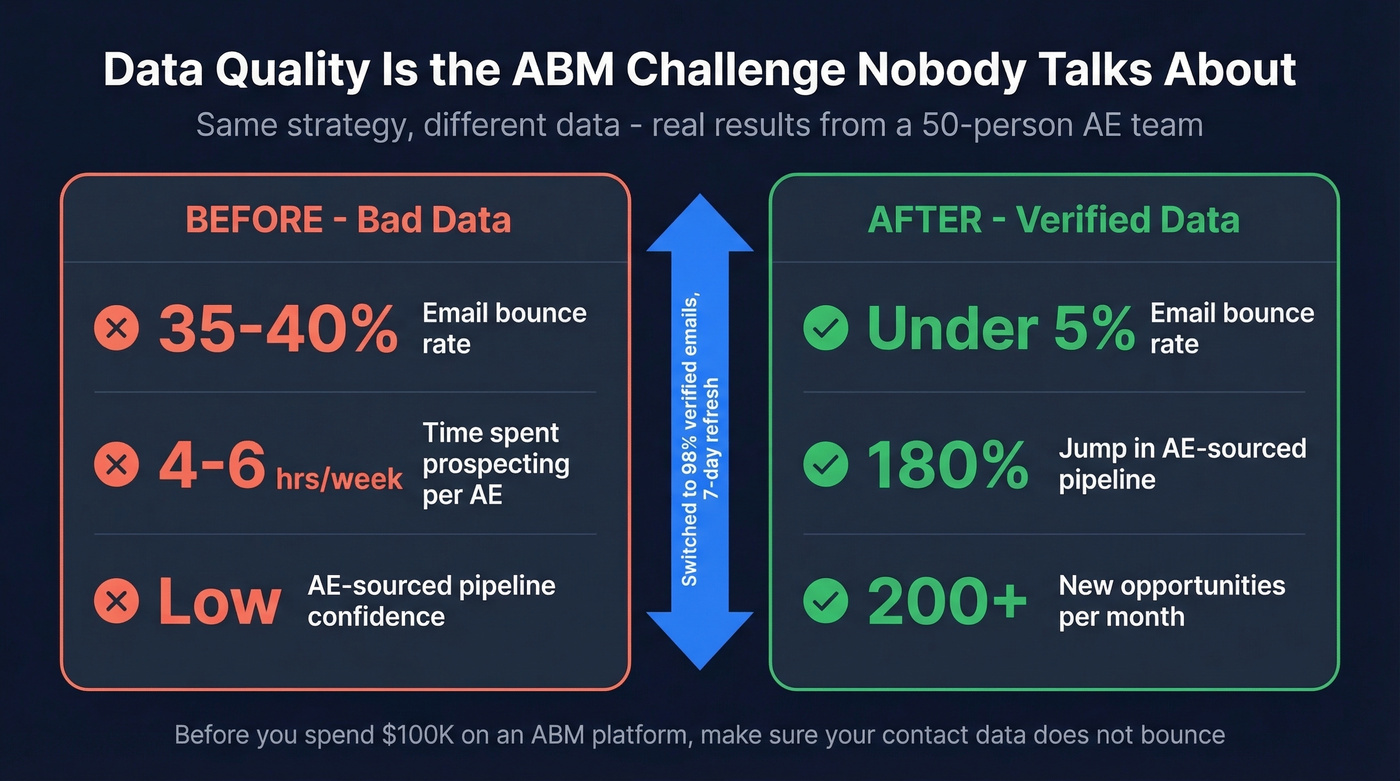
Look - we've watched this play out firsthand. Snyk's 50-person AE team was prospecting 4-6 hours per week with bounce rates hitting 35-40%. After switching to Prospeo's verified database with 98% email accuracy on a 7-day refresh cycle, bounces dropped under 5%, AE-sourced pipeline jumped 180%, and they generated 200+ new opportunities per month. The strategy didn't change. The data did. If bounces are spiking, start with email bounce rate and an email deliverability guide.

Before you spend $100K on an ABM platform, make sure your contact data doesn't bounce. That's the foundation every ABM play sits on, and it costs a fraction of what most teams spend on the platform layer above it.
You don't need a $200K ABM platform to run account-based plays. Prospeo delivers verified emails at $0.01 each, 125M+ direct dials, and intent data across 15,000 topics - refreshed every 7 days, not every 6 weeks.
Cut the stack bloat and get data your sales team actually trusts.
FAQ
What's the biggest challenge in account-based marketing?
Data quality. Stale contacts with 35-40% bounce rates silently kill execution before your plays reach the buying committee. Fix your data foundation first - no amount of strategy overcomes contacts that bounce.
Do you need an ABM platform like 6sense or Demandbase?
Not to start. A CRM, verified contact data, and one intent signal layer get you 80% of the results at a fraction of the cost. The biggest adoption hurdle is teams buying enterprise tooling before proving the model works with a lean stack.
How do you measure ABM success without MQLs?
Track at the account level: percentage of target accounts moving through stages, pipeline velocity, and buying-group penetration depth. Contact-level attribution creates false negatives because purchasing decisions involve multiple stakeholders - one click doesn't represent the whole committee.
What are common reasons ABM programs fail?
Most programs fail due to compounding operational gaps: unverified intent data, misaligned sales and marketing teams, bloated tech stacks, and measurement frameworks built around contacts instead of accounts. Fixing these ABM challenges matters far more than choosing the right platform.