

B2B Lead Generation Marketing: The Guide With Actual Numbers
Cold emails pulling 2% reply rates. LinkedIn requests vanishing into the void. Google Ads burning budget with nothing to show downstream. If that sounds familiar, you're running the same playbook as a lot of teams in r/LeadGeneration right now.
The problem isn't that B2B lead generation marketing doesn't work. It's that most advice skips the numbers that actually matter. Every strategy below comes with real CPL benchmarks, conversion rates, and the specific tech stack we'd build on a $500/month budget.
The Short Version
Pick one inbound channel (content/SEO), one outbound channel (cold email or calls), and one relationship channel (referrals, events, or partnerships). Verify every contact before sending - bad data compounds into domain damage faster than you'd think. Budget $237-$653 per lead depending on your industry, and plan for organic channels to cost 30-50% less than paid over time. We'll show you a complete starter stack under $500/month that covers 90% of what most teams need.
What Is B2B Lead Generation Marketing?
B2B lead generation marketing is the process of identifying, attracting, and qualifying potential buyers for your product or service. Everything else - the tools, the sequences, the ABM plays - is plumbing that connects strangers to your pipeline.

The funnel stages matter more than most teams realize. An MQL (marketing qualified lead) has engaged with your content: downloaded a guide, attended a webinar. An SQL (sales qualified lead) has confirmed budget, authority, and need. An SAL (sales accepted lead) is the accountability handoff where sales commits to pursuing the opportunity. Per Outreach's framework, the SAL stage is where most alignment breaks down - marketing says "we sent you leads," sales says "those weren't real leads," and nobody has a shared definition.
Lead scoring accelerates this. Assign points based on firmographic fit (industry, company size, tech stack) and behavioral signals (pages visited, content downloaded, emails opened). When a lead crosses your threshold, it moves from MQL to SQL automatically - no guesswork, no arguments between teams. (If you need a scoring rubric, start with a simple ideal customer profile and iterate.)
Here are rough conversion benchmarks most B2B SaaS teams can expect:
| Stage | Typical Conversion Rate |
|---|---|
| MQL to SQL | ~13% |
| SQL to Opportunity | ~50% |
| Opportunity to Closed-Won | 20-30% |
Those numbers mean you need around 25-40 MQLs to produce one closed deal. If your ratios are significantly worse, the problem is usually lead quality or scoring criteria, not volume.
What It Actually Costs
These CPL benchmarks from FirstPageSage draw from data collected through mid-2025, published as their 2026 report:
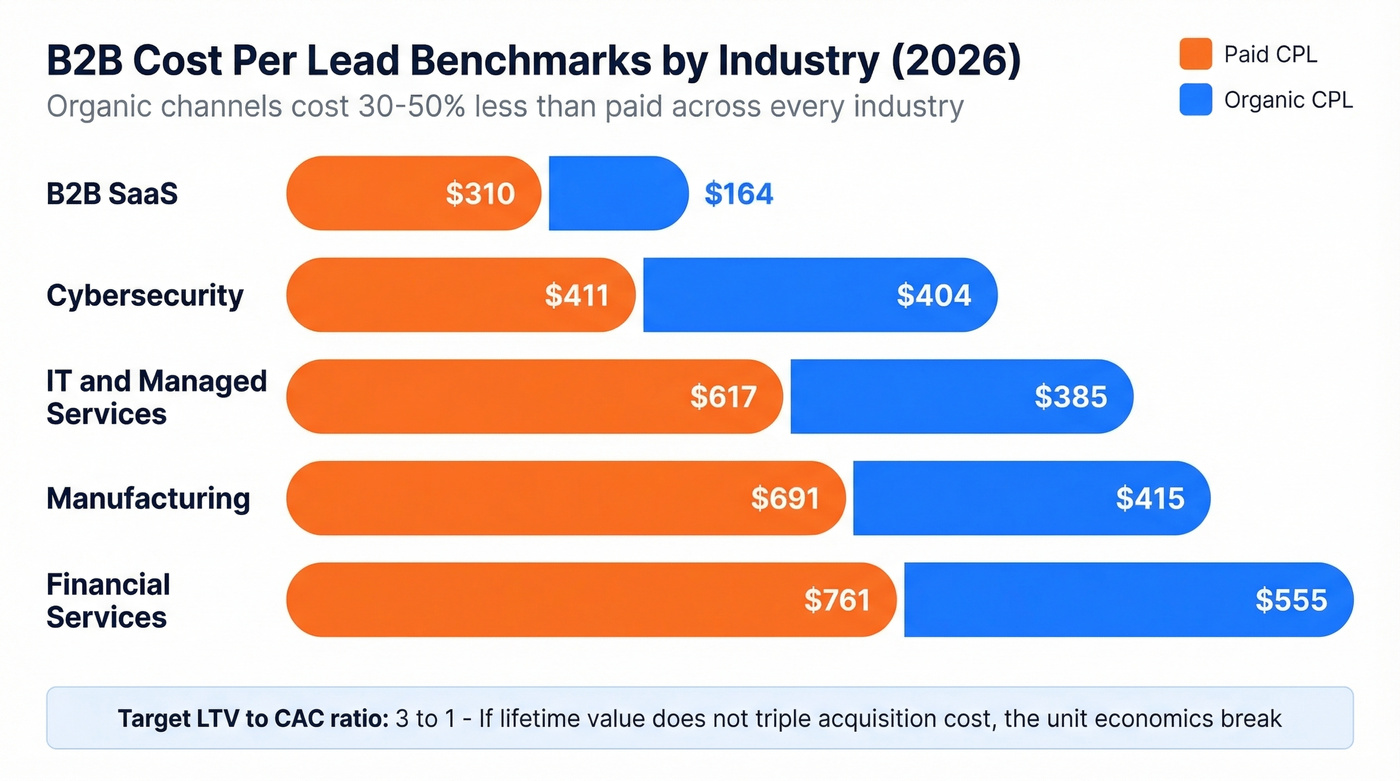
| Industry | Paid CPL | Organic CPL | Blended |
|---|---|---|---|
| B2B SaaS | $310 | $164 | $237 |
| IT & Managed Services | $617 | $385 | $503 |
| Financial Services | $761 | $555 | $653 |
| Manufacturing | $691 | $415 | $553 |
| Cybersecurity | $411 | $404 | $406 |
On the acquisition side, B2B SaaS combined CAC averages $239, with organic CAC at $205 and paid at $341. The benchmark most investors and boards care about: a 3:1 LTV:CAC ratio. If your lifetime value doesn't triple your acquisition cost, the unit economics don't hold. (If you're rebuilding your model, use a clean cost to acquire customer definition across teams.)
Organic channels cost significantly less per lead, but they take 3-6 months to ramp. Paid gets you leads this week at a premium. Most teams need both.
What's Changed in 2026
Trust outranks features. A LinkedIn/Ipsos study of 1,500 senior B2B marketers found 94% agree trust is the key to B2B success. Brand reputation now matters more than feature comparisons in buying decisions, and 92% of buyers rely on social proof before purchasing. (If you're tightening positioning, start with B2B brand positioning.)
Channel diversification is table stakes. Only 6% of teams rely on one or two channels. 94% diversified their channel mix last year, with 45% allocating 10-20% of budget to testing new channels. (More context: lead generation trends.)
Deliverability rules tightened. Gmail and Yahoo now enforce mandatory authentication standards. Sloppy senders get blocked at the server level - not filtered to spam, but rejected entirely. (If you're auditing setup, use an email deliverability guide and confirm DMARC alignment.)
AI referral traffic converts better. 58% of marketers say AI-driven referral traffic carries higher intent, even as traditional search volume declines.
Video is non-negotiable. 78% of B2B marketers already use video; 55% partner with creators and industry SMEs. Combining video with influencer voices makes you 2.2x more likely to be trusted.

Bad data doesn't just waste budget - it compounds into domain damage that tanks every outbound channel you run. Prospeo's 5-step email verification delivers 98% accuracy with a 7-day refresh cycle, so your CPL benchmarks actually hold up downstream.
Stop burning pipeline on bounced emails. Verify before you send.
Strategies That Drive Qualified Leads
Content + SEO
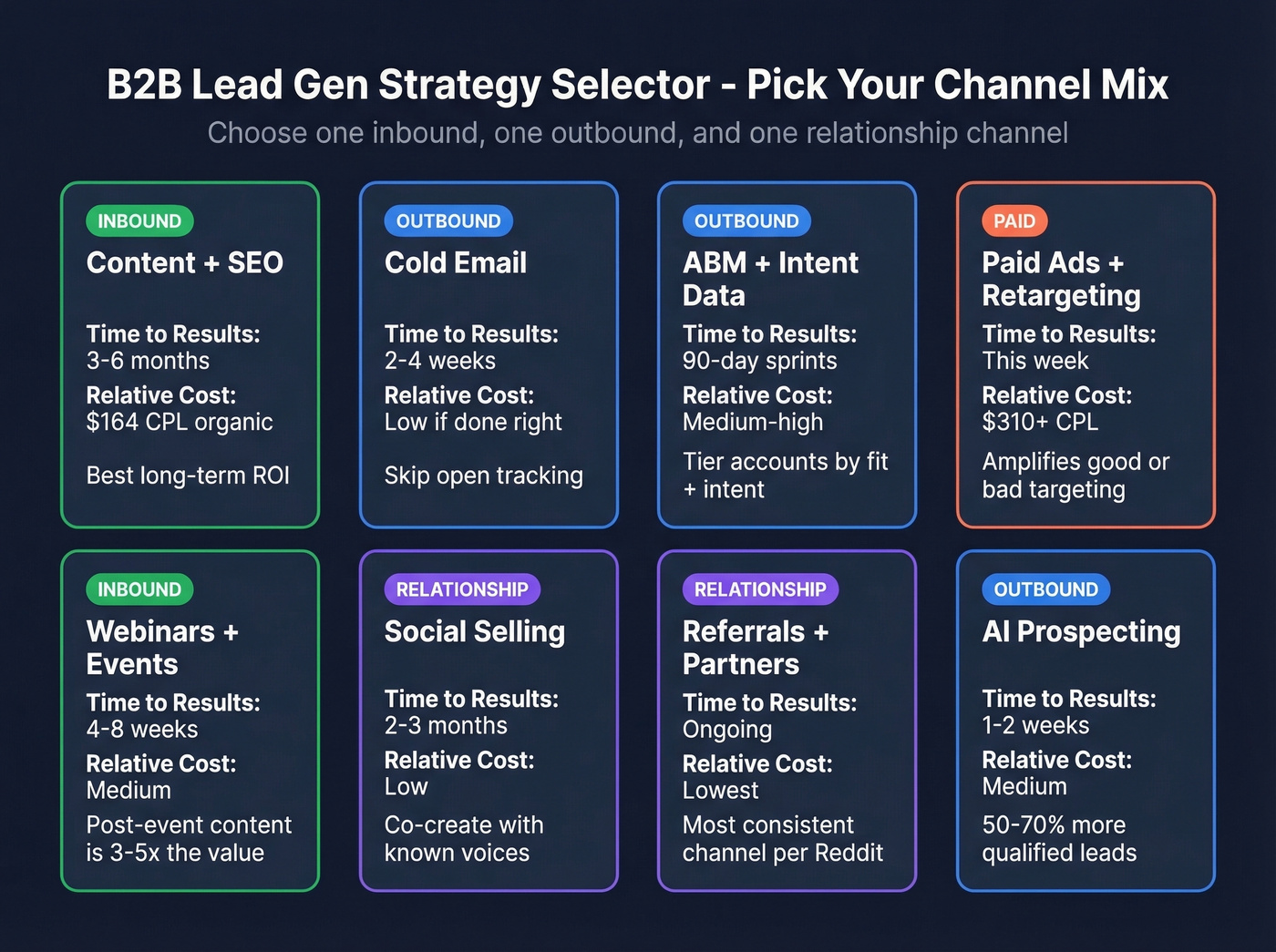
Use this if you can wait 3-6 months for compounding returns and have someone who can write well. Organic B2B SaaS CPL runs $164 vs $310 for paid - nearly half the cost. (If you're building the system, start with what is B2B content marketing.)
Skip this if you need pipeline this quarter and have zero existing content.
Here's the stat that makes this strategy essential: buyers complete up to 80% of their decision-making before talking to sales. Content that answers their questions early wins the deal before your SDR even picks up the phone.
Outbound Email
Lazy cold email is dead. The teams still getting results are doing the boring work: SPF/DKIM/DMARC authentication, proper domain warm-up, and capping at 25-30 emails per day per mailbox. The Reddit consensus on r/sales is pretty consistent - skip open and click tracking, because those tracking pixels tank deliverability. (If you're rebuilding sequences, use a proven B2B cold email sequence and watch email velocity.)
A quick compliance note: if you're targeting EU contacts, GDPR requires a legitimate interest basis for outreach. Use GDPR-compliant data sources and honor opt-outs immediately.
ABM + Intent Data
Account-based marketing works best as a 90-day sprint, not a permanent program. Tier your accounts by fit plus intent: Tier 1 gets fully custom plays, Tier 2 gets semi-personalized sequences, Tier 3 gets automated nurture. Map content to the buying job - the CFO cares about ROI models, the end user cares about implementation timelines. Layering intent signals from providers tracking thousands of topics lets you prioritize accounts actively researching your category, turning broad targeting into precision outreach. (If you want the sales-side playbook, see account-based selling best practices.)
Webinars + Events
The event itself generates leads. The post-event content funnel - recordings, clips, takeaway guides - generates three to five times more. Use ABM invite strategies to get target accounts into the room, then repurpose everything.
Social Selling
78% of B2B marketers use video in their social strategy, and 55% partner with creators or subject-matter experts. The combination yields 2.2x higher trust scores. Solo posting into the void doesn't work - co-creation with recognized voices does. For teams trying to reach business decision-makers, LinkedIn remains the highest-converting social platform in B2B.
Paid Ads + Retargeting
Use this if you need leads this month and have budget. Paid CPL runs 2% to 89% higher than organic depending on industry.
Skip this if you haven't nailed your ICP and messaging yet. Paid amplifies whatever you feed it - including bad targeting. Retargeting is the highest-ROI paid tactic: people who've already visited your site convert at dramatically higher rates than cold audiences.
Referrals + Partnerships
After trying ads, cold calls, Apollo lists, and social, one Reddit poster summed it up: "referrals and in-person networking" were the only things consistently working. That matches everything we've seen. Build a formal referral program. Don't leave it to chance.
AI-Powered Prospecting
AI-powered lead gen tools produce 50-70% more qualified leads and 20-30% shorter sales cycles. The AI SDR category is real - tools that autonomously research accounts, write personalized sequences, and route leads based on predictive scoring. If you're evaluating this space, start with tools that layer AI on top of verified data rather than generating net-new contacts from scratch. (A deeper dive: generative AI lead generation.)
Instant Lead Routing
Speed-to-lead is one of the most underrated conversion levers. Contacting a lead within the first minute dramatically boosts conversion rates - some studies put the lift at nearly 400%. Tools like Chili Piper and Calendly automate instant booking so leads don't sit in a queue while your reps finish lunch.
Data Verification as a Strategy
Here's a number that should bother you: 79% of marketing leads never convert into sales. Bad data is the silent killer. When you send to unverified lists, bounces spike, ISPs flag your domain, deliverability drops, reply rates crater, and the whole system enters a death spiral. (If you're diagnosing issues, start with email bounce rate benchmarks and fixes.)
Let's be honest - we've watched teams burn through three domains in six months because they skipped verification. Meritt went from a 35% bounce rate to under 4% after switching to verified data with Prospeo, and their pipeline tripled from $100K to $300K per week. Nurtured leads produce 47% higher order values, but only if those leads are real people at valid addresses. Data quality isn't a feature. It's the foundation every other strategy depends on.
Why Your Program Is Failing
If your pipeline feels broken, it's one of these five things.
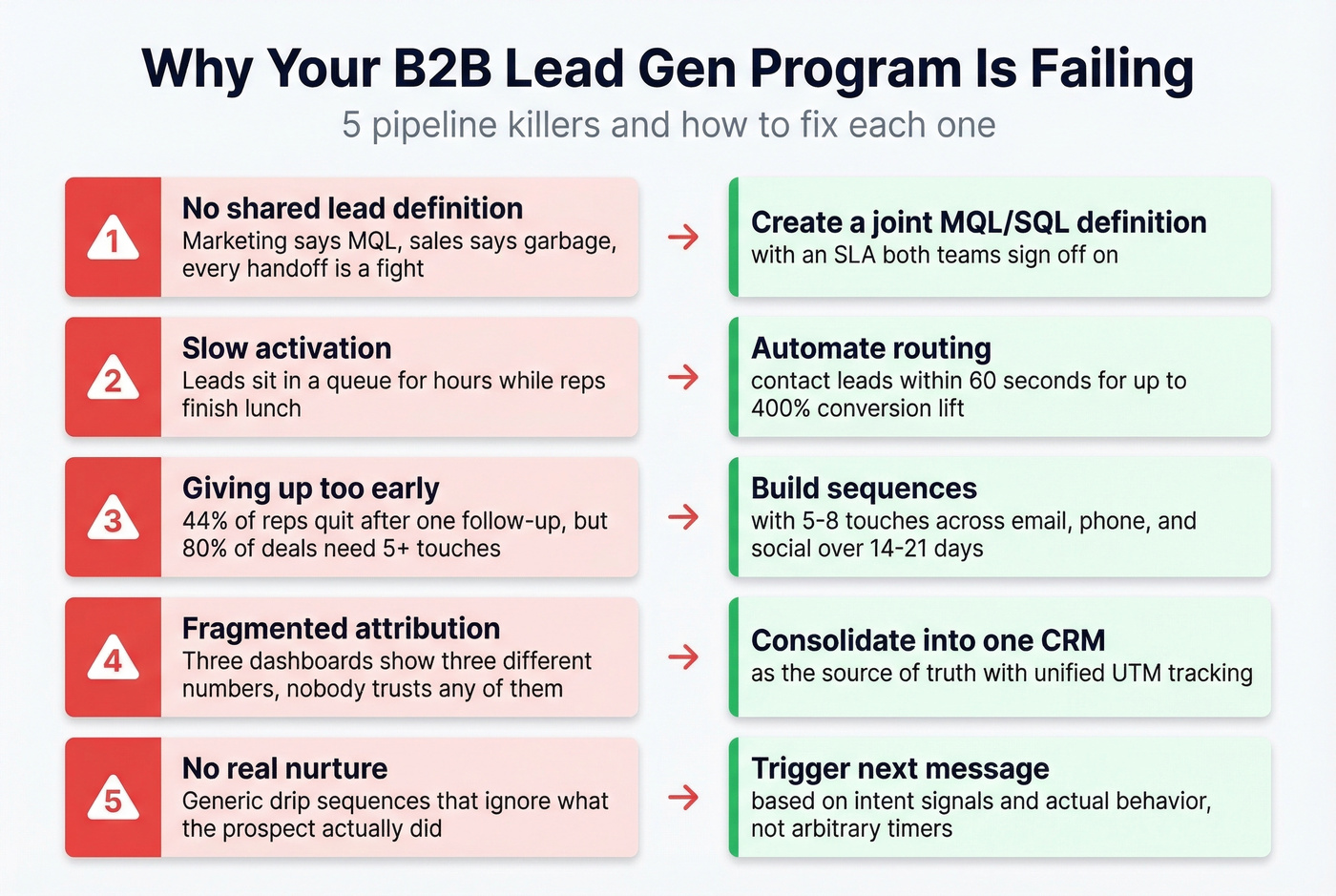
No shared lead definition. Marketing calls it an MQL. Sales says it's garbage. Without a shared definition and SLA, every handoff is a fight. Aligning sales and marketing under one framework is the single highest-leverage fix most teams can make. (Operationally, this is easiest when you standardize lead status in your CRM.)
Slow activation. Speed-to-lead matters more than almost anything else. Manual routing kills conversion. Automate the handoff.
Giving up too early. 44% of reps abandon a lead after one follow-up. 80% of deals require five or more touches. The math is brutal and obvious. (If you need copy you can ship today, use these sales follow-up templates.)
Fragmented attribution. Your CRM, automation platform, and intent tools don't talk to each other. Three dashboards show three different numbers. Nobody trusts any of them.
No real nurture. Generic drip sequences don't count. Intent-based follow-up - where the next message reflects what the prospect actually did - is the only nurture that moves pipeline.

Building Your Tech Stack
There's no shortage of tools. The challenge is assembling a stack that works together without bleeding budget.
| Category | Tool | Starting Price |
|---|---|---|
| Data + Verification | Prospeo | Free; ~$0.01/email |
| Data + Verification | ZoomInfo | From $15K/yr |
| Data + Verification | Apollo.io | Free; from $49/user/mo |
| Enrichment | Clay | From $149/mo |
| CRM | HubSpot | Free; Starter $15/user/mo |
| CRM | Salesforce | $25-$350/user/mo |
| Outreach | Instantly | From $37/mo |
| Outreach | Salesloft | $125+/user/mo |
| Chat | Drift | From $2,500/mo |
| Automation | Zapier | Free; from $19.99/mo |
Here's the thing: most teams don't need a $15K/year data platform. If your average deal size is under $20K, enterprise-grade tools are overkill. A starter stack under $500/month covers 90% of what you actually need - Prospeo for data and verification, Instantly for outbound sequences, and HubSpot's free CRM. Native integrations between all three, plus Salesforce, Smartlead, Lemlist, Clay, and Zapier, mean you're not duct-taping systems together. (If you're comparing providers, start with best B2B company data providers and data enrichment services.)
Running ABM sprints with intent data? Prospeo tracks 15,000 intent topics via Bombora and layers them with 30+ filters - technographics, funding, headcount growth - so your Tier 1 accounts are actually in-market. Teams book 26% more meetings than with ZoomInfo, at 90% lower cost.
Build your $500/mo lead gen stack with data that converts.
Build vs. Buy vs. Outsource
| Factor | Build In-House | Buy Tools (Self-Serve) | Outsource |
|---|---|---|---|
| Time to launch | 3-6 months | 1-4 weeks | 2-4 weeks |
| Cost structure | Higher fixed (salaries) | Variable (subscriptions) | 30-40% less than in-house |
| Control | Full | Full | Partial |
| Ramp speed | Slow | Medium | 3x faster |
| Best for | Teams with budget + time | SMBs and startups | Speed-first orgs |
82% of B2B companies now outsource at least part of their lead generation, and outsourcing launches campaigns 3x faster. We've seen the best results from a hybrid model: outsource list-building and appointment-setting, keep strategy and qualification in-house.
FAQ
What's a good cost per lead in B2B?
B2B SaaS averages $237 blended, while financial services runs $653. Organic channels consistently cost 30-50% less than paid. Benchmark against your specific vertical using the FirstPageSage data above, not generic "good CPL" numbers.
How many channels should I use?
At least three. 94% of B2B marketers diversified their channel mix last year. The minimum viable combination is one inbound channel (content/SEO), one outbound channel (cold email), and one relationship channel (referrals or partnerships). Single-channel teams face dangerous platform risk.
Is cold email still effective in 2026?
Yes - but only with verified data, proper deliverability setup (SPF/DKIM/DMARC), and personalized messaging. Blasting unverified lists to generic personas is dead. Teams winning with cold email treat deliverability as a KPI, not an afterthought.
What's the difference between MQL, SQL, and SAL?
MQL means marketing qualified - the lead engaged with content. SQL means sales qualified - budget, authority, and need are confirmed. SAL means sales accepted - sales commits to pursuing the lead. The SAL stage is where most marketing-sales alignment breaks down, so define it explicitly in your SLA.
How do I verify B2B contact data before outreach?
Use a dedicated verification tool that checks for invalid addresses, spam traps, and catch-all domains before every send. Never trust a single data source unverified - even premium databases ship stale contacts. Clean data is what separates productive outreach from wasted effort and domain damage.