

Business Lead Generation: What Actually Works (With Real Numbers)
You send 5,000 cold emails. 1,400 bounce. Another 2,800 land in spam or get ignored. You book three meetings, and your CEO asks why the pipeline is empty. That's not a business lead generation strategy - it's an expensive way to destroy your domain reputation.
The lead generation software market hit $7.4B in 2025 and is growing at 9.1% CAGR, so there's no shortage of tools promising to fix this. The problem isn't access to tools. It's that most teams skip the fundamentals and scale broken processes.
What You Need (Quick Version)
Three things move the needle. Everything else is noise.
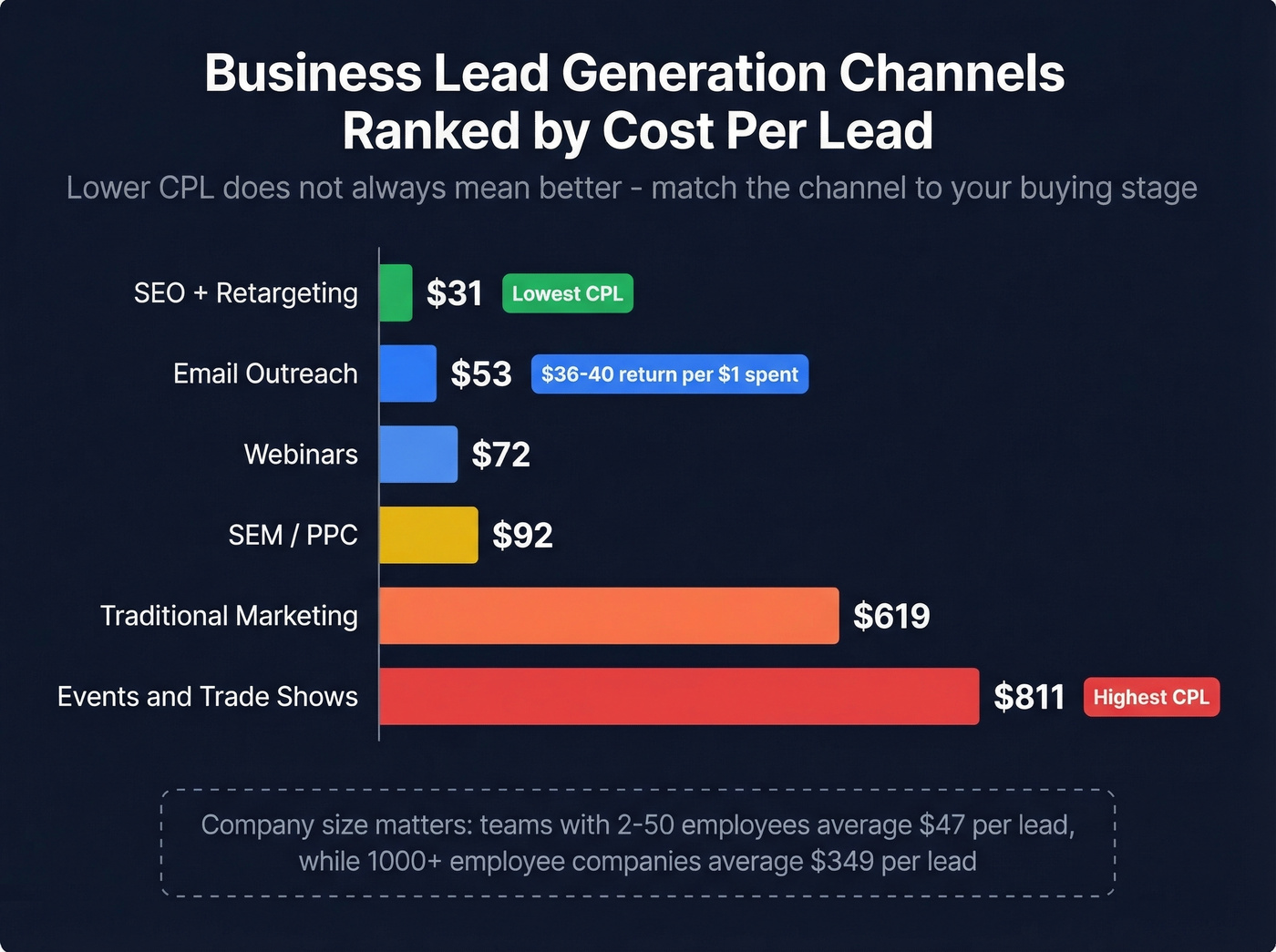
Pick channels using CPL data, not gut feel. SEO drives leads at $31 each. Events cost $811. Most teams don't know their channel economics and overspend on tactics that feel productive but aren't.
Follow a verified-data workflow. Build targeted lists, verify every email before it hits a sequence, and run multichannel touchpoints. Deliverability algorithms punish spray-and-pray - a 30% bounce rate will tank your sender reputation in days.
Fix your data quality before scaling volume. Email lists decay ~28% per year. If you're working off a database that hasn't been refreshed in months, you're burning money and sender reputation simultaneously.
Here's the reframe: only ~5% of your market is actively buying right now. Your system needs to capture the 5% efficiently while building trust with the other 95%. A starter stack that handles both runs under $100/month - a verified data tool, HubSpot Free for CRM, Instantly for sequencing, and Zapier to connect them.
The 95/5 Rule That Changes Everything
The B2B Institute popularized a stat that should reshape how you think about generating leads for your business: only about 5% of your total addressable market is "in market" at any given time. The other 95% aren't ignoring you - they just aren't buying yet.
This matters because most strategies focus exclusively on capturing that 5%. Cold outreach, intent signals, demo requests - all demand capture. It works, but it's a ceiling. You're fighting every competitor for the same small pool.
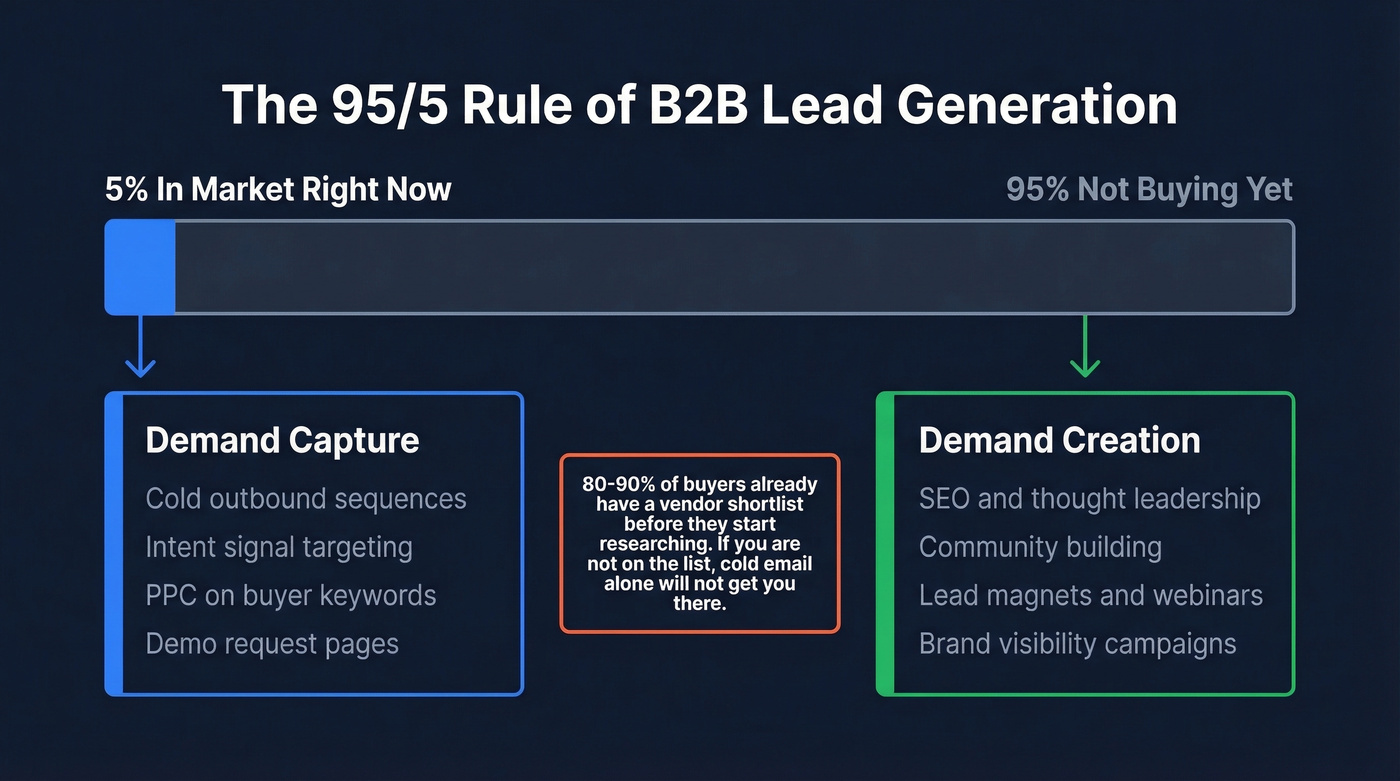
The data gets worse. Bain & Company research shows 80-90% of B2B buyers already have a vendor list in mind before they start researching, and 90% ultimately choose from that day-one list. If you're not on the list before the buying cycle starts, your cold email won't change that.
The practical takeaway: split your efforts into two motions. Demand capture (outbound, paid, intent-based targeting) for the 5% buying now. Demand creation (content, thought leadership, community, lead magnets) for the 95% who'll buy later. Reaching the future-buyer pool requires sustained visibility, not just a single touchpoint.
Channels Ranked by ROI
Here's what the numbers say about channel performance, consolidated from CPL benchmarks, conversion rates, and ROI data across multiple studies.
| Channel | Avg CPL | ROI Signal | Best For |
|---|---|---|---|
| SEO + Retargeting | ~$31 | Lowest CPL | Long-term compounding |
| ~$53 | $36-$40 per $1 | Direct outbound | |
| Webinars | ~$72 | High-intent leads | Mid-funnel nurture |
| SEM / PPC | ~$92 | Immediate, trackable | Buyer-intent keywords |
| Traditional Marketing | ~$619 | High CPL | Brand awareness |
| Events / Trade Shows | ~$811 | Relationship-driven | Enterprise, ABM |
Email remains one of the highest-ROI channels in B2B - $36-$40 return per dollar spent, and up to $44:1 for large businesses. 48% of marketers rank it as their #1 channel. But email-only campaigns delivered 29% fewer leads year-over-year. Email works, but only as part of a multichannel sequence. (If you're building outbound from scratch, start with a tight B2B cold email sequence and iterate weekly.)
LinkedIn converts visitors to leads at 2.74% - roughly 3.5x higher than Facebook and nearly 4x Twitter. Its CPL runs 28% lower than Google AdWords, and LinkedIn Lead Gen Forms hit ~13% conversion rates versus the ~2.35% landing page benchmark. For B2B, it's the only social platform that consistently delivers.
One note for 2026: SEO now includes GEO (Generative Engine Optimization) - your content needs to surface in AI-generated answers, not just traditional search results. (More on building compounding inbound in SEO sales leads.)
Company size dramatically affects CPL. Teams with 2-50 employees average $47 per lead. Companies with 1,000+ employees? $349. Enterprise lead gen is a fundamentally different economic game (and usually needs account-based selling discipline).
How to Find Leads Online
B2B customers now use ~10 channels before making a purchase decision, up from 5 in 2016. Buying committees average 8-13 decision-makers. Your workflow needs to account for this complexity.
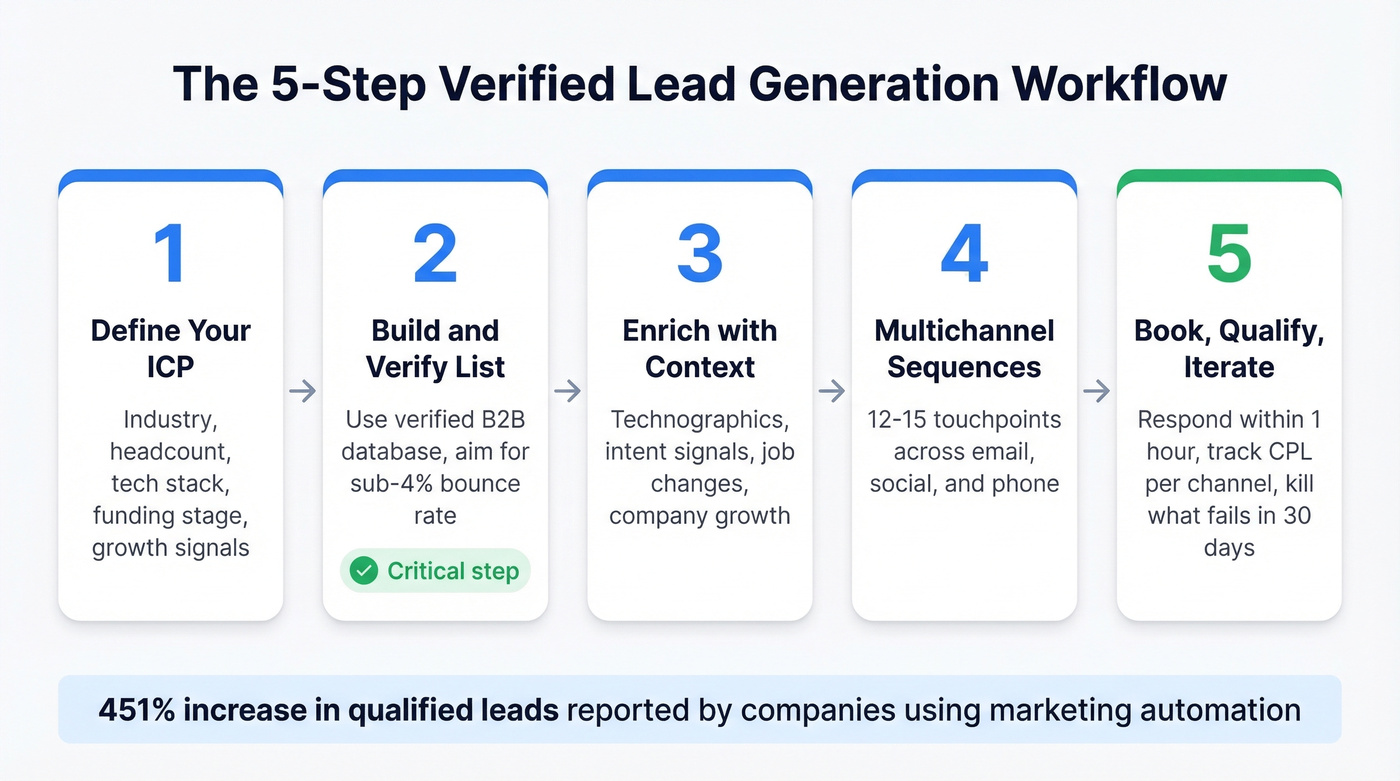
Step 1: Define your ICP with tight specificity. Go beyond "VP of Sales at mid-market SaaS." Specify industry, headcount range, tech stack, funding stage, and growth signals. The tighter your ICP, the higher your conversion rates at every subsequent step. (If you need a rubric, use an ideal customer profile template.)
Step 2: Build and verify your prospect list. This is where most teams cut corners and pay for it later. Use a verified B2B database with tight search filters - industry, headcount, job title, intent signals - and only pay for verified results. Verification is what separates a 35% bounce rate from a sub-4% one. We've tested dozens of data providers, and the difference between verified and unverified lists isn't marginal; it's the difference between a functioning outbound program and a dead one. (If you're comparing vendors, start with data enrichment services and best sales prospecting databases.)

Step 3: Enrich contacts with context. Append technographic data, intent signals, job changes, and company growth indicators. This context powers personalization - without it, you're sending generic messages to a list of names. (See a practical breakdown of firmographic and technographic data.)
Step 4: Launch multichannel sequences. Plan for 12-15 touchpoints across email, social, and phone. AI agents can handle initial research and first-draft personalization, but a human should review before anything goes out. Layer in programmatic ads to email openers and retarget non-openers via display. (If you're struggling with volume vs safety, calibrate email velocity before scaling.)
Step 5: Book, qualify, and iterate. When a prospect engages, speed matters enormously - responding within one hour makes you ~7x more likely to qualify them. Route qualified responses directly into your CRM, track CPL and meeting rate per channel, and kill what doesn't work within 30 days. (To tighten ops, map your lead generation workflow end-to-end.)
The automation investment pays for itself. Companies using marketing automation see a 451% increase in qualified leads and 77% report higher conversion rates. Even basic workflow automation - lead routing, follow-up triggers, scoring thresholds - compounds over time.

The article says a 30% bounce rate tanks your sender reputation in days. Prospeo's 5-step verification delivers 98% email accuracy - teams like Snyk dropped bounce rates from 35% to under 5% and grew AE-sourced pipeline 180%.
Stop burning domains. Start with verified data at $0.01 per email.
Lead Qualification: BANT and Scoring
Generating leads is half the battle. Qualifying them keeps your sales team from wasting cycles on prospects who'll never close.
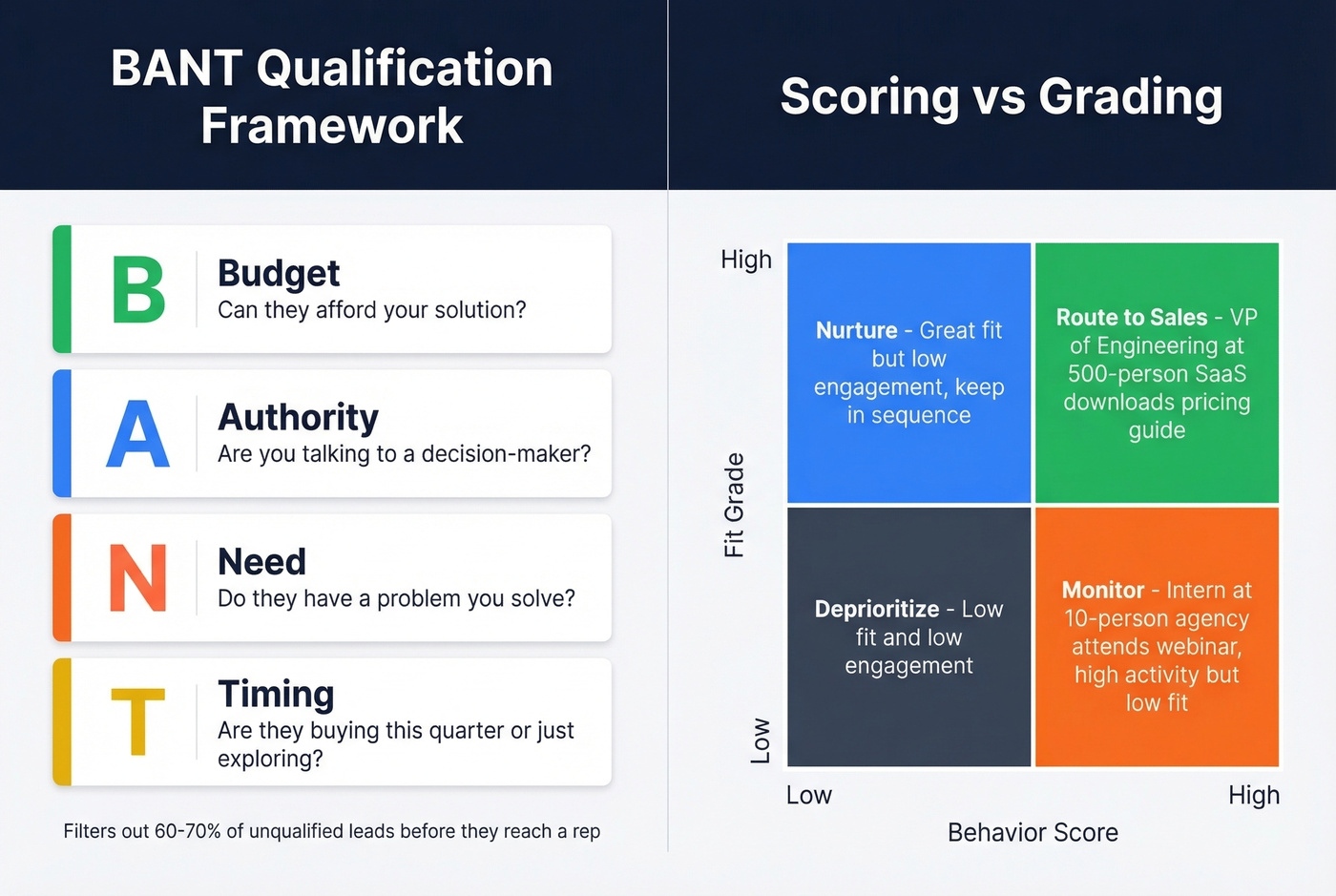
The BANT framework remains the simplest starting point. Budget: can they afford it? Authority: are you talking to a decision-maker? Need: do they have a problem you solve? Timing: are they buying this quarter or "exploring for next year"? Four questions that filter out 60-70% of unqualified leads before they hit a rep's calendar.
Layer BANT with lead scoring for automation at scale. Assign point values based on engagement signals - webinar attendance (+10), pricing page visit (+15), demo request (+25). Set a threshold (say, 80 points) and automatically route leads above it to sales. Everything below stays in nurture. (If you want a full model, implement a dedicated lead scoring system.)
Here's a distinction most teams miss: scoring measures behavior (what they did), while grading measures fit (who they are). A VP of Engineering at a 500-person SaaS company who downloaded your pricing guide scores high on both. An intern at a 10-person agency who attended a webinar scores high on behavior but low on fit. Your system needs both dimensions to work.
Your Lead Gen Tool Stack
You don't need 15 tools. You need five categories covered, and you need them to talk to each other.
| Tool | Category | Starting Price | Best For |
|---|---|---|---|
| HubSpot | CRM | Free; Starter $15/mo | Pipeline management |
| Salesforce | CRM (Enterprise) | $25/user/mo | Complex sales orgs |
| Apollo | Prospecting | Free; ~$49/mo paid | SMB prospecting |
| Instantly | Email Sequencing | ~$30/mo | Cold email at scale |
| Lemlist | Multichannel Seq. | ~$59/mo | Personalized outreach |
| ZoomInfo | Enterprise Data | ~$15-40K/yr | Large sales teams |
| Clay | Enrichment/Workflow | ~$150-500/mo | Custom data workflows |
| Zapier | Automation | Free; $19.99/mo paid | Connecting everything |
For teams under 10 reps, the starter stack is Prospeo + HubSpot Free + Instantly + Zapier. Total cost: under $100/month. That gets you verified prospect data, a CRM, automated sequences, and workflow automation - everything you need to build pipeline from scratch. (If you're shopping on a budget, start with free lead generation tools.)
Let's be honest about ZoomInfo: it's still the enterprise default, and for 50+ rep orgs running complex ABM plays, nothing else matches its breadth. But most teams don't need all-in-one. We've seen companies pay $25K/year for ZoomInfo and only use the search bar. If your average deal size is under $15K, you almost certainly don't need that level of spend - a focused stack of specialized tools will outperform it at a fraction of the cost.
Skip Salesforce if you're under 20 reps. HubSpot's free tier covers contact management and deal tracking, and you won't drown in configuration overhead. (If you're evaluating options, compare examples of a CRM before committing.)
Benchmarks That Set Realistic Expectations
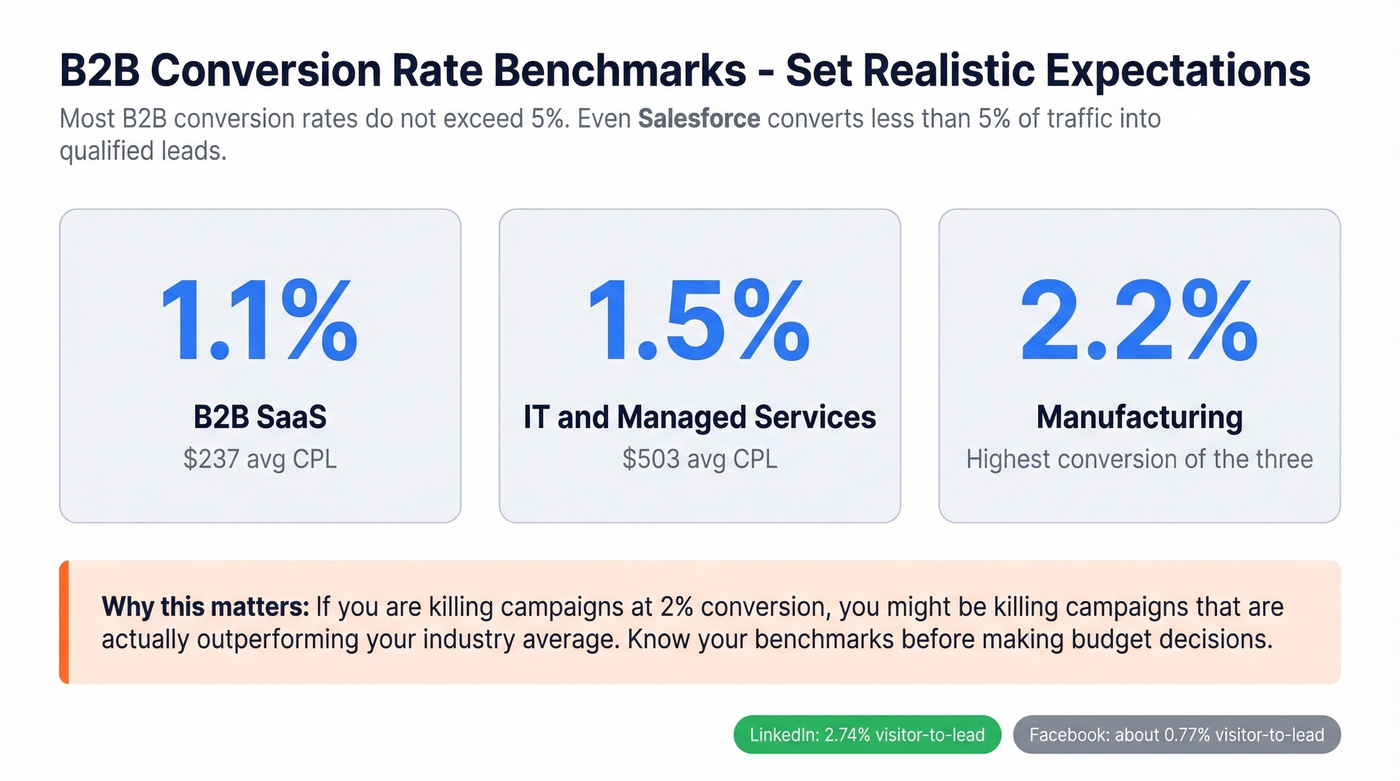
Here's what most content won't tell you: most B2B conversion rates don't exceed 5%. Even Salesforce converts less than 5% of its traffic into qualified leads. Setting realistic expectations prevents you from killing campaigns that are actually performing well.
| Industry | Avg Conversion Rate | Avg CPL |
|---|---|---|
| B2B SaaS | 1.1% | $237 |
| IT & Managed Services | 1.5% | $503 |
| Manufacturing | 2.2% | $553 |
| Industrial IoT | 2.6% | ~$400-600 |
| Financial Services | ~1-2% | $653 |
| Legal Services | 7.4% | ~$200-400 |
The speed-to-lead data is the most actionable benchmark here. Responding to an inbound lead within one hour makes you ~7x more likely to qualify them versus waiting two hours. Wait 24 hours and qualification likelihood drops by 98%+. This single metric justifies investing in routing automation before almost anything else.
Cold email benchmarks worth calibrating against: 15-25% open rates, 1-5% reply rates, 0.2-2% conversion to meeting. One B2B marketer on r/sales reported cold emails hitting ~2% reply rates with connection requests going ignored - a common pattern when list quality and personalization are both weak. If you're below these ranges, the problem is usually data quality or messaging, not the channel itself. (To fix the basics, start with cold email marketing benchmarks and a deliverability-first setup.)
Data Quality: The Multiplier
Here's the thing: you don't have a lead gen problem. You have a data quality problem. Teams that struggle to grow pipeline almost always trace the issue back to stale or unverified contact data.
Email lists decay at ~28% per year. A third of your database goes stale every twelve months - people change jobs, companies get acquired, domains expire. Running sequences off a list you built six months ago without refreshing it means you're sending a significant chunk of your emails into the void.
The damage compounds fast. High bounce rates trigger spam filters. Spam filters tank your domain reputation. Tanked domain reputation means even your good emails stop landing in inboxes. One bad list can poison your outbound for months. (If you're troubleshooting, start with email bounce rate and then tighten your email deliverability controls.)
We saw this play out firsthand with an outbound team that came in with a 35% bounce rate. After switching to Prospeo's verified data with 7-day refresh cycles and 5-step verification - including catch-all handling and spam-trap removal - their bounce rate dropped under 4% and pipeline tripled from $100K to $300K per week. The outreach strategy didn't change. The data did. Any email verification tool is better than none, but the refresh cycle matters - weekly beats monthly beats "whenever we remember."
Five Mistakes Killing Your Pipeline
1. Buying lead lists instead of building verified ones. Purchased lists have no engagement signal, questionable accuracy, and often violate GDPR or CAN-SPAM. Build targeted lists using ICP filters and verify every email before sending. This shortcut backfires more often than it works.
2. Ignoring lead qualification. Treating every inbound inquiry the same wastes sales capacity. Implement BANT screening plus automated lead scoring so reps only work leads above your qualification threshold.
3. Running single-channel outreach. Email alone delivered 29% fewer leads year-over-year. Build multichannel sequences combining email, social touches, and phone across 12-15 touchpoints.
4. No follow-up system. Most deals require multiple touches. Automate your follow-up cadence so no lead falls through the cracks after the first email goes unanswered. This is table stakes, and it's shocking how many teams still rely on reps remembering to follow up manually.
5. Neglecting data hygiene. Verify and refresh your contact data weekly, not quarterly. A 28% annual decay rate means your list loses accuracy every single day. The cost of verification is a fraction of the cost of a burned domain.
You need 12-15 multichannel touchpoints with enriched context to convert. Prospeo gives you 30+ search filters, intent data across 15,000 topics, and 50+ data points per contact - refreshed every 7 days, not every 6 weeks.
Get the ICP filters and intent signals that actually fill pipeline.
FAQ
What is lead generation in business?
It's the process of identifying and attracting potential customers, then nurturing them toward a purchase decision. It splits into inbound (content, SEO, webinars) and outbound (cold email, calls, social outreach), both feeding your sales pipeline with qualified prospects.
How much does business lead generation cost?
CPL ranges from $31 for SEO-driven leads to $811 for events. B2B SaaS averages $237 per lead; financial services runs $653. Small teams (2-50 employees) average $47 per lead versus $349 for enterprises with 1,000+ employees.
Where can I find leads for my business?
LinkedIn (2.74% visitor-to-lead conversion), verified B2B databases, SEO-driven inbound content, and industry webinars are the most reliable sources. Combine a prospecting tool with multichannel outreach - email alone delivers 29% fewer leads year-over-year.
What's the best channel for B2B leads?
Email delivers $36-$40 per dollar spent, and SEO produces the lowest CPL at ~$31. LinkedIn converts at 2.74% - 3.5x higher than Facebook. The strongest approach combines all three in a multichannel workflow with 12-15 touchpoints per prospect.
How do you qualify a business lead?
Use BANT: Budget (can they pay?), Authority (decision-maker?), Need (problem you solve?), Timing (buying soon?). Layer in automated lead scoring - assign points for engagement signals like pricing page visits and demo requests, then route high-scoring leads directly to sales.