

Customer Outreach: The 2026 Playbook With Real Benchmarks
A RevOps lead shared this math with us from his SDR team's last quarter: 500 emails a day, five days a week, three months straight. Total replies that turned into meetings - three. Not three percent. Three. The copy wasn't terrible. The targeting was decent. The problem was simpler and uglier: 20% of those emails never reached an inbox, and the team quit following up after one attempt.
Your customer outreach isn't failing because of your copy. It's failing because of bad data and broken cadences. Let's fix both.
What Is Customer Outreach?
Customer outreach is any proactive communication you initiate with a prospect or existing customer to start, advance, or reopen a business relationship. That covers cold emails, warm follow-ups, phone calls, social touches, and re-engagement campaigns. It's the engine that fills your pipeline when inbound alone can't keep up - and the lever that keeps existing customers from quietly churning.
Most teams treat outreach as a writing problem. It's a systems problem. Everyone obsesses over subject lines while roughly 20% of cold emails get flagged as spam before a human ever sees them. And 44% of reps quit after a single follow-up, even though 80% of sales require five or more touches. Fix the infrastructure first, then optimize the words.
What You Need Before Sending a Single Email
The average cold email reply rate sits at 3.43%. Most outreach fails silently - bad data, premature quitting, and generic messaging are the three killers.
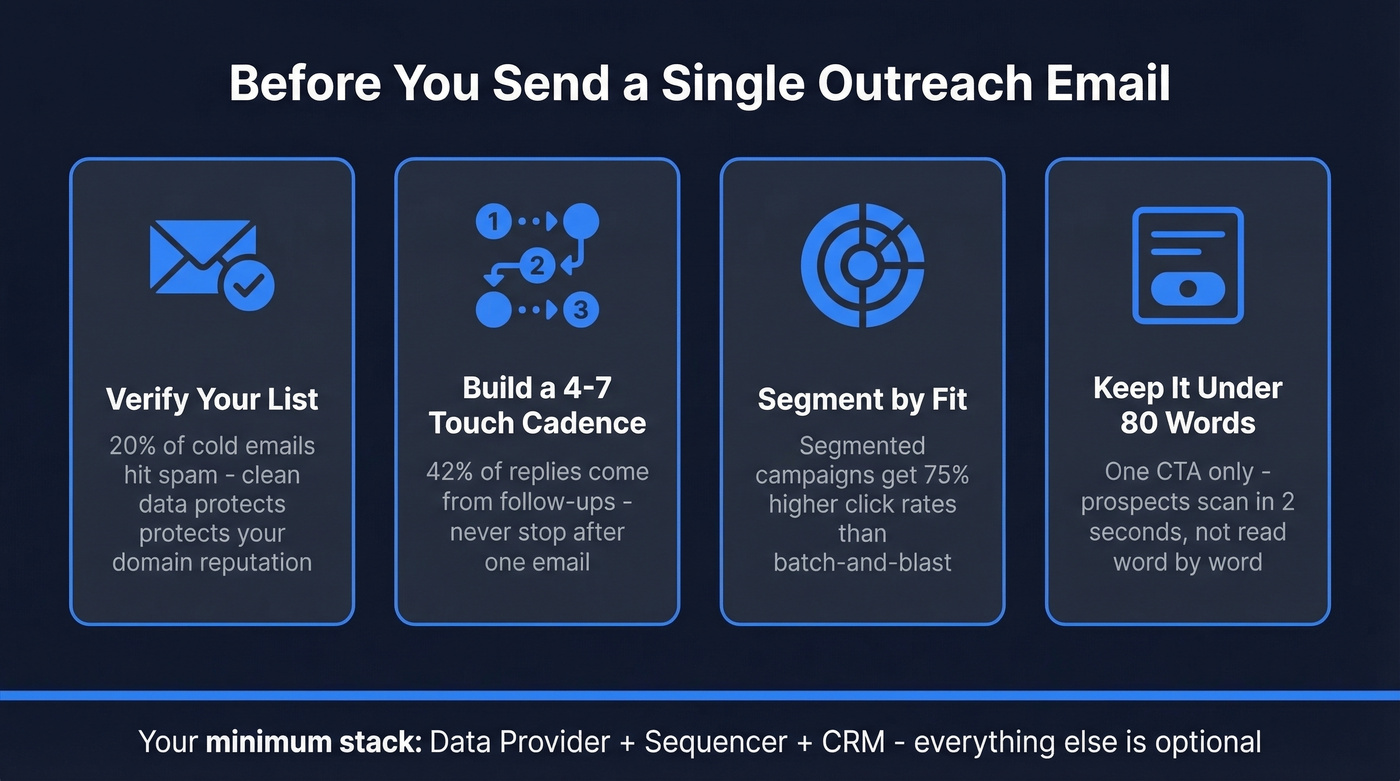
Before you write anything, run through this checklist:
- Verify your list. If 20% of emails bounce or hit spam, your domain reputation degrades and every subsequent send performs worse.
- Build a 4-7 touch cadence spaced 3-4 days apart. Don't stop after one email.
- Segment by fit. Recipients are 75% more likely to click on segmented campaigns - targeted communication consistently outperforms batch-and-blast.
- Keep emails under 80 words with a single CTA.
Your stack needs three tools: a data provider for verified contacts, a sequencer for automated cadences, and a CRM for tracking outcomes. Everything else is optional until those three work together.
2026 Outreach Benchmarks
Numbers ground expectations. Without them, you're guessing whether your 2% reply rate is terrible or average.
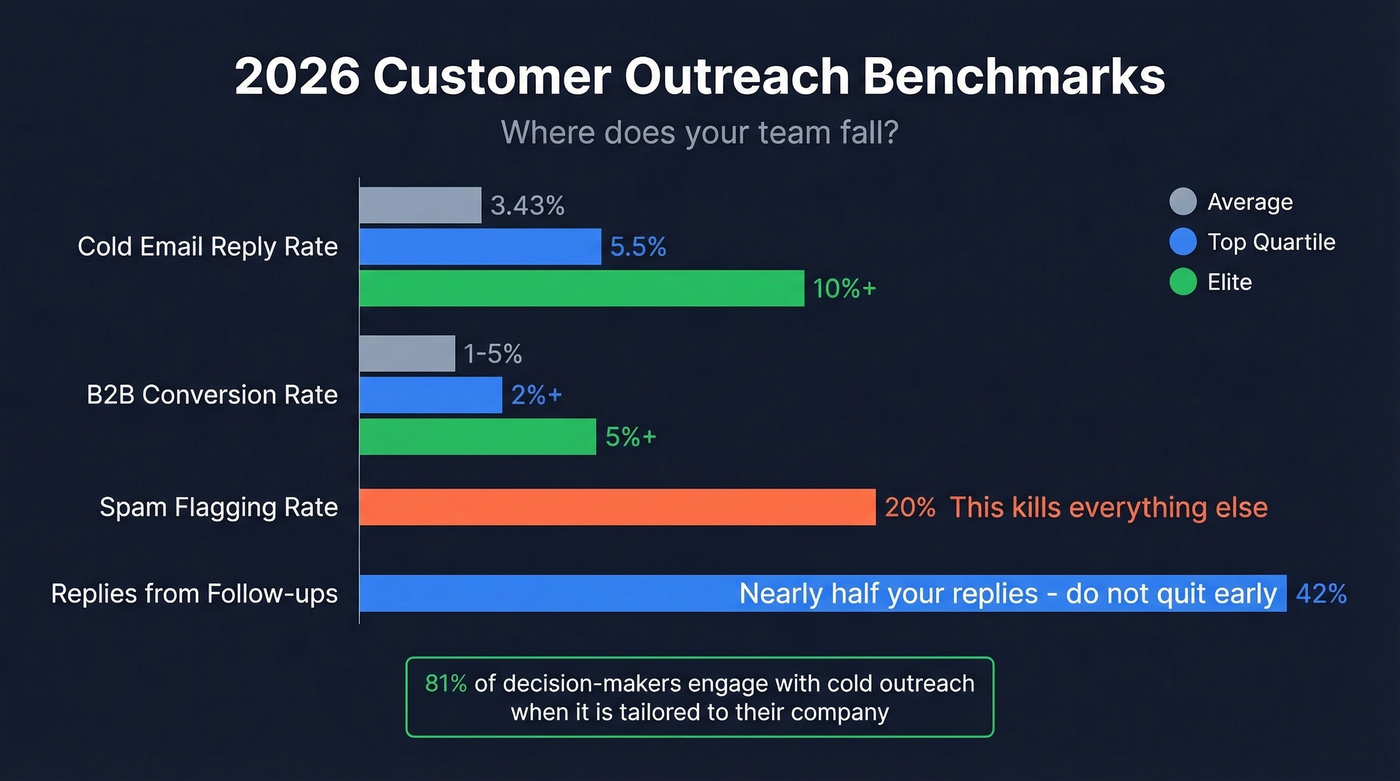
| Metric | Average | Top Quartile | Elite (Top 10%) |
|---|---|---|---|
| Cold email reply rate | 3.43% | 5.5%+ | 10%+ |
| Cold email response rate | 5.1% | ~7%+ | - |
| Conversion rate (B2B) | 1-5% | >2% solid | >5% exceptional |
| Spam flagging rate | ~20% | - | - |
| Replies from Step 1 | 58% | - | - |
| Replies from follow-ups | 42% | - | - |
One stat reframes everything: 81% of decision-makers will engage with cold outreach when it's tailored to their company and context. Buyers don't hate outreach. They hate lazy outreach.
The gap between average and elite mostly comes down to two variables you can actually control: data quality and cadence discipline. Teams sending verified emails through well-spaced multi-touch sequences consistently land in the top quartile. Teams blasting unverified lists with a single email sit at the bottom.

7 Strategies That Actually Work
1. Segment Before You Send
Blasting your entire list with the same message is the fastest way to tank reply rates. Segmented campaigns generate 75% higher click-through rates than non-segmented ones. That's not marginal - it's the difference between a campaign that works and one that doesn't.
Tier your prospects by fit before you write a word. Group by industry, company size, role, or buying stage. And segment by function, not job title - titles vary wildly across companies. "Head of Growth" at one startup is "VP Marketing" at another. Map the org structure to find the right people.
If you need a repeatable way to structure this, start with an Ideal Customer Profile and layer in firmographic filters.
2. Lead With Their Problem
The best-performing cold emails stay under 80 words, use a single CTA, and open with the prospect's problem - not your feature list.
This tracks with how people actually read. NN/g's eyetracking research - 500+ participants, 750+ hours of data - confirms that people scan online content rather than reading word-for-word. Your prospect isn't savoring your email. They're scanning for relevance in two seconds. If the first line is about you, they're gone.
If you're rewriting messaging, use a simple email copywriting checklist and keep your CTA tight with proven Email Call to Action patterns.
3. Build a Multi-Touch Cadence
58% of replies come from the first email. That means 42% come from follow-ups - nearly half your potential replies vanish if you stop after one touch.
The sweet spot is 4-7 touchpoints spaced 3-4 days apart. Under four, you're quitting too early. Beyond seven, diminishing returns kick in unless each touch adds genuine value. Outreach.io's research shows it takes around 9 touches for executives versus roughly 4 for lower-level contacts. Adjust your cadence length based on seniority.
If you want plug-and-play sequences, pull from these cold email follow-up templates and track your follow-up email reply rate by segment.
4. Personalize by Tier
Not every prospect deserves an hour of research. But your top accounts do. Assembly documented a case where they sent 5 ultra-personalized emails - each one took about an hour to craft, including a mini-audit of the prospect's website. Three responded. Two became clients at five-figure monthly contracts.
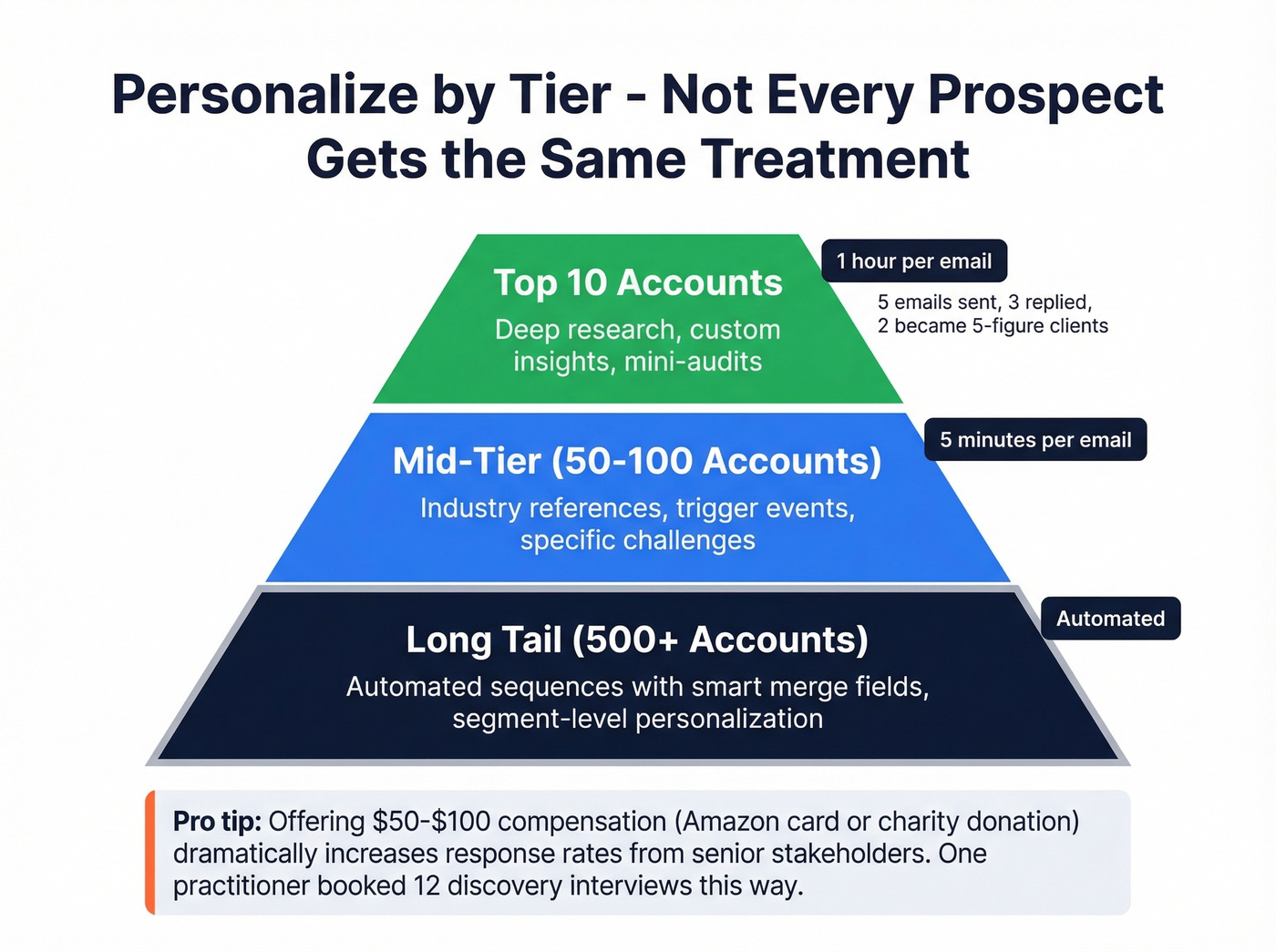
That math works for whale accounts. It doesn't work for a list of 500. So tier it:
- Top 10 accounts: Deep research, custom insights, mini-audits. One hour per email.
- Mid-tier (next 50-100): Reference their industry, a recent trigger event, or a specific challenge. Five minutes per email.
- Long tail: Automated sequences with smart merge fields. Segment-level personalization, not individual.
If you're building this into a system, borrow a few sales prospecting techniques and formalize your personalized outreach tiers.
Here's a move worth stealing for discovery outreach: offering $50-$100 compensation - an Amazon card or charity donation - dramatically increases response rates from senior stakeholders. One practitioner on Reddit booked 12 discovery interviews using this approach. If your deal sizes clear five figures, the ROI on a $100 gift card is absurd.
5. Go Multi-Channel
McKinsey's B2B Pulse Survey found that buyers engage across roughly 10 channels during their journey. Email alone isn't enough.
The channels reinforce each other. A practitioner in r/startups reported that their best phone conversations came from people who'd ignored the first two touches across email and social. The prospect didn't respond to the email or the connection request - but when the phone rang, they already had context. That familiarity converted.
To operationalize this, treat it like sequence management and make sure your tools can connect outreach tool to CRM.
6. Follow Up Relentlessly
44% of salespeople quit after one follow-up. Meanwhile, 80% of sales require five or more touches. Almost half the sales force gives up right when persistence would start paying off.
The Reddit practitioner who booked 12 discovery interviews attributed the results to multi-touch persistence - following up multiple times across email and social, repositioning the message each time. Not "just checking in." Each follow-up added a new angle or piece of value. That's the difference between persistence and pestering.
If your team needs a policy-level nudge, bake in the importance of follow-up in sales and standardize your sales follow-up templates.
Here's our hot take: if your average contract value is under $15K, you probably don't need a 9-touch executive cadence. But you absolutely need at least 4-5 touches for anyone. The single biggest ROI improvement most teams can make isn't better copy - it's simply not quitting after email two.
7. Verify Your Data First
This is the strategy most teams skip, and it's the one that silently destroys everything else. 54% of B2B sales leaders say lack of quality data is their biggest barrier to success.
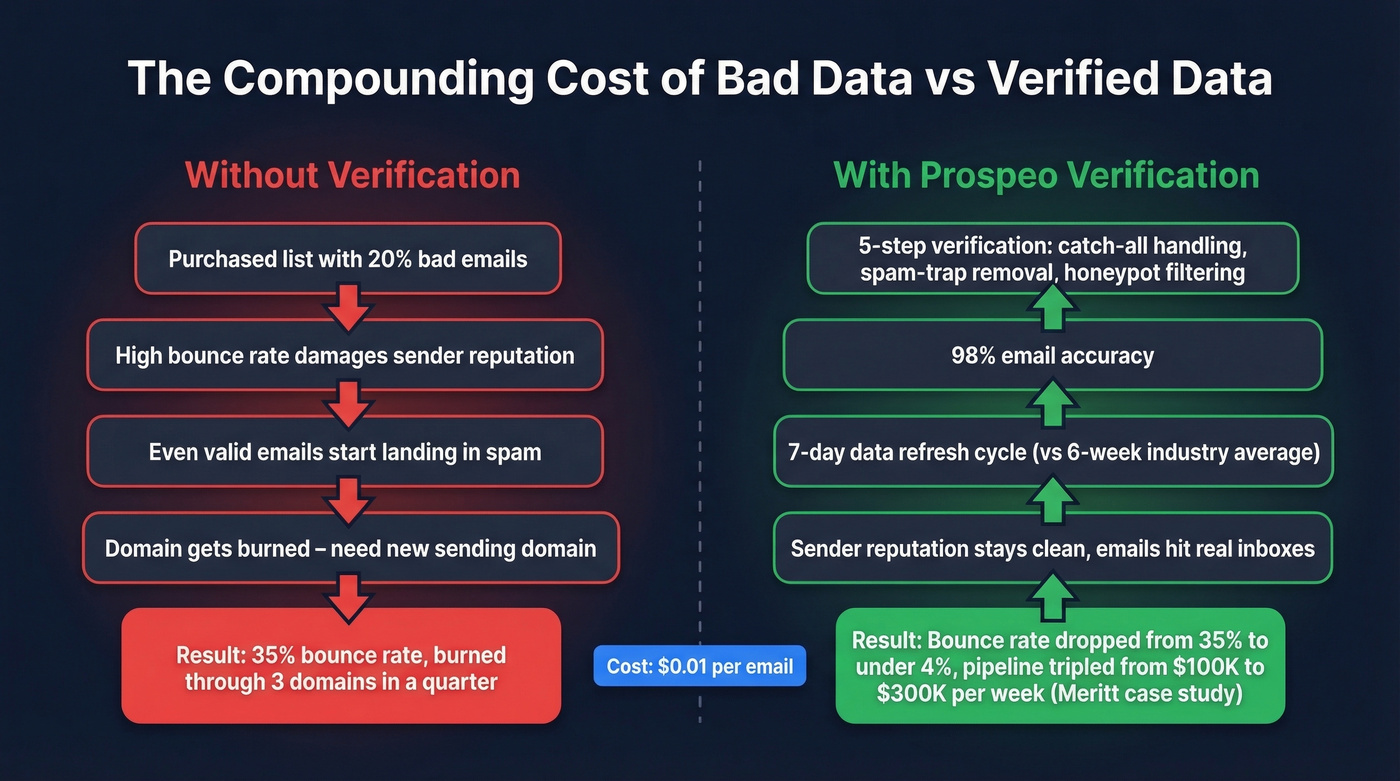
Bad data doesn't just cause bounces. It damages your sender reputation, which means even your valid emails start landing in spam. It's a compounding problem - by the time you notice deliverability dropping, the damage is already done. We've watched teams burn through three sending domains in a quarter because they skipped verification on a purchased list.
Clean your list before every campaign. Prospeo runs a 5-step verification process including catch-all handling, spam-trap removal, and honeypot filtering to deliver 98% email accuracy, with data refreshing on a 7-day cycle compared to the 6-week industry average. Meritt, an outbound agency, saw their bounce rate drop from 35% to under 4% after switching - pipeline tripled from $100K to $300K per week.

You just read that ~20% of cold emails get flagged as spam - mostly because of bad data. Prospeo's 5-step verification delivers 98% email accuracy with a 7-day refresh cycle, so every send hits a real inbox. At $0.01 per email, cleaning up your outreach costs less than the meetings you're losing.
Stop burning your domain reputation on unverified lists.
Day-by-Day Cadence Framework
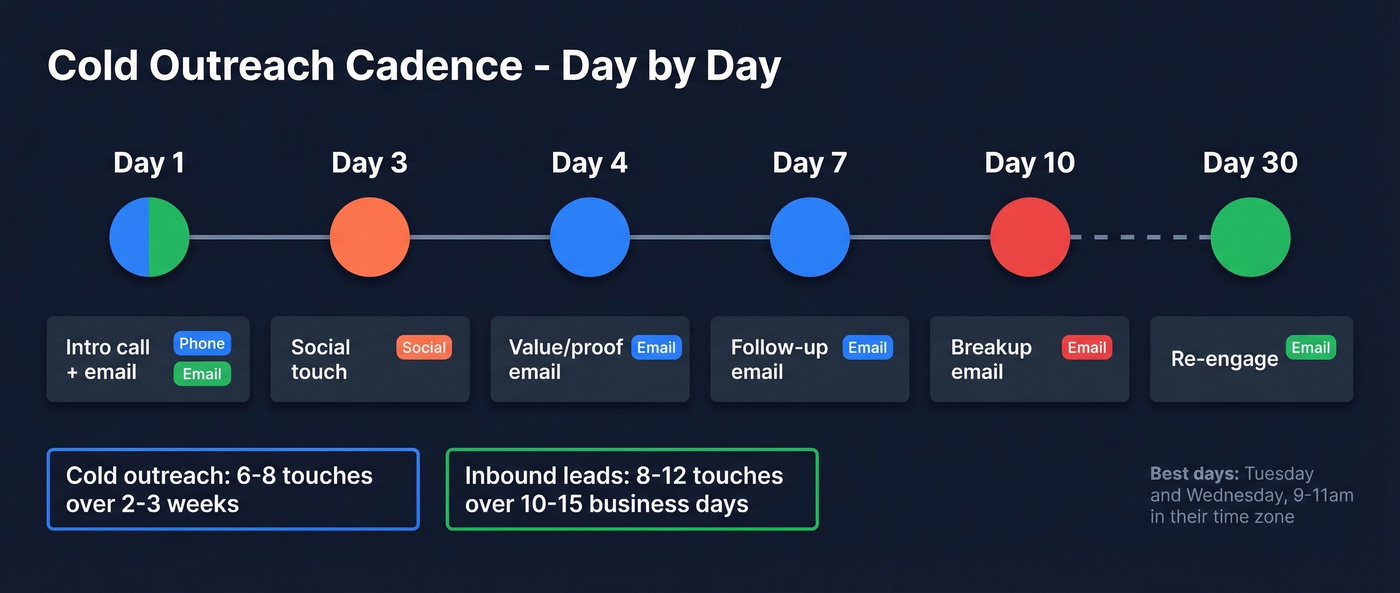
Theory is nice. Here's the actual timeline we recommend for cold outreach:
| Day | Action | Channel |
|---|---|---|
| Day 1 | Intro call + email | Phone + Email |
| Day 3 | Social touch | Social |
| Day 4 | Value/proof email | |
| Day 7 | Follow-up email | |
| Day 10 | Breakup email | |
| Day 30 | Re-engage |
For cold outreach, plan 6-8 touchpoints over 2-3 weeks. For inbound leads, compress to 8-12 touchpoints over 10-15 business days - they've already shown interest, so you can afford tighter spacing.
Timing matters more than most teams realize. Tuesday and Wednesday produce the highest reply rates, with Wednesday at the top. Send emails between 9-11am in the recipient's time zone. For calls, the 4-5pm window catches people winding down and more willing to talk.
If you want the data behind send windows and sequencing, see our breakdown of the best time to send cold emails.
Templates for Outbound Sales Communication
Every template below follows the data: under 80 words, single CTA, problem-first. Subject lines stay under 50 characters - 35% of recipients decide to open based on the subject line alone.
Cold First Touch
Subject: Quick question about [challenge]
Hi [First Name],
[Company] looks like it's scaling fast - congrats. Teams at that stage usually hit a wall with [specific problem]. We helped [similar company] cut [metric] by [result] in [timeframe].
Worth a 15-minute call to see if that's relevant?
[Your name]
Follow-Up (Value Add)
Subject: Thought this might help
Hi [First Name],
Saw [relevant article/data point] that connects to what [Company] is doing with [initiative]. Figured it was worth sharing.
[Link or one-sentence insight]
Still happy to chat if [original problem] is on your radar.
Breakup Email
Subject: Closing the loop
Hi [First Name],
I've reached out a few times and haven't heard back - totally fine. I'll assume the timing isn't right.
If [problem] comes back up, I'm here. No hard feelings either way.
[Your name]
Warm Re-Engagement
Subject: Been a while, [First Name]
Hi [First Name],
We spoke back in [month] about [topic]. Since then, we've [new result or capability] that might change the math.
Would it make sense to reconnect for 10 minutes?
Mistakes That Kill Your Results
We've seen teams optimize copy for weeks while ignoring the infrastructure that actually determines whether emails land. Skip this section if your bounce rate is already under 3% and you're running authenticated domains - you've got the basics covered.
Data mistakes are the silent killers. Sending to unverified lists, relying on job titles instead of mapping functions at target companies, and not cleaning your list before every campaign will tank your deliverability before a prospect ever sees your message.
Sending process mistakes compound the damage. Missing SPF/DKIM/DMARC authentication, skipping domain warm-up, sending from non-personal accounts like info@ or sales@, and blasting too many messages per day from a single domain all erode sender reputation. These are boring operational details, and they matter more than your subject line.
Content and structure mistakes are what most teams fixate on, but they matter less than the above. Generic templates that could apply to anyone, misleading subject lines, inconsistent tone across channels, no follow-up cadence, and missing CTAs - these are fixable in an afternoon once your infrastructure is solid.
On the operations side, ignoring CAN-SPAM and GDPR compliance, missing opt-out links, and not tracking reply rates or bounce rates by segment will catch up with you eventually. The deliverability pre-send checklist - verified lists, proper authentication, warm domains, clean segmentation, opt-out link - should be non-negotiable.
Best Outreach Tools for 2026
You need three things: a data provider, a sequencer, and a CRM. Everything else is a nice-to-have.
| Category | Tool | Pricing |
|---|---|---|
| Data & Contacts | Prospeo | Free tier (75 emails/mo), ~$0.01/email paid |
| Data & Contacts | Hunter.io | Free tier, paid from ~$49/mo |
| Data & Contacts | LeadIQ | Free tier, paid from ~$79/mo |
| Email Sequencing | Instantly | From ~$30/mo |
| Email Sequencing | Smartlead | From ~$39/mo |
| Email Sequencing | Lemlist | From ~$59/mo |
| CRM | HubSpot | Free CRM, Sales Hub from ~$20/mo/user |
| CRM | Salesforce | From ~$25/mo/user |
| Sales Engagement | Outreach.io | ~$100-$150/user/mo (annual contract) |
| Sales Engagement | Salesloft | ~$100-$150/user/mo (annual contract) |
For sequencing, Instantly and Smartlead handle high-volume cold email well at the SMB level. Lemlist adds more personalization features. At the enterprise level, Outreach.io and Salesloft offer deeper analytics and multi-channel orchestration, but expect annual contracts.
If you're evaluating platforms, start with a shortlist of SDR tools and compare options for best contact management software.
Multi-channel cadences only work when you have real contact data across channels. Prospeo gives you 143M+ verified emails and 125M+ verified mobile numbers with a 30% pickup rate - so your calls, emails, and social touches actually reach decision-makers.
Build the multi-touch cadence buyers actually respond to.
FAQ
What's a good reply rate for customer outreach?
The average cold email reply rate is 3.43%. Top-quartile campaigns hit 5.5%+, and elite campaigns exceed 10%. If you're below 2%, audit your list quality and cadence length before rewriting copy.
How many follow-ups should I send?
Plan 4-7 touchpoints spaced 3-4 days apart. 42% of replies come from follow-ups, and 80% of sales require five or more touches. Stopping after one email leaves nearly half your potential responses on the table.
What's the best day to send outreach emails?
Wednesday produces the highest reply rates, followed by Tuesday. Send between 9-11am in the recipient's time zone for email; try the 4-5pm window for cold calls.
How do I keep outreach emails out of spam?
Verify your list before every send, set up SPF/DKIM/DMARC authentication, warm your domain gradually, and include an opt-out link. Reducing bounces is the single fastest way to protect sender reputation.
What's the difference between inbound and outbound cadences?
Inbound cadences move faster - 8-12 touchpoints over 10-15 business days - because the lead already showed interest. Cold outbound runs 6-8 touchpoints over 2-3 weeks with wider spacing to avoid overwhelming prospects who don't know you yet.