

Enterprise Software Marketing Strategy: The Execution Playbook for 2026
A RevOps lead we know ran a 90-day ABM pilot targeting 100 named accounts. Twelve weeks in, the team had two meetings - not because the content was bad, but because every outreach thread died when a single champion went dark. They'd single-threaded every account. That's the enterprise software marketing strategy problem in miniature: complexity kills you before competition does.
The average B2B purchase now involves 13 stakeholders - not decision-makers with signing authority, but everyone who touches the process. Enterprise deals run higher. Buyers spend just 17% of their purchasing time meeting with any vendor, and 86% of purchases stall at some point. Worse, 41% of buyers already have a preferred vendor before formal evaluation begins. If you're not shaping that preference months before the RFP drops, you're playing for second place.
What Makes Enterprise Marketing Different
Enterprise software marketing targets organizations with 1,000+ employees, months-long sales cycles, and 6-10+ decision-makers per deal. You're not generating leads. You're orchestrating a buying group across procurement, IT, finance, and the business unit that actually wants your product. Account-based strategies replace spray-and-pray, and firmographic , technographic , and intent signals replace broad demographic targeting.
Mapping the Buying Committee
Every enterprise deal has the same five archetypes. Your content needs to speak to each one differently - same core story, different framing.
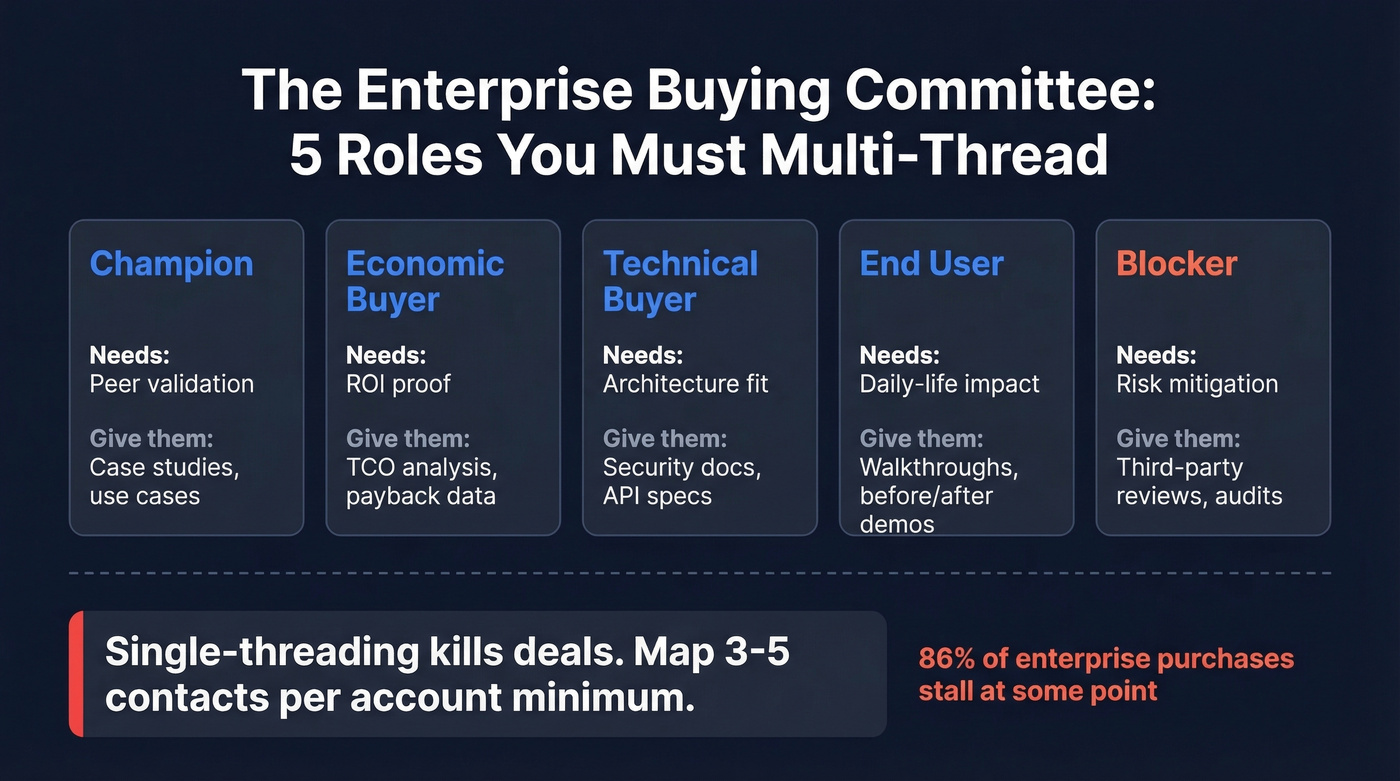
| Role | What They Need | Content That Works |
|---|---|---|
| Champion | Peer validation | Case studies, use cases |
| Economic Buyer | ROI proof | TCO analysis, payback data |
| Technical Buyer | Architecture fit | Security docs, API specs |
| End User | Daily-life impact | Walkthroughs, before/after |
| Blocker | Risk mitigation | Third-party reviews, audits |
Single-threading - relying on one champion to sell internally - is the #1 way enterprise deals die. Champions leave companies. Champions get overruled. Champions aren't in the room when the final decision happens.
The fix is multi-threading: map 3-5 contacts per account before you launch outreach. You need the champion, the economic buyer, and the technical evaluator at minimum. Stagger outreach over 2-3 weeks so it doesn't look like a coordinated carpet bomb (even though it is). Measure account-level engagement - three stakeholders engaging lightly beats one person downloading everything.
Multi-threading 50+ accounts means sourcing and verifying hundreds of contacts. Prospeo's B2B database lets you filter by job title, department, and company size across 300M+ professional profiles, then verify emails in real time - 98% accuracy on a 7-day refresh cycle. Bounced emails don't just waste credits; they burn your sender domain before the campaign even ramps.
The 4-Week ABM Launch Plan
You don't need six months to launch ABM. You need four focused weeks and the discipline to start small. Most ABM programs we've seen fail don't fail on strategy - they fail because the team spent three months "getting ready" and never shipped anything.
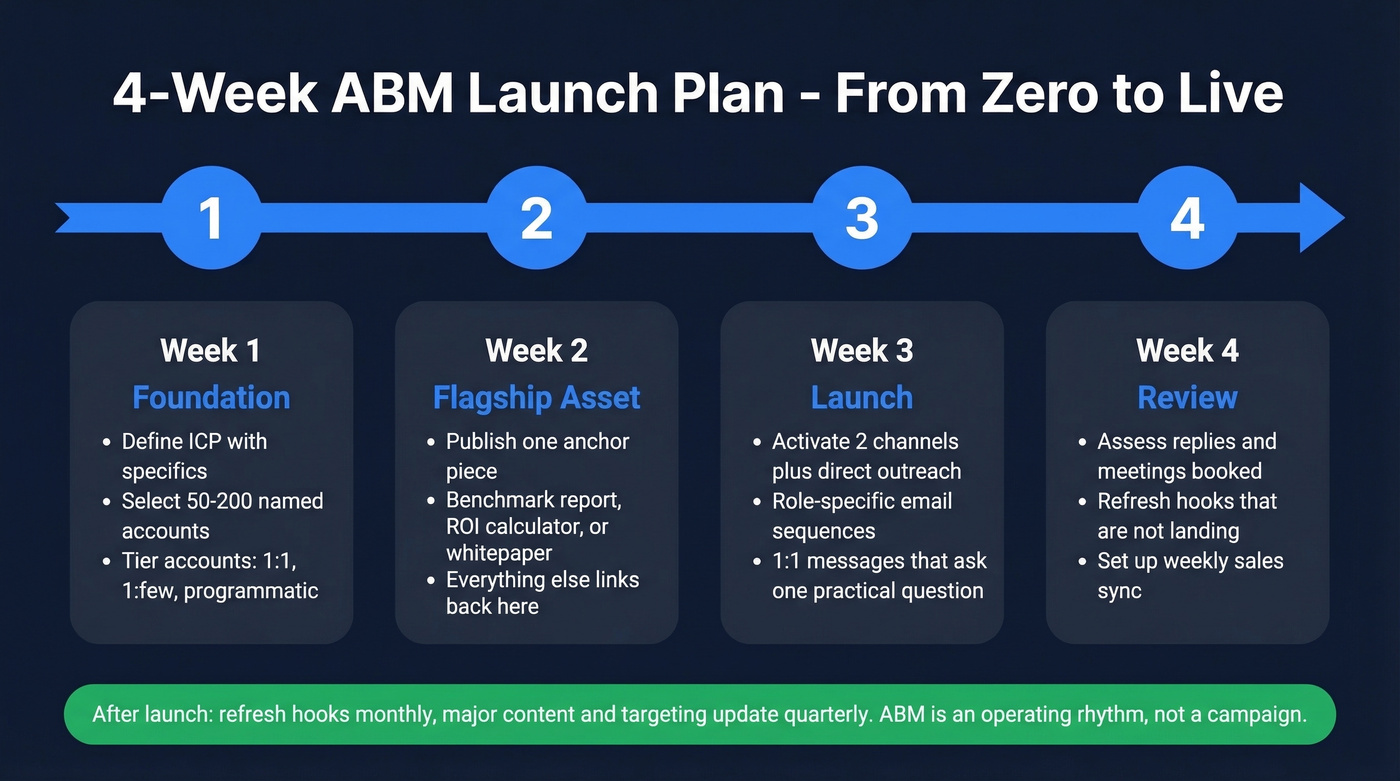
Week 1: Foundation. Define your ICP with specifics - industry, headcount range, tech stack signals, funding stage. Select 50-200 named accounts based on intent signals and fit score. Tier them: Tier 1 gets 1:1 treatment, Tier 2 gets 1:few campaigns, Tier 3 gets programmatic coverage. If you want a tighter selection model, use an ABM account selection framework.
Week 2: Flagship asset. Publish one high-value piece - a benchmark report, an ROI calculator, a technical whitepaper. This is your anchor. Everything else links back to it.
Week 3: Launch. Activate two channels plus direct outreach. Role-specific email sequences, targeted display to widen buying committee reach, and 1:1 messages that ask one practical question (not a pitch). If you're tightening outbound execution, borrow proven sales prospecting techniques to keep sequences sharp. For more channel ideas, pull from proven account-based marketing tactics.
Week 4: Review. Assess replies, meetings booked, and account-level engagement. Refresh hooks that aren't landing. Set up the weekly sales sync - shared doc of objections, approved claims, and follow-up within 24 hours. If you're formalizing the cadence, a lightweight RevOps program helps keep ownership clear.
After launch, refresh hooks monthly. Major content and targeting update quarterly. ABM isn't a campaign - it's an operating rhythm. If you need more real-world patterns, review a few ABM campaign examples.

Multi-threading 50+ enterprise accounts means sourcing hundreds of verified contacts across buying committees. Prospeo's 300M+ profiles with 30+ filters - job title, department, headcount, intent signals - let you map 3-5 stakeholders per account in minutes, not days. At 98% email accuracy on a 7-day refresh, your outreach actually lands.
Stop losing enterprise deals to single-threaded outreach and stale data.
Benchmarks That Matter
Blended CAC is a vanity metric. It hides the fact that your partner channel acquires customers at $150 while outbound runs $1,980.
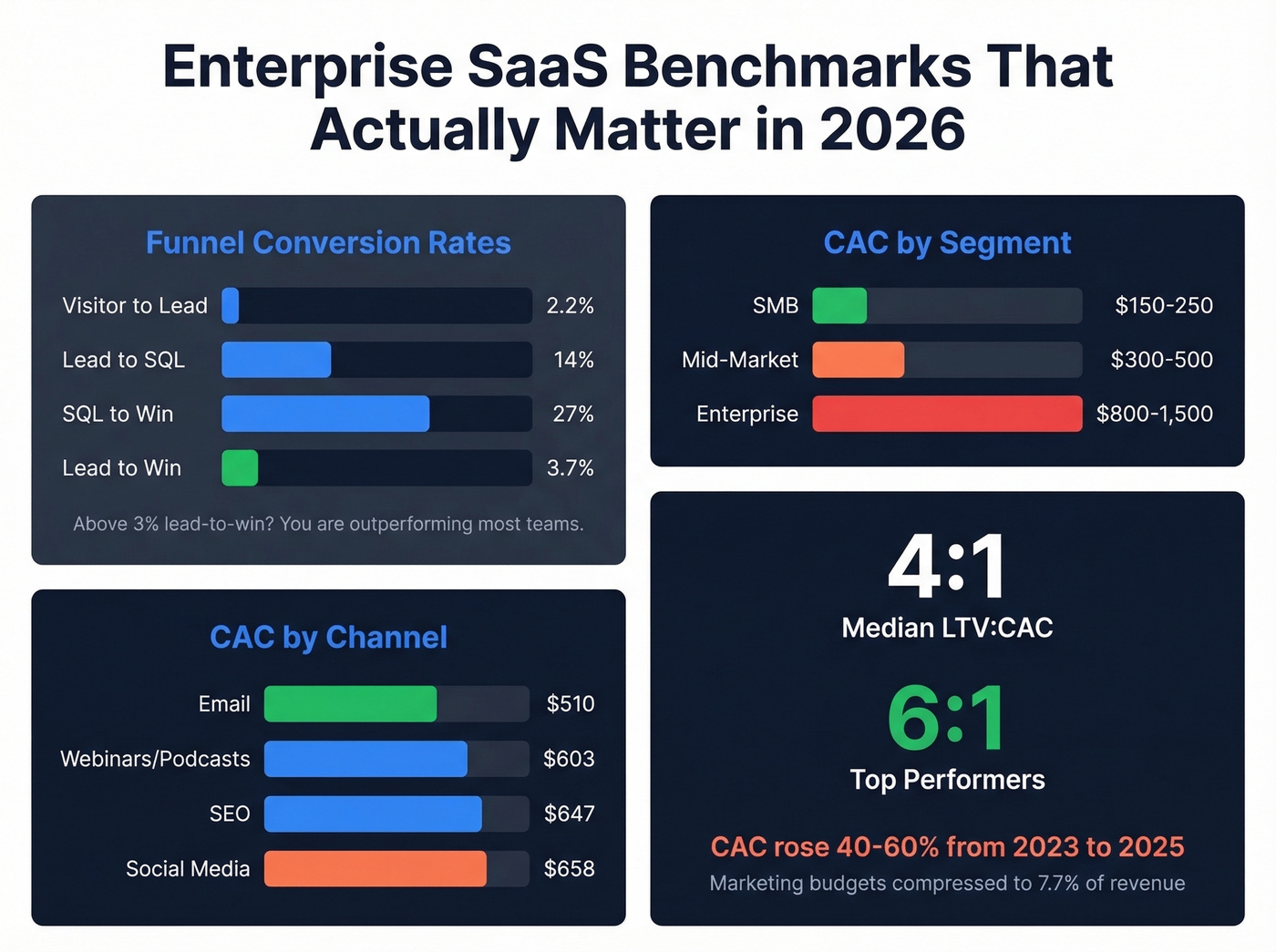
Funnel Conversion Benchmarks (B2B SaaS)
| Stage | Rate |
|---|---|
| Visitor to Lead | 2.2% |
| Lead to SQL | 14% |
| SQL to Win | 27% |
| Lead to Win | 3.7% |
Enterprise funnels convert at the lower end of these ranges. If your enterprise lead-to-win rate is above 3%, you're outperforming most teams we've benchmarked against.
CAC by Segment
| Segment | CAC Range |
|---|---|
| SMB | $150-250 |
| Mid-Market | $300-500 |
| Enterprise | $800-1,500 |
CAC by Channel
| Channel | Avg CAC |
|---|---|
| $510 | |
| Webinars/Podcasts | $603 |
| SEO | $647 |
| Social Media | $658 |
Here's the number your CFO actually cares about: LTV:CAC of 4:1 at median, 6:1 for top performers. CAC payback under 12 months for SMB, under 18 for mid-market, under 24 for enterprise. Meanwhile, CAC across B2B SaaS rose 40-60% between 2023 and 2025, and marketing budgets compressed to 7.7% of revenue - down from 9.1% the prior year. You're expected to do more with less, and the squeeze is accelerating. If you need to pressure-test your ratios, use a CAC LTV ratio benchmark.
Let's be honest: if your average deal size is under $25k, you probably don't need a full enterprise marketing stack. A CRM, an ABM-lite workflow, and verified contact data will outperform a $200k/year platform suite that your team uses at 30% capacity.
Content That Moves Committees
68% of enterprise marketers rate their content marketing as effective - but only 15% say they exceeded goals. That gap isn't a strategy problem. It's an execution problem.
The hub-and-spoke model works: one flagship asset with derivative pieces tailored to each buying committee role. Your benchmark report becomes an ROI summary for the economic buyer, a technical architecture overview for IT, and a quick-start guide for end users. Same research, different framing, five times the coverage. If you want a tighter system for planning, start with B2B buyer journey mapping.
Most enterprise teams have enough content. What they lack is content mapped to specific stakeholders at specific deal stages. Go back to the buying committee table and audit whether you have at least one asset per role. If you don't, that's your next sprint.
AI and GEO: The New Discovery Layer
Roughly 60% of searches now end without a click. AI Overviews, featured snippets, and LLM-powered answers are consuming the traffic that used to flow to your blog.
For enterprise marketers, the implication is structural: your content needs to be citation-ready for LLMs. That means clear definitions, structured data, authoritative sourcing, and concise answers near the top of every page. If an AI can't extract your key claim in one sentence, it won't cite you. This isn't a nice-to-have anymore - it's table stakes for staying visible during the 83% of the buying process that happens before a prospect ever talks to your sales team. (If you're building pipeline from organic, see how teams turn SEO into sales leads.)
Seven Mistakes That Kill Deals
- Features over outcomes. Nobody buys software for the feature list. They buy it because it solves a problem their CEO mentioned in the last board meeting.
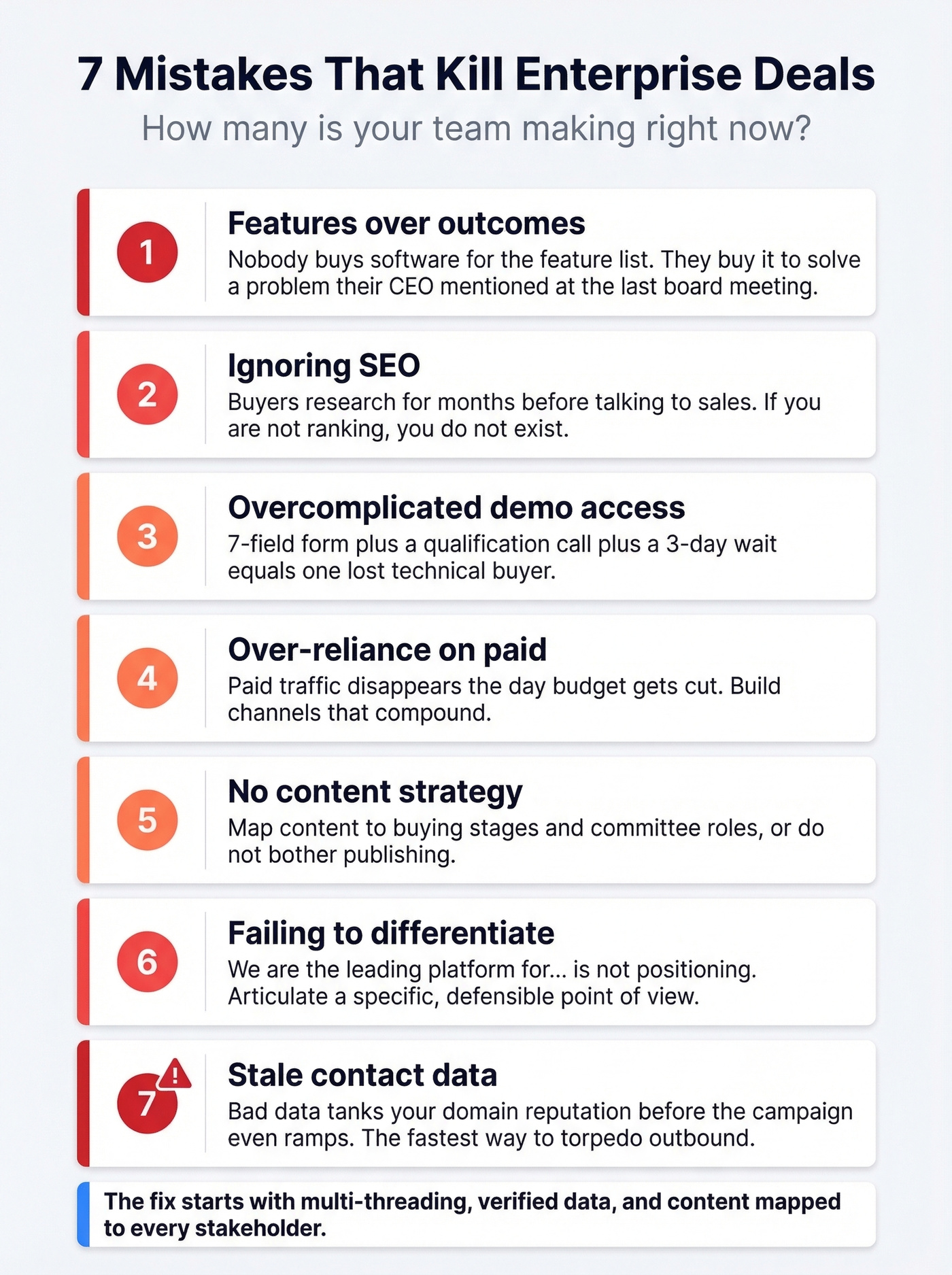
Ignoring SEO. Enterprise buyers research for months before talking to sales. If you're not ranking for their search terms, you don't exist during the research phase.
Overcomplicated demo access. A 7-field form, a qualification call, and a 3-day wait? You've already lost the technical buyer who just wanted to see the API docs.
Over-reliance on paid. Paid traffic disappears the day budget gets cut. Build organic and partner channels that compound.
No content strategy. Map content to buying stages and committee roles, or don't bother publishing at all.
Failing to differentiate. "We're the leading platform for..." is not positioning. In our experience, the teams that win enterprise deals articulate a specific, defensible point of view - not a feature matrix. If you're tightening your narrative, start with B2B brand positioning.
Stale contact data. You built a beautiful ABM playbook, mapped 5 contacts per account, launched sequences - and a chunk of your emails bounced because the data was weeks old. Bad data tanks your domain reputation before the campaign even ramps. Skip this step at your own risk; the consensus on r/sales is that bad data is the single fastest way to torpedo an outbound motion. If you want a checklist for keeping deliverability stable, see how to check domain reputation online.
Enterprise CAC rose 40-60% since 2023. At $0.01 per verified email, Prospeo cuts your contact sourcing costs by 90% compared to legacy platforms - without sacrificing accuracy. Layer buyer intent data across 15,000 topics to prioritize the accounts already in-market before your ABM sprint even starts.
Do more with less: enterprise-grade data without the enterprise price tag.
FAQ
How long does an enterprise software sales cycle typically take?
Most enterprise deals close in 3-9 months. Deals involving 6-10+ stakeholders across procurement, IT, and business units trend toward the longer end. Contracts above $100k ACV routinely exceed six months.
What's a good LTV:CAC ratio for enterprise SaaS?
The median is 4:1, with top performers hitting 6:1. Target a CAC payback period under 24 months for enterprise segments and under 18 months for mid-market.
How do you build an accurate ABM account list?
Start with 50-200 named accounts based on ICP fit and intent signals. Map 3-5 contacts per account using a verified data platform with real-time email verification and a short data refresh cycle - stale records are the fastest way to burn your sender domain before you've even started.
What's the biggest enterprise software marketing strategy mistake?
Single-threading accounts - relying on one champion to push a deal through a 10-person buying committee. Multi-thread at least three contacts per account before launching outreach, and measure engagement at the account level, not the individual level.