

Gmelius vs Mixmax: Which Gmail Tool Actually Fits Your Team?
Every Gmelius vs Mixmax comparison on the first page of Google is the same auto-generated feature table with zero analysis. Two columns, a bunch of checkmarks, and no opinion on which tool you should actually buy. Here's the thing: these tools solve fundamentally different problems, and the fact that they both live inside Gmail is about where the similarities end. Gmelius is a team collaboration platform that happens to do email. Mixmax is a sales automation tool that happens to live in your inbox.
Picking between them based on a feature checklist is like choosing between Slack and Outreach because they both send messages.
30-Second Verdict
Pick Gmelius if: your team manages shared inboxes (sales@, support@, info@) and needs collision detection, email assignment, and Kanban boards inside Gmail. It's the team chaos solver.
Pick Mixmax if: you're an individual sales rep or AE who needs powerful sequences, real-time email tracking, and one-click meeting scheduling. It's the individual productivity multiplier.
Who Each Tool Is Actually Built For
These tools emerged from completely different problems. Understanding that history saves you from buying the wrong one.
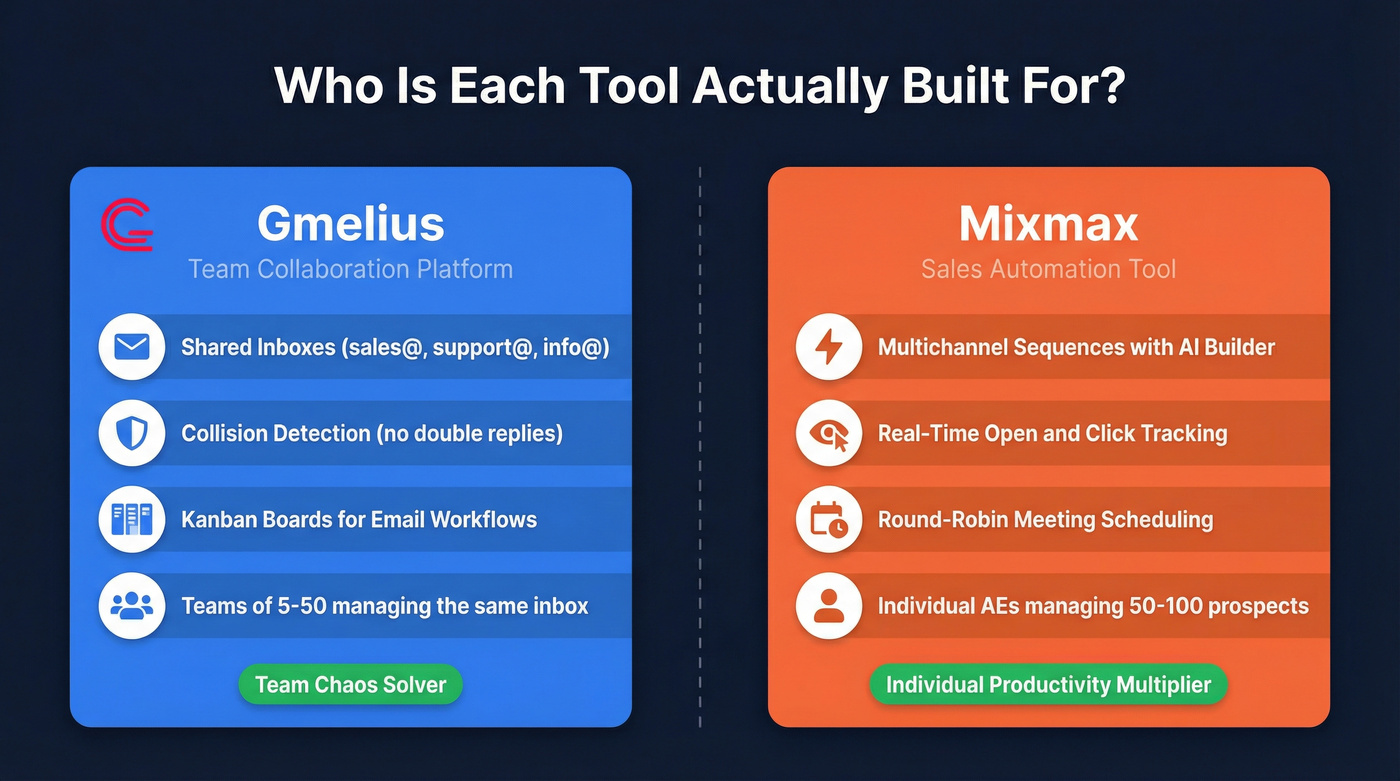
Mixmax - Built for Individual Sales Reps
Mixmax launched in 2014 and has grown to 90,000+ active users, almost entirely on the strength of one promise: make individual reps faster inside Gmail. The core loop is simple - track opens, send sequences, book meetings, follow up - all without leaving your inbox.
The "Remind Me" feature alone has a cult following. One G2 reviewer described using it "20 times a day." Another said what used to take "15+ hours now takes 30 minutes" with sequences. That's the Mixmax pitch in a nutshell: it's a time-compression tool for reps who live in Gmail.
Where Mixmax shines brightest is multichannel sequences with an AI builder, round-robin meeting scheduling, and real-time open/click notifications that help reps time their follow-ups. One Reddit user reported getting better results with Mixmax for low-volume sequences (300-400/week) from a personal email than with dedicated cold email tools using purchased domains - reinforcing that Mixmax's sweet spot is warm outreach from your real inbox, not high-volume cold email blasting. If you're an AE managing 50-100 active prospects and need to know the second someone opens your proposal, Mixmax was built for exactly that workflow. (If you're building a more repeatable outbound motion, see our guide to sales sequence best practices.)
Gmelius - Built for Teams Managing Shared Inboxes
Gmelius (YC S19) took a different path entirely. The core problem it solves: multiple people need to manage the same inbox without stepping on each other's toes.
Think sales@, support@, info@ - any alias where three people are all staring at the same emails, unsure who's handling what. Gmelius adds 1-click assignment, collision detection (so two reps don't reply to the same lead), shared drafts with @mentions, and Kanban boards that turn your inbox into a visual workflow. As one reviewer put it, Gmelius "feels like it's actually part of Gmail." That native feel matters - it's why teams stick with it over heavier helpdesk tools.
The tradeoff? Gmelius's sequence capabilities are simpler. Email-only drip campaigns, up to 10,000 contacts enrolled per month on the Growth plan. No LinkedIn steps, no multichannel AI builder. If outbound sequences are your primary use case, Gmelius isn't the right tool. (For a broader shortlist, compare cold email outreach tools.)
Tellingly, Gmelius's own Mixmax comparison page is mostly migration offers targeting Hiver and Front customers - suggesting they see those tools, not Mixmax, as their real competition.
The TrustRadius switching story from Adrienne Cooley captures the dynamic perfectly: she switched from Mixmax to Gmelius for the shared inbox features, then switched back to Mixmax after a year because the open tracking was more accurate and the UX was better for her individual workflow. Different problems, different winners.

Gmelius and Mixmax optimize how you send emails - but neither solves the upstream problem: finding accurate contact data. Prospeo gives you 143M+ verified emails at 98% accuracy, so the sequences you build in either tool actually land.
Stop perfecting sequences that bounce. Start with data that connects.
Feature-by-Feature Comparison: Gmelius vs Mixmax in 2026
Here's the comparison table that actually matters - with a call in every row.
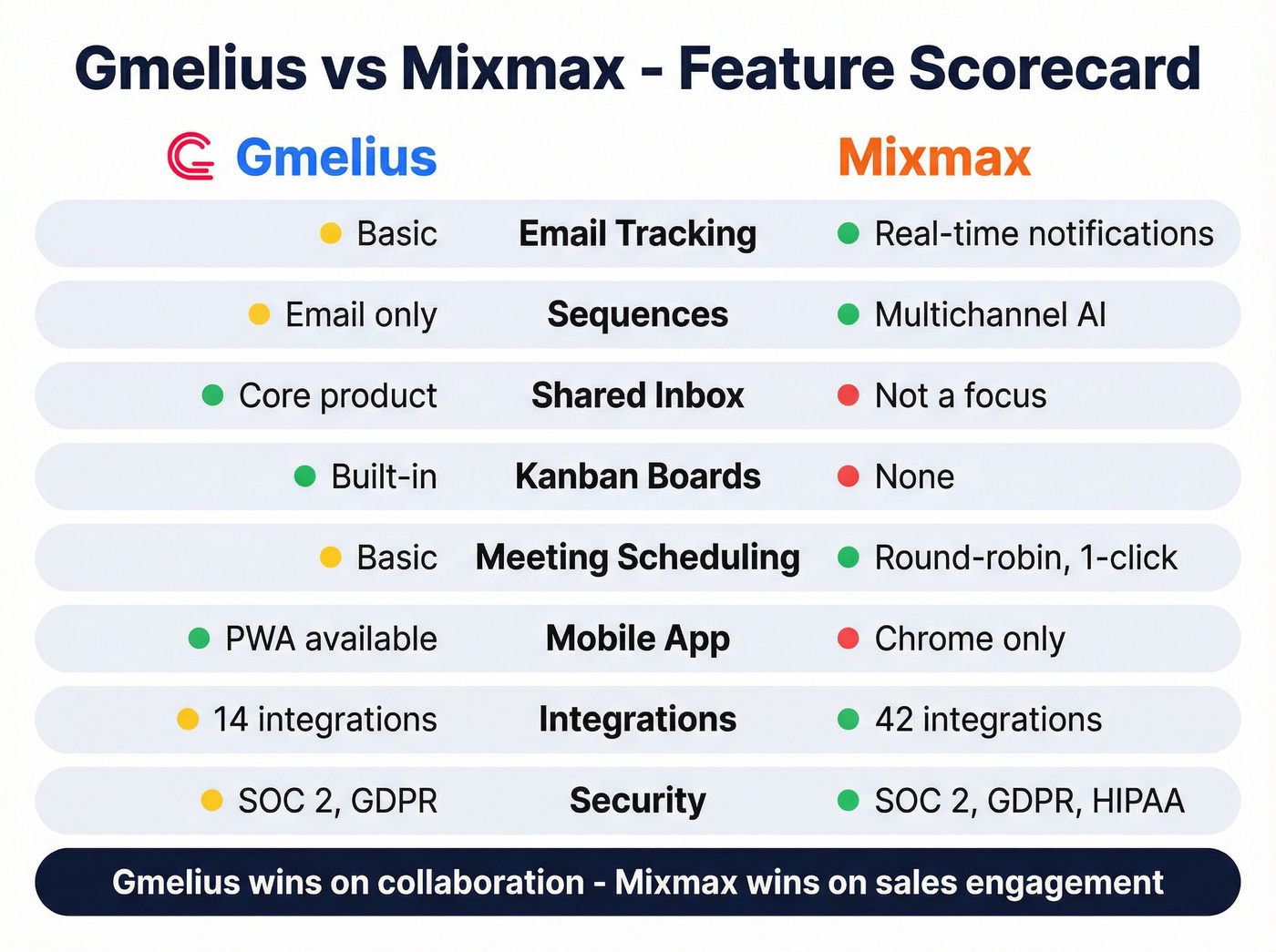
| Feature | Gmelius | Mixmax | Edge |
|---|---|---|---|
| Email tracking | Basic open/click | Real-time notifications | Mixmax |
| Sequences | Email-only, 10K/mo | Multichannel, AI builder | Mixmax |
| Shared inbox | Core product | Not a focus | Gmelius |
| Kanban boards | Built-in | None | Gmelius |
| Meeting scheduling | Basic | Round-robin, 1-click | Mixmax |
| AI features | Sorting, drafting | Sequence builder, signals | Tie |
| Mobile app | PWA (iOS/Android) | None | Gmelius |
| Integrations | 14 (SF, HubSpot, Slack) | 42 (SF, HubSpot, Slack) | Mixmax |
| Security | SOC 2 II, GDPR | SOC 2 II, GDPR, HIPAA | Mixmax |
| Outlook support | No | No | Neither |

A few rows deserve more context.
Sequences is where the gap is widest. Mixmax offers multichannel sequences with LinkedIn steps, OOO detection, and an AI builder that generates personalized messaging. Gmelius offers email-only drip campaigns - functional, but basic. One Mixmax quirk worth knowing: attachments in sequences can fail to send without any warning, which means your carefully crafted proposal deck might never arrive. And once a Mixmax sequence starts, it's hard to adjust or add steps mid-campaign. That rigidity frustrates teams running iterative outbound. (If you need a tighter cadence structure, use these cold email cadence templates.)
Shared inbox is Gmelius's entire reason for existing. Collision detection alone - preventing two reps from replying to the same email - is worth the price of admission for any team managing a shared alias. Mixmax doesn't even attempt this.
Integrations tilt toward Mixmax with roughly 42 versus Gmelius's 14. The ones that matter most - Salesforce, HubSpot, Slack - are covered by both. But if you rely on niche tools in your stack, Mixmax is more likely to have a native connection. (Related: CRM integration for sales automation.)
Mobile app is a quiet Gmelius win. Mixmax is Chrome-only. No mobile app, no Outlook support. If your reps need to triage emails from their phone, Gmelius's PWA handles it. It lacks certain desktop features, but it exists - which is more than Mixmax can say.
Security tilts toward Mixmax with HIPAA and CPRA compliance on top of SOC 2 Type II and GDPR. If you're selling into healthcare or handling California consumer data, that matters.
Mixmax support quality is a recurring complaint worth flagging. One reviewer called it "the worst I've seen," and multiple users report slow response times for technical issues. Gmelius support doesn't generate the same volume of complaints.
Neither tool supports Outlook. If your org isn't on Google Workspace, stop reading and look at Outreach or Salesloft instead.
Pricing Breakdown - What You'll Actually Pay
Most comparison sites still show Mixmax's old SMB/Growth tier structure. That's wrong. Mixmax restructured into a "Copilot" model, and the pricing looks different now.
Gmelius Pricing
| Plan | Annual Price | Monthly Price | Key Limits |
|---|---|---|---|
| Meli | $19/user/mo | ~$24/user/mo | 5 users, 5K emails/mo |
| Growth | $25/user/mo | $45/user/mo | 50 users, 10K contacts/mo |
| Pro | $40/user/mo | ~$52/user/mo | Unlimited users/emails |
| Enterprise | Custom | Custom | Custom everything |
Gmelius offers a 7-day free trial on Growth features. No free plan. Non-profits get 30% off (5-19 users) or 50% off (20+ users), which is a nice touch.
Mixmax Pricing (Updated Copilot Structure)
| Plan | Annual Price | Monthly Price | What You Get |
|---|---|---|---|
| Free | $0 | $0 | 20 tracked emails/mo |
| Inbox Copilot | $29/user/mo | $34/user/mo | Tracking, smart signals |
| Meeting Copilot | $29/user/mo | $34/user/mo | Summaries, auto follow-ups |
| Engagement Copilot | $49/user/mo | $65/user/mo | AI sequences, multichannel |
| Suite (bundle) | $89/user/mo | $105/user/mo | All three copilots |
| Teams | Contact sales | Contact sales | Dialer, custom domains |
Mixmax's 14-day free trial is more generous than Gmelius's 7-day window. The free plan exists but is barely functional - Mixmax previously offered 100 tracked emails on the free plan before cutting it to 20. That's a taste, not a workflow.
The Copilot model means you can buy individual capabilities a la carte. Need sequences but not meeting summaries? Just grab Engagement Copilot at $49/mo. That modularity sounds flexible until you actually price it out - you realize you need two copilots, you're suddenly at $58/user/mo, close enough to the $89 Suite that you just buy everything.
Real Cost for Your Team
Here's where the math gets interesting.
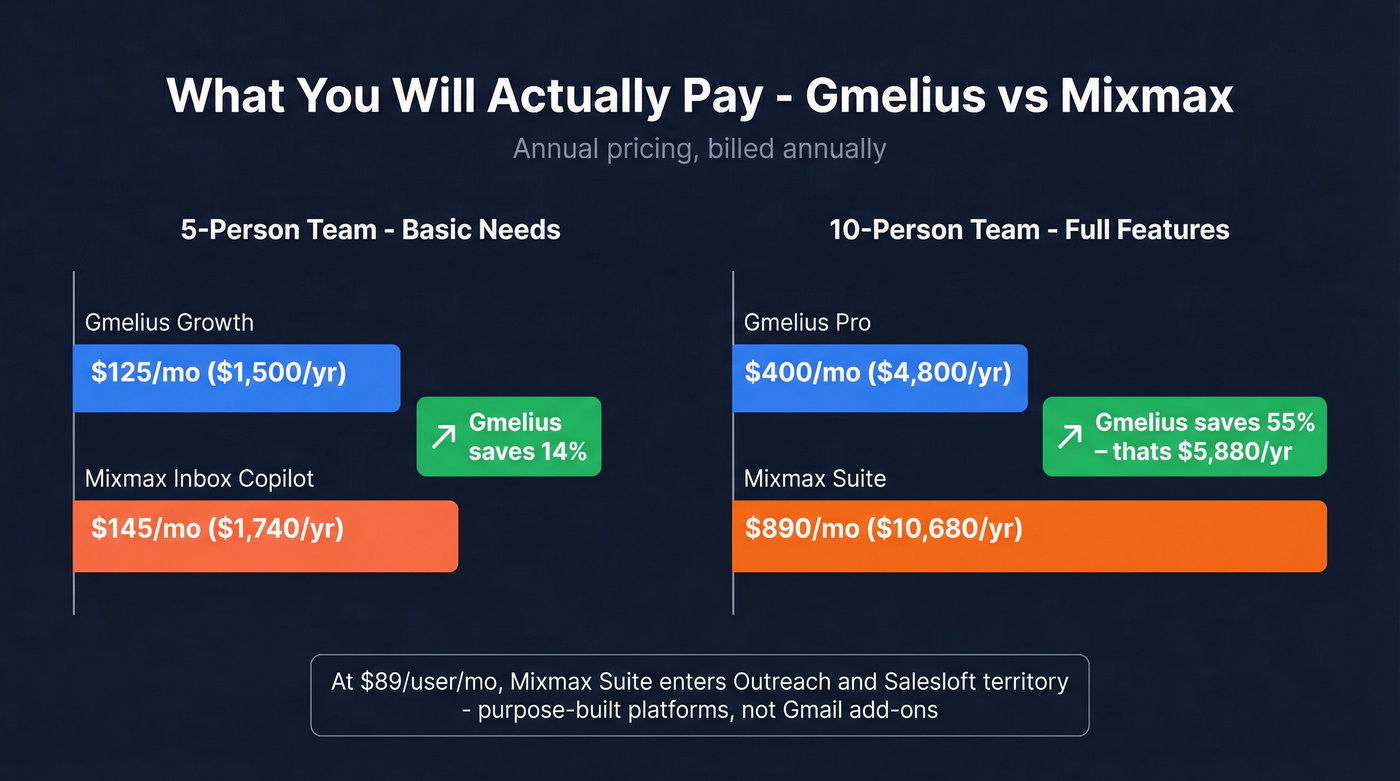
5-person team, basic needs:
- Gmelius Growth: $125/mo (annual) - shared inbox, basic sequences, Kanban
- Mixmax Inbox Copilot: $145/mo (annual) - tracking, smart signals, no sequences
Gmelius is 14% cheaper and includes more collaboration features. But if those 5 people need sequences, you're comparing Gmelius Growth ($125/mo) to Mixmax Engagement Copilot ($245/mo) - and the gap widens fast.
10-person team, full features:
- Gmelius Pro: $400/mo (annual) - everything, unlimited
- Mixmax Suite: $890/mo (annual) - all copilots bundled
Gmelius is 55% cheaper. That's $5,880/year in savings.
My hot take: $89/user/month for the full Mixmax Suite means you're paying enterprise prices for what is, at its core, a Chrome extension. For a 10-person team, that's $10,680/year. At that price point, you should be evaluating Outreach (~$100-150/user/mo) or Salesloft (~$75-150/user/mo), which are purpose-built sales engagement platforms with dialers, analytics, and proper CRM sync - not Gmail add-ons. (If you're doing the stack math, start with cost of sales tech stack.)
The caveat: Mixmax's higher price buys more sophisticated sales engagement features. If your reps need multichannel sequences with AI and round-robin scheduling, Gmelius's simpler sequences won't cut it. You're paying for capability, not just inbox access.
The Deliverability Problem Nobody Talks About
Both tools have a dirty secret. Mixmax's is worse.
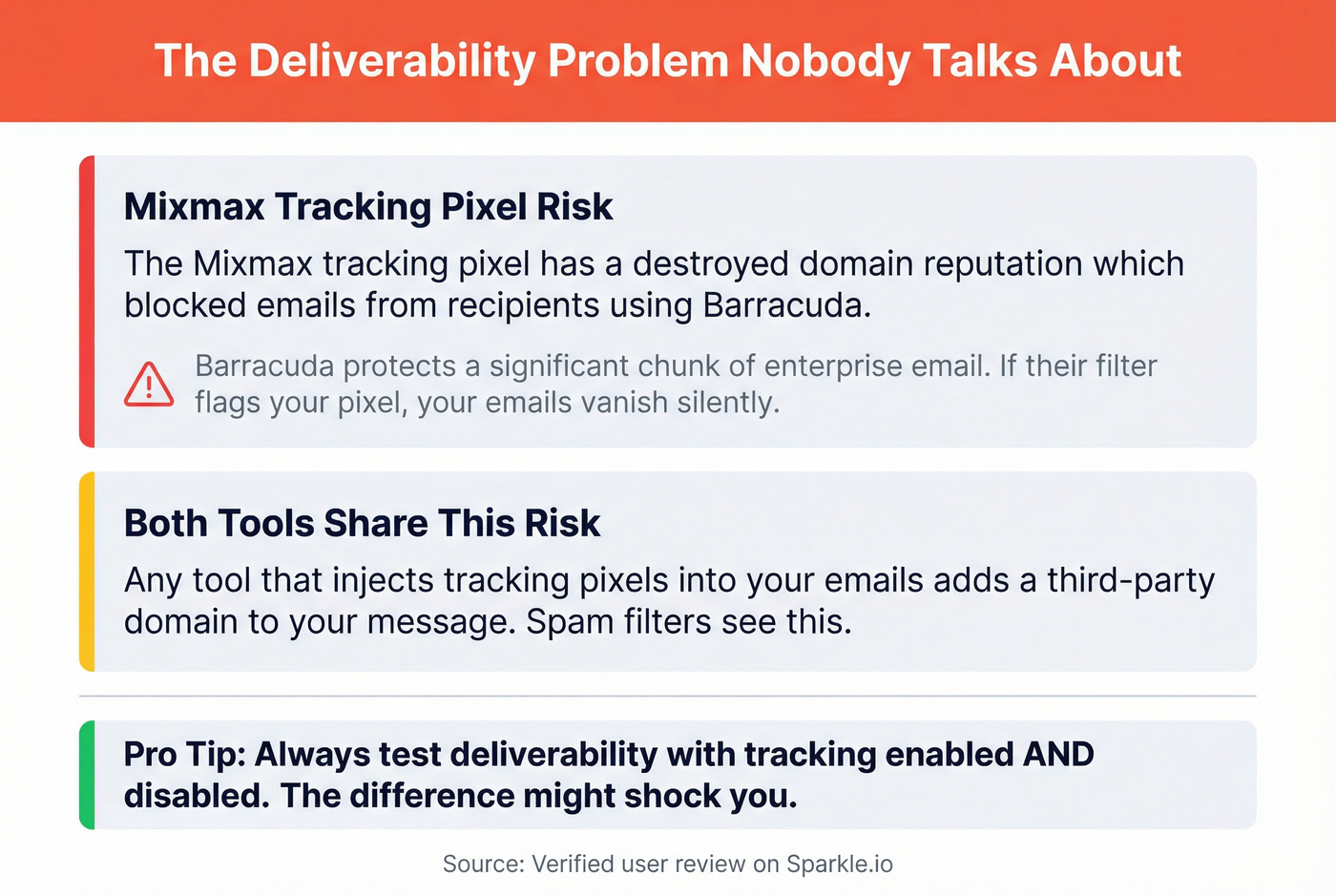
A verified user on Sparkle.io's Mixmax alternatives review put it bluntly: "The MixMax tracking pixel has a destroyed domain reputation which in turn blocked our emails from recipients using Barracuda. Pretty big deal."
That's not a minor bug. Barracuda protects a significant chunk of enterprise email. If your tracking pixel triggers their spam filter, your emails don't just go to spam - they get blocked entirely. For a tool whose entire value proposition is email engagement, having your tracking pixel flagged as malicious is a serious problem. (If you're diagnosing reputation issues, read what is domain reputation and keep a blacklist alert workflow ready.)
Gmelius isn't immune either. The same TrustRadius reviewer who switched between both tools specifically called out Gmelius's open tracking as less accurate than Mixmax's. So you've got a spectrum: Mixmax tracks more accurately but risks deliverability; Gmelius tracks less accurately but causes fewer blocking issues.
User Ratings at a Glance
| Platform | Gmelius | Mixmax |
|---|---|---|
| G2 | 4.4/5 (776 reviews) | 4.6/5 (1,436 reviews) |
| TrustRadius | 8.1/10 | 8.8/10 |
| Crozdesk (overall score) | 89% | 92% |
| Would buy again | 83% | 100% |
Mixmax wins on every rating platform, though the margins are tighter than the numbers suggest.
Mixmax's G2 star distribution is striking - 80% five-star reviews versus Gmelius's 62%. That's a meaningful gap in user enthusiasm. The "would buy again" split (100% vs 83% on TrustRadius) is even more telling, though the sample sizes are small (16 and 5 responses respectively).
The top G2 praise tags tell the story of each tool's strength. Mixmax users highlight email tracking, features, and time-saving. Gmelius users highlight ease of use, email management, and team collaboration.
Different tools, different fans.
On the complaint side, Mixmax users flag email management issues, missing features, and a learning curve. Gmelius users flag missing features, performance issues, and email management issues of their own. Neither tool is complaint-free. We've seen teams pick tools based purely on G2 scores and regret it within a quarter. A 4.6 that solves the wrong problem is worse than a 4.4 that solves the right one.
What Neither Tool Solves
Neither Gmelius nor Mixmax helps you find or verify email addresses. Both assume you already have good data.
That assumption is where most teams bleed money.
One Reddit user complained their "team spends too much time managing MixMax sequences." Part of that time is wasted on bounced contacts, dead addresses, and leads who changed jobs six months ago. The sending tool can't fix what the data broke. If you're running outbound through either Gmelius or Mixmax, verifying your list before loading it into sequences is the single highest-ROI step you can take. Tools like Prospeo handle this with a 7-day data refresh cycle and native integrations with Salesforce, HubSpot, Smartlead, and Instantly - so verified contacts flow directly into whichever platform you choose. (If you want a broader benchmark, compare email verifier websites or follow this email verification list SOP.)
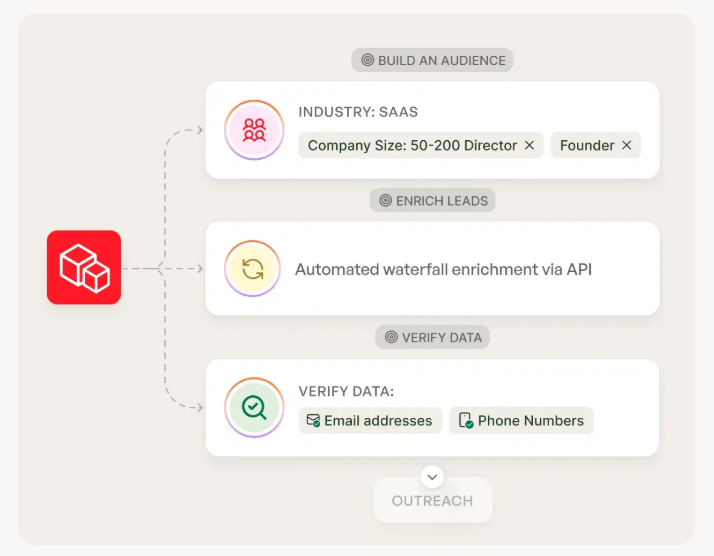
Whether you pick Gmelius for shared inboxes or Mixmax for sales sequences, bad email data kills your results. Prospeo's 7-day refresh cycle and 5-step verification keep bounce rates under 4% - at $0.01 per email, no contracts required.
Pair your Gmail tool with emails that actually reach real buyers.
Final Verdict - Pick by Use Case, Not by Feature Count
Stop comparing feature counts. Start with your primary problem.
Solo sales rep sending sequences from Gmail → Mixmax. Grab the Engagement Copilot at $49/user/mo, or the full Suite at $89 if you need meeting scheduling too.
Team managing a shared inbox (sales@, support@, info@) → Gmelius. The Growth plan at $25/user/mo covers most teams. Upgrade to Pro at $40 if you need Salesforce/HubSpot integrations and unlimited users.
Budget-conscious team under 5 people → Gmelius Meli at $19/user/mo. It's the cheapest entry point with AI assistants and basic shared inbox features.
Team needing both outbound sequences AND shared inbox → Neither tool alone is ideal. You could run Mixmax for outbound and Gmelius for inbox management, but two Chrome extensions in Gmail is asking for conflicts. At that point, evaluate Outreach or Salesloft - they're purpose-built for sales engagement at scale.
Team needing omnichannel support (chat, voice, SMS) → Skip both. Gmelius is email-only. Look at Hiver (starts at ~$19/user/mo, free plan available, 4.6/5 on G2) or Front (starts at ~$19/user/mo, 4.7/5 on G2) for true omnichannel shared inbox.
Whichever side of the Gmelius vs Mixmax debate you land on, start with Gmelius Growth at $25/user/mo or Mixmax Engagement Copilot at $49/user/mo. Run it for 90 days. If you're not hitting a wall, you've found your tool.
FAQ
Can Gmelius and Mixmax work together?
Technically yes - both are Chrome extensions for Gmail - but running two simultaneously causes conflicts, slow performance, and tracking inconsistencies. Most teams pick one based on their primary need: shared inbox (Gmelius) or sequences (Mixmax). If you genuinely need both capabilities, a dedicated sales engagement platform like Outreach or Salesloft is a better bet.
Does Mixmax have a mobile app?
No. Mixmax is Chrome-only with no mobile app and no Outlook support. Gmelius offers a progressive web app for iOS and Android that handles basic inbox triage, though it lacks certain desktop features. If mobile access matters to your workflow, Gmelius has the clear edge.
Which tool has better email tracking accuracy?
Mixmax delivers more accurate open tracking based on user reports - the TrustRadius switching story specifically cites this advantage. But Mixmax's tracking pixel has been flagged by Barracuda and other security gateways, which can block emails entirely. More accurate tracking comes with a real deliverability risk.
Is there a free plan for either tool?
Mixmax offers a free plan with 20 tracked emails per month - functional for testing, not for real campaigns. Gmelius has no free plan, only a 7-day trial. For a zero-cost starting point to verify your contact data before choosing either tool, Prospeo's free tier includes 75 verified emails per month.
How do I improve deliverability regardless of which tool I pick?
Verify every email address before loading it into sequences. Keep your bounce rate under 4%, and consider whether you actually need open tracking enabled - tracking pixels themselves can trigger spam filters at enterprise gateways. Clean data is the foundation; the sending tool is just the last mile.