

How to Generate Leads in Sales: The 2026 Playbook
A RevOps lead we know ran a three-tool bake-off last quarter. The "best" database created 4,000 duplicate contacts in Salesforce in five days. The cheapest tool had better phone connect rates. The lesson wasn't about which tool won - it was that figuring out how to generate leads in sales fails when you start with tactics instead of data quality. And 79% of marketing leads never convert into sales, which tells you most teams are still getting this wrong.
Threads in r/b2bmarketing and r/sales tell the same story: cold emails pulling ~2% reply rates, connection requests ignored, ads burning budget with nothing to show. The problem isn't that lead gen is broken. It's that most teams are running a 2021 playbook in a 2026 market - and the market has changed in ways that matter. Google and Microsoft now require strict email authentication. AI-generated outreach has flooded every inbox, making generic messages invisible. Buyers complete 61% of their journey before talking to a seller. The tools that worked three years ago have been commoditized or outpaced. If your playbook doesn't account for these shifts, you're optimizing a machine that no longer exists.
What You Need (Quick Version)
- Fix your data before you fix your tactics. 79% of marketing leads never convert - and it's usually a data problem, not a messaging problem.
- Blend inbound and outbound. SEO leads close at 14.6% vs. 1.7% for outbound. You need both engines running.
- Personalize with signals, not just names. Generic personalization pulls ~3.43% reply rates. Signal-based personalization hits 18%.
- Score every lead before it hits sales. A working model is included below - steal it.
- Verify every contact before you send. Bad data destroys sender reputation. A 7-day refresh cycle and a 98% accuracy bar is what we recommend aiming for.
The Buyer Journey Problem Nobody Talks About
Here's the thing most lead gen advice ignores: your buyers aren't waiting for you. 92% of B2B buyers start research with at least one vendor already in mind. 41% have a preferred vendor before they even begin a formal evaluation. The winning vendor is on the Day One shortlist 95% of the time.
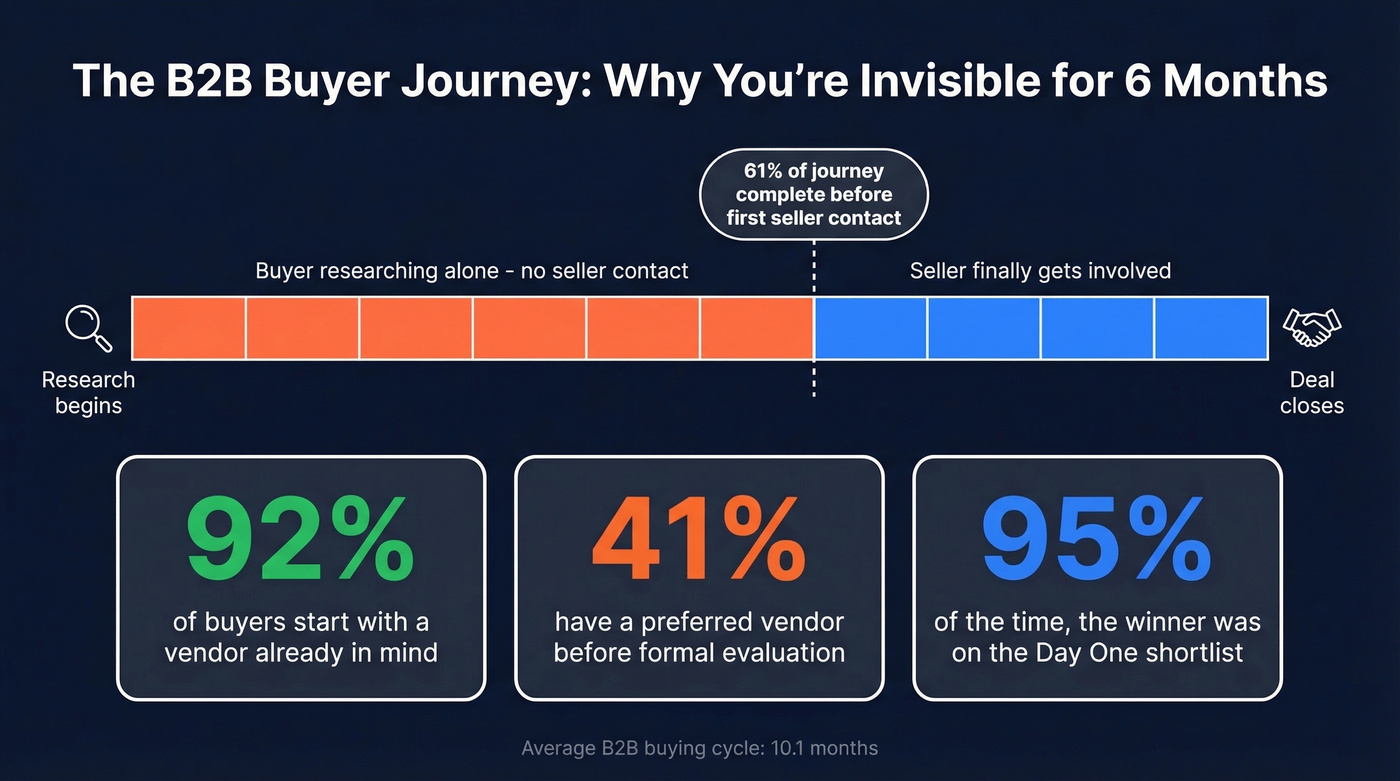
The average B2B buying cycle runs 10.1 months. Buyers don't contact sellers until they're 61% through that journey - meaning for roughly six months, your prospect is researching, comparing, and forming opinions while you don't even know they exist.
This has massive implications for how you generate sales leads. If you're only doing outbound, you're reaching people who've already made up their minds. If you're only doing inbound, you're waiting for them to come to you - which is too late if a competitor got on that Day One shortlist first. The answer is both, layered intelligently.
Inbound Strategies That Drive Sales Leads
Inbound leads are cheaper and close at dramatically higher rates. SEO-driven leads close at 14.6% - nearly nine times the 1.7% close rate for outbound. That 9x gap makes content the highest-ROI channel for most B2B teams, but it takes 6-12 months to compound, which is why most teams underinvest. (If you want a tighter system for this, see our guide on SEO-driven leads.)
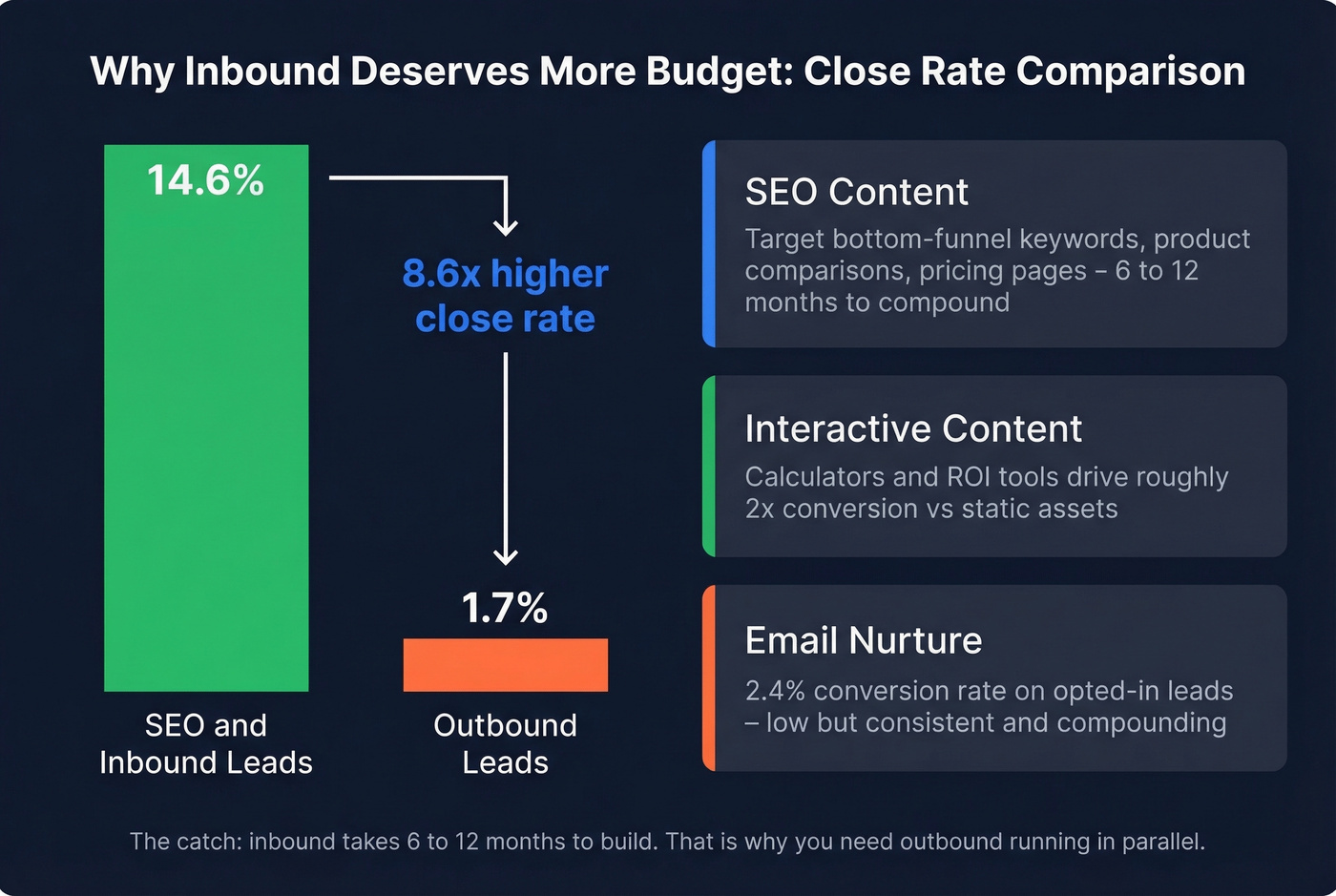
The channels that matter most: SEO content targeting bottom-funnel keywords, interactive content like calculators and ROI tools that drive roughly 2x conversion rates versus static assets, and email nurture sequences. B2B email marketing converts at about 2.4%, which sounds low until you realize it's working on leads who already opted in.
The mistake we see repeatedly is teams treating inbound as "publish blog posts and wait." Inbound lead gen in 2026 means building content around the specific questions your ICP asks during that 10-month buying cycle - product comparisons, pricing breakdowns, implementation guides, the stuff that gets you on the Day One shortlist. Brand awareness content is fine for top-of-funnel, but it doesn't produce pipeline by itself. You need bottom-funnel content that captures intent when buyers are actively evaluating. (If you need the foundation, start with an Ideal Customer Profile you can actually score against.)
Two channels worth adding to your inbound mix: Generative Engine Optimization - optimizing content so AI-powered search engines like Perplexity and Google's AI Overviews surface your brand in answers. If your content isn't structured for AI retrieval, you're invisible to a growing share of researchers. And referral programs, which 46% of respondents rank as their highest-ROI lead source. A structured referral program turns your happiest customers into your best prospecting channel.
Outbound Lead Generation
Outbound is harder than it was three years ago. But it's not dead - it's more demanding. The teams that win at outbound in 2026 treat it as a precision game, not a volume game. (For more plays beyond email/calls, use these sales prospecting techniques.)
Cold Email That Works
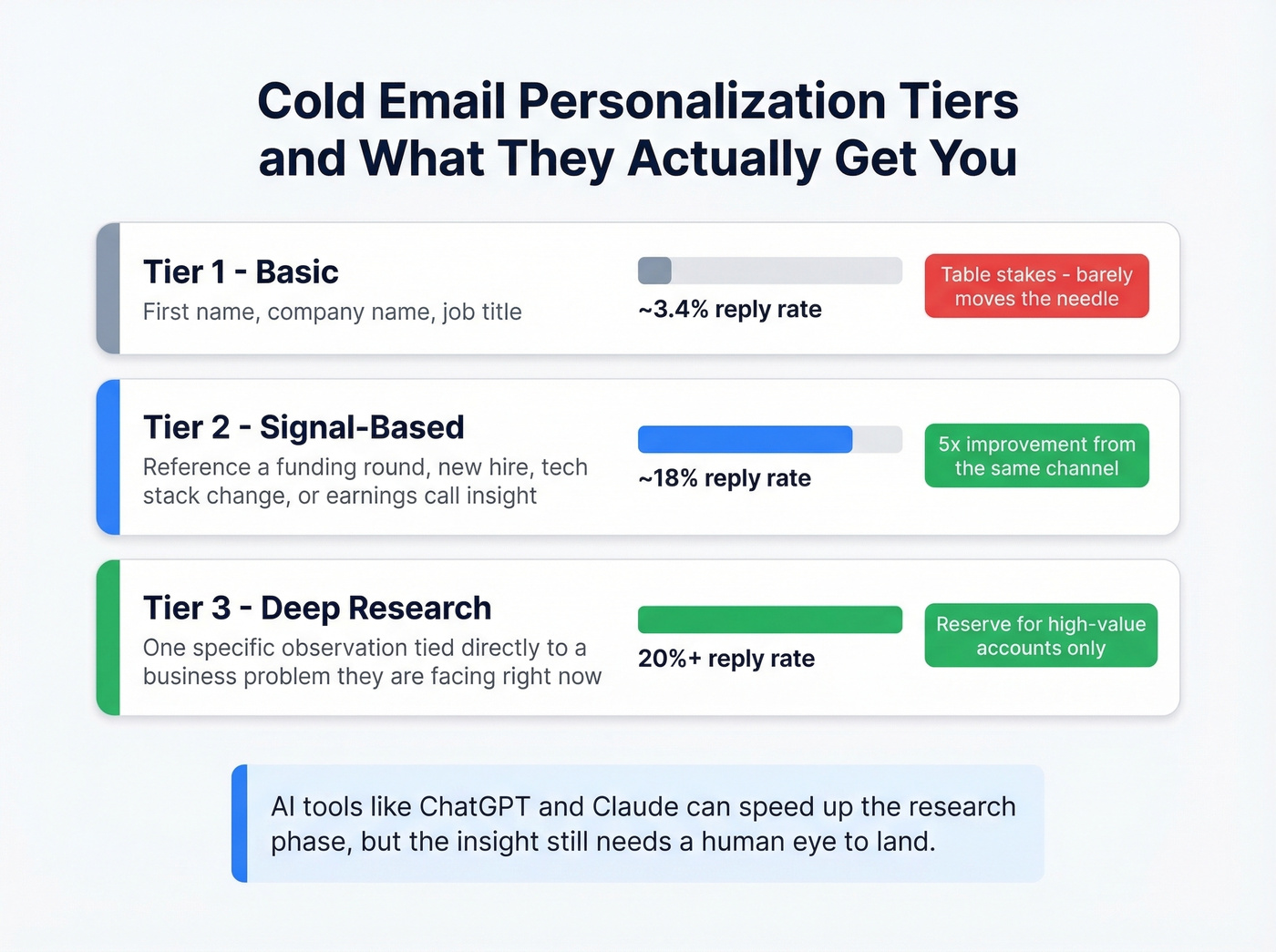
The average cold email reply rate sits at 3.43%. Most teams live below it. Signal-based personalization - where you reference a specific trigger like a funding round, a job change, or a tech stack shift - pushes reply rates to 18%. That's a 5x difference from the same channel. If you're building sequences, this B2B cold email sequence framework is a solid baseline.
Personalization Tiers Beat Templates
Basic personalization like first name and company name is table stakes. It barely moves the needle anymore. The next tier - referencing a specific business context - is where reply rates jump. Something like "I noticed you're hiring three SDRs, which usually means outbound is scaling" shows you did real research. Deep personalization, where you tie one specific observation to a business problem, is reserved for high-value accounts where the research time pays off. AI tools like ChatGPT and Claude can accelerate this research phase, pulling context from earnings calls, press releases, and job postings in seconds - but the insight still needs a human eye to land. (If you want a dedicated system, see personalized outreach.)
Follow-Ups Are Where Deals Happen
42% of replies come on follow-up emails, yet 70% of salespeople stop after one. That's staggering. A three-to-five touch sequence is the minimum. Keep body copy between 50 and 125 words. Subject lines between 6 and 10 words hit a 49.1% open rate - shorter is better than longer. If you need copy you can paste today, use these cold email follow-up templates.
Deliverability Is Technical
Google and Microsoft's authentication mandates made SPF, DKIM, and DMARC non-negotiable. If your domain isn't properly authenticated, your emails land in spam regardless of how good your copy is. Turn off open and click trackers - they tank deliverability. Count warm-up emails inside your daily sending limits. If you're sending 30 emails per day, that's 25 outreach emails plus 5 warm-up, not 30 plus warm-up on top. (For the full checklist, see our email deliverability guide.)
None of this matters if your contact data is bad. Sending to invalid emails destroys your sender reputation, which kills deliverability for every future campaign. (Benchmarks and fixes: email bounce rate.)
Cold Calling: When to Invest
| Use cold calling if... | Skip cold calling if... |
|---|---|
| Deals above $25K ACV | High-volume outbound to SMBs |
| Targeting director+ roles | Small team without phone specialists |
| Reps have strong phone skills | Budget doesn't support parallel dialing |
| Layering intent signals first | No intent data to prioritize accounts |
The conversation success rate when you actually connect is 65.6% - excellent. The problem is getting connected. 97% of people ignore cold calls from unknown numbers, and VoIP numbers get flagged as spam increasingly often. If you do call, call the accounts showing buying behavior, not a random list. (If you're rebuilding the motion, start with a cold calling system.)
Skip cold calling entirely if your average deal is a sub-$10K contract. The math doesn't work - connect rates are too low and the deal value doesn't justify the labor cost. Put those hours into better email sequences and social touches instead.
Social Selling
Email alone isn't enough. Adding social touches - profile views, connection requests with context, DMs that reference a specific trigger - turns a cold sequence into a warm one. Omnichannel sequencing is the 2026 reality, and the data is clear: multichannel outperforms single-channel. The key is coordination, not just adding more channels for the sake of it.

You just read that 79% of marketing leads never convert - and bad data is the root cause. Prospeo's 5-step verification delivers 98% email accuracy on 300M+ profiles, refreshed every 7 days. That's the data quality bar this article recommends.
Stop generating leads that never convert. Start with data that connects.
How to Score and Prioritize Leads
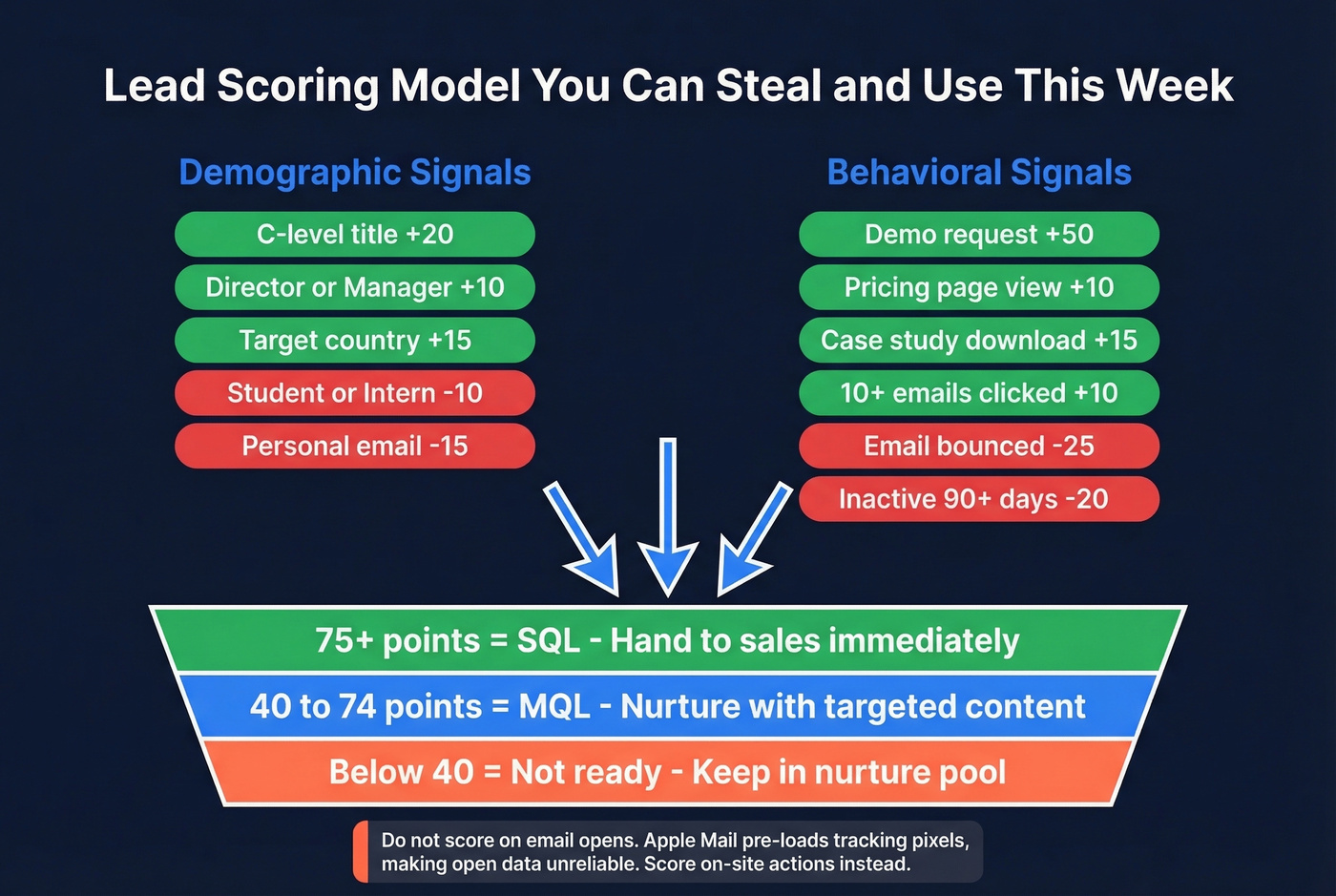
Most teams either don't score leads at all or use a model so complex nobody trusts it. Here's a working model you can implement this week. (If you want to go deeper, use this lead scoring guide.)
Demographic Scoring:
| Signal | Points |
|---|---|
| C-level title | +20 |
| Director/Manager | +10 |
| Student/Intern | -10 |
| Target country | +15 |
| Personal email | -15 |
Behavioral Scoring:
| Action | Points |
|---|---|
| Demo request | +50 |
| Pricing page view | +10 |
| Case study download | +15 |
| 10+ marketing emails clicked | +10 |
| Email bounced | -25 |
| Inactive 90+ days | -20 |
Thresholds: 75+ points = SQL, hand to sales immediately. 40-74 = MQL, nurture with targeted content. Below 40 = not ready.
One critical caveat: don't score on email opens. Apple Mail's privacy features pre-load tracking pixels, making open rates unreliable. Shift your behavioral scoring toward on-site actions - pricing page visits, form submissions, and bottom-funnel content engagement. These signals actually correlate with buying intent. AI-powered scoring models can layer in firmographic and technographic signals automatically, but even a manual model like the one above will outperform no model at all.
Your scoring model is only as good as your data. If contacts bounce, scores are meaningless - which is why enrichment that returns 50+ data points per contact and runs on a 7-day refresh cycle matters more than most teams realize. (More on this: lead enrichment.)
Fix Sales and Marketing Alignment
The average sales and marketing targeting overlap is just 23%. That means 77% of the time, sales and marketing are chasing different people. It gets worse: 53% of B2B sales teams follow up on fewer than 35% of marketing-generated leads. Marketing generates leads that sales ignores, and sales blames marketing for lead quality.
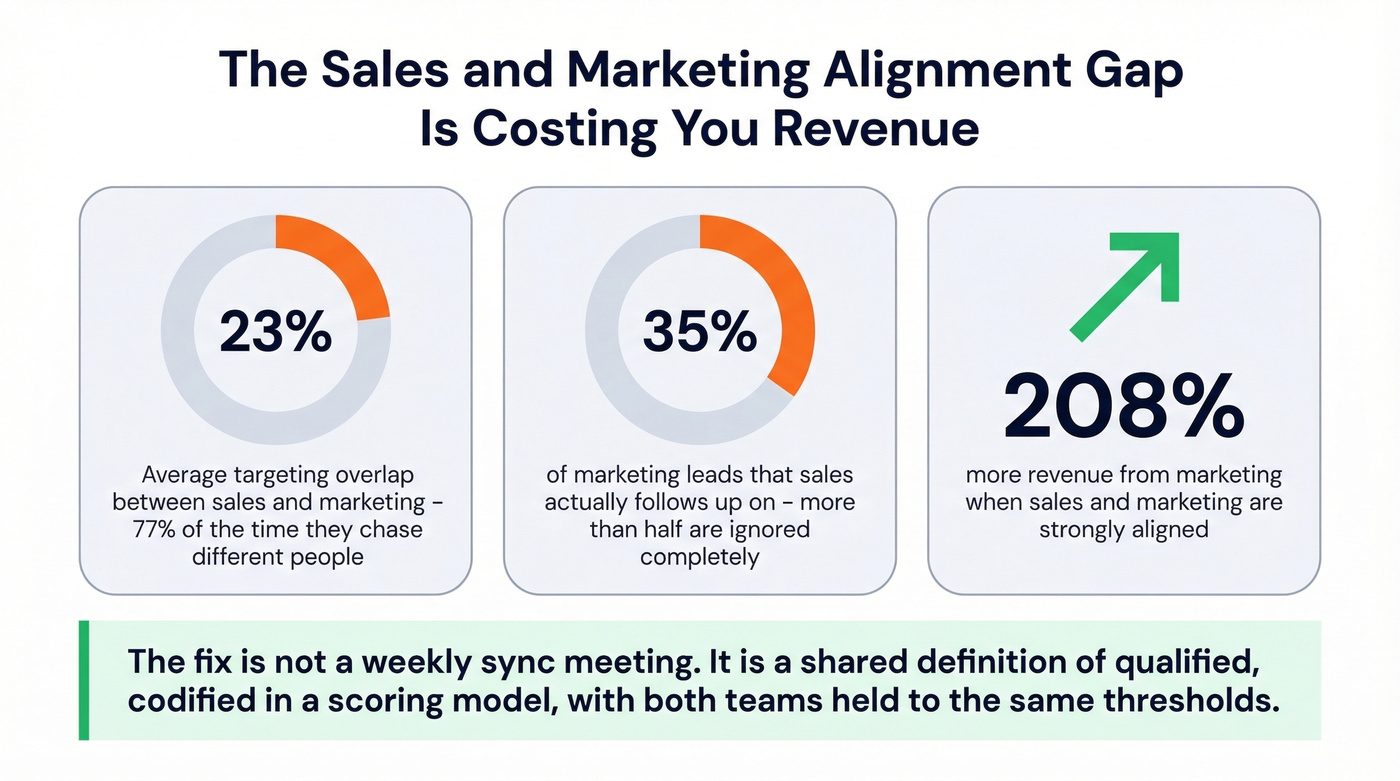
The fix isn't a weekly sync meeting. It's a shared definition of what a qualified lead looks like - codified in the scoring model above - and a shared view of the data. Teams with strong alignment generate 208% more revenue from marketing efforts. That's not a marginal improvement. It's a completely different business.
Let's be honest: if your sales team won't follow up on marketing leads, the problem isn't the leads. It's that nobody agreed on what "qualified" means. Define it, score it, and hold both teams accountable to the same thresholds. (If you need the operational layer, build a lead generation workflow both teams can follow.)
What Leads Actually Cost
Lead generation isn't free, even when it's "organic." Here's what CPL looks like across industries:
| Industry | Paid CPL | Organic CPL | Blended |
|---|---|---|---|
| B2B SaaS | $310 | $164 | $237 |
| eCommerce | $98 | $83 | $91 |
| Cybersecurity | $411 | $404 | $406 |
| Financial Services | $761 | $555 | $653 |
| Higher Education | $1,261 | $705 | $982 |
The mean CPL across all industries is $198.44. Two things jump out. First, organic CPL is consistently lower than paid - sometimes by half. That's the compounding effect of content and SEO. Second, the spread between industries is enormous. A $91 eCommerce lead and a $982 higher ed lead require completely different unit economics. Know your number before you set a budget. Profitable lead generation means tracking CPL against customer lifetime value and doubling down on channels where the ratio works. (If you want the KPI set, track lead generation metrics alongside CPL.)
Building the Right Tool Stack
Five Layers, One Stack
Think of lead generation as a stack, not a single tool. You need five layers: Capture (forms, landing pages), Verify (email and phone validation), Contact (finding decision-makers), Nurture (sequences and content), and Manage (CRM). The lead gen software market is projected to grow from $7.4B to $16.2B by 2034, which means the options are only getting more crowded. Get one strong tool per layer rather than an all-in-one that does everything poorly. (If you're comparing vendors, start with these data enrichment services.)
Don't overlook website visitor identification tools like Leadfeeder. They unmask anonymous traffic and feed warm accounts into your outbound sequences - a bridge between inbound interest and outbound action.
Recommended Tools and Pricing
| Layer | Tool | Starting Price | Best For |
|---|---|---|---|
| Data + Verify | Prospeo | Free (75 emails/mo) | Email/mobile verification |
| CRM | HubSpot | Free | SMBs, marketing automation |
| CRM | Salesforce | $25/user/mo | Enterprise workflows |
| Sequencing | Instantly / Smartlead | ~$30/mo | Cold email at scale |
| Enrichment | Clay | Free tier | Complex enrichment |
| Automation | Zapier | Free / $19.99/mo | Connecting tools |

CRM pricing in full: HubSpot runs Free to $15/user/month (Starter) to $90/user/month (Professional) to $150/user/month (Enterprise). Salesforce tiers go $25 to $175 to $350/user/month. Most B2B teams under 50 people do fine on HubSpot's free or Starter tier. Salesforce earns its price tag when you need complex workflows, CPQ, or territory management. (If you want more options, here are examples of a CRM with real pricing.)
Enrichment and sequencing: Apollo offers a generous free tier and runs ~$49-99/mo per user on paid plans, but the data is largely user-populated, and we've seen teams run into accuracy issues when they skip a separate verification step. Clay is powerful for complex enrichment workflows but gets expensive fast - expect ~$149/mo and up. Instantly and Smartlead both start around $30/mo and handle deliverability infrastructure well.
Prospeo sits at the foundation - the Data + Verify layer. With 300M+ professional profiles, 143M+ verified emails, and 125M+ verified mobile numbers on a 7-day refresh cycle, it covers contact-finding and verification in one platform. The Chrome extension lets you prospect from any website or CRM in one click, and native integrations with HubSpot, Salesforce, Instantly, Smartlead, Lemlist, and Clay mean verified contacts flow into your existing workflows without manual exports. Pricing starts free and scales at roughly $0.01 per email - no annual contracts, no sales calls required.
Signal-based personalization hits 18% reply rates, but only if your contacts are real. Prospeo gives you 30+ filters - buyer intent, job changes, tech stack, funding - plus 125M+ verified mobiles with a 30% pickup rate. All at $0.01 per email, 90% cheaper than ZoomInfo.
Layer real signals on verified data and watch reply rates climb.
FAQ
What's the difference between MQL and SQL?
An MQL meets basic demographic and engagement criteria - typically scoring 40-74 points in a lead scoring model. An SQL scores 75+ and shows high-intent behavior like requesting a demo or visiting the pricing page. MQLs need nurturing; SQLs need a sales conversation immediately.
How many leads should a sales team generate per month?
Organizations generate an average of 1,877 leads per month, but that number is meaningless without context. A team generating 200 high-quality SQLs will outperform one generating 2,000 unqualified MQLs every time. Focus on conversion rate and pipeline value, not raw volume.
Is cold email still effective in 2026?
Yes - with the right approach. Generic cold email pulls about 3.43% reply rates. Signal-based personalization pushes that to 18%. The difference is relevance, not volume. Pair strong personalization with verified contact data and proper deliverability setup.
What's a good cost per lead?
The mean CPL across industries is $198.44, ranging from $91 in eCommerce to $982 in higher education. Organic channels consistently cost 30-50% less than paid. Benchmark against your specific industry and track CPL against customer lifetime value.
How do you start generating sales leads from scratch?
Start with a clear ICP definition, then build a minimum viable stack: a data and verification platform like Prospeo (free tier: 75 emails/mo), a free CRM like HubSpot, and a sequencing tool like Instantly or Smartlead at ~$30/mo. Combine inbound content targeting bottom-funnel keywords with signal-based outbound sequences. All three offer free tiers, so you can launch for $0 and scale as pipeline grows.