

Lead Manager: The Complete Guide to Managing Leads That Actually Convert
You generated 200 leads last month. Marketing's celebrating. But six weeks later, 160 sit untouched - no follow-up, no score, no owner. You don't have a lead generation problem. You need a lead manager: a system that turns raw contacts into closed deals.
79% of marketing leads never convert into sales, and the root cause is almost always broken follow-up, not bad leads. Organizations without a clear strategy lose roughly 70% of potential customers due to slow or nonexistent follow-up. The fix isn't complicated, but it does require a system.
Here's the short version. Lead management follows a 6-stage lifecycle: capture, tracking, qualification/scoring, routing/distribution, nurturing, and conversion. You don't need a $50K platform - HubSpot's free CRM paired with a pipeline tool like Pipedrive can get most SMBs most of the way there for under $100/month. And the #1 mistake isn't bad process. It's bad data. If 30% of your emails bounce, nothing downstream works.
What Is a Lead Manager?
Lead management is the process of capturing, qualifying, and nurturing prospects through the sales pipeline until they convert or get archived. It's the bridge between "someone raised their hand" and "we closed the deal."
The term means different things depending on who's using it. In sales and marketing software, it refers to platforms like HubSpot, Pipedrive, or Salesforce that automate the lead lifecycle - this is what most B2B teams mean when they search for lead management software. As a job title, it's a sales ops or program management role responsible for lead routing and SLA governance (see what that looks like in a modern RevOps Manager org). In construction, BCI Central's LeadManager product tracks building projects and stakeholder contacts. Mortgage platforms use the term for tools that centralize lead data and loan officer pipelines. Allstate even has an "Allstate Lead Manager" tool for insurance agents.
This guide focuses on the sales and marketing meaning - the system and software that turns raw leads into revenue.
Why Lead Management Matters
The average cost per lead across industries is $198.44, though that varies dramatically by vertical and channel. Organizations generate roughly 1,877 leads per month on average. That's over $370K/month in lead acquisition cost, and most of it gets wasted. (If you want a tighter measurement framework, use these lead generation metrics.)
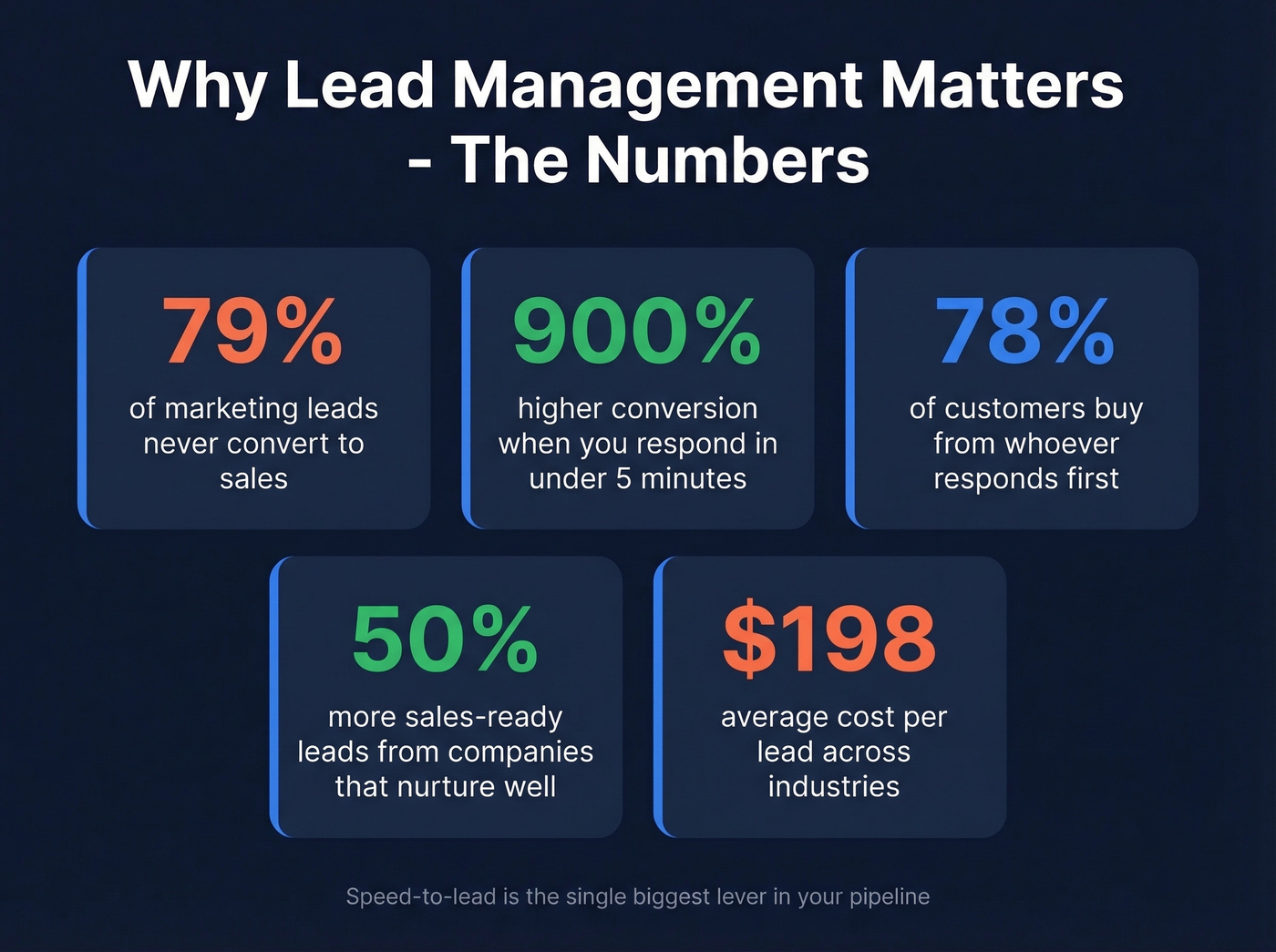
Companies that excel at lead nurturing generate 50% more sales-ready leads at 33% lower cost. The speed-to-lead data is even more dramatic: responding within 5 minutes increases conversion likelihood by 900%. Yet only 37% of businesses respond within the first hour, and 41% of sales teams struggle with timely, personalized engagement. Speed-to-lead dominates sales ops conversations for a reason (and it's a core lever in sales execution).
78% of customers buy from the company that responds first. That single stat should reshape how you think about managing leads. It's not about having the best pitch - it's about showing up before the competition does.
The 6-Stage Lead Management Process
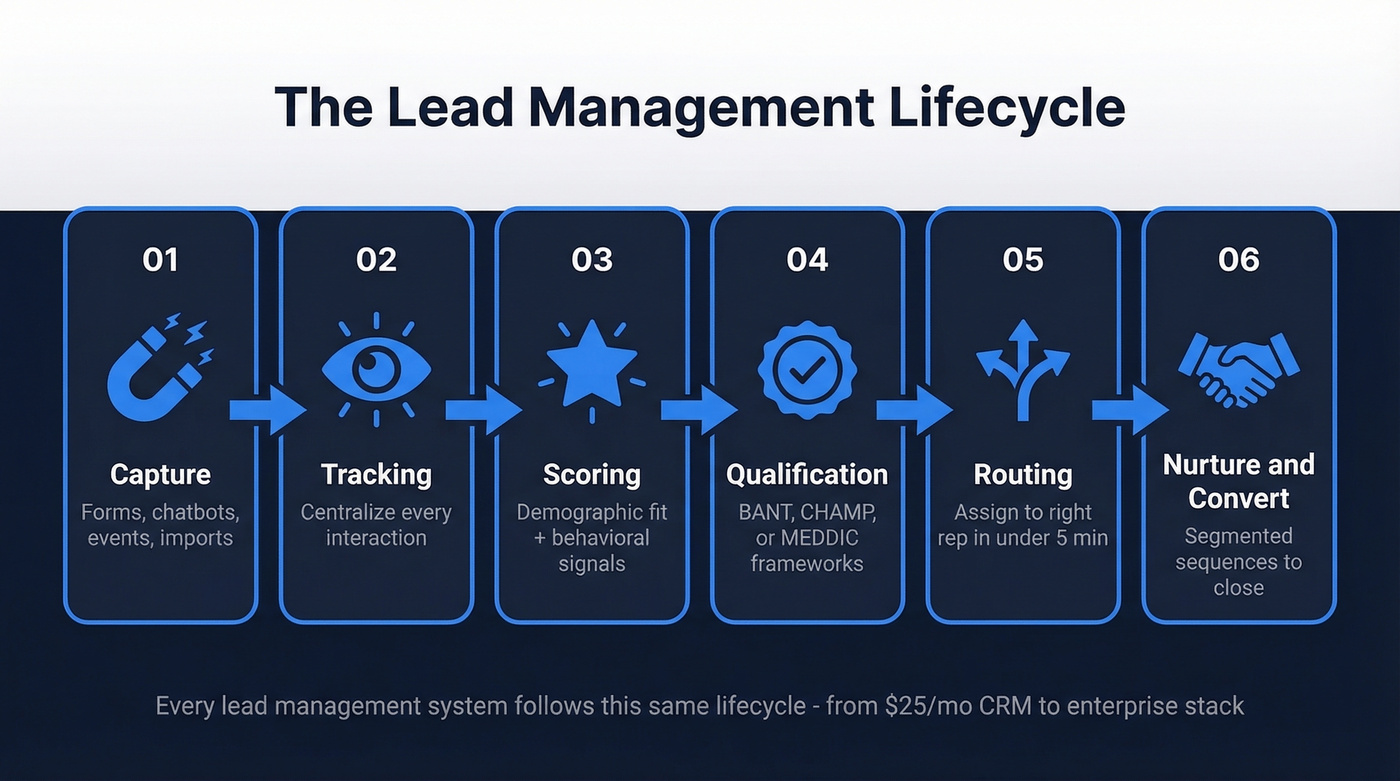
Every lead management system, whether it's a $25/month CRM or a six-figure enterprise stack, follows the same lifecycle.
Lead Capture
Leads enter your system through form fills, chatbots, event registrations, and outbound list imports. Reducing form fields from 11 to 4 increased submissions by 160% in one study. But capture isn't just about volume - verify contact data at point of entry so stale emails don't compound errors at every stage below. (If you're building lists at scale, see lead generation workflow.)
Lead Tracking
Centralize every interaction - email opens, pricing page visits, content downloads, webinar attendance - into a single record. Without centralized tracking, reps contact cold leads while missing active prospects who are signaling buying intent right now.
The best platforms track behavior automatically and surface it in the contact timeline. If your reps are manually logging activities, your tracking is already broken. (Related: identifying buying signals.)
Lead Scoring
Scoring separates signal from noise using two axes: demographic fit (job title, company size, industry, geography) and behavioral engagement (email clicks, pricing page visits, demo requests, webinar attendance). A VP of Engineering at a 200-person SaaS company who visited your pricing page twice this week scores differently than a marketing intern who downloaded a whitepaper once. Without scoring, reps treat every lead the same and waste time on the wrong ones. (Use a formal lead scoring model to standardize this.)
AI-powered scoring models are becoming table stakes in 2026. Platforms like HubSpot and Salesforce offer predictive lead scoring that adjusts weights automatically based on historical conversion data, removing the guesswork from manual threshold-setting.
Lead Qualification
Scoring tells you who's engaged. Qualification tells you who can actually buy. Only about 27% of leads passed from marketing to sales are genuinely qualified - that gap is where pipeline bloat lives. Frameworks like BANT, CHAMP, and MEDDIC give your team a shared language for deciding which leads deserve sales time. We'll break those down below. (If you're implementing MEDDIC, start with these MEDDIC discovery questions.)
Lead Routing
The fastest qualification in the world doesn't matter if the lead sits in a queue for 48 hours. Routing assigns qualified leads to the right rep based on territory, deal size, or round-robin rules. A common complaint on r/sales and sales ops communities is that leads get routed to the wrong rep or sit in queues for days - and every hour of delay after that first five-minute window erodes conversion probability. A well-configured lead management app can automate routing rules so no lead waits longer than it should.
Nurturing & Conversion
Most leads aren't ready to buy when they first engage. Proper segmentation can drive a 760% increase in email revenue. The marketing automation market was valued at roughly $47B in 2025 and is projected to reach $81B by 2030, with 80% of companies using automation reporting increased leads. The tools are ready. The bottleneck is execution - building sequences that match where the buyer actually is in their journey, not blasting the same drip to everyone. (For a practical system, see personalized drip campaigns.)
Qualification Frameworks Compared
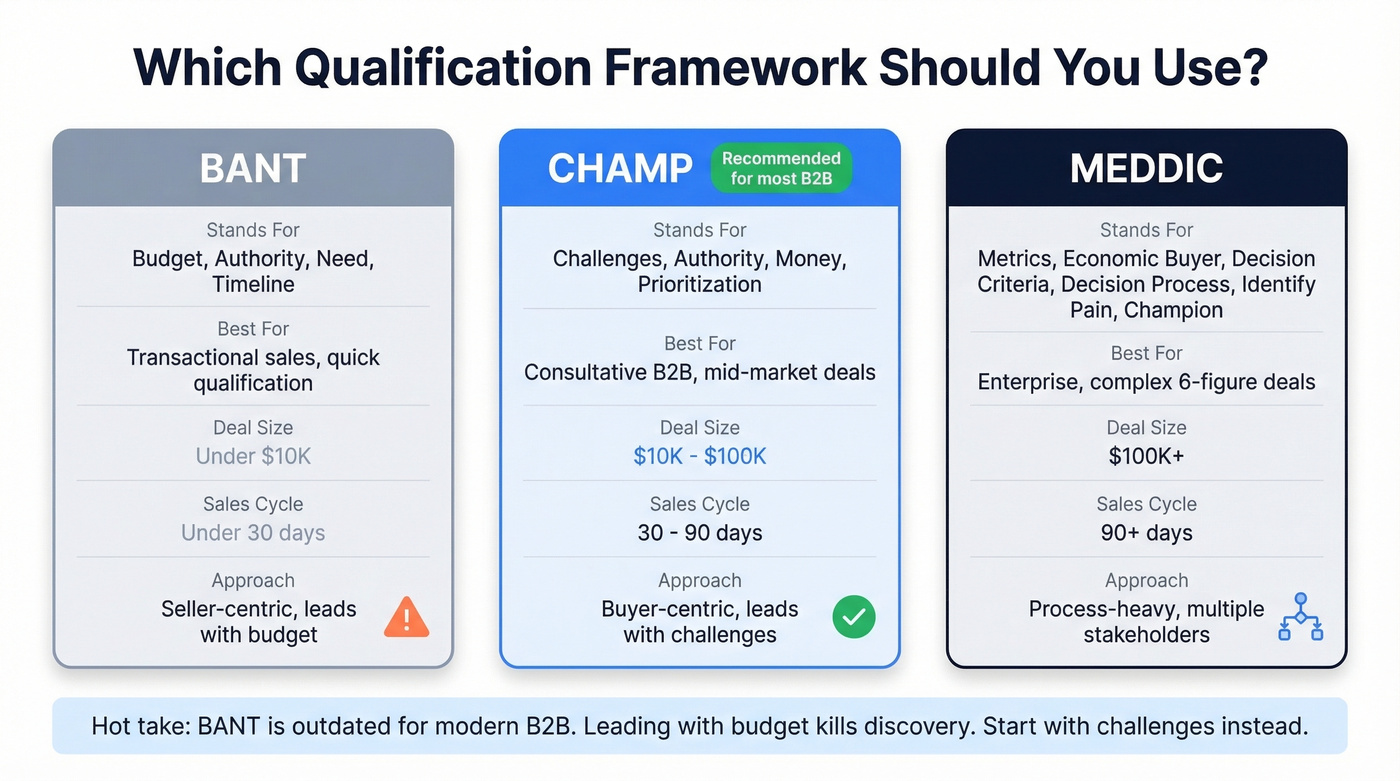
Three frameworks dominate B2B lead qualification:
| Framework | Stands For | Best For |
|---|---|---|
| BANT | Budget, Authority, Need, Timeline | Transactional sales, quick qualification |
| CHAMP | Challenges, Authority, Money, Prioritization | Consultative B2B sales |
| MEDDIC | Metrics, Economic Buyer, Decision Criteria, Decision Process, Identify Pain, Champion | Enterprise, complex deals |
Here's the take most articles won't give you: BANT is outdated for modern B2B. Leading with "what's your budget?" is seller-centric and kills discovery conversations. CHAMP flips the script - start with the prospect's challenges, then work toward whether they can buy. For most B2B teams selling mid-market deals, CHAMP is the sweet spot.
MEDDIC is powerful but overkill if your average deal closes in under 60 days. We've seen teams try to implement MEDDIC for $15K deals and the overhead just slows reps down. Save it for enterprise sales cycles with multiple stakeholders and six-figure contracts.

Bad data is the #1 lead management killer. If 30% of your emails bounce, scoring, routing, and nurturing all break downstream. Prospeo's 5-step verification delivers 98% email accuracy with a 7-day refresh cycle - so every lead in your pipeline has a valid contact attached.
Stop managing leads you can't actually reach.
Lead Management Software vs. CRM
These terms get used interchangeably, but they solve different problems:
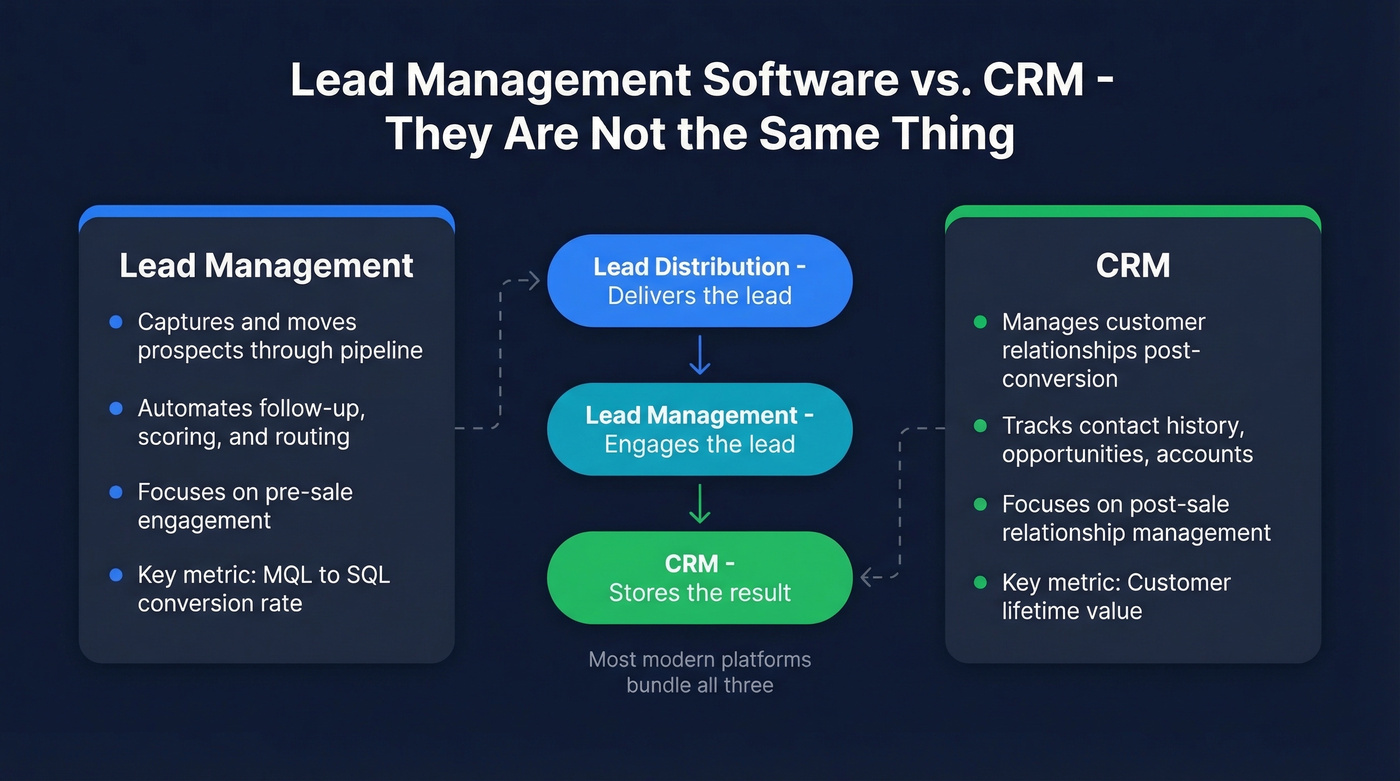
| Lead Management Software | CRM | |---|---|---| | Captures and moves prospects through the pipeline | Manages customer relationships post-conversion | | Automates follow-up, scoring, and routing | Tracks contact history, opportunities, and accounts | | Focuses on pre-sale engagement | Focuses on post-sale relationship management | | Key metric: MQL-to-SQL conversion rate | Key metric: customer lifetime value |
The cleanest way to think about the three-part stack: lead distribution delivers the lead, lead management engages it, CRM stores the result. Most modern platforms like HubSpot and Salesforce blur these lines by bundling all three. But understanding the distinction helps you diagnose where your pipeline is actually leaking. (If you need examples to map your stack, see examples of a CRM.)
Best Software for 2026
| Tool | Starting Price | G2 Rating | Best For |
|---|---|---|---|
| HubSpot | Free / from $20/user/mo | 4.4 | SMBs, free CRM + upgrades |
| Prospeo | Free / ~$0.01/email | - | Verified emails + mobiles |
| Salesforce | $25/user/mo | 4.3 | Enterprise customization |
| Pipedrive | $19/user/mo | 4.2 | Simple pipeline management |
| ActiveCampaign | $15/user/mo | 4.5 | Marketing automation + nurturing |
| Zoho CRM | Free (3 users) / $20/user/mo | 4.0 | Budget all-in-one |
| Freshmarketer | $11/mo | 4.6 | Cheapest marketing automation |
| LeadSquared | $40/user/mo | 4.4 | High-volume (education, lending) |
| Zendesk Sell | $25/user/mo | 4.2 | Teams on Zendesk support stack |
| Creatio | $40/user/mo | 4.6 | No-code workflow flexibility |
| Apptivo | $20/user/mo | 4.4 | Small team all-in-one suite |
| Keap | $229/mo | 4.2 | Built-in payments/invoicing |
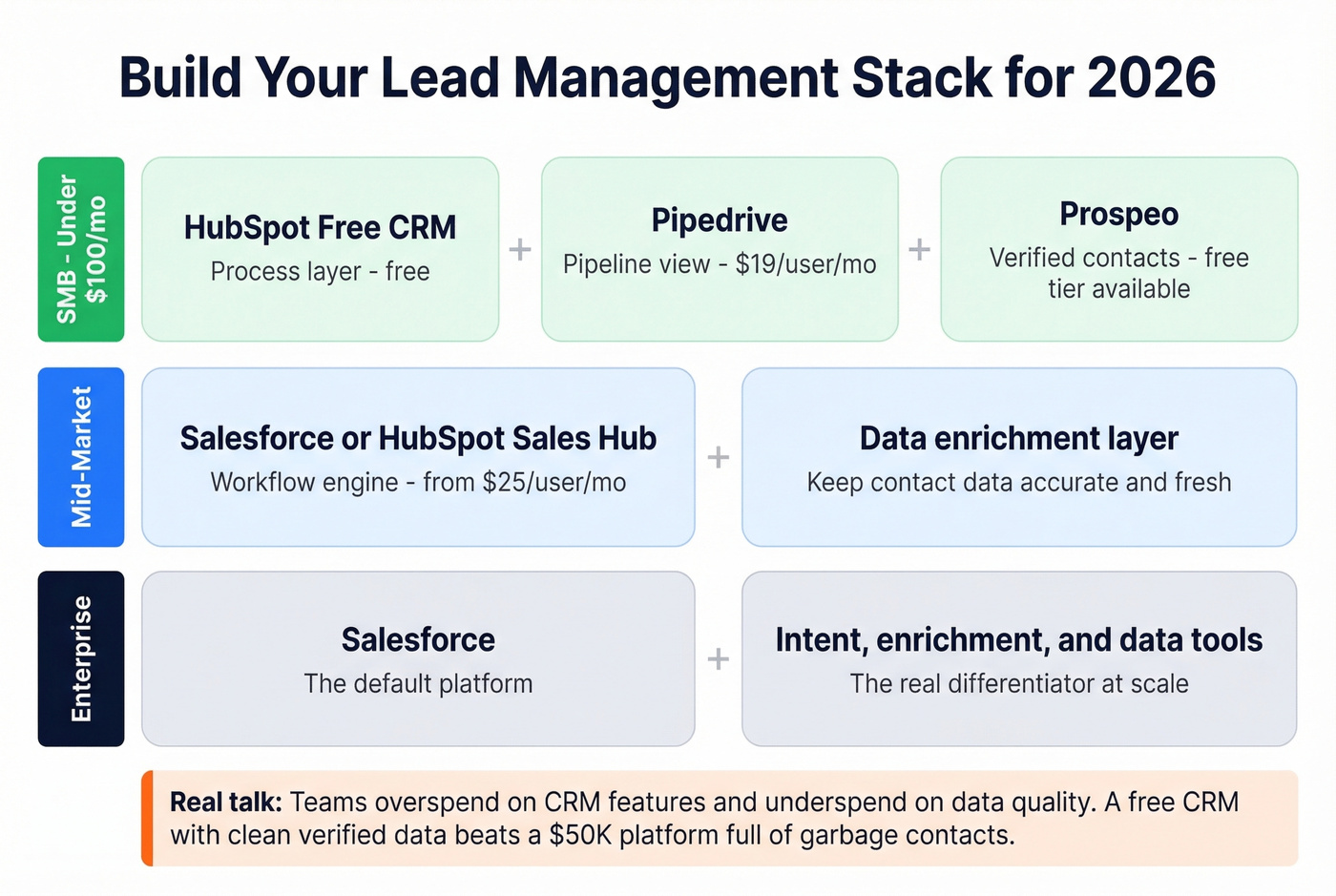
For SMBs: HubSpot's free CRM handles the process layer. Pair it with Pipedrive if you want a dedicated pipeline view. Layer in Prospeo for verified contact data - 300M+ professional profiles, 143M+ verified emails, and 125M+ verified mobile numbers on a 7-day refresh cycle, with native HubSpot and Salesforce integrations. Total cost: under $100/month for a 1-2 user setup, plus Prospeo's free tier of 75 emails/month. (If you're comparing data vendors, start with data enrichment services.)
For mid-market: Salesforce or HubSpot Sales Hub for the workflow engine, plus an enrichment layer to keep contact data accurate. The CRM manages the process; data quality tools ensure reps can actually reach the people inside it. (More on this in lead enrichment.)
For enterprise: Salesforce is the default. The real question is what data, intent, and enrichment tools you layer on top.

Let's be honest about something most vendors won't say: teams overspend on CRM features and underspend on data quality. We've run bake-offs where the "best CRM" lost because reps couldn't reach anyone on the lists it generated. If your average deal size is under $20K, a free CRM with clean, verified data will outperform a $50K platform filled with garbage contacts every single time. (If bounces are a recurring issue, benchmark against email bounce rate.)
Skip Keap unless you specifically need built-in invoicing - at $229/month it's hard to justify when HubSpot + a payment tool costs less and does more.
You just read that 79% of marketing leads never convert - and the root cause is broken follow-up. But follow-up fails when contact data is stale. Prospeo refreshes 300M+ profiles every 7 days (industry average: 6 weeks) and returns 50+ data points per contact, so your reps route and nurture real buyers, not dead emails.
Enrich your pipeline with data that actually connects.
KPIs Worth Tracking
You can't fix what you don't measure. These five metrics diagnose pipeline health:
Conversion rate by stage - what percentage of leads advance from MQL to SQL to opportunity to closed-won? This reveals exactly where your funnel leaks. If MQLs convert at 40% but SQLs stall at 10%, your qualification criteria are off. (To go deeper, use a dedicated funnel metrics dashboard.)
Cost per lead - total spend divided by leads generated, segmented by channel. Forbes recommends tracking this monthly to catch channel degradation early.
Speed-to-lead - median time from lead creation to first rep contact. If this exceeds 5 minutes, you're leaving money on the table.
MQL-to-SQL ratio - the handoff quality metric. Below 30% means marketing and sales disagree on what "qualified" means, and that disagreement is costing you pipeline.
Average sales cycle length - how many days from first touch to closed-won? Shortening this by even a few days compounds across your entire pipeline.
Mistakes That Kill Your Pipeline
The most common pipeline killer is targeting the wrong audience. If your ICP isn't defined with firmographic, technographic, and behavioral criteria, you're generating leads that will never convert. Define it, then enforce it. (Use an ideal customer profile template to make it operational.)
Broken qualification runs a close second. Too loose and reps waste time on unqualified leads; too rigid and good leads get filtered out. Standardize scoring with both fit and behavior signals to find the balance.
Single-channel dependency creates fragility that catches teams off guard. One team we talked to built their entire pipeline on a single paid channel, and when CPMs spiked 40% in Q3, their pipeline cratered overnight. Diversify before you have to.
The remaining mistakes are equally damaging but easier to fix. Ignoring analytics means you can't diagnose what's broken - A/B test everything and track the KPIs above. Neglecting nurturing loses the 73% of leads who aren't ready to buy today. Poor sales/marketing alignment lets leads fall through the cracks - shared definitions and SLAs fix this. And bad data quality is the silent killer: if 30% of your emails bounce, your sender reputation tanks and nurture sequences land in spam.
FAQ
What does a lead manager do?
A lead manager - whether a person or a system - captures, scores, qualifies, routes, and nurtures prospects through the sales pipeline until they convert or get archived. In most B2B organizations, the term refers to the software and processes that automate this lifecycle. A dedicated leads manager on a sales ops team typically owns the routing rules, SLAs, and reporting.
How fast should you respond to a new lead?
Within five minutes. Responding in that window increases conversion likelihood by 900%, and 78% of buyers choose the first company to respond. Configure your lead management app to trigger instant notifications - that alone closes the gap most teams struggle with.
What is lead scoring?
It's a system that ranks leads by fit (job title, company size, industry) and behavior (email opens, page visits, demo requests) to prioritize sales outreach. The best scoring models weight both axes and adjust thresholds as conversion data matures, ensuring reps spend time on prospects most likely to close.
How do you keep lead data accurate?
Use a verification tool that checks emails and phone numbers before they enter your CRM. Look for providers with weekly refresh cycles - the industry average is 6 weeks, which means most databases are already stale by the time reps use them.
What's the difference between lead management and CRM?
Lead management focuses on pre-sale pipeline activity - scoring, routing, and nurturing. CRM manages post-conversion customer relationships. Most modern platforms bundle both, but understanding the distinction helps you pinpoint exactly where your pipeline is leaking.
Remember those 200 leads from the top of this article? With a real lead manager system in place - capture verified, scoring automated, routing instant, nurturing personalized - 160 of them don't rot in a spreadsheet. They get worked. The ones that were never going to buy get archived fast so your reps focus on the ones that will. That's the difference between generating leads and generating revenue.