

Persuasive Sales Talk: The Framework Top Reps Actually Use
84% of reps missed quota last year, and the average B2B close rate sits at just 29%. Buyers spend only 17% of their total buying time meeting with potential suppliers - across all vendors, not just yours. So the window where persuasive sales talk actually matters is razor-thin, and most reps blow it by talking too much, pitching too early, or following up once and giving up.
Here's the one number worth memorizing: 43/57. That's the benchmark talk-to-listen ratio across millions of analyzed calls. Top reps talk 43% of the time and listen 57%. Everything below builds on that foundation.
The Three-Move Version
If you take nothing else from this piece, nail these three moves:
- Diagnose before you prescribe. Ask questions until you understand the problem better than the prospect does. Then - and only then - connect your solution. (If you need a bank of prompts, start with these open-ended sales questions.)
- Use real customer numbers instead of adjectives. Swapping vague value props for data-backed proposals lifted win rates by 20% in one practitioner's two-quarter test.
- Follow up five times, not once. 80% of deals need five follow-ups. 44% of reps quit after one. Persistence isn't annoying - it's table stakes. (Use a repeatable follow up cadence.)
Monroe's Motivated Sequence for Sales Calls
Alan Monroe published this five-step persuasion framework in 1943, and it still maps perfectly onto a modern sales call. It works because it mirrors how people actually decide - you can't skip to the ask without building the case first.
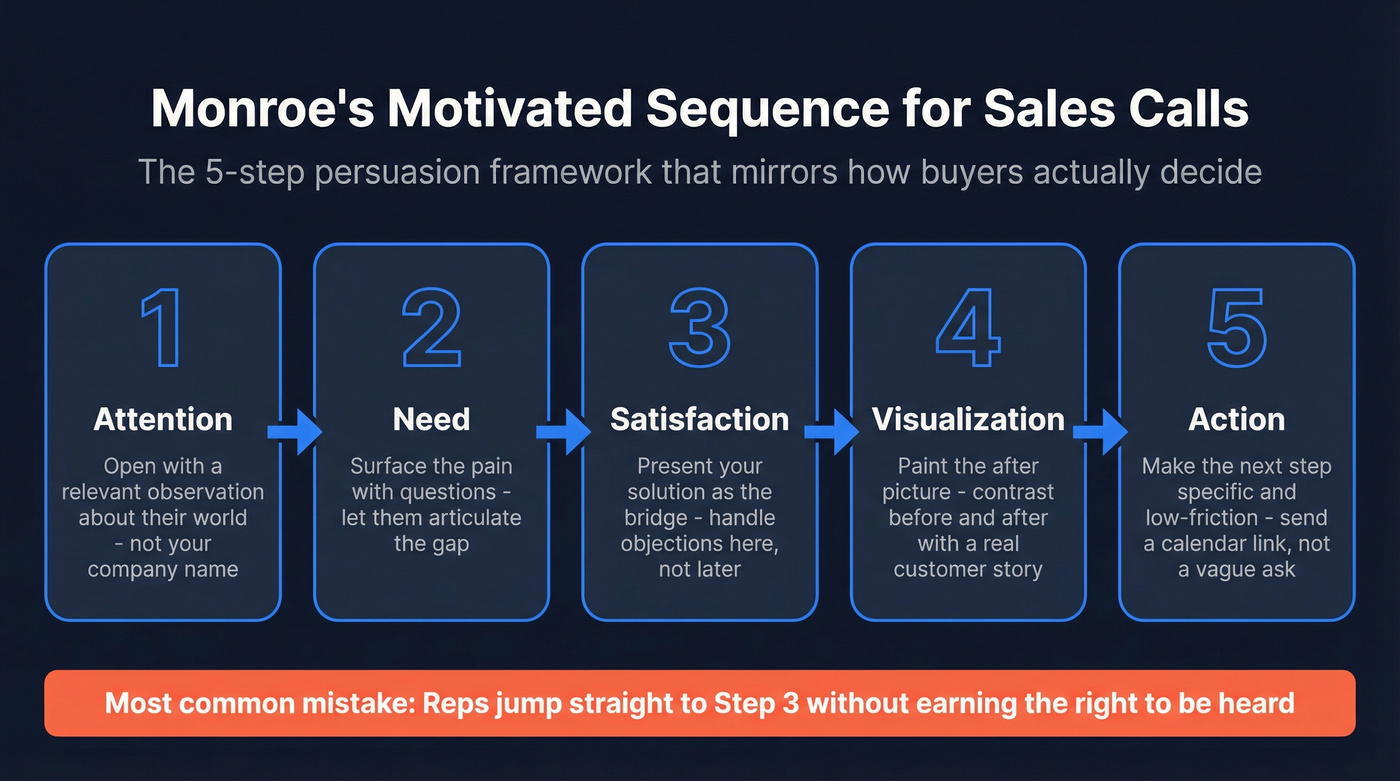
Step 1 - Attention. Open with something that earns the next 30 seconds. Not a feature. Not your company name. A relevant observation about their world. (More examples: sales pitch opening lines.)
Step 2 - Need. Surface the pain with questions, not statements. Let the prospect articulate the gap between where they are and where they want to be. (Use a tighter discovery call structure.)
Step 3 - Satisfaction. Present your solution as the bridge. Handle objections here - not at the end when the prospect's mentally checked out, but woven into the solution narrative. This is also where product demo storytelling shines: walk the prospect through a real scenario that mirrors their workflow instead of clicking through features in order.
Step 4 - Visualization. Paint the "after" picture. Go positive, negative, or contrast both. In our experience, the contrast method hits hardest - especially when you anchor it to a customer story that shows the before-and-after in concrete terms. We've seen reps close deals they had no business winning simply because the prospect could feel the gap between their current state and the outcome a similar company achieved.
Step 5 - Action. Make the next step specific and low-friction. Not "let me know what you think." Try: "I'll send a 15-minute calendar link for Thursday. We'll walk through the numbers together." (If you want templates, see these schedule meeting email examples.)
This sequence prevents the most common mistake in sales: reps jumping straight to Step 3 without earning the right to be heard.
Techniques That Make Sales Conversations Stick
Listen More Than You Talk
Every call. No exceptions. Analysis of millions of calls shows top performers hold steady at that 43/57 ratio. The real insight isn't the ratio itself - it's the consistency. Low performers' talk time swings wildly: 54% in won deals, 64% in lost deals. That 10-point swing means they monologue when nervous, which is exactly when they should be asking questions. (If you want the bigger picture, see sales conversation science.)
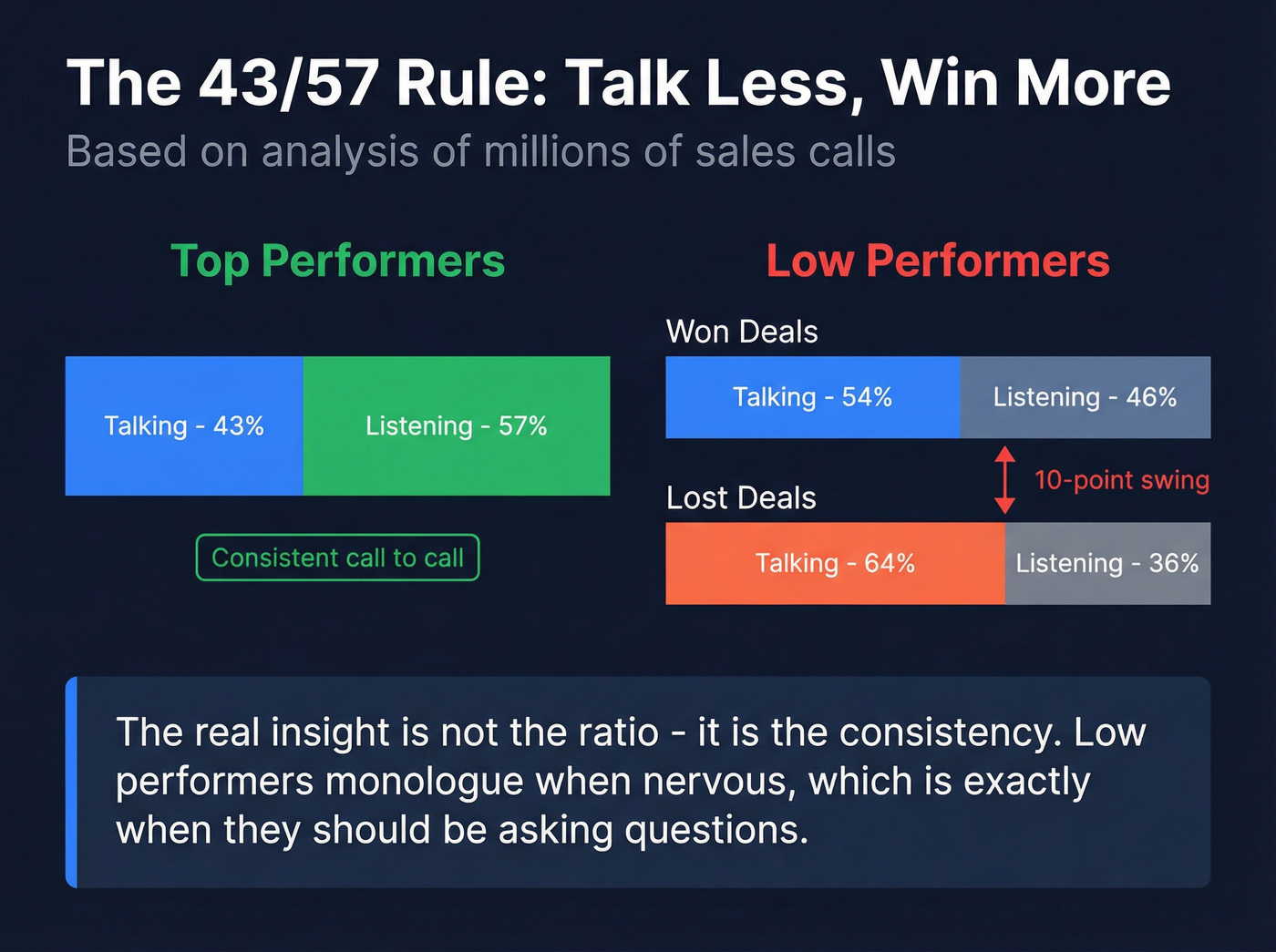
Here's the thing: if you only change one thing about your sales calls this quarter, put a sticky note on your monitor that says "57%." That single number will do more for your close rate than any script.
Lead With "Because"
You need the prospect to do something - take a meeting, loop in a stakeholder, share budget info. A Harvard study found that adding "because" increases agreement by 34%. "Can we schedule 15 minutes Thursday because I want to show you the ROI model before your planning cycle closes" beats the naked ask every time. (Pair it with a clean how to ask for a meeting via email ask.)
Skip this when the reason you'd give is obviously hollow. "Because I need to hit my number" isn't persuasion - it's desperation.
Use Social Proof in Demos
Don't say "companies like yours love us." Say "three SaaS companies in your revenue range cut bounce rates from 35% to under 4% in the first month." Bryan Vasquez, Head of Sales at LinkBuilder.io, found that replacing urgency-based CTAs with data-backed proposals increased win rates by 20% over two quarters. The best social proof is specific, quantified, and matched to the prospect's segment - irrelevant proof points erode trust faster than no proof at all.
Weave Stories Into the Process
Data and logic get a prospect's attention, but stories are what make the information stick. When you share how a similar company struggled with the exact same bottleneck, the prospect stops evaluating features and starts seeing themselves in the outcome.
Keep each story tight - situation, turning point, result - and always tie it back to the metric the prospect cares about most. I once watched a rep lose a deal by telling a beautiful customer story about reducing churn when the buyer only cared about pipeline velocity. Relevance beats eloquence.
Name the Competition Early
Data from millions of enterprise calls shows that bringing up competitors early increases win odds by 32%. Competitive mentions in sales conversations are up 57% since 2022 - buyers expect you to address alternatives. Ignoring them makes you look uninformed or evasive. (This also ties into competitive insights.)
Respect Their Autonomy
When you feel the prospect pulling back, try the "But You Are Free" technique. Explicitly acknowledging the prospect's right to say no has been tested across field studies with 22,000+ participants and roughly doubles compliance rates. Something like "Obviously, this is entirely your call - I just want to make sure you have the full picture" is the opposite of a hard close. And it works better.

Social proof only works when you reach the right prospects. Prospeo gives you 300M+ verified profiles with 98% email accuracy - so every data-backed story you tell lands in front of a real buyer, not a dead inbox.
Stop perfecting your pitch for contacts that bounce.
Objection-Handling Scripts
Stated objections almost always mask the real objection. Your job isn't to overcome - it's to diagnose. These diagnostic questions shift the conversation from defense to discovery. (Related: handling sales objections with curiosity.)
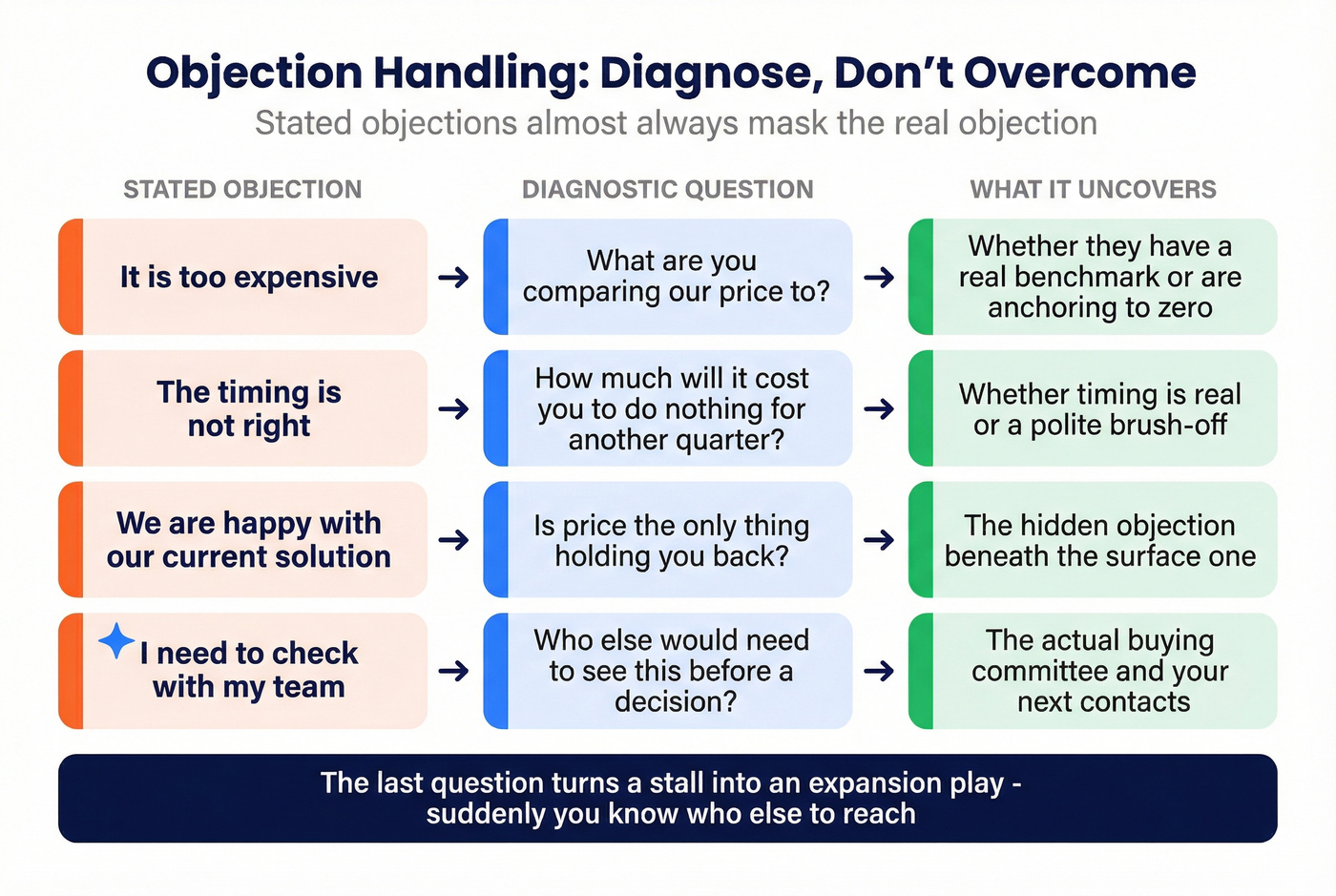
| Objection | Diagnostic Question | What It Uncovers |
|---|---|---|
| "It's too expensive" | "What are you comparing our price to?" | Whether they have a real benchmark or are anchoring to zero |
| "The timing isn't right" | "How much will it cost you to do nothing for another quarter?" | Whether timing is real or a polite brush-off |
| "We're happy with our current solution" | "Is price the only thing holding you back?" | The hidden objection beneath the surface one |
| "I need to check with my team" | "Who else would need to see this before a decision?" | The actual buying committee and your next contacts |
The last question is the most important one on this list. It turns a stall into an expansion play - suddenly you know who else to reach and what their concerns are.
Mistakes That Kill Persuasion
Pitching too early. We've watched reps send a deck five minutes into a call - before asking a single question - and it tells the prospect you don't care about their situation. You're just running a playbook. Wait. (This is the classic pitch slap.)
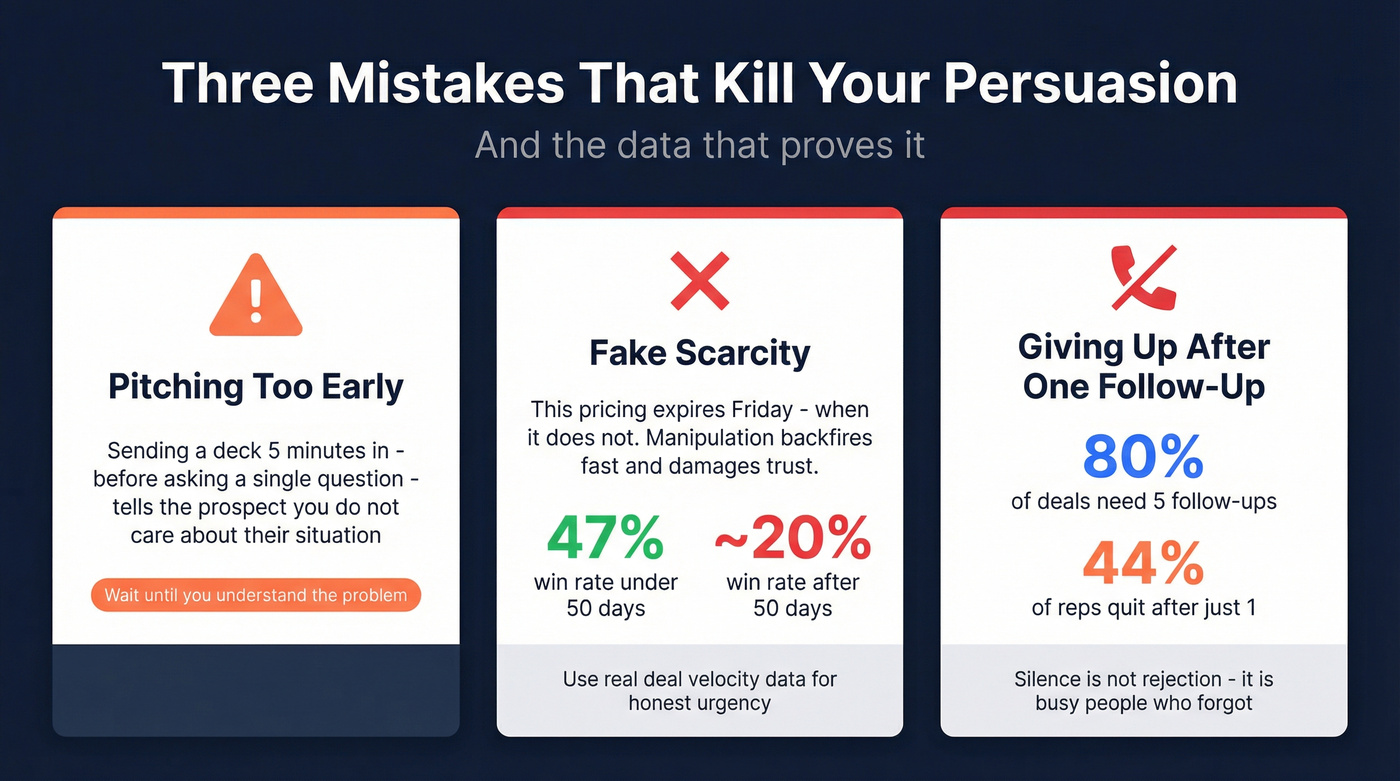
Fake scarcity. "This pricing expires Friday" when it doesn't. Vasquez puts it bluntly: manipulation "backfires fast" and "damages trust." Real urgency comes from deal velocity data - opportunities closed within 50 days have a 47% win rate versus roughly 20% after that window. Use that data to create honest urgency, not manufactured pressure.
Giving up after one follow-up. This is the silent killer. 80% of deals need five follow-ups to close, but 44% of reps stop after one attempt. Space your follow-ups, add new value each time, and don't confuse silence with rejection. The consensus on r/sales is that most "ghosting" is just busy people who forgot - not people who hate you.
Persuasion Starts Before the Call
Every technique above assumes you're actually reaching the right person. That's harder than it sounds. (Start with a tighter account qualification process.)
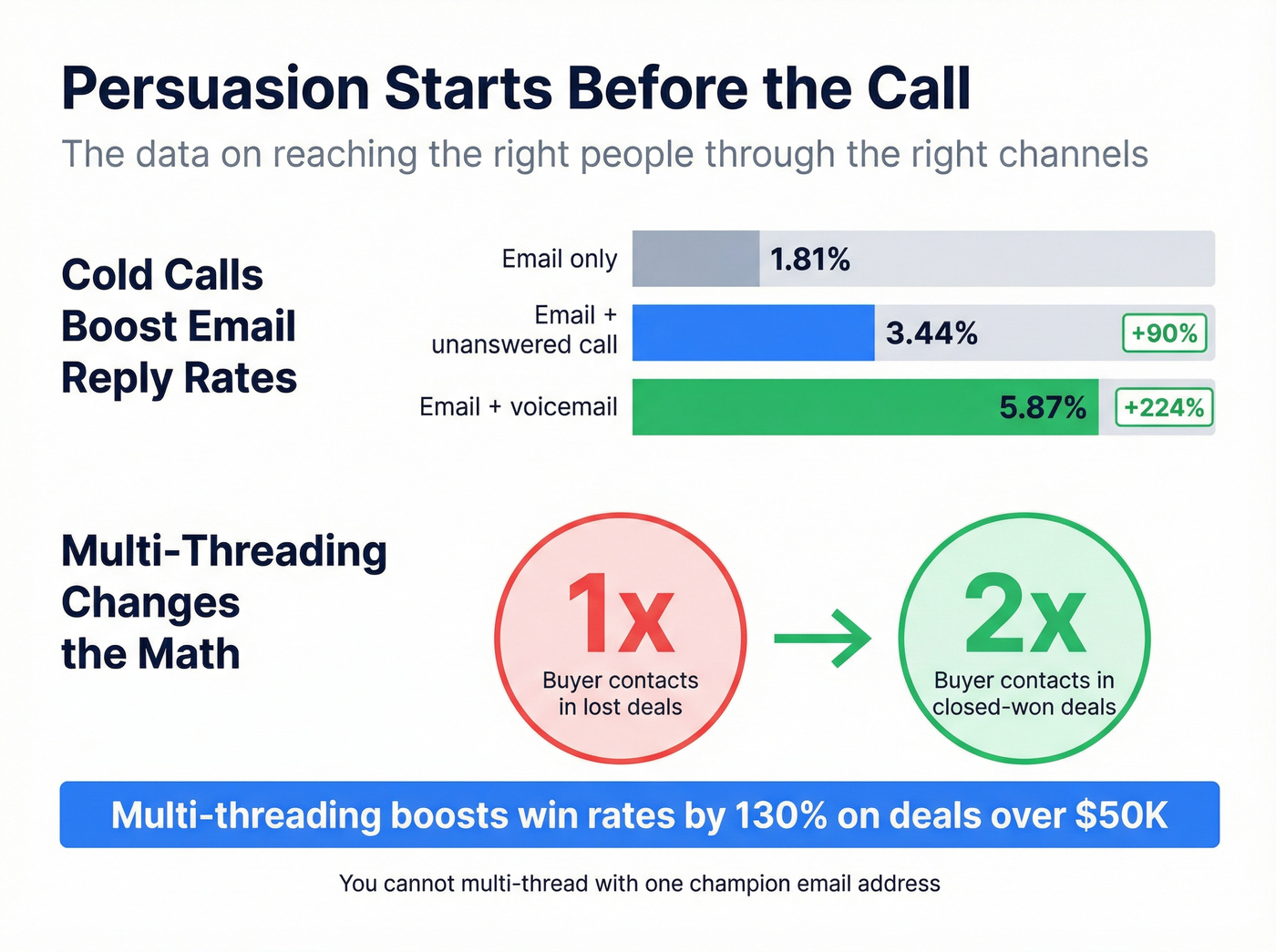
Cold calling nearly doubles email reply rates - 3.44% versus 1.81% - even without a live connection. Leaving a voicemail pushes it to 5.87%. But you need working phone numbers and verified emails to make any of that happen. The data on multi-threading makes this even more urgent: closed-won deals involve 2x more buyer contacts than losses, and multi-threading boosts win rates by 130% on deals over $50K. You can't multi-thread with one champion's email address.
Let's be honest - the best persuasion framework in the world doesn't matter if you're pitching the wrong person or bouncing off a dead inbox. Prospeo covers 300M+ professional profiles with 98% email accuracy on a 7-day refresh cycle, and their 125M+ verified mobiles hit a 30% pickup rate. For teams that need to reach entire buying committees, not just one champion, that kind of coverage changes the math on every deal.
You just learned that 80% of deals need five follow-ups. But following up five times with bad data burns your domain and kills deliverability. Prospeo's 7-day data refresh and 5-step verification keep bounce rates under 4% - so every follow-up actually reaches someone.
Protect your sender reputation at $0.01 per verified email.
FAQ
What's the ideal talk-to-listen ratio?
Top performers talk 43% and listen 57%, based on analysis of millions of sales calls. The bigger finding is consistency - low performers swing from 54% to 64% talk time between won and lost deals. Aim for the ratio, but focus on keeping it steady call to call.
How many follow-ups does it take to close a deal?
80% of sales require about five follow-ups, yet 44% of reps quit after one. Each follow-up should add new value - a case study, a relevant data point, or a stakeholder introduction - not just "checking in."
Does cold calling still work in 2026?
Yes. Analysis of 300M+ cold calls found top-quartile callers book 3x more meetings than average. Even unanswered calls boost email reply rates from 1.81% to 3.44%. The channel isn't dead - most reps are just bad at it.
How do I build a persuasive pitch around customer stories?
Pick a customer whose industry, size, and pain point closely match the prospect's. Structure the story as situation, turning point, measurable result - and let the prospect draw the parallel themselves. A well-placed story does more persuasive work than a slide full of bullet points.