

Prospecting and Qualifying: The Modern Rep's Guide to Pipeline That Converts
It's 2 PM on a Tuesday. You've made 40 calls, gotten three pickups, and one was a wrong number. Your CRM shows 200 "leads" but you can't tell which are real buyers and which are just names in a spreadsheet. This isn't a bad day - it's the default experience for most reps. 84% of reps missed quota last year, and the gap between reps who handle prospecting and qualifying systematically and those who wing it grows wider every quarter.
The fix isn't working harder. It's building a system where these two activities reinforce each other so every hour you spend actually moves pipeline forward.
What You Need (Quick Version)
Finding and vetting leads aren't separate steps you do in sequence. They're an iterative loop. You qualify as you prospect, and you prospect based on what you've qualified. To do both well, you need three things:
- A scored ICP so you stop guessing which accounts deserve your time. Not a vague persona doc - a numeric rubric that ranks accounts A, B, or C. (If you want a starting point, use an Ideal Customer Profile Template.)
- One qualification framework used consistently. BANT, MEDDIC, CHAMP - the specific framework matters less than using it on every deal. (If you're leaning enterprise, start with MEDDIC sales qualification.)
- Verified contact data so you're reaching real people. The best framework in the world doesn't help if 30% of your emails bounce. (Use data enrichment services to fill gaps before you scale.)
Here are the templates, benchmarks, and questions to implement all three.
What Are Prospecting and Qualifying?
Prospecting is finding potential buyers - identifying people and companies that might need what you sell. Qualifying is determining whether those people are worth pursuing right now. Can they buy? Do they have a real problem? Is there urgency?
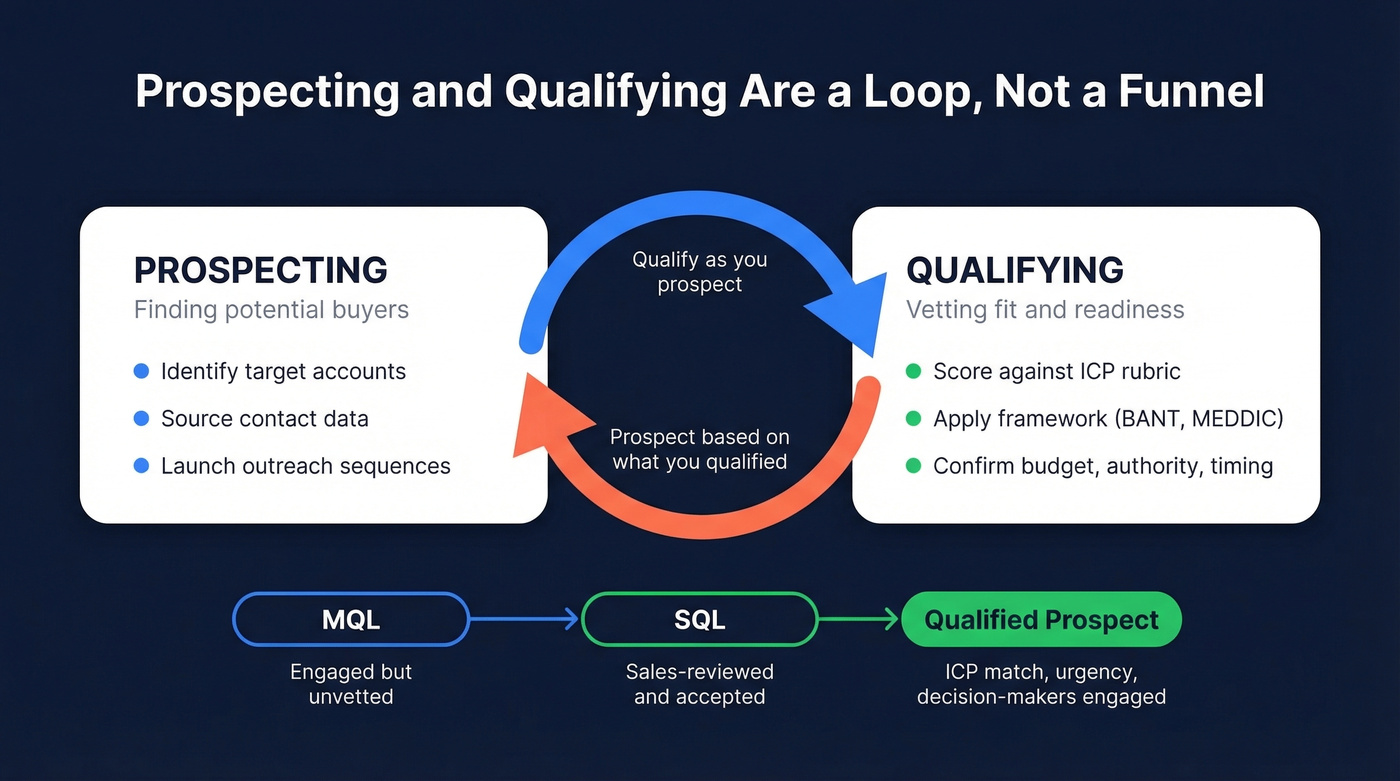
The distinction between MQL, SQL, and qualified prospect matters. An MQL has engaged with your content but hasn't been vetted by sales. An SQL has been reviewed and accepted for direct conversation. A truly qualified prospect matches your ICP, has a clear reason to act, has decision-makers engaged, and fits your sales cycle timeline.
Most teams treat these as a linear funnel: prospect first, qualify later. That's backwards. You should be qualifying from the first touchpoint - filtering your prospect list by ICP fit before you ever pick up the phone, then deepening qualification through every conversation.
The data backs this up. 95% of top-performing sales teams closely follow a defined sales process. Among underperformers, that number drops to 69%. The difference isn't talent. It's system. (If you need a baseline, start with sales process optimization.)
Why B2B Buying Changed Everything
B2B buying looks nothing like it did five years ago. Per Gartner, 80% of buyer interactions now happen in digital channels. Buyers use an average of 10 interaction channels - up from 5 in 2016 - and they spend just 17% of their buying time actually meeting with suppliers. The rest is independent research, internal alignment, and committee deliberation.
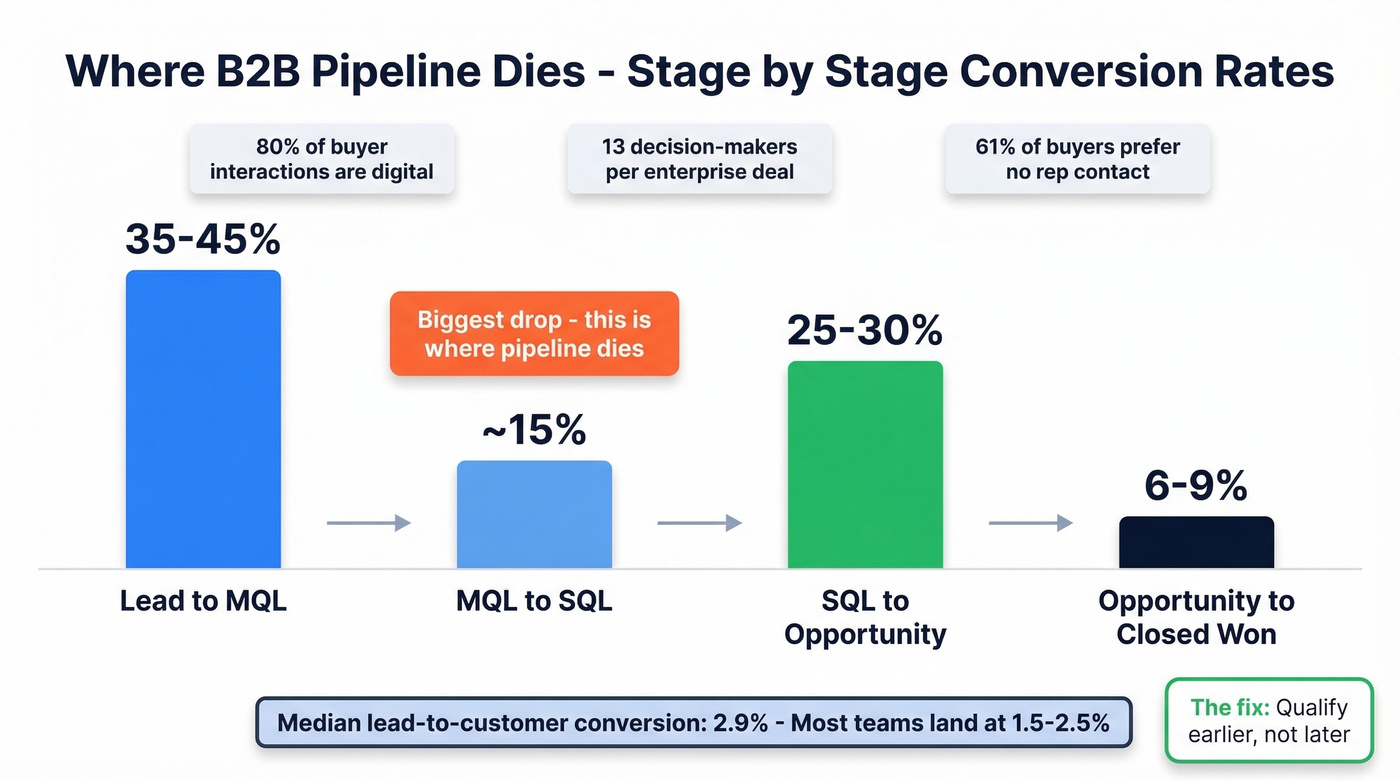
Those committees are massive. The average enterprise B2B deal now involves 13 decision-makers, with mid-market deals averaging around 7. Your "champion" is one voice among many, and they're all doing their own homework before you even get a meeting.
Meanwhile, 61% of B2B buyers prefer a completely rep-free buying experience. They don't want to talk to you. So when they do agree to a conversation, you'd better make it count - which means qualifying hard and fast. And 89% of B2B buyers report at least one deal stalling in the past year, often due to budget freezes or internal reorganization. Qualification isn't just about getting in. It's about knowing when the ground shifts beneath you.
The funnel math is brutal. The median B2B lead-to-customer conversion rate is 2.9%, and many teams land around 1.5-2.5% depending on channel and industry. Stage by stage: Lead-to-MQL converts at 35-45%, MQL-to-SQL drops to roughly 15%, SQL-to-Opportunity runs 25-30%, and Opportunity-to-Closed-won lands at 6-9%. That MQL-to-SQL gap is where most pipeline dies, and it's almost entirely a qualification problem. (To benchmark your own stages, use these funnel metrics.)
Build Your ICP First
Before you prospect a single account, you need to know what a good account looks like. Not in vague terms like "mid-market SaaS companies" but in scored, ranked, measurable terms.
An ICP isn't a buyer persona. Your ICP describes the ideal company - the firmographic, technographic, and behavioral profile of accounts most likely to buy, retain, and expand. Buyer personas describe the people within those companies. You have one ICP. You might have five personas. (If you're building this from scratch, start with firmographic and technographic data.)
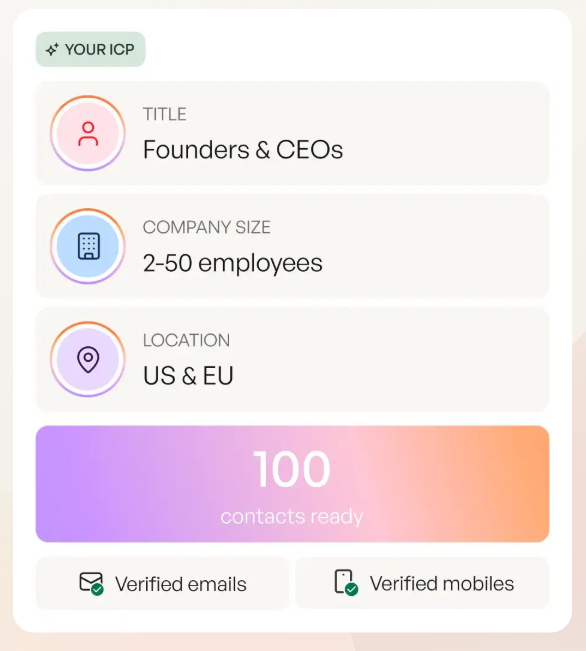
Pull 50-100 closed-won deals from the last 12 months and look for clusters. In our experience, 70-80% of wins share 3-5 common traits - industry, headcount range, tech stack, growth stage, or a specific pain trigger. Those traits become your scoring criteria.
The 100-Point Scoring Rubric
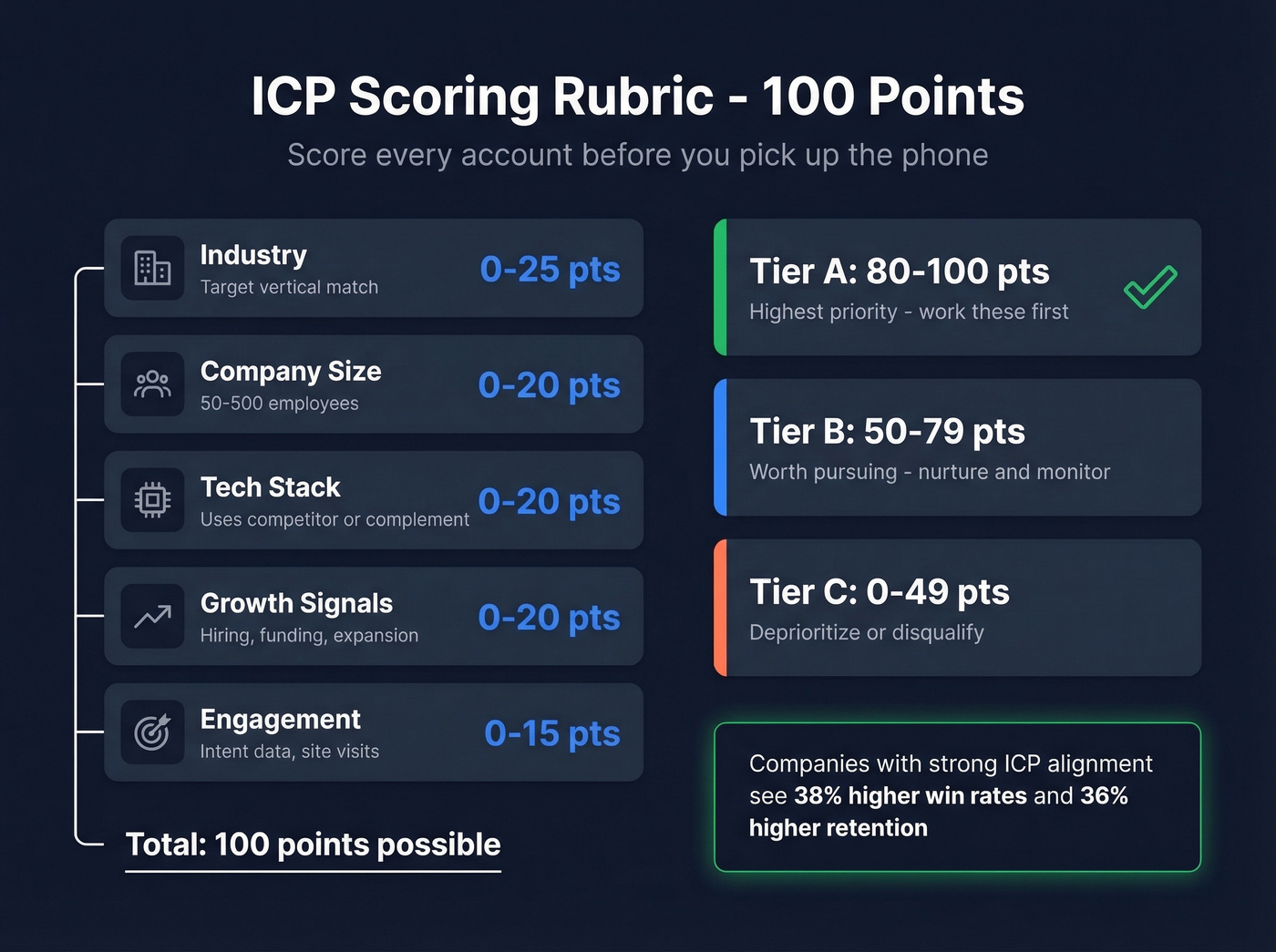
Assign points across your key dimensions:
| Dimension | Criteria Example | Points |
|---|---|---|
| Industry | Target vertical | 0-25 |
| Company size | 50-500 employees | 0-20 |
| Tech stack | Uses competitor/complement | 0-20 |
| Growth signals | Hiring, funding, expansion | 0-20 |
| Engagement | Intent data, site visits | 0-15 |
Tier thresholds: Tier A = 80-100 points. Tier B = 50-79. Tier C = 0-49.
Worked example: Say you sell an HR analytics platform to mid-market companies. You score a prospect: Healthcare vertical = 25 pts, 200 employees = 20 pts, uses Workday = 20 pts, just raised Series B = 20 pts, visited your pricing page twice = 15 pts. Total: 100 - Tier A. Now compare that to a 30-person retail startup with no HR tech and no engagement signals. That's a Tier C. The rubric makes the decision for you.
Your Tier A accounts should show 1.5-2x the win rate of Tier B and 15-20% shorter sales cycles. If they don't, recalibrate your scoring. Companies with strong ICP alignment see 36% higher retention, 38% higher win rates, and 208% growth in marketing-generated revenue.
Channels That Work in 2026
Not every channel works for every team. Here's what to use and what to skip, based on where the data actually points. (For more plays, see these sales prospecting techniques.)
Cold Calling
57% of C-level executives prefer phone over any other channel. The overall success rate is just 2.3%, and it takes an average of 8 attempts to reach someone - but when you connect, the conversation quality is unmatched. If you're selling to C-suite or VP-level buyers, this is your highest-leverage channel. Skip it if you're targeting individual contributors or technical buyers who screen every call; your time is better spent on async channels. (If you're rebuilding your motion, use a cold calling system.)
Cold Email
Signal-specific personalization drives 18% response rates vs 3.4% for generic outreach. That's a 5x difference. The key is personalizing based on real signals - job changes, funding rounds, tech stack, intent data - not blasting the same template to 10,000 contacts. Do the latter and you'll tank your domain reputation and get worse results than doing nothing. (If you need structure, start with a B2B cold email sequence.)
Social Selling and Inbound
This is the channel most reps underinvest in. Sharing insights, commenting on prospects' posts, and publishing short-form content that demonstrates expertise builds familiarity before you ever send a cold message. Personalized InMail sees a 46% lift in acceptance when you mention a shared connection or commonality. The compounding effect is real: reps who consistently post and engage build inbound pipelines that reduce their dependence on cold outreach over time.
Referrals
Referral leads convert at 3-5x the rate of cold outreach and close faster. Most teams know this but don't build a process around it. If you have happy customers, create a systematic way to ask - a quarterly check-in, a post-onboarding prompt, a mutual introduction template. If your product is too new for a referral base, focus on outbound first and layer referrals as you build your customer roster.
Multi-Channel Sequences
It takes 5-18 touches to book a meeting in 2026, and multi-channel outreach converts dramatically better than single-channel. 43% of buyers who accept meetings say it's fine to be contacted 5+ times. Here's the speed imperative: up to 50% of sales go to the first vendor to respond. But a bad multi-channel sequence is worse than a good single-channel one, so don't layer channels until you can maintain quality across all of them.

You just built a 100-point ICP scoring rubric. Now you need data that matches it. Prospeo's 30+ search filters - buyer intent, technographics, headcount growth, funding, job changes - let you find Tier A accounts and pull 98% accurate emails in the same workflow. No bounces killing your domain. No wrong numbers wasting your Tuesday.
Stop qualifying leads you can't actually reach.
Qualification Frameworks - Pick One
There are four frameworks worth knowing. They all work. The one you pick matters less than whether your team actually uses it.
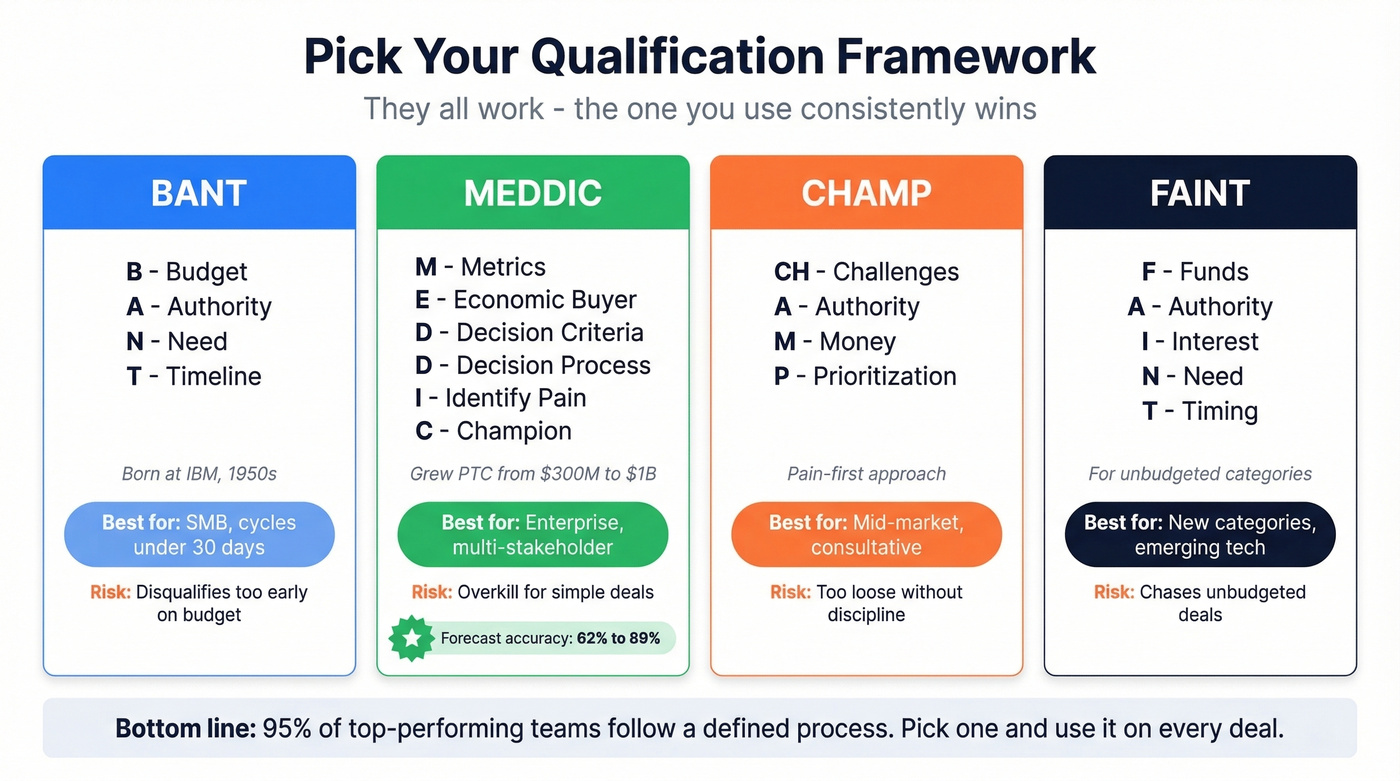
| Framework | Best For | Starts With | Risk |
|---|---|---|---|
| BANT | SMB, short cycles (<30 days) | Budget | Disqualifies too early |
| MEDDIC | Enterprise, multi-stakeholder | Metrics | Overkill for simple deals |
| CHAMP | Mid-market, consultative | Challenges (pain) | Too loose without discipline |
| FAINT | No formal budget exists | Funds (available $) | Chases unbudgeted deals |
BANT came out of IBM in the 1950s. It's fast and effective for high-velocity sales with small buying committees and cycles under 30 days. The risk is disqualifying prospects who have real need but haven't allocated budget yet.
MEDDIC was created at PTC in the 1990s and helped them grow from $300M to $1B in four years. It's built for enterprise complexity - multi-stakeholder deals where you need to map the entire decision process. Teams that adopt MEDDIC consistently report forecast accuracy jumping from 62% to 89%. (If you want prompts, use these MEDDIC discovery questions.)
CHAMP flips the script by starting with Challenges instead of Budget. Natural fit for consultative mid-market sales where the prospect knows they have a problem but hasn't quantified it yet.
FAINT works when your buyer doesn't have a formal budget line item. Think new categories or emerging tech where you're creating the budget, not competing for it.
Worked example (MEDDIC): You're selling a $120K analytics platform to a 500-person fintech. Metrics: the prospect's team wastes 15 hours/week on manual reporting. Economic Buyer: the CFO, who controls the budget. Decision Criteria: they need SOC 2 compliance and Snowflake integration. Decision Process: the CFO needs sign-off from IT security and procurement, with a 6-week review cycle. Identify Pain: their current tool breaks every quarter-end. Champion: the VP of Data, who brought you in. Now you have a map. Without it, you're guessing.
One more thing worth adding to any framework: a winnability check. Even a fully qualified deal can be unwinnable if the incumbent has a lock on the account or your brand doesn't have credibility in that vertical. Before investing serious cycles, ask yourself honestly - can we actually win this, or are we just column fodder?
The consensus on r/sales is that all these methodologies boil down to the same fundamentals: need, budget, stakeholders, timeline. That's not wrong. But having a named framework gives your team a shared language and a consistent process. Pick one, commit for 90 days, measure your results, then decide if you need to switch.
Qualifying Questions by Stage
Strong questioning skills correlate directly with results. Teams that ask better discovery questions report 20-30% win rates vs low teens for teams relying on scripted, closed-ended questions. (If you want a deeper library, use these discovery questions.)
Discovery (First Call)
These questions uncover whether a real problem exists and whether there's urgency:
- "What happens if you do nothing about this for the next 12 months?"
- "What's prevented you from solving this until now?"
- "How is this problem affecting your team day-to-day?"
- "Who else is feeling the impact of this?"
Evaluation (Second/Third Touch)
Now you're mapping the decision process and competitive landscape:
- "Walk me through how your team has evaluated solutions like this before."
- "What alternatives are you considering right now?"
- "Who else needs to weigh in before a decision gets made?"
- "What would a successful outcome look like in 6 months?"
Decision (Late Stage)
These questions confirm you're not chasing a dead deal:
- "What's your timeline for making a decision?"
- "Are there any internal hurdles - legal review, procurement, security - we should plan for?"
- "Has budget been allocated, or does that still need approval?"
- "What would cause this deal to stall?"
At minimum, you need answers to 8 core questions before moving any deal to pipeline: problem, why now, consequence of inaction, alternatives tried, budget, decision-maker, hurdles, and timeframe. If you can't answer all eight, you haven't qualified - you've just had a nice conversation.
Lead Scoring - From Gut Feel to System
Most teams score leads by gut feel. "This one seems warm." That doesn't scale. A simple point-based system turns subjective judgment into a repeatable process. (If you want a full model, see lead scoring.)
Point Values
| Action | Points |
|---|---|
| Open email | +5 |
| Click link | +10 |
| Download whitepaper | +15 |
| Visit pricing page | +20 |
| Request demo | +50 |
| Unsubscribe | -20 |
| Email bounce | -10 |
| No engagement 60+ days | -15 |
Thresholds: 0-30 = Cold | 31-70 = Warm | 71+ = Hot
Negative scoring matters as much as positive. An unsubscribe or a bounced email should pull a lead's score down fast. If someone hasn't engaged in 60+ days, that penalty prevents stale leads from clogging your pipeline.
Build this collaboratively between sales and marketing. Marketing knows which content signals intent; sales knows which behaviors actually correlate with closed deals. Neither team has the full picture alone. We've seen teams where marketing scores a whitepaper download at 25 points, but sales knows those leads almost never convert. Alignment on the model prevents wasted handoffs. Companies that map customer journeys this way are 2x more likely to outperform competitors.
Common Mistakes That Kill Pipeline
Five patterns destroy pipeline more than anything else.
Targeting the wrong people. Without a scored ICP, reps spray outreach across accounts that were never going to buy. This is the most expensive mistake because it wastes time on every subsequent step.
Giving up too soon. 43% of buyers who accept meetings say they're fine being contacted 5+ times. Most reps stop after 2-3 touches. Persistence isn't annoying - it's expected. (If you need copy, use these sales follow-up templates.)
Impersonal outreach. Buyers say 58% of sales meetings aren't valuable. If your emails read like they were written for anyone, they'll be ignored by everyone.
Not qualifying continuously. Qualification isn't a one-time gate at the top of the funnel. Deals change. Champions leave. Budgets get frozen. If you're not re-qualifying at every stage, you're building pipeline on assumptions.
Bad data - the silent killer. I watched a team load 5,000 contacts into a sequence, only to see 38% bounce on the first send. Their domain reputation tanked, deliverability cratered, and it took weeks to recover. If your bounce rate is above 5%, fix your data before touching your scripts. (Start with email bounce rate and then go deeper with an email deliverability guide.) Snyk's team went from a 35-40% bounce rate to under 5% after switching to Prospeo's real-time verification and 7-day refresh cycle, and their AE-sourced pipeline jumped 180%.
Modern Prospecting Tools
The AI sales tools market hit $3B in 2025 and is growing at ~13% annually. Sellers who effectively partner with AI are 3.7x more likely to meet quota, and AI reclaims 4-7 hours per rep per week on research and list building. Intent-based timing alone can compress sales cycles by 20-30%. Responding to buying signals within an hour makes you 7x more likely to qualify the lead.
Let's break down the tools that actually earn their keep. (If you're comparing stacks, start with these SDR tools.)

Prospeo
Prospeo's edge is data freshness and accuracy: 98% email accuracy on a 7-day refresh cycle versus a ~6-week industry average. The database covers 300M+ professional profiles with 143M+ verified emails and 125M+ verified mobiles with a 30% pickup rate. Filters go beyond firmographics into buyer intent, technographics, and job changes. Native integrations include Salesforce, HubSpot, Clay, Instantly, Smartlead, and Lemlist. Real results: Snyk's 50-person AE team now generates 200+ new opportunities per month, and Meritt tripled pipeline from $100K to $300K per week. Free tier available (75 emails/month + 100 Chrome extension credits/month), paid plans run about $0.01 per email with no contracts.
Clay
Clay is the tool for "weirdly specific" lists. It chains enrichment steps together - pull a company list, enrich with technographics, filter by hiring signals, then append verified contacts. The setup is heavier than a traditional database, but the output is hyper-targeted. The consensus on r/salestechniques is that Clay is unmatched for creative list building once you learn the workflow. (If you're new to it, start with Clay list building.) Free tier available, paid plans from ~$149/mo.
Apollo
Apollo is the obvious starting point for teams that need a database and basic sequencing in one platform. Broad coverage, easy UI, and a generous free tier make it the default for SMB and early-stage teams. Data accuracy runs lower than specialized providers - expect gaps in mobile coverage and EMEA data specifically - but for getting reps moving fast, it's hard to beat. Free tier, paid from ~$49-99/mo per user.
Amplemarket
Amplemarket ties intent scoring, personalization, and outreach into a single platform. Its "Duo" copilot handles signal detection and message drafting. Heavier learning curve, but strong for teams that want enrichment-to-delivery in one workflow. Not public pricing - expect $500-1,500/mo depending on team size.
Lusha
Quick phone number lookups, especially for European contacts. More of a utility than a platform - useful as a complement to your primary database when you need a direct dial fast. Plans start around $36/mo per user.
Here's the thing: if your average deal size is under $15K, you probably don't need a $30K/year data platform. Start with a self-serve tool, nail your ICP scoring, and upgrade when your pipeline justifies it. The reps who outperform aren't the ones with the most expensive tech stack. They're the ones who actually use what they have.
That MQL-to-SQL gap where most pipeline dies? It's a data problem. Reps waste hours chasing contacts that bounce, disconnect, or never existed. Prospeo refreshes 300M+ profiles every 7 days - not every 6 weeks - so your qualification calls connect to real decision-makers with verified emails and direct dials.
Close the gap between qualified and reachable - for $0.01 per email.
FAQ
What's the difference between prospecting and qualifying?
Prospecting is finding potential buyers; qualifying is determining whether they're worth pursuing based on fit, need, budget, and timing. In practice, they overlap - you should qualify from the first touchpoint, not after building a full list. Every conversation should deepen your understanding of whether a deal is real.
Which qualification framework works best?
BANT suits SMB deals with cycles under 30 days, MEDDIC handles enterprise multi-stakeholder complexity, and CHAMP fits consultative mid-market sales. The best framework is whichever your team uses consistently - all of them cover need, budget, authority, and timeline.
How many touches does it take to book a meeting?
Expect 5-18 touches depending on deal size and seniority of the buyer. Multi-channel outreach - email, phone, and social combined - converts significantly better than any single channel alone. Don't give up after three attempts; 43% of buyers who accept meetings are fine being contacted 5+ times.
What's a good lead-to-customer conversion rate?
The median B2B conversion rate is 2.9%, with many teams landing around 1.5-2.5%. The biggest drop-off is MQL-to-SQL (~15% conversion), which is almost entirely a qualification gap. Tightening your ICP scoring and discovery questions is the fastest way to improve this number.
How do I fix high bounce rates before scaling outreach?
Use a data provider with real-time verification and a refresh cycle measured in days, not weeks. Aim for under 5% bounce rate to protect domain reputation. If you're above that threshold, fix your data before scaling - no amount of copywriting fixes a deliverability problem.