

The SaaS Sales Strategy Playbook for Operators Who Need Pipeline, Not Theory
Your VP of Sales just showed you the Q2 pipeline report and it's 40% lighter than Q1. The board deck is in three weeks. You don't need another "what is SaaS sales" explainer - you need a SaaS sales strategy that connects your motion, your metrics, and your execution cadence into something that actually generates revenue.
That's what this playbook covers: the operating system behind selling software in 2026, built for people who own a number. No fluff, just the mechanics that move pipeline.
Three Quick Diagnostics
Before you read further:
- Pipeline leaking? Check your MQL-to-SQL conversion. The benchmark is 15-21% - most teams sit below it. If yours is under 10%, your qualification criteria are broken before anything else matters. (If you want a deeper breakdown of what to track, start with pipeline report metrics.)
- Outbound not working? It's probably a data problem before it's a messaging problem. If 30%+ of your emails bounce, no subject line on earth will save you. (More on bounce thresholds in bounce rates.)
- Don't know which motion to run? Match it to your deal size. Pure PLG under $5K ACV, hybrid for $1K-$50K, sales-led above $50K. We break each one down below.
What Makes SaaS Sales Different
SaaS flipped the incentive structure of enterprise software. When your customer can cancel next month, retention becomes more valuable than closing. The relationship doesn't end at signature - it starts there.
That changes everything about how you sell, staff, and measure. Switching costs are lower than traditional software, which means churn risk is constant. Your sales team isn't just acquiring revenue; they're setting the stage for expansion and renewal. A rep who closes a bad-fit deal is actively destroying value.
This is also why pricing strategy is a sales lever, not just a finance decision. About 68% of SaaS companies offer both annual and monthly billing, with 16.7% being the most common annual discount. Annual contracts improve cash flow and reduce churn by creating a natural commitment cycle. If you're only offering monthly billing, you're leaving retention and cash efficiency on the table.
One number should shape your entire go-to-market: 97% of B2B buyers want to try before buying. Only 3% prefer talking to a salesperson first. If your motion doesn't account for that, you're swimming upstream from day one.
PLG vs. Sales-Led vs. Hybrid
The PLG-versus-sales-led debate is a false binary. It's a spectrum, and your position on it should be dictated by your ACV, not by what's trendy on Twitter.
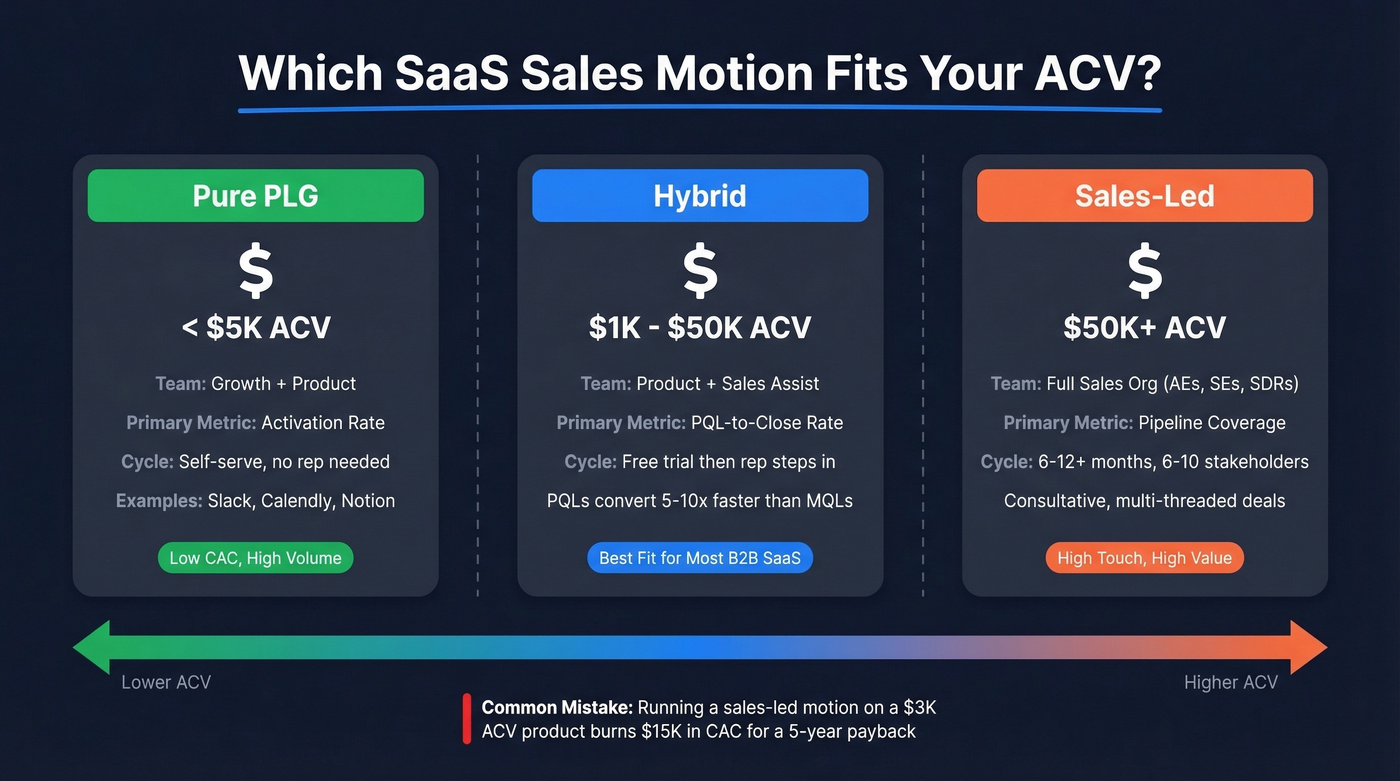
Pure PLG works when your product can deliver value without human intervention and your deal size is under $5K. Think Slack, Calendly, Notion. The user signs up, experiences the product, and either converts or doesn't. Your "sales team" is the product itself.
Sales-led makes sense above $50K ACV. At that price point, buyers expect a consultative process. They have procurement teams, security reviews, and 6-10 stakeholders. No free trial is going to close that deal. (If you're building for that segment, use an enterprise sales playbook, not SMB tactics.)
The hybrid zone - $1K to $50K - is where most B2B SaaS companies actually live, and it's where free trial strategy becomes critical. Users try the product, hit a usage threshold, and a rep steps in to expand the account. The best hybrid teams call within five minutes of a trial signup and make the product feel indispensable before the trial expires. Time-limited trials (14 days) create urgency; feature-limited free tiers create expansion triggers. PQLs from these motions convert 5-10x faster than MQLs, prospects who've experienced the product close 25% faster, and launching a free tier typically yields 20-30% more signups.
| Motion | ACV Range | Team Structure | Primary Metric |
|---|---|---|---|
| Pure PLG | < $5K | Growth + product | Activation rate |
| Hybrid | $1K-$50K | Product + sales | PQL-to-close rate |
| Sales-led | $50K+ | Full sales org | Pipeline coverage |
The most common mistake we see: companies running a sales-led motion on a $3K ACV product. You're burning $15K in CAC to close a deal that won't pay back for five years. Match the motion to the math. (If you need to pressure-test your unit economics, start with CAC.)
Selling by Segment
Your sales process should look fundamentally different depending on who you're selling to. An SMB deal and an enterprise deal share almost nothing in common except the CRM they're tracked in.
| Dimension | SMB (< 500 emp) | Mid-Market (500-2K) | Enterprise (2K+) |
|---|---|---|---|
| Cycle length | < 40 days | 3-6 months | 6-12+ months |
| Decision-makers | 1-2 | 3-5 | 6-10 |
| Close rate | ~39% | ~35% | ~31% |
The conversion gap between SMB and enterprise is real. Enterprise close rates drop by 8 points compared to SMB, and visitor-to-lead rates run at roughly half. That's not a problem to solve - it's a structural reality to plan around. Enterprise deals need more pipeline coverage, more multi-threading, and longer nurture sequences.
Here's what's frustrating: teams with aligned sales and marketing see 2.3x higher conversion rates and 1.6x faster revenue growth, yet 60% of organizations still lack that alignment. If your marketing team is generating MQLs that sales ignores, you don't have a lead gen problem - you have an alignment problem. A recurring theme on r/sales is reps complaining that marketing sends over "leads" who never asked to talk to anyone. That's the symptom. Misaligned ICP definitions are the disease. (Use an ICP definitions rubric to stop the argument.)
Choosing a Sales Methodology
A methodology isn't a process. Your process is the sequence of steps a deal moves through. Your methodology is the philosophy your reps use inside each step. Pick one and train the team on it. Methodology drift - where every rep runs their own playbook - kills consistency and makes coaching impossible. (If you're standardizing stages, pair this with sales process work.)
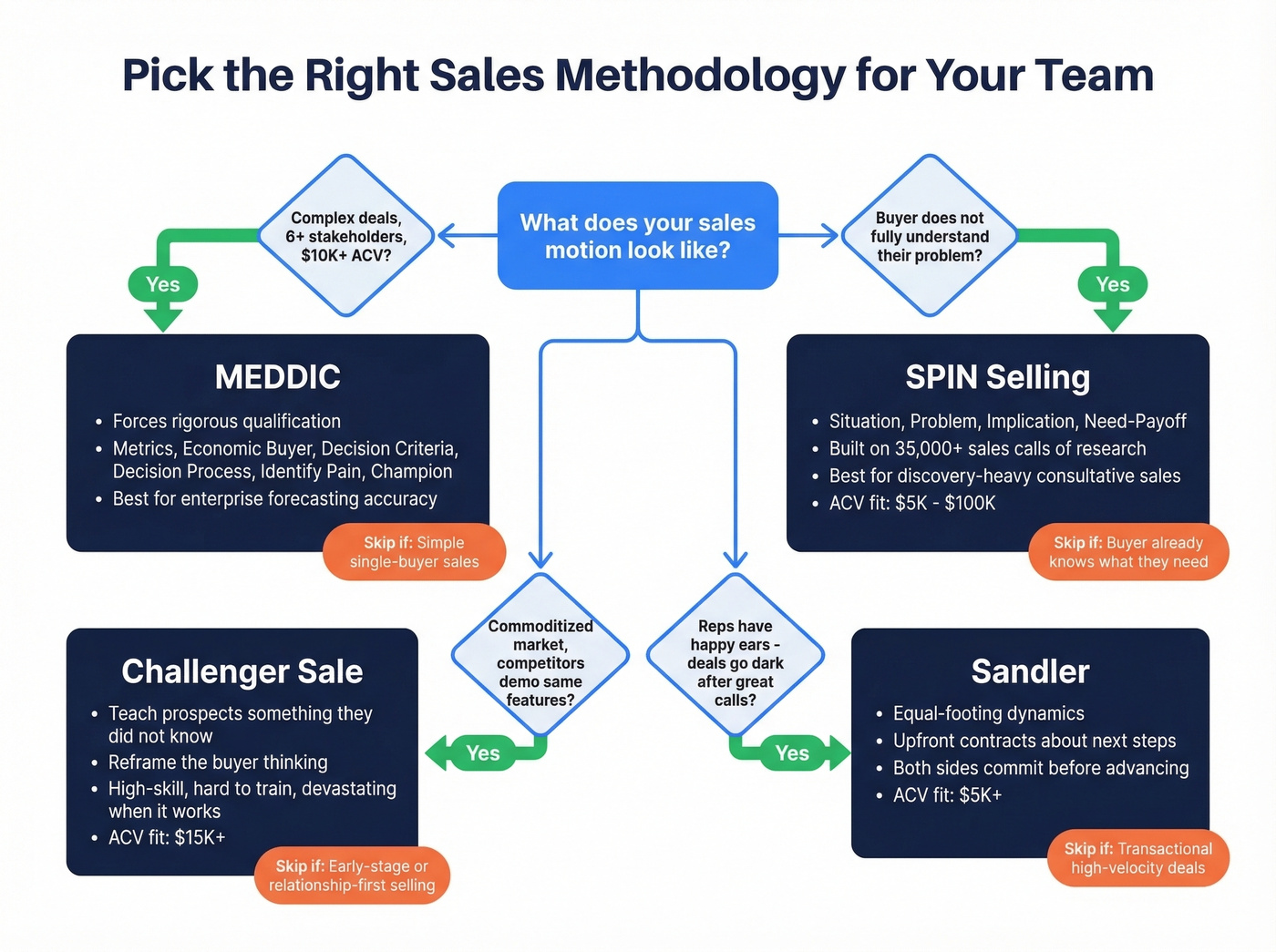
And revisit your methodology as you scale. What works at $1M ARR can actively hurt at $10M.
| Methodology | Best For | Skip If | ACV Fit |
|---|---|---|---|
| MEDDIC | Complex, multi-stakeholder deals | Simple, single-buyer sales | $10K+ |
| SPIN | Discovery-heavy, consultative | Buyer already knows the problem | $5K-$100K |
| Challenger | Commoditized markets | Early-stage, relationship-first | $15K+ |
| Sandler | Teams with "happy ears" problem | Transactional, high-velocity | $5K+ |
MEDDIC
For 80% of B2B SaaS companies selling five-figure deals, MEDDIC is the right starting point. It forces rigorous qualification - Metrics, Economic Buyer, Decision Criteria, Decision Process, Identify Pain, Champion - and it's the reason enterprise teams can forecast accurately. It's not glamorous. It works. (If you want to operationalize it, use MEDDIC qualification and MEDDIC discovery questions.)
SPIN Selling
Neil Rackham built SPIN on 12 years of research and 35,000+ sales calls, making it one of the most empirically validated frameworks in sales. The structure - Situation, Problem, Implication, Need-Payoff - shines when your buyer doesn't fully understand their own problem yet. If your product is self-explanatory and the buyer already knows what they need, SPIN adds friction instead of clarity.
Challenger Sale
Picture this: you're in a competitive deal where three vendors are demoing the same features to the same committee. The rep who wins isn't the one with the best product - it's the one who teaches the prospect something they didn't know. That's the Challenger model. Reps reframe the buyer's thinking and push them out of their comfort zone. It's high-skill and hard to train, but devastating in commoditized markets.
Sandler
Every sales manager has dealt with the rep who comes out of a call saying "they loved it!" and then the deal goes dark for six weeks. Sandler fixes this by enforcing equal-footing dynamics and upfront contracts about next steps. It eliminates the "happy ears" problem by making both sides commit before advancing.

You just read that 30%+ bounce rates kill outbound before messaging even matters. Prospeo's 5-step email verification delivers 98% accuracy - teams using it cut bounce rates from 35% to under 4% and tripled pipeline in weeks.
Stop debugging your cadence when the real problem is your data.
2026 SaaS Sales Benchmarks
Numbers without context are useless. Here are benchmarks you can actually use to diagnose where your funnel is broken.
Funnel Conversion Rates
| Stage | Benchmark | Notes |
|---|---|---|
| Visitor to Lead | 1.9% | SEO: 2.1%, PPC: 0.7% |
| Lead to MQL | 39% | Scoring matters here |
| MQL to SQL | 15-21% | Biggest bottleneck |
| SQL to Opportunity | 42% | Discovery quality |
| Opp to Close | ~20-39% | SMB: 39%, Ent: 31% |
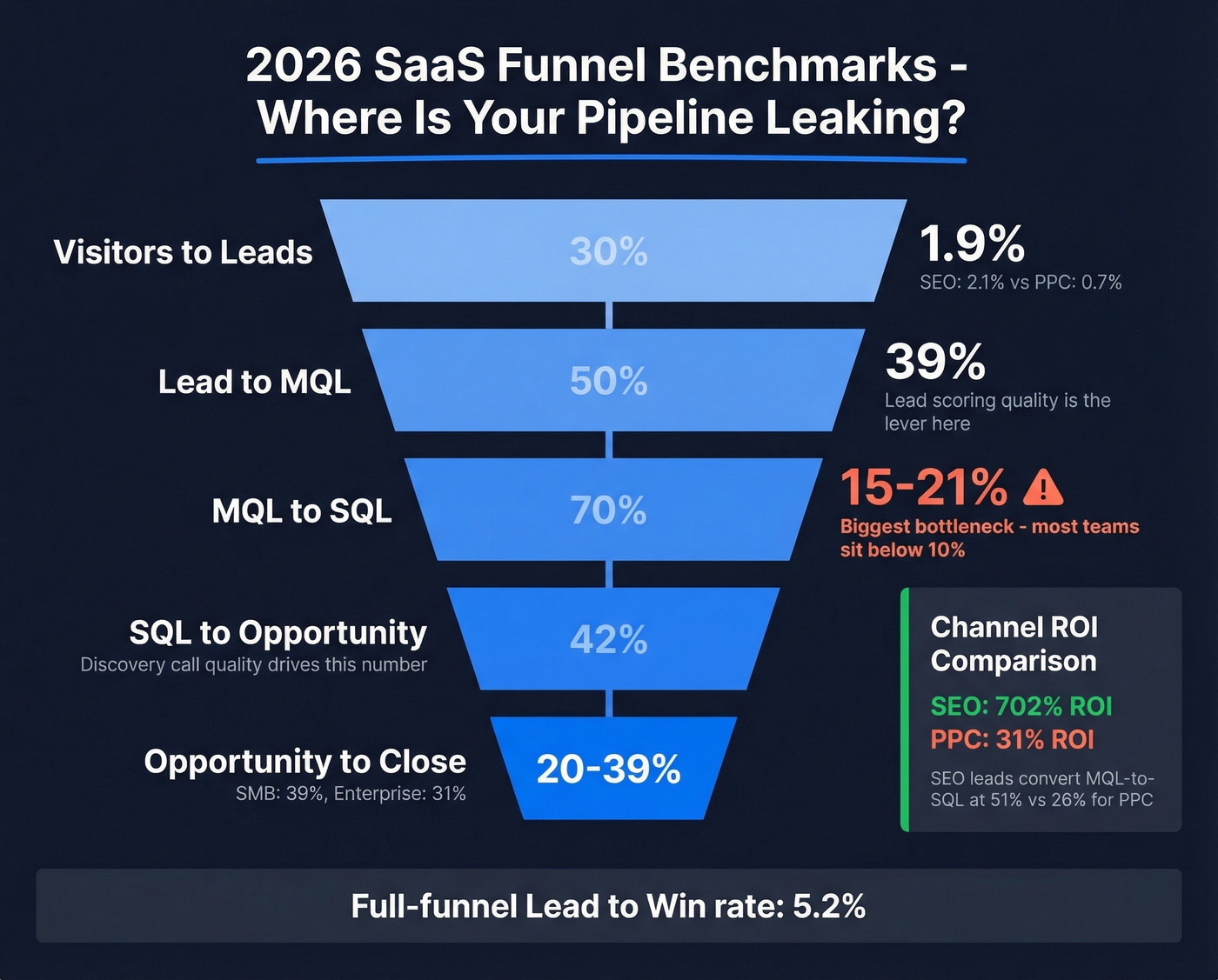
The channel deltas are striking. SEO-sourced leads convert MQL-to-SQL at 51% versus 26% for PPC. SEO delivers 702% ROI versus 31% for PPC. That doesn't mean kill your paid budget, but it does mean your content engine is probably underinvested. (If you need a funnel view that ties these stages together, use an AIDA funnel model.)
SaaS Health Scorecard
| Metric | Target | Why It Matters |
|---|---|---|
| CAC payback | 6 months | Cash efficiency |
| LTV:CAC | 6:1 | Unit economics |
| Annual churn | 5.2% | Retention health |
| Lead to Win | 5.2% | Full-funnel efficiency |
| Upsell rate | 23% | Expansion revenue |
| Burn multiple | < 1.5 | Capital efficiency |
| Median cycle | 84 days (optimal: 46-75) | Velocity |
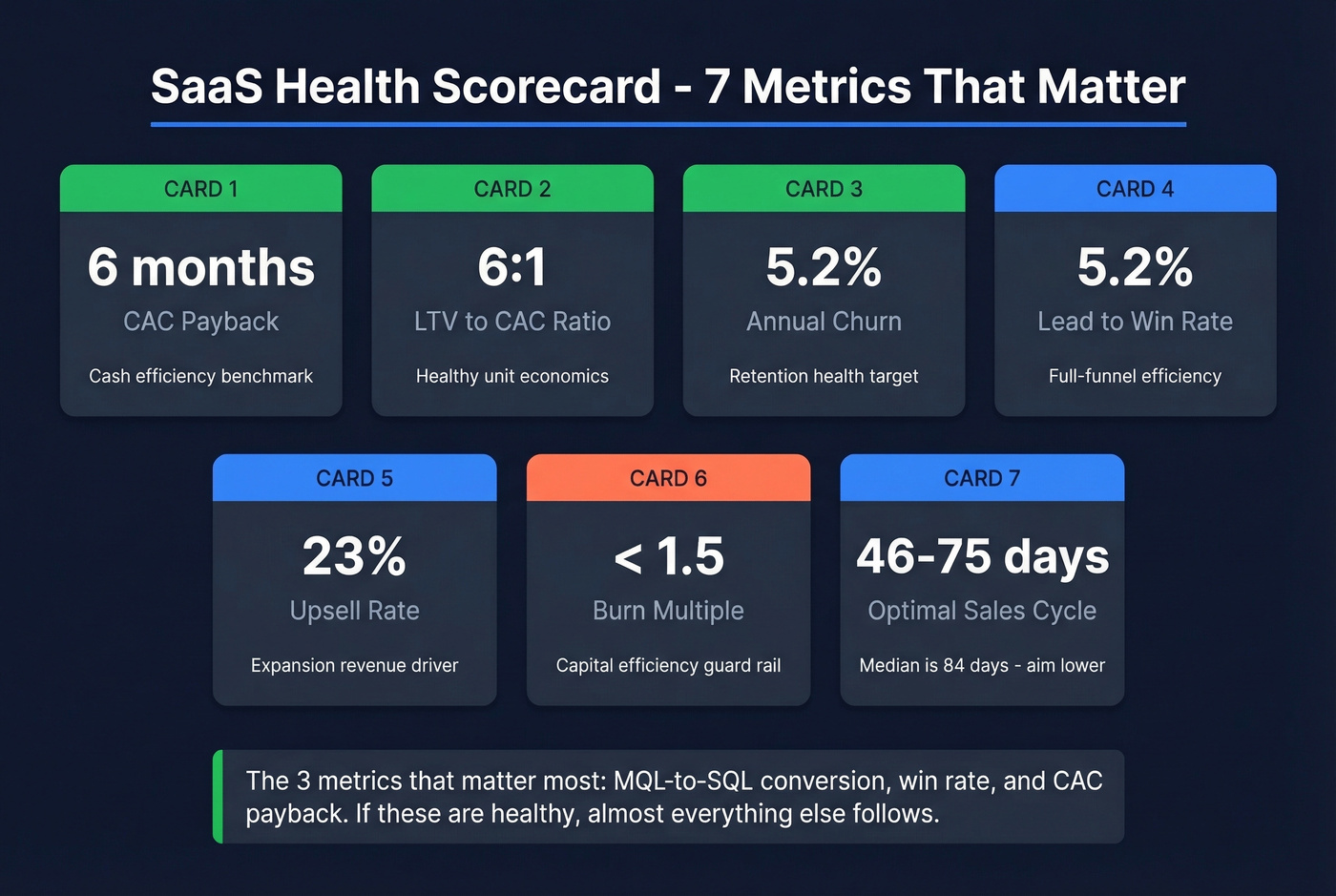
For mature SaaS orgs, expansion revenue often exceeds new-logo revenue. Your operating cadence and comp plans should reflect that reality - not treat upsells as an afterthought. (If you're formalizing expansion, see upsell vs cross-sell.)
The three metrics that matter most: MQL-to-SQL conversion, win rate, and CAC payback. If those three are healthy, almost everything else follows. If any one is broken, no amount of top-of-funnel volume will save you.
Outbound Cadence That Works
10-14 touches over 30 days, spread across email, phone, and social. Multi-channel outreach doubles email reply rates because touches on other channels pull attention back to the inbox. You're not spamming - you're creating presence. Consider replacing one email touch with a 60-second async video; personalized screen recordings consistently outperform text-only emails in mid-funnel sequences. (If you need a structure to build and QA sequences, use a cold email sequence framework.)
Sell one problem per theme, then rotate. Your first 3-4 touches should hammer one specific pain point. Touches 5-8 pivot to a second problem. Touches 9+ shift to a "get the truth" or breakup theme. Don't try to pitch your entire platform in email one. A common refrain on r/SaaS: "nobody reads your 8-paragraph cold email." They're right. (If you're still iterating on hooks, pull from cold email subject lines.)
Bubble-up emails - the ones that re-surface a thread after silence - get just as many replies as first emails. On social, blank connection requests often outperform personalized ones because personalization triggers the "sales alarm." Test both. (If you want ready-to-use copy, grab sales follow-up templates.)
Step one is always data quality. Before you run any sequence, verify your list. If 30%+ of your emails bounce, your domain reputation tanks and every subsequent campaign suffers. Prospeo runs a 7-day refresh cycle with 98% email accuracy, which means your reps aren't wasting touches on dead contacts. At roughly $0.01 per email with a free tier of 75 emails/month, it's the cheapest insurance policy in your stack. (For the full system, see an email deliverability checklist.)
Top-performing SaaS SDR teams average 15-25% email open rates and 2-5% reply rates. If you're below those ranges, fix your data and your targeting before you rewrite a single subject line.
Data Quality - The Silent Pipeline Killer
If your bounce rate is above 5%, your data provider is the problem. Not your copy, not your sequencing tool, not your reps. The data.
We've seen this pattern dozens of times: a team invests in a sequencer, hires SDRs, builds a playbook - and then feeds the whole machine with stale contact data. Reps spend 4-6 hours per week manually finding contacts. Emails bounce at 30%+. Domain reputation tanks. Pipeline looks full on paper but half the opportunities are phantoms built on bad contact info. Among B2B SaaS best practices, clean data hygiene ranks near the top - yet it's the one most teams skip. (If you're evaluating vendors, start with data enrichment services.)
This is where your data provider earns its keep. Prospeo runs 300M+ professional profiles through a 5-step verification process on a 7-day refresh cycle, compared to the 6-week industry average. That's not incremental; it means your data is 6x fresher than most competitors'. You get 143M+ verified emails at 98% accuracy and 125M+ verified mobile numbers with a 30% pickup rate. Search with 30+ filters including buyer intent, technographics, job changes, and funding signals, then push verified contacts straight into Salesforce, HubSpot, Lemlist, or Instantly.

The proof is in the results. Meritt tripled pipeline from $100K to $300K per week after switching, with bounce rates dropping from 35% to under 4%. Snyk - 50 AEs, bounce rate 35-40% before, under 5% after - saw AE-sourced pipeline jump 180% with 200+ new opportunities per month.
Multi-threading enterprise deals means reaching 6-10 stakeholders with real contact data. Prospeo gives you 125M+ verified mobiles with a 30% pickup rate and 30+ filters - buyer intent, technographics, headcount growth - to build pipeline that matches your ICP, not just your TAM.
Build pipeline coverage that closes at every segment and ACV tier.
AI in SaaS Sales - Hype vs. Reality
Let's be honest about where AI actually stands. Per SPOTIO's 2026 State of Field Sales Survey, 33% of sales teams aren't using AI at all. Among those who are, the use cases are overwhelmingly tactical: 30% use it for email personalization, 28% for conversation intelligence, 26% for content generation, and 24% for automated CRM data entry.
The strategic applications lag behind. Only 20% use AI for predictive forecasting and just 18% for lead scoring. (If you're rebuilding scoring, use a lead scoring model that matches your motion.)
Our take: AI is a productivity tool right now, not a strategy. It can help a good rep write faster emails and summarize calls. It can't fix a broken ICP, a misaligned motion, or a pipeline built on unverified data. The teams winning in 2026 aren't the ones with the fanciest AI stack - they're the ones with clean data, a clear motion, and reps who know how to qualify. If your average deal is a few thousand dollars, you probably don't need an AI-powered sales suite. You need a verified contact list and a disciplined cadence.
GTM Operating Cadence
Strategy without a cadence is just a slide deck. Here's the operating rhythm that keeps a SaaS revenue org accountable.
Weekly: Pipeline health, lead flow, expected bookings, churn risks. Forward-looking, not backward-looking. Update the sales forecast every week - not monthly. (If forecasting is still a spreadsheet fight, use sales forecasting solutions.)
Monthly: Funnel quality deep-dive. Where are deals stalling? Which channels are producing qualified pipeline versus noise? Integrated RevOps analysis across marketing, sales, and CS.
Quarterly: QBRs against plan. Set OKRs that translate priorities into measurable outcomes. Focus on ARR at the right cost - Rule of 40, CAC payback, burn multiple. (If you need a tighter QBR structure, use QBR questions.)
Annually: Strategy reset. Revisit ICP, motion, and segment focus. Realign incentives. One idea worth testing: tie CS variable comp partially to landing new business, and pay AEs partly on renewal and expansion. It aligns the entire revenue team around customer outcomes instead of handoff points.
Practices That Prevent Common Failures
A YC founder once emailed a prospect from a personal Gmail, described their product's features in detail, and got a hostile reply accusing them of competitive intelligence gathering. The prospect was irritated by the private email and assumed the founder was hiding behind a mask. Credibility signals matter - domain, title, company context. Skip them and you're dead before the pitch starts.
SaaStr's analysis of startups scaling to $10M ARR surfaces the same patterns over and over.
Not wanting to do sales as a founder. Nobody loves cold outreach. But if you can't sell your own product, you can't hire someone who will. The first 10-20 customers come from founder hustle, period.
Hiring a VP of Sales you don't believe in. If you have doubts during the interview process, those doubts will compound at scale. A mediocre VP of Sales is worse than no VP of Sales.
Ignoring partners. Many SaaS leaders generate 40%+ of revenue through partnerships and marketplace distribution. If your entire pipeline depends on outbound and inbound, you're leaving a massive channel untouched. Marketplace listings on platforms like AWS, Salesforce AppExchange, or HubSpot's ecosystem can generate qualified inbound at near-zero CAC.
Mismanaging burn. The heuristic is simple: you need roughly 50% of your ARR on your balance sheet to invest and hire aggressively. Below that, you're one bad quarter from cutting the team you just built.
Look - stop building a 15-tool sales stack. You need a CRM, a data provider, and a sequencer. Everything else is a distraction until you're past $5M ARR. The teams that outperform revenue targets aren't running the most complex tech stack - they're running the most disciplined process. (If you're auditing the stack, start with SDR tools.)
FAQ
What is a SaaS sales strategy?
It's the framework connecting your sales motion, target segment, methodology, and metrics into a repeatable system for generating recurring revenue. It differs from traditional sales because SaaS economics reward retention and expansion over one-time closes.
What's the average sales cycle length?
The median B2B SaaS sales cycle is 84 days. SMB cycles run under 40 days, while enterprise deals stretch 6-12+ months. The optimal range is 46-75 days - above 84, audit deal qualification and multi-threading.
Which methodology works best?
MEDDIC is the right choice for most B2B SaaS companies selling $10K+ deals. SPIN works better for consultative, discovery-heavy sales. Challenger fits commoditized markets. Pick one and train consistently - methodology drift kills forecasting accuracy.
How do I choose between PLG and sales-led?
Match your motion to your ACV. Pure PLG for sub-$5K deals, hybrid for $1K-$50K, sales-led for $50K+. Even sales-led motions benefit from some product experience in the funnel - 97% of buyers want to try before they buy.
How can I improve outbound deliverability?
Keep bounce rates under 5% by verifying every contact before sequencing. A 7-day data refresh cycle and 98% email accuracy keep domain reputation intact. Meritt cut bounces from 35% to under 4% and tripled weekly pipeline to $300K after switching to a provider with verified, fresh data.