

How to Build a Sales Target List That Actually Converts
84% of sales reps missed quota last year. That's not a data problem - it's a targeting problem. Deals closed within 50 days carry a 47% win rate; drag past that window and you're under 20%. The difference starts with your sales target list - specifically, who you're reaching out to, not how many times you follow up.
A list built on verified, ICP-matched contacts compresses that timeline. Here's how to build one that actually moves pipeline.
The Short Version
- Define your ICP in one sentence. Industry, company size, buyer title, pain point. If you can't say it in one sentence, it isn't sharp enough.
- Build a 100-300 contact test list. Same persona, same vertical, same company size. No mixing.
- Verify every email before sending. Unverified lists often bounce 15-20%. That kills your domain reputation.
- Track reply rate, meeting rate, and waste rate. Not opens. Not clicks. Meetings booked.
Here's the thing: if your average deal size is under $10K, you don't need a $15K/year data platform. You need 300 verified contacts, a tight sequence, and the discipline to measure what happens before you scale anything.
What Is a Sales Target List?
A sales target list is a curated set of contacts you've deliberately chosen to pursue - not a dump of everyone who downloaded a whitepaper. A lead list is reactive: people who raised their hand. A target list is proactive: people you've decided fit your ICP, whether they know you exist or not.
Most deals require 5-12 touchpoints before a conversation happens. Every name on your list needs to be worth the effort of a multi-week sequence. Burning touches on bad-fit contacts means losing weeks you don't get back.
Define Your ICP First
You can't build a useful prospecting list without a clear Ideal Customer Profile. Skip this step and you'll end up with a big spreadsheet of contacts who'll never buy. SDRs already spend 20-40% of their time on manual data research - a sharp ICP cuts that waste in half.
Start with three layers:
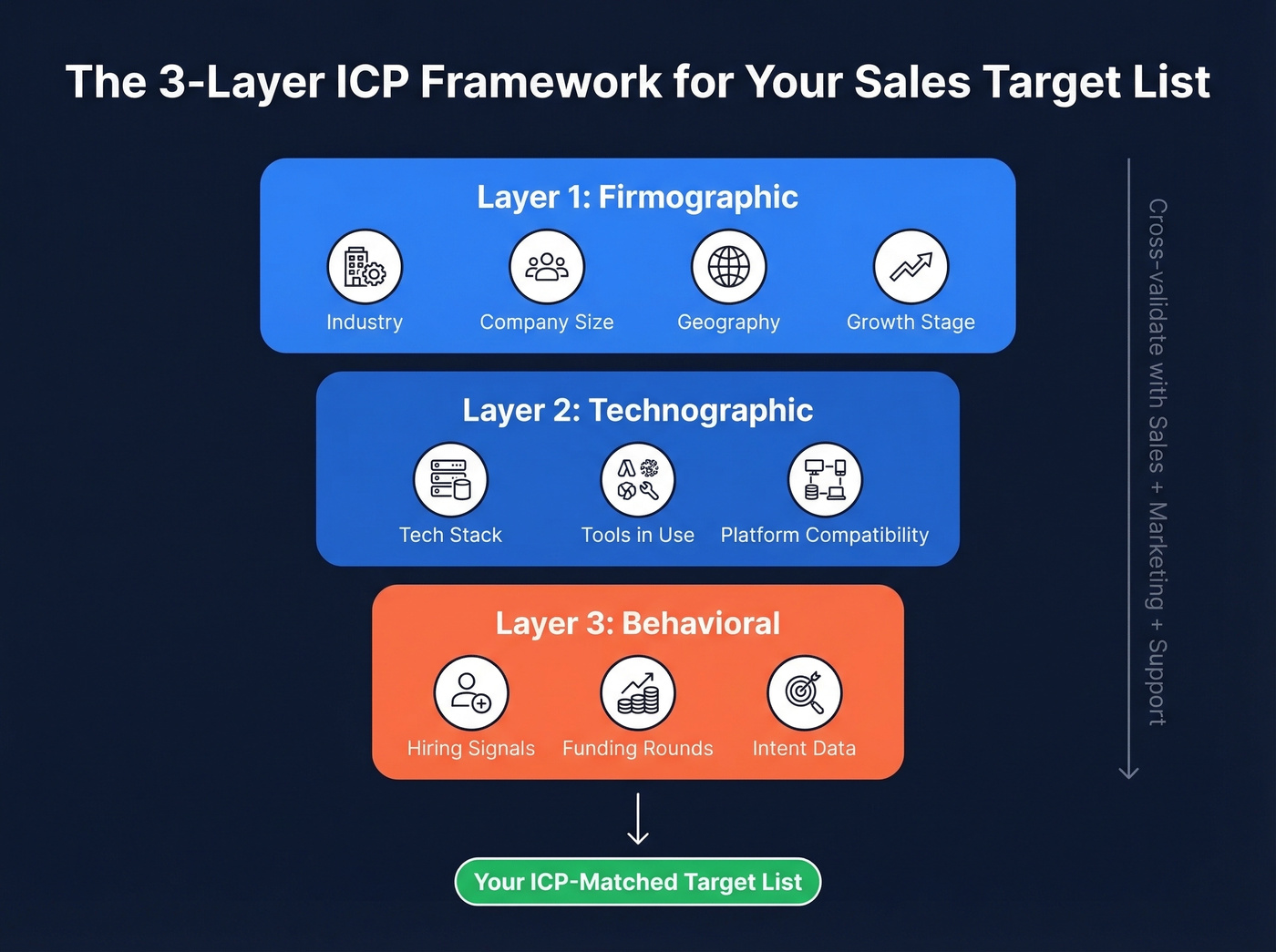
- Firmographic: Industry, company size (headcount and revenue), geography, growth stage. These are your hard filters. (If you need help operationalizing this, start with firmographic criteria.)
- Technographic: What tools do they use? If you sell a Salesforce integration, companies running HubSpot aren't your first call. (More on firmographic and technographic data.)
- Behavioral: Hiring signals, funding rounds, leadership changes, intent data showing they're researching your category. (See a practical framework for identifying buying signals.)
Now here's the step most teams skip: cross-validate your ICP with sales, marketing, and support. Your best-customer profile isn't just who marketing thinks is ideal - it's who actually renews, expands, and doesn't churn. Support knows which customers are nightmares. Sales knows which deals close fastest. Get them in a room together and you'll walk out with a profile that's grounded in reality, not assumptions. (If you want a starting point, use an Ideal Customer Profile template.)
One more thing. Mid-sized firms with 100-500 employees typically have around 7 people involved in a buying decision. Your target list should include multiple contacts per account, not just one.
How to Build Targeted Lists Step by Step
Once your ICP is locked, the build itself is straightforward.
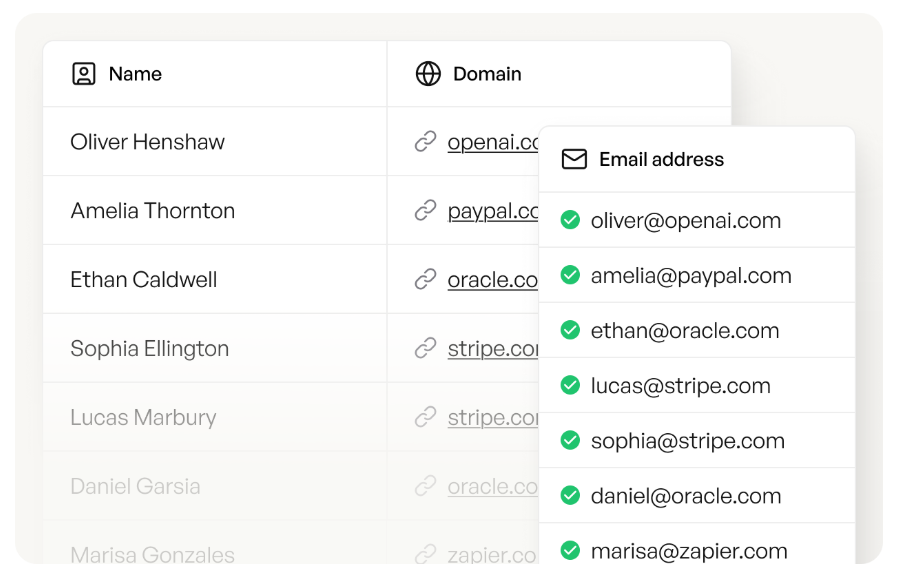
1. Start with your total addressable list. Use a B2B database with filters for industry, headcount, revenue, tech stack, and geography. Cast wide - you'll narrow down fast. (If you need to sanity-check TAM vs SAM vs SOM, see addressable market.)
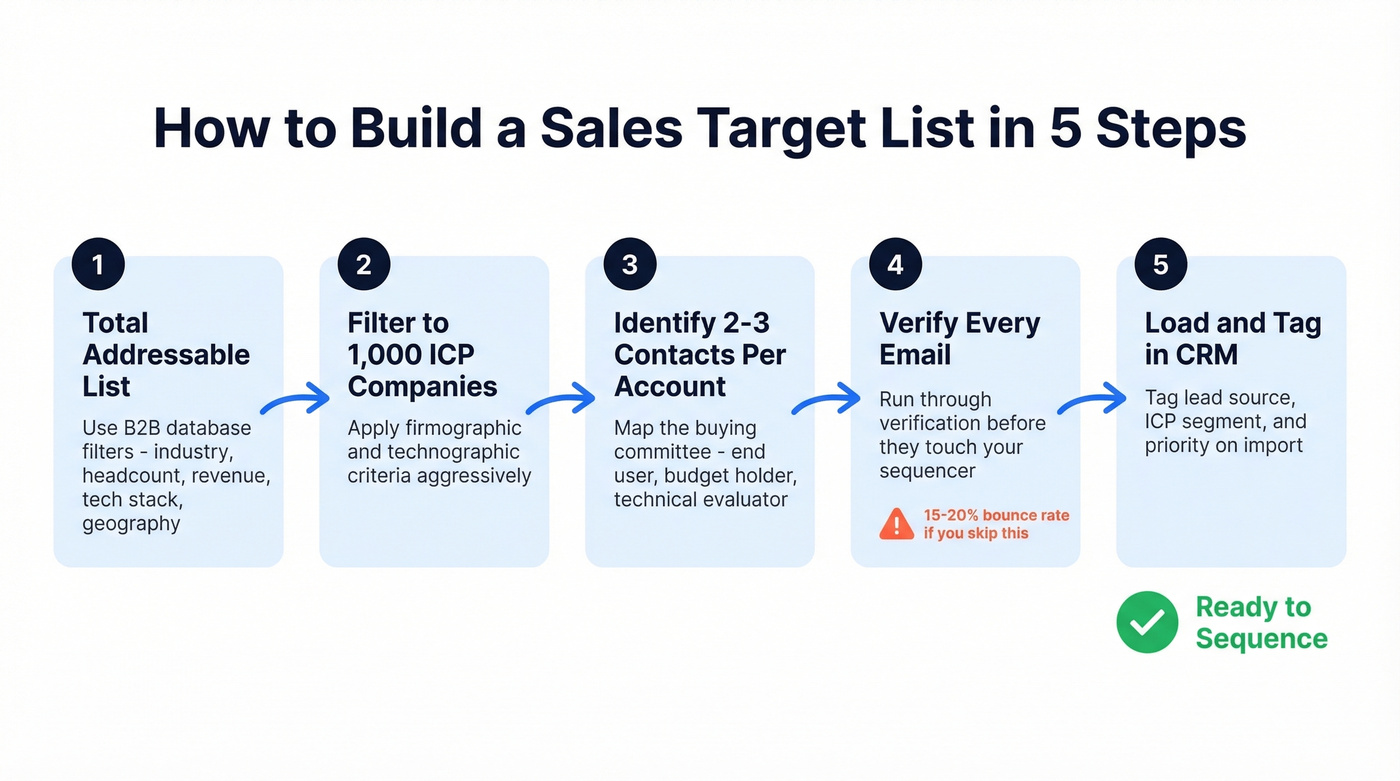
2. Filter to ~1,000 ICP-fit companies. Don't export 10,000 contacts and hope for the best. Tighter lists convert better. Apply your firmographic and technographic criteria aggressively. This is where you assemble your target company list - the set of accounts that genuinely match your ICP before you identify individual contacts. (If you're building this as an ABM motion, follow account-based selling best practices.)
3. Identify 2-3 contacts per account. Map the buying committee: the end user, the budget holder, and a technical evaluator. (This is a core part of modern sales prospecting.)
4. Verify everything. Run emails through a verification tool before they touch your sequencer. We've watched teams torch brand-new domains in a single week by skipping this step. (If you want the mechanics, see how to check if an email exists.)
5. Load and tag. Import into your CRM with proper tagging - lead source, ICP segment, and priority. If contacts aren't tagged correctly on import, your reporting is useless from day one. (A clean lead status setup prevents reporting chaos later.)

You just read why tighter lists convert better. Prospeo gives you 30+ filters - industry, headcount, tech stack, intent data, funding - to build an ICP-matched target list from 300M+ profiles. Every email is 98% accurate on a 7-day refresh cycle. Snyk's team cut bounce rates from 35% to under 5% and added 200+ opportunities per month.
Stop torching domains with unverified data. Build your target list right.
Your Target List Template
A good template keeps your data clean and your follow-ups on schedule:
| Column | What Goes Here |
|---|---|
| Sector / Industry | Vertical (SaaS, fintech, etc.) |
| Company Name | Legal or common name |
| Contact Name | First + last |
| Title | Exact job title |
| Phone | Direct dial or mobile |
| Verified work email | |
| Key Business Info | Funding, tech stack, pain points |
| Website | Company URL |
| Deal Stage | Prospect → Demo → Proposal |
| Lead Status | New / Contacted / Interested |
| Last Contact Date | Auto-update if possible |
| Next Action | Call / Email / Follow-up date |
Use data validation dropdowns for Status and Priority - free-text fields turn into a mess within a week. Add conditional formatting to flag any row where Last Contact Date is older than 14 days. Stale follow-ups are invisible pipeline killers.
Start With a Test List
Don't build a 5,000-contact list on day one. Start with 100-300 contacts sharing the same industry, persona, and company size. Run them through a single channel for two weeks.
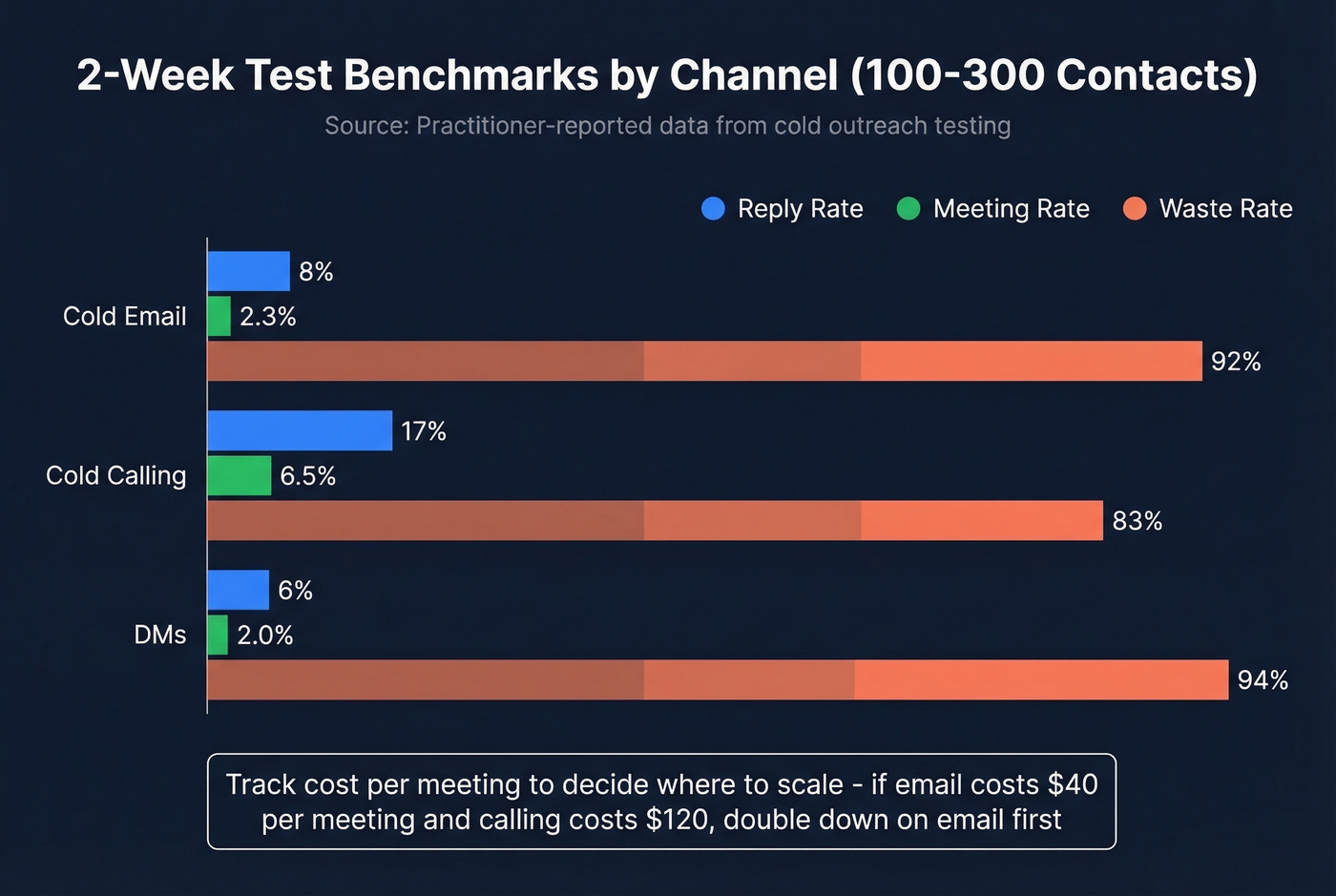
Here's what realistic benchmarks look like, based on practitioner-reported data from a 2-week test:
| Channel | Reply Rate | Meeting Rate | Waste Rate |
|---|---|---|---|
| Cold Email | ~8% | ~2.3% | ~92% |
| Cold Calling | ~17% | ~6.5% | ~83% |
| DMs | ~6% | ~2.0% | ~94% |
In our experience, cold email lists under 300 contacts give you cleaner signal than anything larger. Track reply rate, meeting rate, waste rate, and cost per meeting. If cold email gets you meetings at $40 each and cold calling costs $120, that tells you where to double down. Scale only after you've validated the channel and the ICP segment. (To pressure-test your numbers, use these lead generation metrics.)
Tools for Building Your Sales Target List
Your list is only as good as the data behind it. Let's break down the options worth considering.

Prospeo is where we'd start. The database covers 300M+ professional profiles with 98% email accuracy and 125M+ verified mobile numbers on a 7-day refresh cycle - most competitors refresh every 4-6 weeks. The results speak for themselves: Snyk's 50-person AE team cut bounce rates from 35-40% to under 5% and generated 200+ new opportunities per month after switching. Free tier gives you 75 emails and 100 Chrome extension credits monthly, no credit card required. Paid plans run about $0.01 per email. No contracts.
Apollo.io bundles list building and sequencing in one platform with 275M+ contacts. Paid plans start at $49/user/mo and run to $119/user/mo for Organization tier. The catch: Apollo's data is largely user-populated. Practitioners on r/sales describe it as "crazy powerful when you know how to use it" but also "jack of all trades, master of none" - and they flag 15-20% bounce rates without separate verification. Don't trust Apollo emails without a second pass. That isn't optional, it's table stakes. (If you're evaluating options, compare sales prospecting databases.)
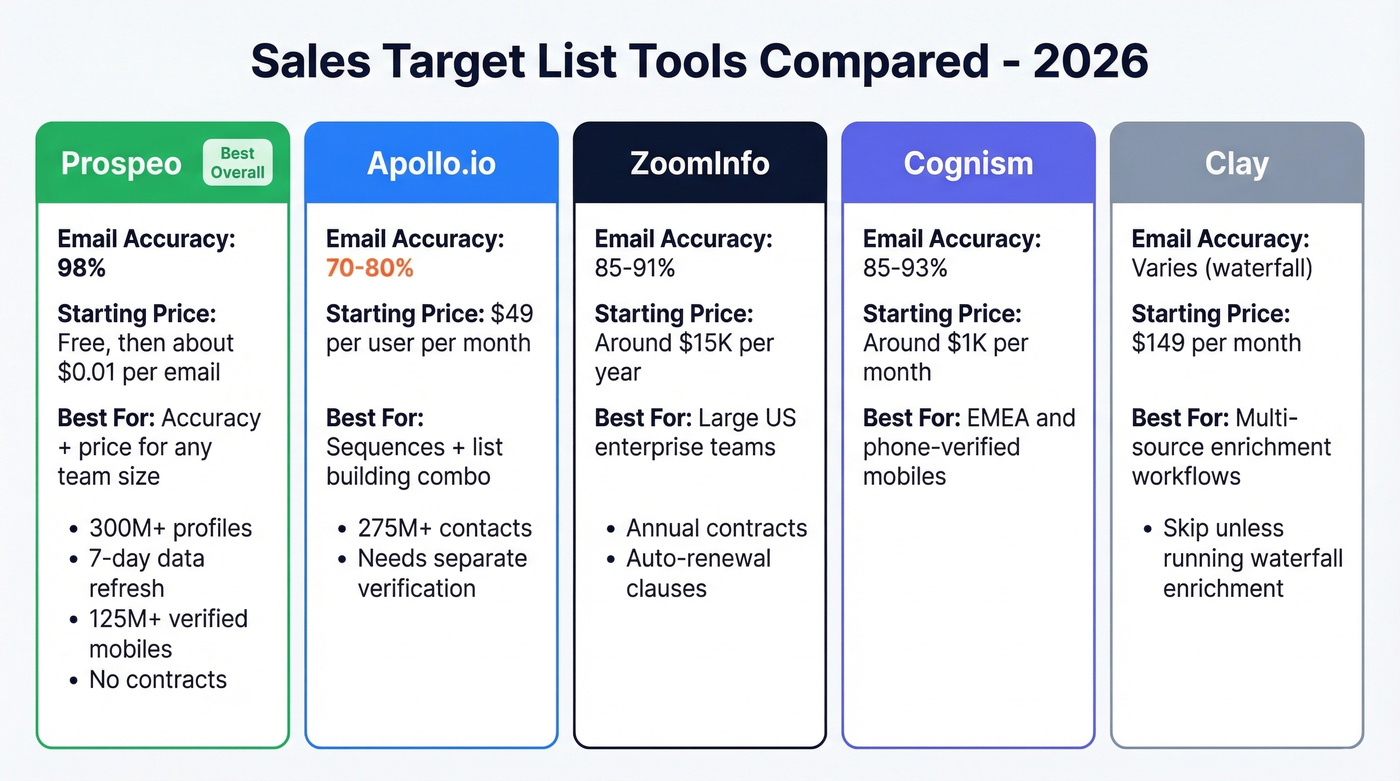
ZoomInfo delivers strong data - 85-91% email accuracy, 60-75% phone coverage. But you're looking at $14K-$25K+/year on annual contracts, often $30K+ for enterprise, with auto-renewal clauses that Reddit threads consistently complain about. For a 20+ rep enterprise team, it makes sense. For everyone else, it's overkill.
Cognism specializes in phone-verified mobiles with 85-93% email accuracy. Custom pricing, typically around $1K/mo for small teams. Strong in EMEA. Clay is an enrichment workflow layer at $149-$185/mo on credits. Skip Clay unless you're running multi-source waterfall enrichment - for straightforward list building, it's expensive overhead. (If you're comparing vendors, start with data enrichment services.)
| Tool | Email Accuracy | Starting Price | Best For |
|---|---|---|---|
| Prospeo | 98% | Free / ~$0.01/email | Best overall - accuracy + price |
| Apollo.io | 70-80% | $49/user/mo | Sequences + list building combo |
| ZoomInfo | 85-91% | ~$15K/yr | Large US enterprise teams |
| Cognism | 85-93% | ~$1K/mo | EMEA, phone-verified mobiles |
| Clay | Varies (waterfall) | $149/mo | Multi-source enrichment workflows |
Mistakes That Kill Your List
Do this: Verify every email before loading it into a sequence. At $0.01 per check, there's no excuse to skip it. (If you're troubleshooting, start with email bounce rate.)
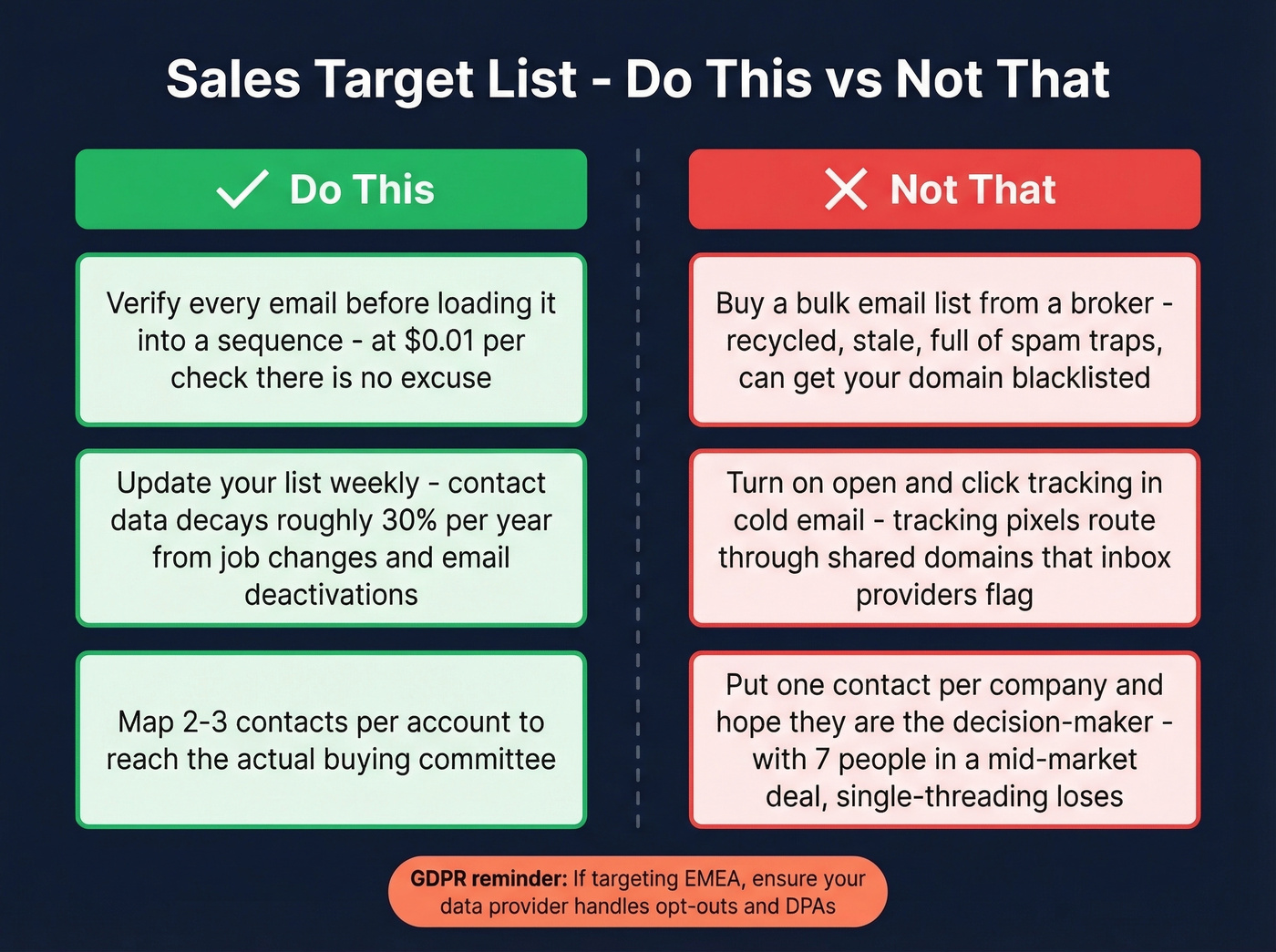
Not that: Buy a bulk email list from a broker. Those lists are recycled, stale, and full of spam traps. One campaign on a purchased list can get your domain blacklisted. (If you're unsure on legality, read is it illegal to buy email lists.)
Do this: Update your list weekly. Contact data decays roughly 30% per year - job changes, company moves, and email deactivations compound fast.
Not that: Turn on open and click tracking in your cold email tool. Tracking pixels route through shared domains that inbox providers flag. Real talk: if you're running cold outbound, disable those trackers. They'll hurt your deliverability more than the data is worth.
Do this: Map 2-3 contacts per account so you're reaching the actual buying committee.
Not that: Put one contact per company and hope they're the decision-maker. With around 7 people involved in a mid-market deal, single-threading is a losing bet.
And if you're targeting EMEA contacts, GDPR compliance isn't optional. Make sure your data provider handles opt-outs and DPAs before you send a single email.
Your template says 'Verified Work Email' for a reason. Prospeo verifies every address through a 5-step process with catch-all handling, spam-trap removal, and honeypot filtering - no third-party email providers involved. At $0.01 per email with 75 free credits to start, you can validate your 100-300 contact test list before it ever touches your sequencer.
Verify your entire target list before you send a single email.
FAQ
How many contacts should a sales target list have?
Start with 100-300 contacts sharing the same persona and vertical. Scale only after you've validated reply and meeting rates over a 2-week test. Tighter lists with verified data consistently outperform massive exports.
How often should I update my target list?
Review weekly, clean quarterly. Contact data decays around 30% per year as people change jobs and emails deactivate. Remove contacts who've responded or disqualified, and re-verify emails older than 90 days.
What's the difference between a target list and a lead list?
A target list is proactive - contacts you've chosen based on ICP criteria before they know you exist. A lead list is reactive - people who've shown interest through inbound channels. Most high-performing teams build targeted lists for outbound while nurturing inbound leads separately.
What's a good free tool for building a B2B target list?
Prospeo's free tier includes 75 verified emails and 100 Chrome extension credits monthly with no credit card required - enough to build and test a solid contact list each month. Apollo.io also offers a limited free plan, though emails need separate verification due to 15-20% bounce rates.