

Warm Leads: How to Identify, Score, and Convert Them
A RevOps lead we know ran the numbers last quarter: 30% of their inbound leads were never contacted. The ones that were? Average response time was 42 hours. Those leads were warm when they came in. By the time a rep touched them, they were ice cold.
Most teams don't have a lead generation problem. They have a speed problem and a data quality problem.
What You Need (Quick Version)
- A lead scoring model - even five criteria will do - so you stop treating warm and cold contacts identically. A pricing page visit and a blog skim aren't the same signal. (If you need a deeper framework, see our lead scoring guide.)
- A sub-5-minute response process. 78% of buyers go with whoever responds first. Responding within five minutes can increase conversion chances by up to 100x compared to waiting 30 minutes.
- Verified contact data so your prospects don't go cold while you hunt for a working email. Prospeo handles this with 98% email accuracy, 125M+ verified mobiles, and data refreshed every seven days. (More options: data enrichment services.)
Now let's break down how to actually build this.
Why Warm Leads Matter in 2026
The B2B buying cycle has stretched to 10.1 months on average. Buyers aren't waiting for your outbound sequence to educate them - they're researching on their own, building shortlists before your SDR even knows they exist.
Here's the stat that should change how you think about pipeline: 92% of buyers start their research with at least one vendor already in mind. The winning vendor is on the Day One shortlist 95% of the time. 41% already have a preferred vendor before formal evaluation even begins, and the pre-contact favorite wins roughly 80% of deals.
If you're not warming prospects before they enter a buying cycle, you're fighting for the 5-20% of deals where the frontrunner stumbles. That's not a strategy - that's hope.
The entire game has shifted toward being known, trusted, and top-of-mind before the prospect ever fills out a form. Engaged prospects aren't just "nicer to work." They're the only leads that reliably close. (Related: B2B brand positioning.)
What Is a Warm Lead?
A warm lead is someone who's shown genuine interest in your product or category but hasn't yet signaled they're ready to buy. They've done something - visited your pricing page, downloaded a whitepaper, attended a webinar, replied to an email - that separates them from the mass of cold contacts in your CRM.
The key distinction: warm leads combine ICP fit with demonstrated interest. A Fortune 500 VP who's never heard of you is a cold lead with great fit. A student who downloaded your ebook is engaged but poor fit. A warm prospect sits at the intersection. (Use an Ideal Customer Profile Template to define fit.)
Warm outreach converts 15x more often than pure cold outreach, and 82% of buyers accept meetings at least occasionally when sellers reach out.
Cold vs. Warm vs. Hot
| Cold | Warm | Hot | |
|---|---|---|---|
| Definition | No prior interaction | Engaged but not buying | Explicit purchase intent |
| Signals | Fits ICP, no engagement | Site visits, downloads, replies | Demo request, pricing ask |
| Conversion rate | 1-3% | 5-15% | 15-30% |
| Time to close | 3-9+ months | 1-3 months | Days to weeks |
| Framework | BANT | CHAMP | MEDDIC |
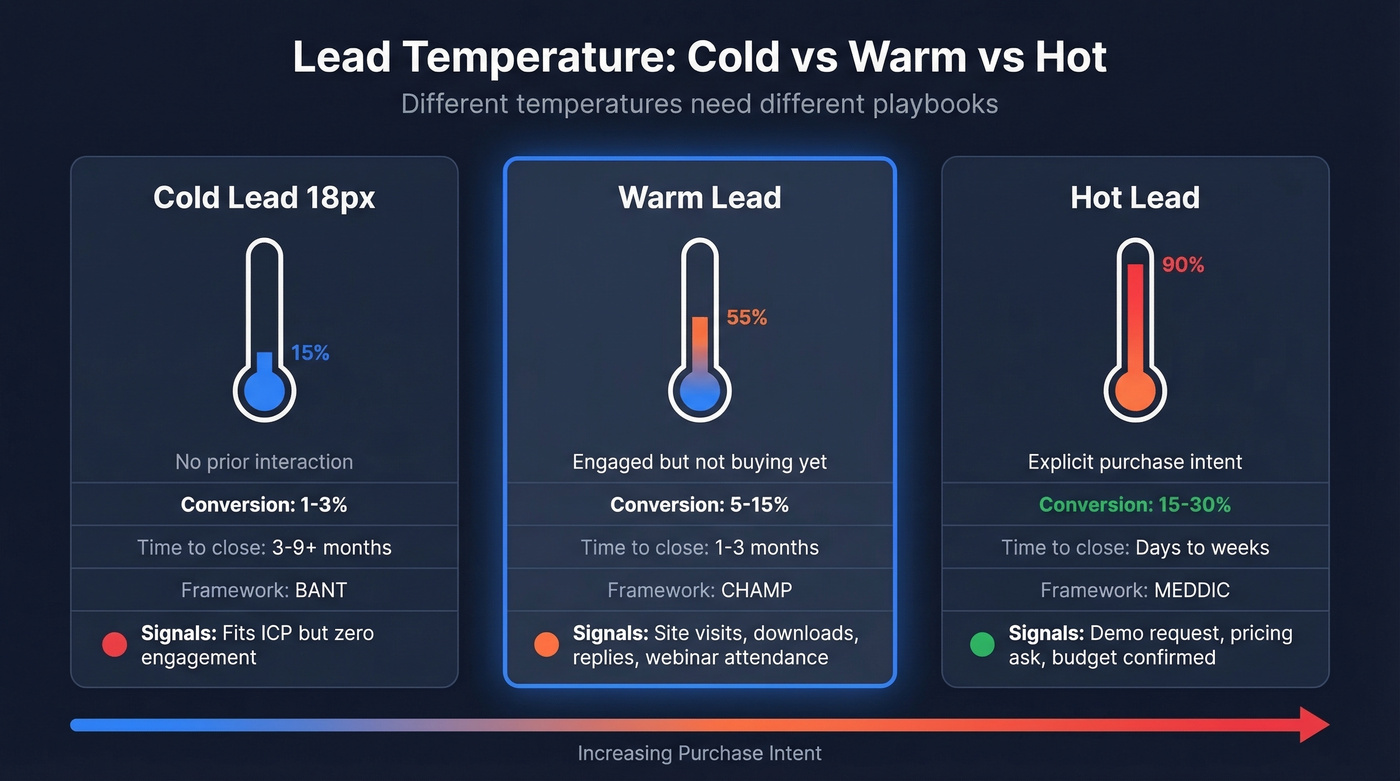
Here's the thing: this framework only matters if your process actually changes based on temperature. A warm prospect that gets the same generic email as a cold lead is functionally cold. The categories are useless without differentiated workflows behind them. (See sequence management for how to operationalize this.)
Behavioral Signals That Matter
Signals that move someone from cold to warm:
- Pricing page visits - especially repeat visits within a week
- Webinar attendance - they gave you 30-60 minutes of attention
- Content downloads - whitepapers, guides, comparison sheets
- Email replies - even a "not now" is warmer than silence
- Referrals - someone they trust vouched for you, making them a warm contact before you ever reach out
- Multiple site visits in a single month
- Intent data spikes - researching your category across third-party sites (more on identifying buying signals)
How to Score Warm Leads
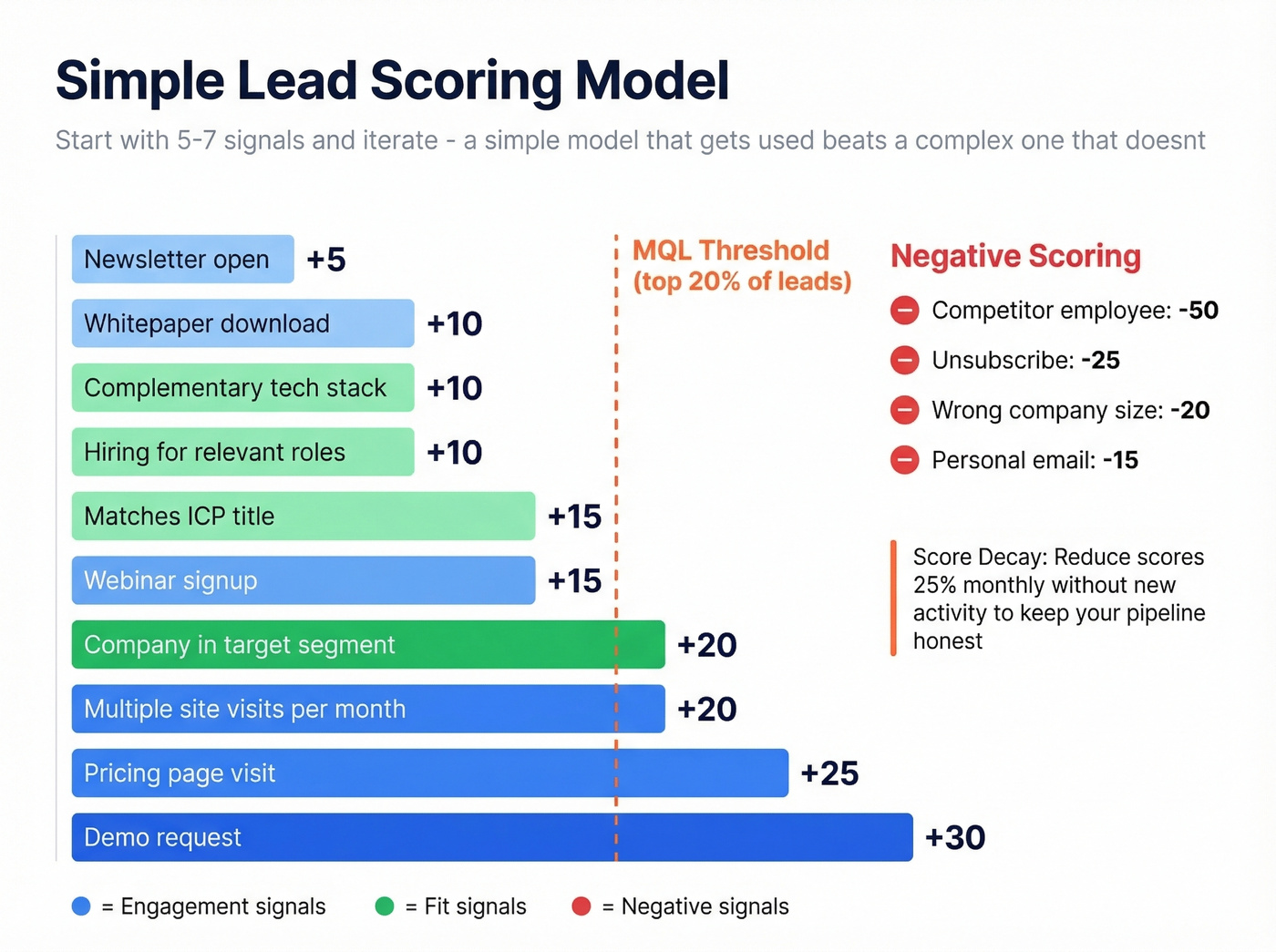
Lead scoring doesn't need to be complicated. In our experience, teams that start with 5-7 signals and iterate outperform teams that build a 30-variable model on day one. A simple model that gets used beats a complex model that sits in a spreadsheet nobody opens.
What to Score
| Signal | Points | Category |
|---|---|---|
| Newsletter open | +5 | Engagement |
| Whitepaper download | +10 | Engagement |
| Webinar signup | +15 | Engagement |
| Multiple site visits/month | +20 | Engagement |
| Pricing page visit | +25 | Engagement |
| Demo request | +30 | Engagement |
| Matches ICP title | +15 | Demographic |
| Company in target segment | +20 | Firmographic |
| Uses complementary tech | +10 | Technographic |
| Hiring for relevant roles | +10 | Firmographic |
Set your MQL threshold at the top 20% of leads by score - typically 50-75 points on a 100-point scale. Teams that do this consistently see 15-25% conversion rates from qualified leads to closed deals.
Negative Scoring and Decay
Positive scoring alone creates false positives. You need to subtract points too:
- Competitor employee: -50
- Personal email address: -15
- Unsubscribe: -25
- Wrong company size: -20
Scores should also decay over time. A lead who downloaded a whitepaper six months ago and went silent isn't warm anymore. We reduce scores by 25% monthly without new activity. This keeps your pipeline honest and prevents reps from chasing ghosts.
Matching Frameworks to Temperature
Different lead temperatures need different qualification approaches. BANT (Budget, Authority, Need, Timeline) works for cold leads where you're still establishing basics. CHAMP (Challenges, Authority, Money, Prioritization) fits warm prospects because it leads with the prospect's pain, not your checklist. MEDDIC is the right framework for hot leads in complex deals - but skip it for deals under $15K in annual value. The overhead isn't worth it. (If you run MEDDIC, use these MEDDIC discovery questions.)
The 5-Minute Rule
This is the single biggest lever most teams ignore.
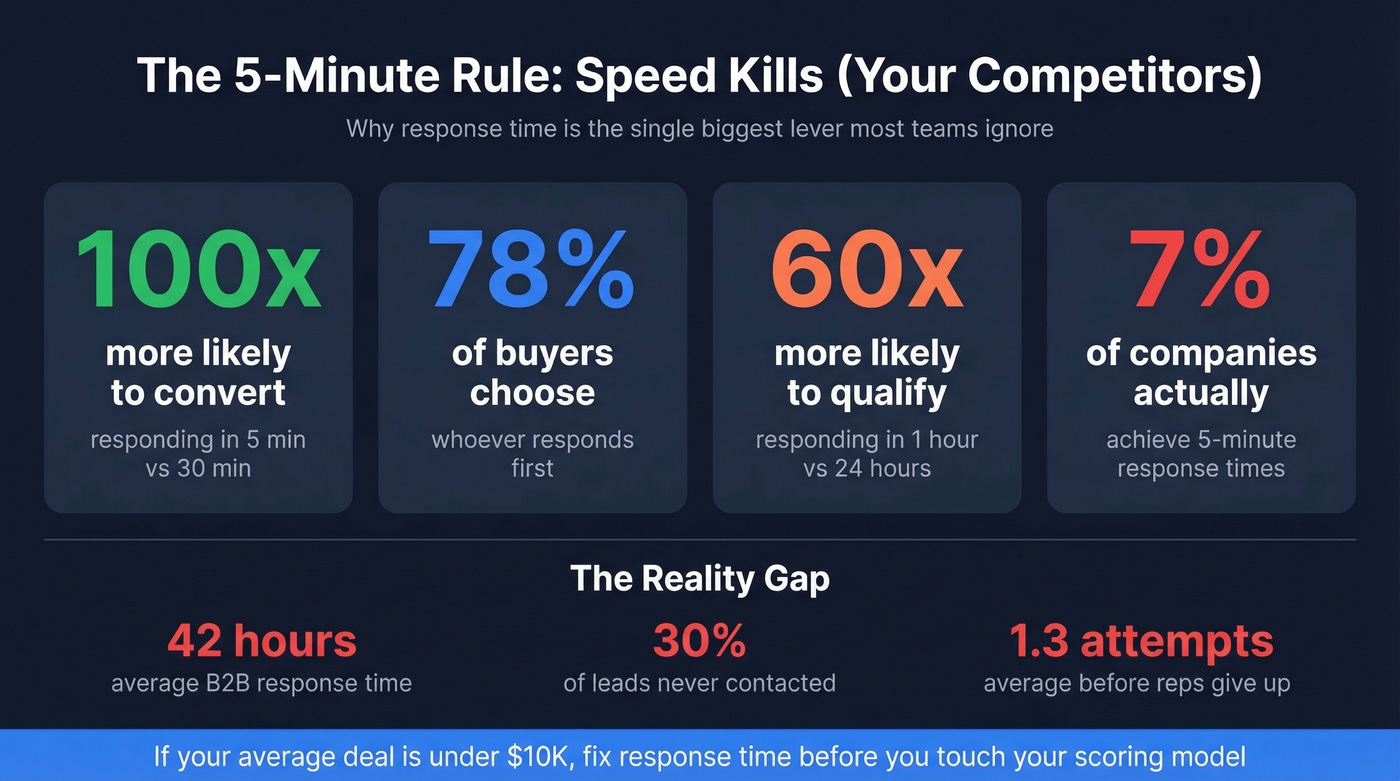
Responding within five minutes increases conversion chances by up to 100x compared to waiting 30 minutes. Leads contacted within one hour are 7x more likely to qualify. Reps who respond within that hour are 60x more likely to qualify a lead than those who wait 24 hours. And 78% of customers buy from the first company that responds.
The average B2B response time? 42 hours. 30% of leads are never contacted at all. Reps average 1.3 call attempts before giving up. Only 7% of companies achieve five-minute response times.
This is where data quality becomes a speed problem. If your rep gets a notification and then spends eight minutes hunting for a valid email or direct dial, you've already blown the five-minute window. You need verified contact data already loaded when the lead comes in - not a manual research step wedged into the response workflow. (Related: lead generation workflow.)
Our take: If your average deal size is under $10K, speed-to-lead matters more than lead scoring. A fast response to a mediocre lead will outperform a slow response to a perfect one every single time. Fix response time before you touch your scoring model.

The 5-minute rule only works if you have a verified email or direct dial the moment a lead goes warm. Prospeo gives you 98% accurate emails and 125M+ verified mobiles - refreshed every 7 days so your data never goes stale while your prospects go cold.
Stop losing warm leads to bad contact data.
7 Ways to Generate Warm Leads
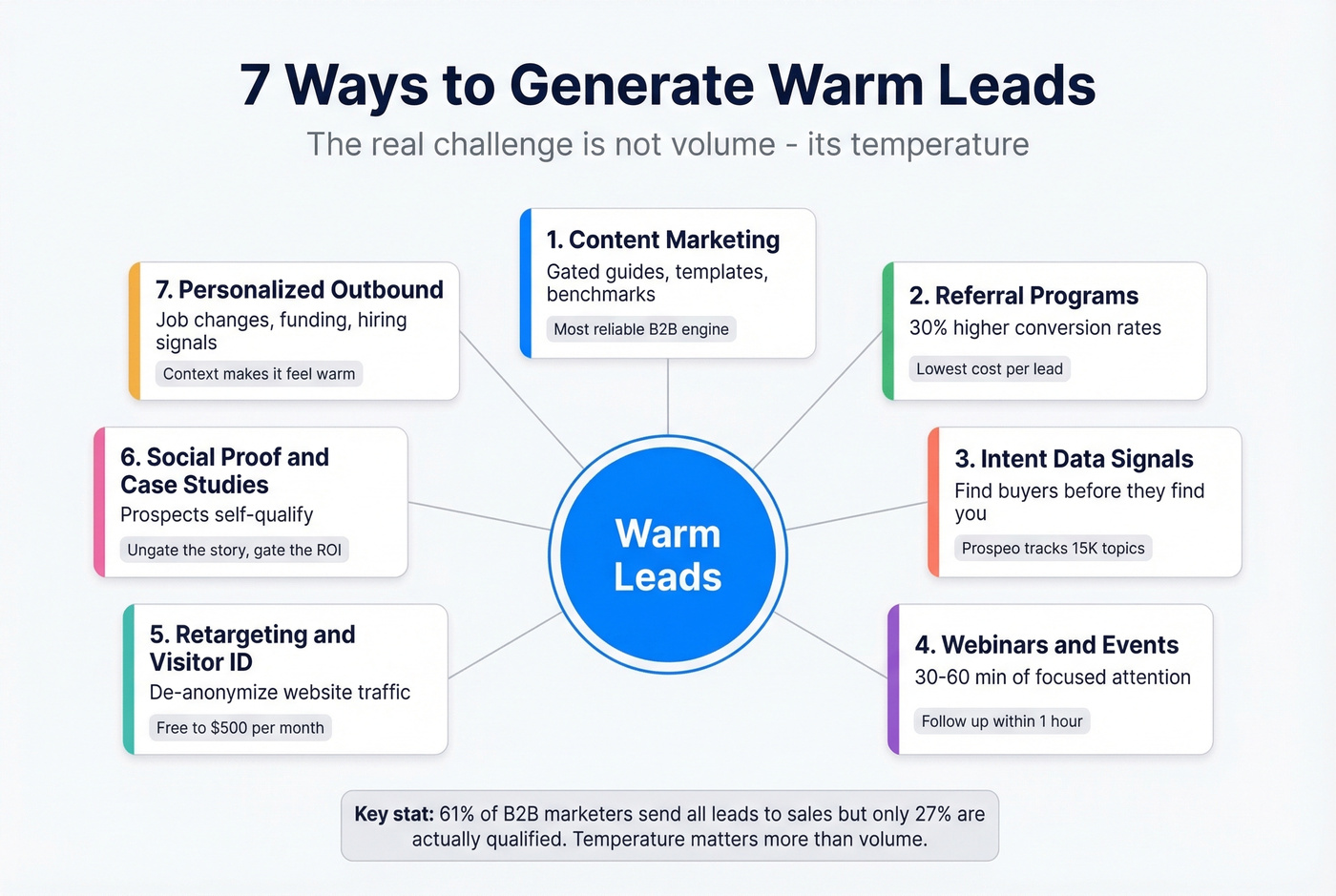
65% of marketers say generating traffic and leads is their biggest challenge - but the real challenge isn't volume, it's temperature. 61% of B2B marketers send all leads directly to sales, but only 27% of those leads are actually qualified. (More: lead generation metrics.)
1. Content Marketing and Lead Magnets
Gated content - guides, templates, benchmark reports - remains the most reliable engine for generating engaged prospects in B2B. Blog posts should be open. Comparison guides, ROI calculators, and industry benchmarks are worth an email address. Match the gate to the intent signal you want. (See what is B2B content marketing.)
2. Referral Programs
Referrals convert at roughly 30% higher rates than most acquisition channels and consistently produce the lowest cost per lead. A referred prospect arrives pre-warmed - someone they trust already did the selling for you. Even a simple "refer a colleague, get a month free" program outperforms most paid acquisition. The consensus on r/sales is that referral leads close faster and churn less, and our experience lines up.
3. Intent Data Signals
Third-party intent data identifies companies researching your category before they ever visit your site. Prospeo tracks 15,000 intent topics via Bombora at self-serve pricing - a fraction of the $12K-$40K/year Bombora charges directly. Layer intent signals with job title and company growth filters to find in-market buyers who don't even know they're warm yet. (Related: intent based segmentation.)
4. Webinars and Events
A webinar attendee gave you 30-60 minutes of focused attention. That's a warm prospect by any definition. The follow-up matters more than the event itself - send a personalized recap within an hour, not a generic "thanks for attending" three days later.
5. Retargeting and Visitor ID
Website visitor identification tools like Clearbit Reveal, RB2B, and Warmly de-anonymize traffic so you can see which companies are browsing your pricing page. Most range from free tiers to $200-$500/month for paid plans. Pair visitor ID with retargeting ads that address the specific pages they visited - a prospect who sees a case study ad after viewing your pricing page is significantly warmer than one who sees a generic brand ad.
6. Social Proof and Case Studies
Case studies do double duty: they warm existing leads and generate new ones. A prospect who reads a case study about a company similar to theirs is self-qualifying. Publish case studies ungated but put the detailed ROI breakdown behind a form. That form fill is a strong warm signal.
7. Personalized Outbound
Job changes, funding rounds, and hiring velocity are all warming signals. When a VP of Sales starts at a new company, they're evaluating every tool in their stack. When a company raises a Series B, they're scaling the team. These aren't cold outreach - they're contextually relevant touches that feel warm because they are. (Tactics: sales prospecting techniques.)
Some teams are taking this further, building a "media brand" around their company so prospects are pre-warmed through content before outbound ever starts. It's resource-intensive, but the teams doing it well see dramatically shorter sales cycles.
Nurture Sequences That Convert
Lead-nurturing emails deliver 4-10x more responses than standalone blasts. Nurtured leads close into deals 47% larger than non-nurtured leads. Formal nurture programs generate 50% more sales-ready leads at 33% lower cost.
Before you launch any sequence, verify your list. We've seen bounce rates above 20% tank entire nurture campaigns - not just killing that send, but damaging domain reputation for every future email. Bulk verification catches bad addresses in minutes, before they torch your deliverability. (If you're troubleshooting, start with email bounce rate.)
SaaS Nurture Sequence (8 Emails / 30 Days)
| Email # | Timing | Open Rate | CTR |
|---|---|---|---|
| 1 - Welcome + value | Day 0 | 52% | 12% |
| 2 - Educational | Day 3 | 45% | 9% |
| 3 - Case study | Day 7 | 41% | 8% |
| 4 - Resource | Day 10 | 38% | 7% |
| 5 - Social proof | Day 14 | 35% | 6% |
| 6 - Objection handling | Day 18 | 33% | 5% |
| 7 - Comparison/ROI | Day 24 | 30% | 5% |
| 8 - CTA / offer | Day 30 | 28% | 4% |
B2B Consultation Sequence (10 Emails / 60 Days)
For higher-ticket services, stretch the cadence to ten emails over 60 days. Structure it in three phases: education first (pricing context, industry benchmarks, common mistakes), then credibility (case study, evaluation framework, ROI guide), then close (objection handling, decision-maker resources, readiness checklist, personal meeting offer). Research shows it takes roughly five touches to engage a typical prospect and nine for executives - so don't cut the sequence short because email four didn't convert. Marketing automation platforms like HubSpot or ActiveCampaign make these sequences easy to build and trigger based on lead score thresholds.
Why Performance Declines (And That's Fine)
Open rates dropping from 52% to 28% across a sequence isn't failure - it's natural filtering. The people still opening email eight are your warmest prospects. The decline is the sequence doing its job: separating the interested from the curious. Judge the sequence by pipeline generated, not by email-seven open rates.
Tools to Identify and Reach Warm Leads
The B2B intent data market hit $4.49 billion in 2026 and is projected to reach $20.89B by 2035. 91% of B2B marketers use intent data, but only 24% report exceptional ROI. The tool isn't the problem - the price-to-value ratio is.
Enterprise Intent Data
Bombora runs $12K-$40K/year and tracks 17 billion interactions monthly across 5,000+ sites. It's the gold standard for third-party intent signals. 6sense starts around $35K/year and scales to $300K+ for enterprise, with a 3-6 month implementation timeline. Both are powerful. Both are absurdly expensive for teams under 50 people.
Look - a Series A company spending $40K on Bombora before they've nailed their ICP is lighting money on fire. Skip these until you're past $5M ARR and have a dedicated RevOps team to actually operationalize the data. (Related: RevOps Manager.)
Self-Serve Intent + Contact Data
The gap in the market is obvious: enterprise intent tools tell you a company is in-market but leave you scrambling to find the right person's email. You need the signal and the reach in one place. Prospeo fills that gap with Bombora-powered intent data across 15,000 topics paired with 143M+ verified emails and 125M+ verified mobile numbers, all on a seven-day refresh cycle. Paid plans start at $39/month - about 1.3% of what 6sense costs annually. No contracts, no six-month implementation.
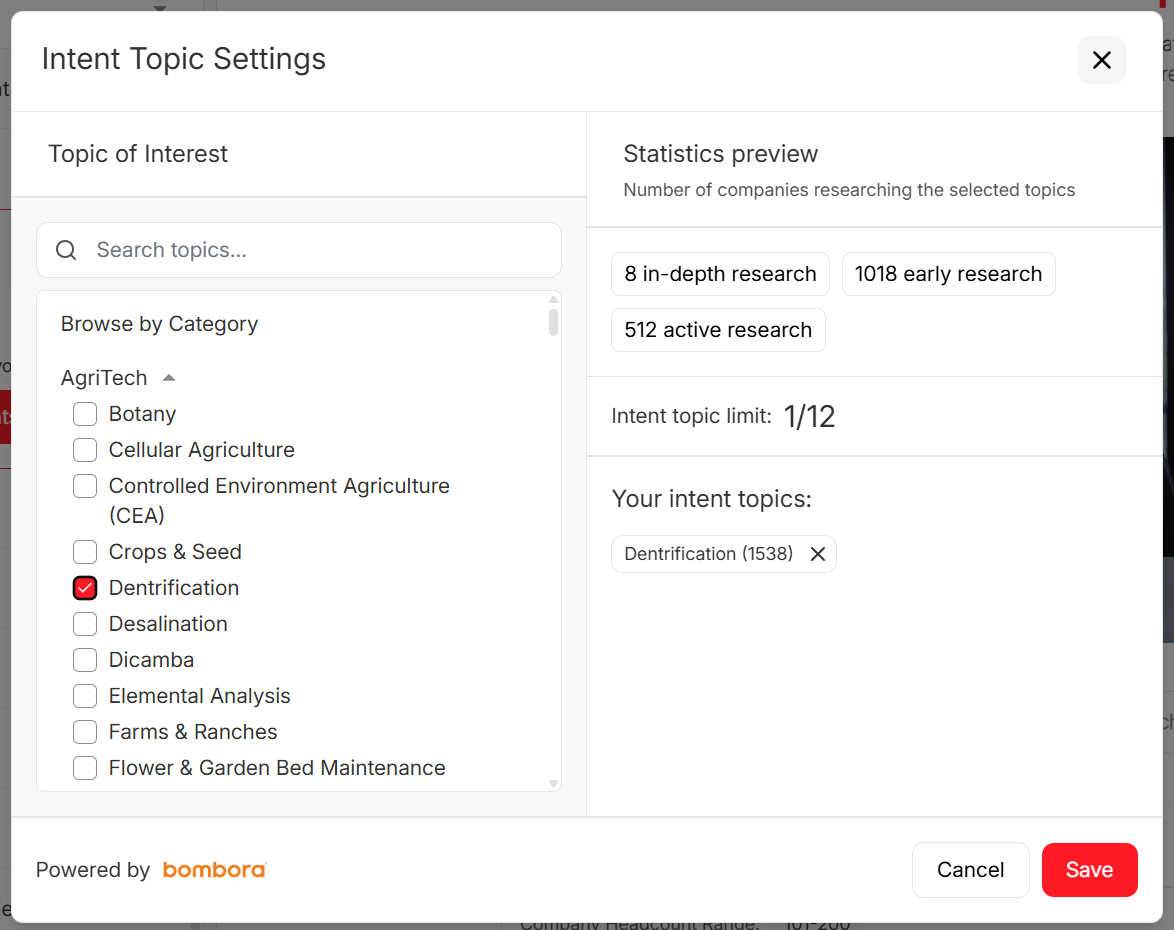
Scoring warm leads is pointless if your reps spend 20 minutes hunting for contact info. Prospeo's Chrome extension pulls verified emails and direct dials from any profile or website in one click - 40,000+ sales pros already use it to reach warm prospects before competitors do.
Reach warm leads in seconds, not hours - at $0.01 per email.
What Warm Leads Actually Cost
Not all leads cost the same, and not all industries play by the same rules. Here are blended CPL benchmarks by industry:
| Industry | Paid CPL | Organic CPL | Blended CPL |
|---|---|---|---|
| B2B SaaS | $310 | $164 | $237 |
| Cybersecurity | $411 | $404 | $406 |
| IT & Managed Services | $617 | $385 | $503 |
| Financial Services | $761 | $555 | $653 |
Two patterns jump out. First, organic consistently costs less than paid across every industry above. Second, referrals often produce warmer prospects and strong economics. If you're not investing in referral programs, you're overpaying for pipeline.
These are blended CPL numbers - they include cold leads mixed in. Your cost per warm lead will be higher, but your conversion rate more than compensates. A $400 engaged lead that converts at 10% costs $4,000 per customer. A $150 cold lead that converts at 2% costs $7,500. Warm is cheaper where it counts. (Benchmark your funnel with average B2B lead conversion rate.)
Warm Leads FAQ
What is a warm lead?
A warm lead is a person or company that has already interacted with your brand - through content downloads, site visits, email engagement, or referrals - but hasn't yet expressed explicit buying intent. They sit between cold leads (no prior interaction) and hot leads (ready to purchase). All MQLs are warm leads, but not all warm leads meet MQL thresholds.
How are warm leads different from MQLs?
A warm lead shows behavioral interest like content downloads or site visits. An MQL meets both behavioral and demographic/firmographic criteria your team has defined - it's where your scoring model says "this person is worth a sales conversation." Once sales accepts and further qualifies an MQL, it becomes an SQL.
How many touches to convert?
Roughly five touches for most engaged prospects and nine for executives. An eight-email nurture sequence over 30 days is a strong starting framework for B2B SaaS. Don't give up after two emails - the majority of conversions happen in touches four through eight.
Can you buy warm leads?
No. If someone else generated the interest, the lead isn't warm for your brand. You can buy intent data to identify who's researching your category, but the warming has to come from your own content and outreach. You can't outsource brand familiarity.
What's a good conversion rate?
Expect 5-15% conversion from warm leads to opportunity, depending on your industry and deal size. Below 5%, your scoring model is too loose or your follow-up is too slow. Above 15%, you're likely under-counting - tighten your warm definition and you'll find even higher-intent segments to prioritize.