

7 ABM Plays That Actually Generate Pipeline in 2026
56% of opportunities handed to sales die before they close. The culprit isn't bad strategy - it's running "ABM" that's really just ads to a big list with the same creative for everyone.
The plays below are signal-triggered, buying-committee-aware, and built to generate pipeline. Each one includes cost ranges and real pipeline numbers, because vague frameworks don't close deals.
What Makes an ABM Play Work
Signal triggers. Static account lists are dead. Accounts showing 3+ concurrent signals convert 5-7x higher than single-signal accounts. Layer intent surges with hiring patterns, funding events, tech changes, and leadership moves. Without real-time signals, you're guessing. (If you need a system for this, see signal triggers and How to Track Sales Triggers.)
Verified contact data. Enterprise buying committees run 12+ deep, and 94% of buying groups rank vendors before ever contacting sales. Bounced emails kill every play before it starts. You need a weekly refresh cycle - not the six-week industry average. (More on email bounce rate and the Email Deliverability Guide.)
Sales alignment. Weekly sprint meetings, shared dashboards, and agreed handoff criteria separate real account-based marketing from marketing theater. We've seen teams with great plays fail simply because the handoff between marketing and sales was a black hole. (If this is a recurring issue, tighten sales execution and your marketing enablement.)
7 Plays That Generate Pipeline
1. Signal-Led Outbound
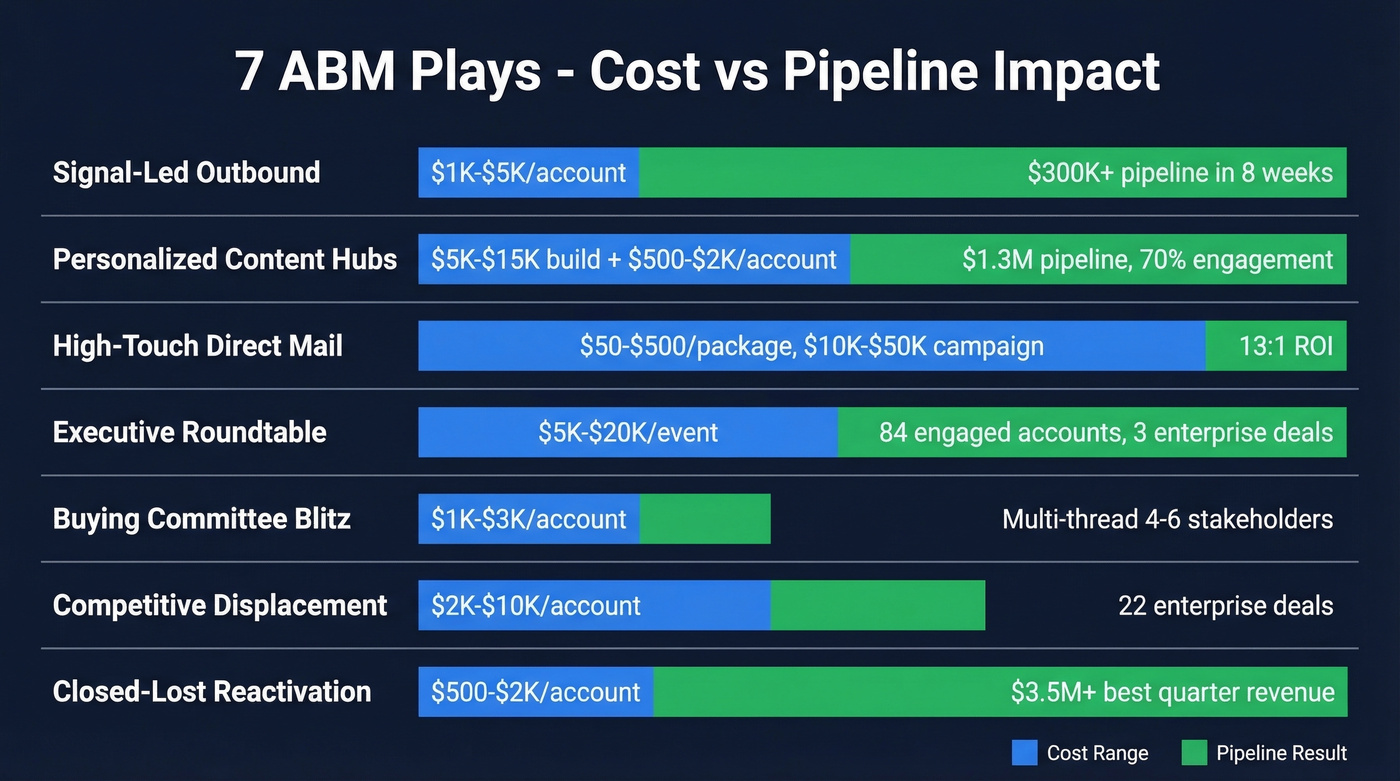
Wait for 3+ concurrent signals, then launch personalized multi-channel outreach to the buying committee. This isn't cold outbound - it's warm outbound with timing. One enterprise team generated $300K+ in pipeline in 8 weeks using personalized microsites that averaged 5.6 minutes time on page. Cost per account: $1K-$5K at the 1:few tier. (For sequencing and messaging, borrow from sales prospecting techniques and personalized outreach.)
This is the play we recommend starting with. It has the highest signal-to-effort ratio, works at nearly any deal size, and forces you to build the signal infrastructure every other play depends on. Get this one right before you add complexity.
2. Personalized Content Hubs
When an account crosses an engagement threshold, spin up a microsite tailored to their industry, use case, and stage. A cloud services provider targeting 50 enterprise manufacturing accounts generated [$1.3M in pipeline with a 70% engagement rate](https://www.inverta.com/resources/the-power-of-precision - building-effective-abm-campaigns-a-case-study). Building the hub costs $5K-$15K; personalizing per account runs $500-$2K. (If your hubs are underperforming, revisit B2B content marketing.)
3. High-Touch Direct Mail
Direct mail works when it's targeted and creative - not when it's a branded mug to 500 people. O2 targeted their top 50 accounts with a holographic mailer and hit 13:1 ROI. Full Tier 1 campaigns run $10K-$50K; individual packages cost $50-$500. (More examples in Direct Mail for Lead Generation.)
4. Executive Roundtable
Skip this play if you can't fill the room with decision-makers. When multiple stakeholders from the same account engage your content, invite them to an intimate dinner or workshop with 10-15 attendees from your top accounts. Certn generated 84 engaged target accounts and 3 enterprise deals from targeted event engagement. Budget $5K-$20K per event.
5. Buying Committee Blitz
Single-threading is how deals die. Your champion loves you, but the deal stalls because nobody else in the buying committee knows you exist.
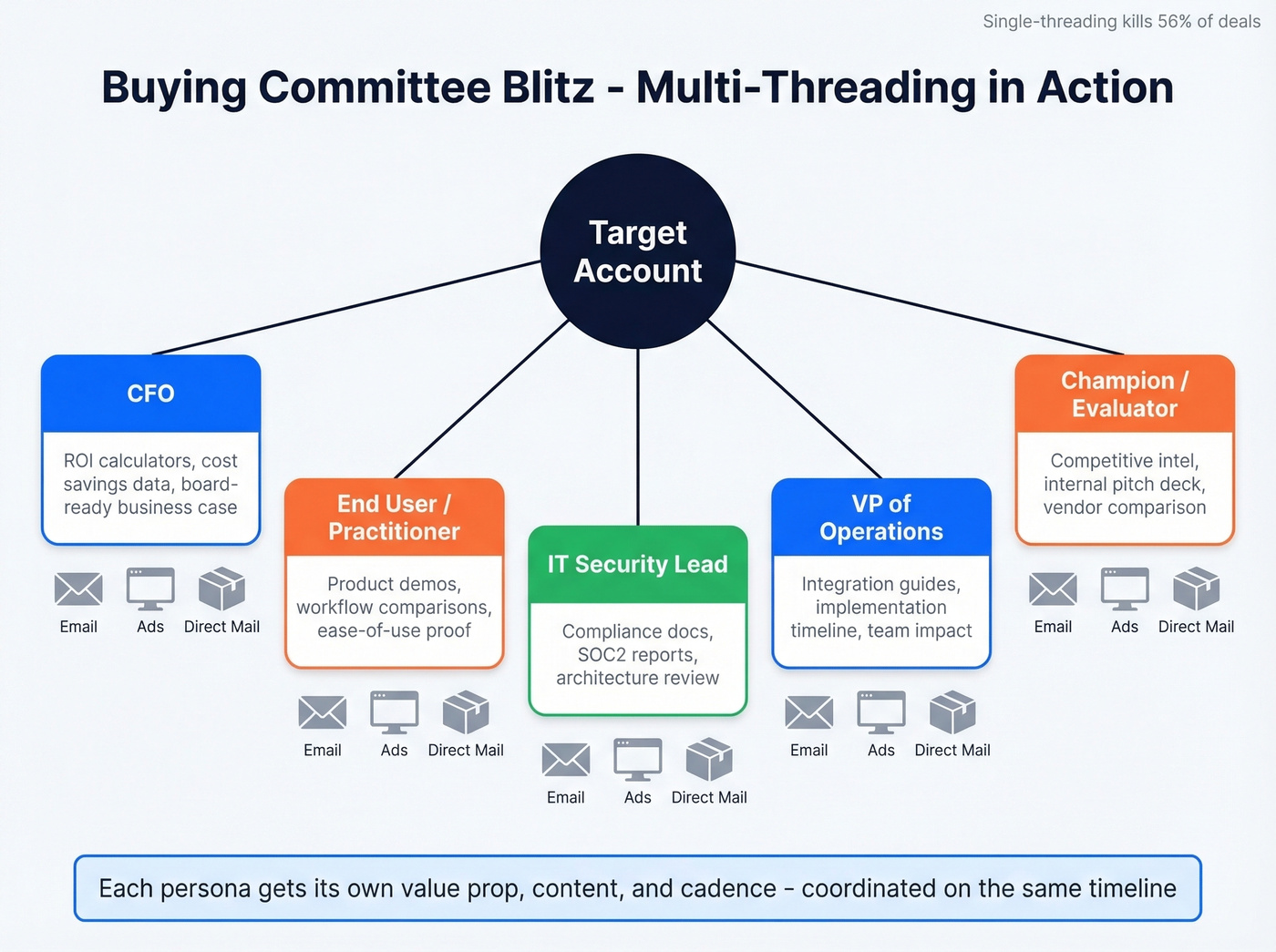
Map the full committee - 4-6 stakeholders minimum - and launch coordinated outreach with different messaging for the CFO, the end user, and the IT security lead. Each stakeholder gets a distinct sequence across email, ads, and direct mail, all orchestrated around the same timeline. This multi-threaded approach separates winners from everyone else. Cost: $1K-$3K per account.
Here's the thing: most teams think they're multi-threading because they CC'd someone on an email. That's not multi-threading. Each persona needs its own value prop, its own content, and its own cadence. The CFO doesn't care about your API docs, and the developer doesn't care about your ROI calculator.
6. Competitive Displacement
Spot accounts running a competitor's tool via technographic signals, layer on hiring or intent data, and launch a play built around switching. TestRail created 22 enterprise deals using competitive positioning in ABM. Don't just say "we're better" - build migration guides and ROI calculators tailored to the competitor they're actually using. Cost: $2K-$10K per account. (To operationalize this, build sales battle cards and a lightweight competitive intelligence strategy.)
7. Closed-Lost Reactivation
Your best prospects are accounts that already went through your sales process and said no. When a closed-lost account shows a new intent surge or leadership change, reactivate with fresh messaging that acknowledges the history. Charlesgate hit $3.5M+ revenue in their best quarter using reactivation-style ABM. This is the cheapest play on the list at $500-$2K per account.
Let's be honest: if your average deal size is under $15K, you probably don't need most of these plays. Pick signal-led outbound and closed-lost reactivation, run them well, and skip the rest until deal sizes justify the investment.
Why Most ABM Plays Fail
Generic content dressed up as personalization. The consensus on r/b2bmarketing is brutal: teams run "ABM" that's really just ads to a big list with minimal messaging changes. ABM backlash isn't about the strategy - it's about lazy implementation.
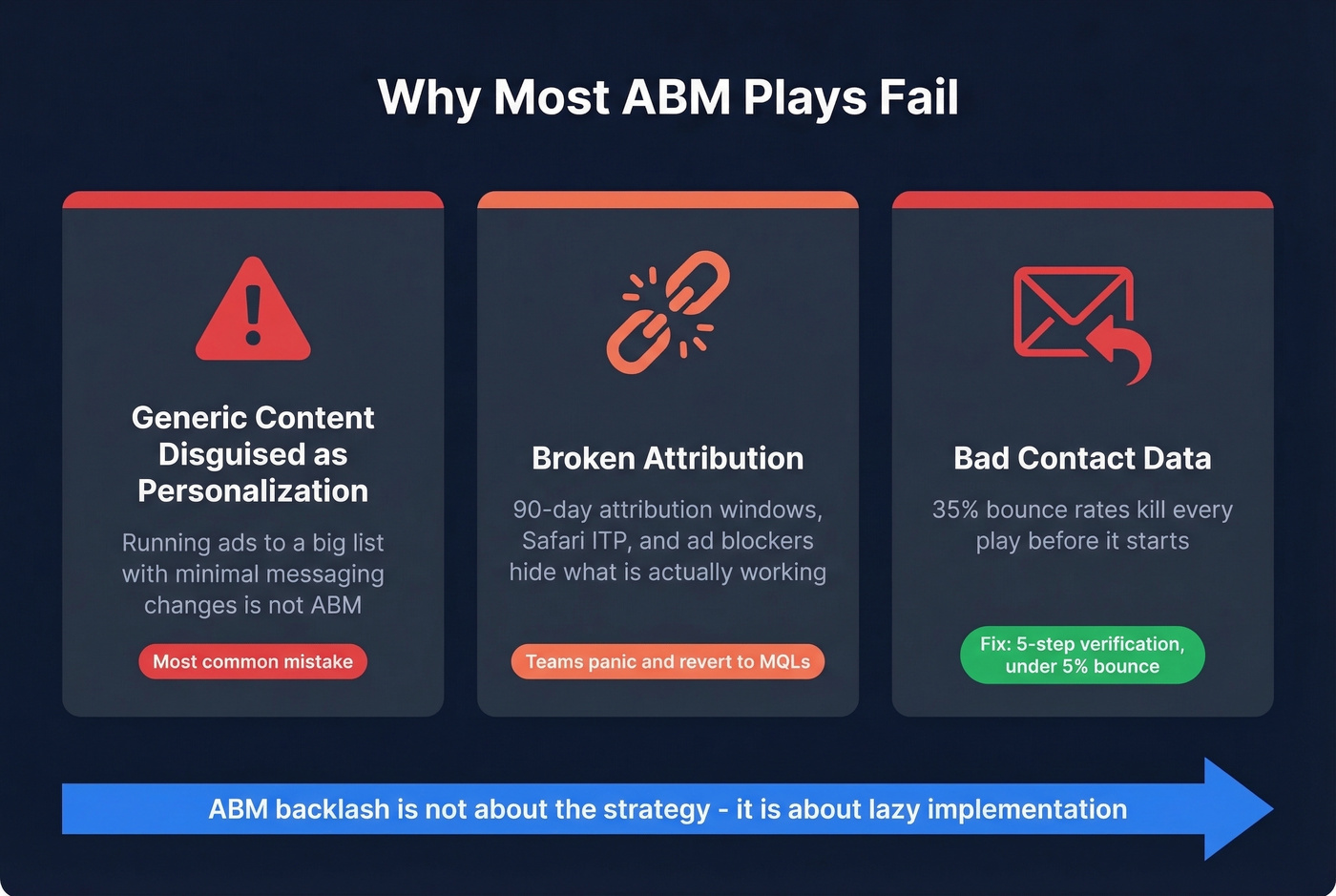
Broken attribution. HubSpot's 90-day attribution window, Safari ITP, and ad blockers conspire to make ABM look broken even when it's working. Teams panic and revert to MQL-chasing. If you're only measuring last-touch, you'll never see the full picture.
Bad contact data. If ~35% of your emails bounce, every play fails before it starts. Prospeo's 5-step verification drops bounce rates to under 5%, and Snyk's team of 50 AEs saw AE-sourced pipeline jump 180% after switching to verified data on a 7-day refresh cycle.

Signal-led outbound only works when your emails actually land. Prospeo's 5-step verification delivers 98% email accuracy - Snyk's 50 AEs cut bounce rates from 35% to under 5% and grew AE-sourced pipeline 180%. Layer in Bombora-powered intent data across 15,000 topics to spot the 3+ concurrent signals that trigger your best ABM plays.
Stop killing ABM plays with bounced emails. Start with verified data.
The Minimum ABM Stack
| Job | Tool | Cost |
|---|---|---|
| Contact Data & Verification | Prospeo | Free tier; ~$0.01/email |
| Intent Data | Bombora-powered (available via Prospeo, 15,000 topics) | Varies |
| CRM | HubSpot or Salesforce | $0-$3,000+/mo |
| Orchestration | Clay, Zapier, or manual | $0-$500/mo |
| Personalization | Mutiny or manual microsites | $1,000-$6,000+/mo |
| ABM Platform (optional) | 6sense, Demandbase, ZoomInfo | $30K-$100K+/yr |
Most teams targeting under 50 accounts don't need the expensive ABM platform at launch. In our experience, a CRM, verified contacts, and intent signals cover 80% of what you need for the first three plays. (If you're evaluating data vendors, start with data enrichment services and B2B company data providers.)

Buying committee blitzes need verified contacts for every stakeholder - CFO, end user, IT lead. Prospeo maps 300M+ profiles with 30+ filters including intent signals, technographics, and job changes. At $0.01 per email, multi-threading a 12-person buying committee costs less than a single bounced sequence destroys in domain reputation.
Map the full buying committee with verified data for under a dollar.
How to Measure Your Plays
Stop tracking MQLs. These three metrics actually tell you if your account-based plays are working.
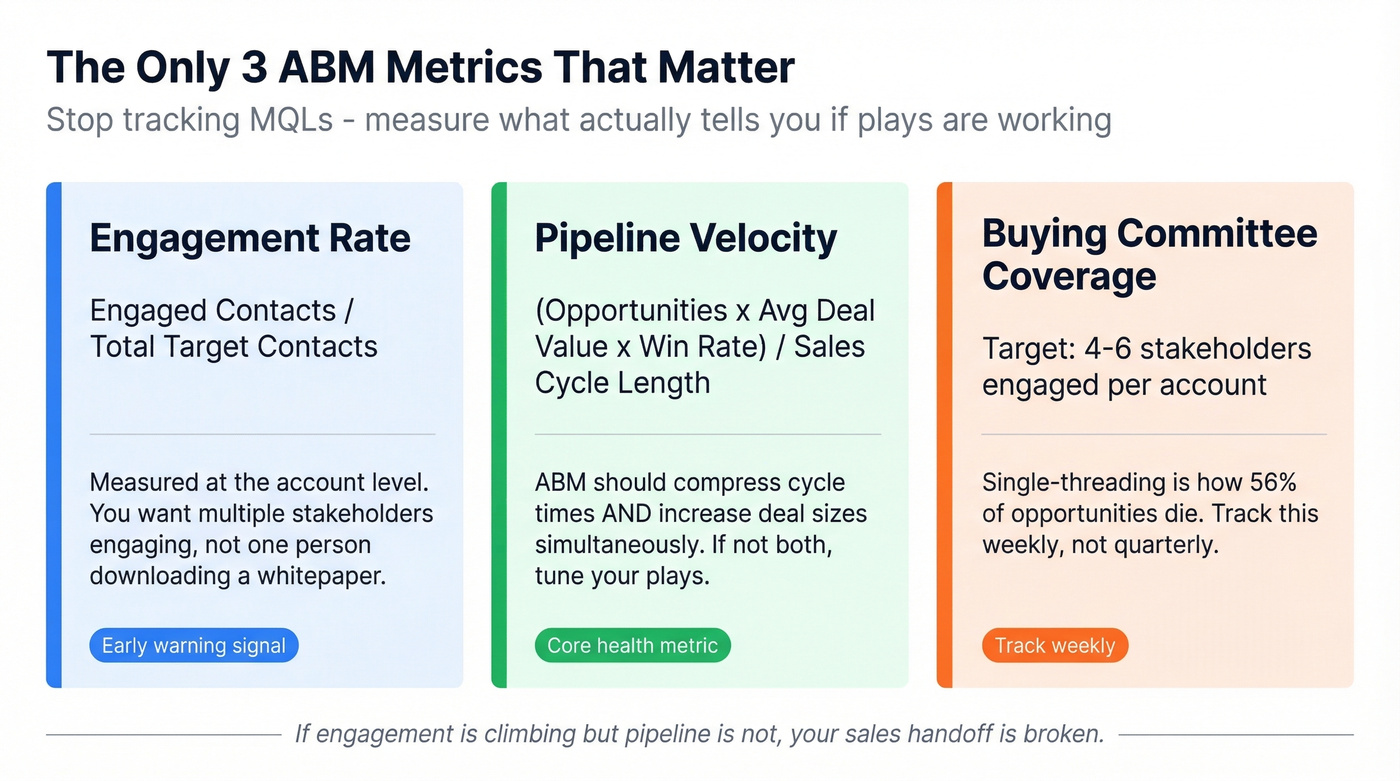
Engagement rate - engaged contacts divided by total target contacts, measured at the account level. You want multiple stakeholders engaging, not one person downloading a whitepaper. Low engagement across the committee is the earliest warning sign a play needs reworking.
Pipeline velocity - opportunities multiplied by average deal value and win rate, divided by sales cycle length. ABM should compress cycle times and increase deal sizes simultaneously. If it's not doing both, your plays need tuning.
Buying committee coverage - aim for 4-6 stakeholders engaged per account. Single-threading is how 56% of opportunities die. Track this weekly, not quarterly. (To pressure-test your funnel math, use funnel metrics and pipeline health.)
ABM Plays FAQ
What's the difference between a play and a campaign?
A play is a repeatable, signal-triggered motion you run whenever accounts match your criteria. A campaign is a one-time execution of that play against specific accounts. Build plays as templates; run campaigns from them.
How many plays should we run at once?
Start with three: signal-led outbound, a content hub play, and direct mail for your top 10 accounts. Master execution on those before adding complexity - most teams spread too thin and execute none of them well.
Can we run ABM plays without 6sense or Demandbase?
Yes. Verified contacts and intent signals, a CRM for account movement, and manual personalization cover most plays for teams under 50 accounts. Don't let a $30K-$100K software purchase delay your first play by six months.
What works best for small teams?
Focus on plays with the highest signal-to-effort ratio: signal-led outbound and closed-lost reactivation. Both require minimal tooling, and a two-person team can run them against 20-30 accounts without an enterprise platform.
How do we know a play is working?
Track account engagement rate, pipeline velocity, and buying committee coverage weekly. If engagement is climbing but pipeline isn't, your sales handoff is broken. If you're only tracking MQLs, you're measuring the wrong thing entirely.