

BDR Sales Tactics: Cadences, Scripts, and Benchmarks for 2026
It's week three. You've sent 200 emails, made 150 calls, and booked two meetings - one of which no-showed. Your manager keeps saying "trust the process," but the process feels like throwing darts blindfolded. Meanwhile, the top rep's Slack channel is a steady stream of "meeting booked" notifications, and you're wondering what they know that you don't.
This playbook replaces the motivational fluff with actual BDR sales tactics - numbers, templates, and frameworks that separate reps hitting 88% of quota from the ones updating their resumes.
2026 BDR Benchmarks
Before you can fix your outbound motion, you need to know what "good" actually means. The 6sense BDR Benchmark report surveyed 262 BDRs and the numbers are clear: top performers don't work harder, they work with more structure.
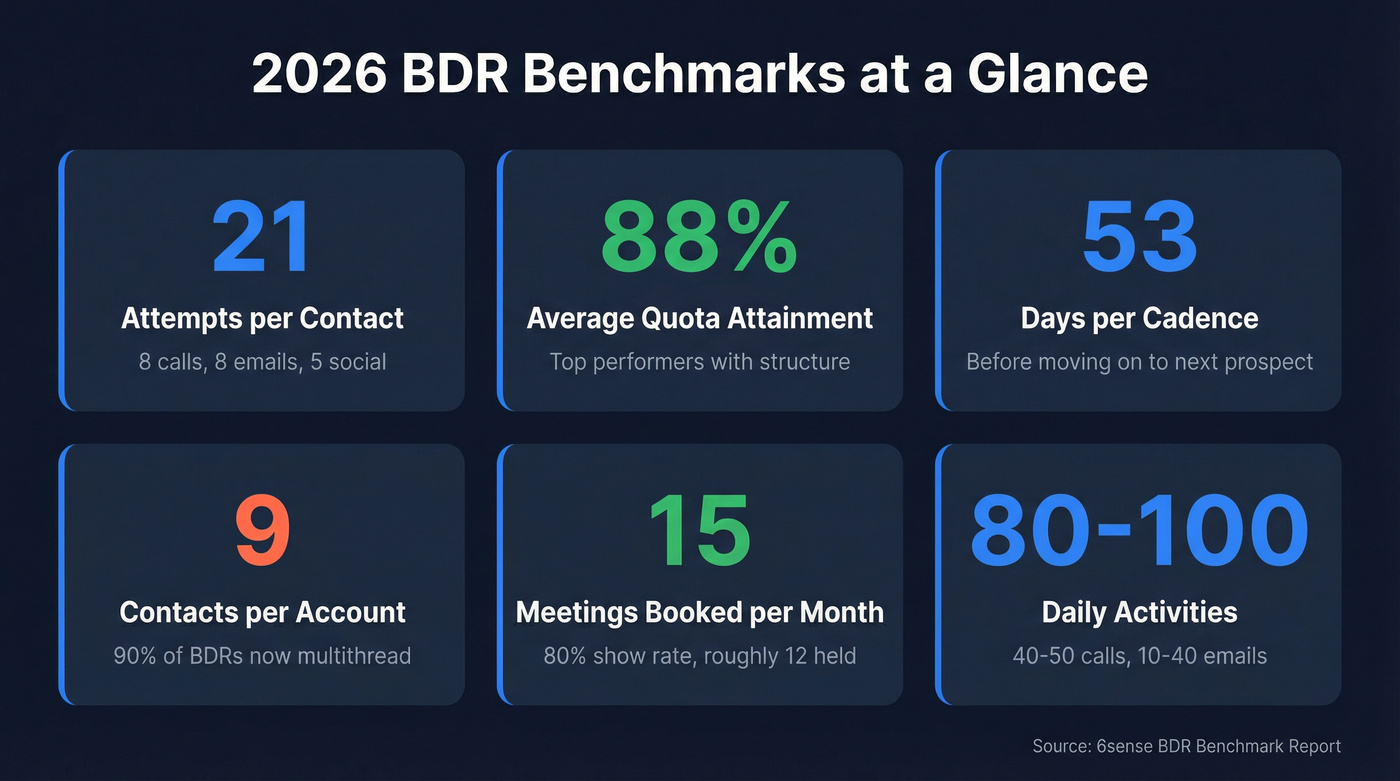
| Metric | Benchmark |
|---|---|
| Quota attainment | ~88% average |
| Attempts per contact | 21 (8 calls, 8 emails, 5 social) |
| Cadence length | 53 days before moving on |
| Multithreading | 90% of BDRs, ~9 contacts/account |
| Daily calls | 40-50 |
| Daily emails | 10-40 |
| Total daily activities | 80-100 |
| Meetings booked/month | 15 (outbound) |
| Show rate | 80% |
| Meetings held/month | ~12 |
Two things jump out. First, 21 attempts per contact is up from 17 last year - buyers are harder to reach, so persistence isn't optional. Second, 90% of BDRs now multithread into ~9 contacts per account. If you're still single-threading to one champion, you're playing a 2022 game. (If you need a refresher, here’s what multithreading actually means in practice.)
What the benchmarks don't always surface: 60% of BDRs now use AI tools for research, personalization, or sequencing, and 79% of BDR orgs grew or maintained headcount this year. The role isn't shrinking. It's evolving. BDRs who feel supported by their org hit 95% of quota versus 80% for those who don't. In our experience, the reps who hit these numbers aren't working longer hours - they're maximizing prospecting productivity with cleaner data and tighter cadences.
Outbound Prospecting: The 3-7-7 Cadence
Most BDRs either blast all their prospecting touches in the first three days or space them so far apart that prospects forget they exist. The 3-7-7 framework fixes both problems: follow up 3 days after your initial email, then space subsequent touches 7 days apart.
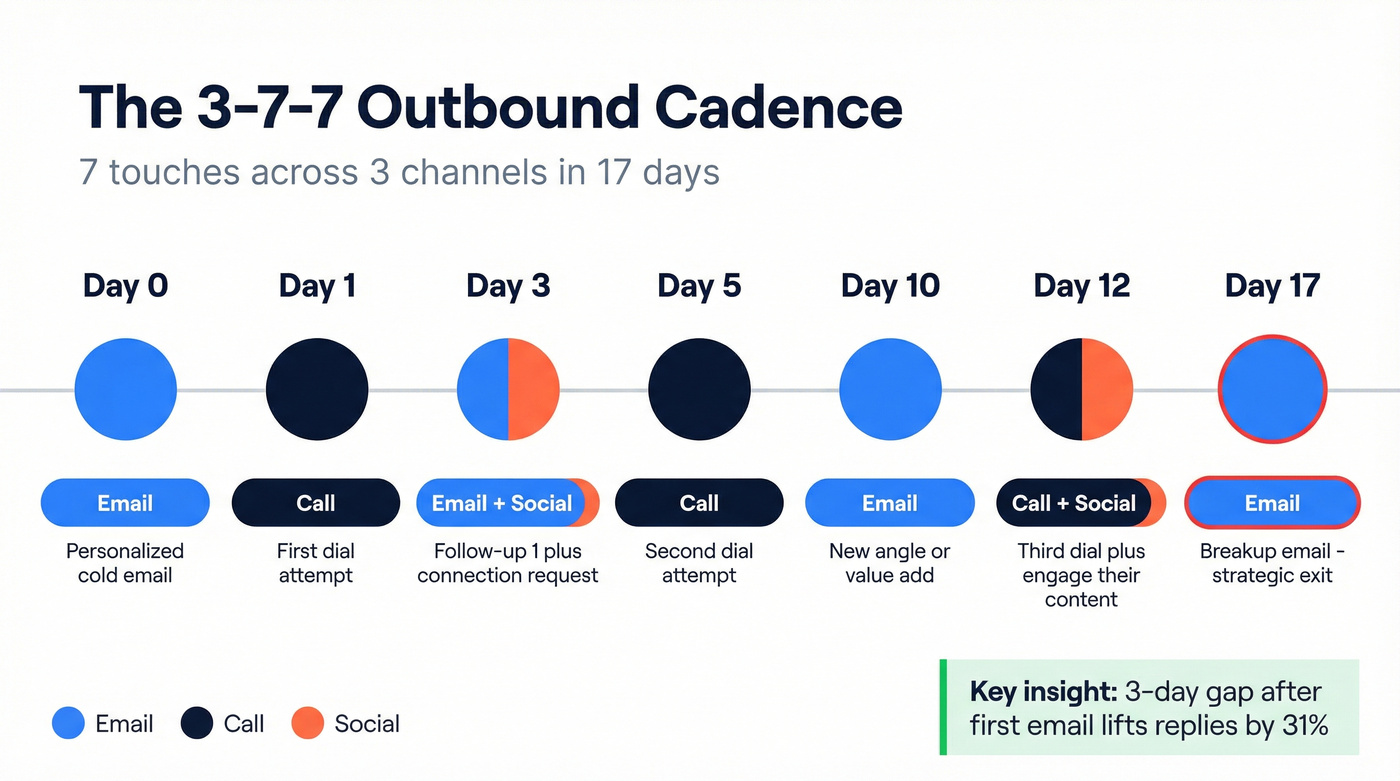
Here's the thing - following up within 24 hours actually hurts reply rates by about 11%. A 3-day gap lifts replies by 31%. Patience pays, but only structured patience.
| Day | Channel | Action |
|---|---|---|
| 0 | Personalized cold email | |
| 1 | Call | First dial attempt |
| 3 | Email + Social | Follow-up #1 + connection request |
| 5 | Call | Second dial attempt |
| 10 | Follow-up #2 (new angle/value) | |
| 12 | Call + Social | Third dial + comment on their content |
| 17 | Breakup email |
That's 7 touches across 3 channels in 17 days - a shorter, front-loaded cadence compared to the 53-day average. RAIN Group research shows 43% of buyers who accept meetings say it's fine for sellers to contact them 5+ times. The breakup email on Day 17 isn't giving up. It's strategic.
Cold Email Tactics That Get Replies
Most cold emails get a 1-5% reply rate. Well-optimized sequences with verified contacts and real personalization hit 12%. The gap between those two numbers is where quota lives.
Personalized emails drive 14% higher open rates than generic blasts. But personalization means more than {{first_name}} - it means referencing something specific about their company, role, or a trigger event that makes your outreach timely. Relevance always beats volume. Always. (More frameworks here: cold email tactics.)
Deliverability guardrails matter just as much as copy. Keep your bounce rate under 2% and spam complaint rate below 0.01%, or your sender reputation craters and none of your emails land in the primary inbox. Before you send a single sequence, verify your list. Prospeo's 5-step verification - catch-all handling, spam-trap removal, honeypot filtering - keeps bounce rates under 2% with records refreshing every 7 days so your list doesn't decay mid-campaign. (If you’re comparing tools, start with this list of email validators.)
Subject line principles:
- Keep it under 6 words - curiosity beats cleverness
- Reference their company name or a specific trigger
- Test question-based vs. statement-based in A/B splits (here’s how to A/B test reply rates)
Your opening line should answer one question: "Why are you emailing me, specifically, right now?" If you can't answer that in one sentence, your email isn't personalized enough.
Cold Call Scripts and Objections
Cold calling isn't dead - it's just harder. Expect 18+ dials per connect and roughly 1 meeting per 59 calls. The math works if your data's clean and your talk track is tight. (If you want deeper benchmarks + KPIs, use this B2B cold calling guide.)
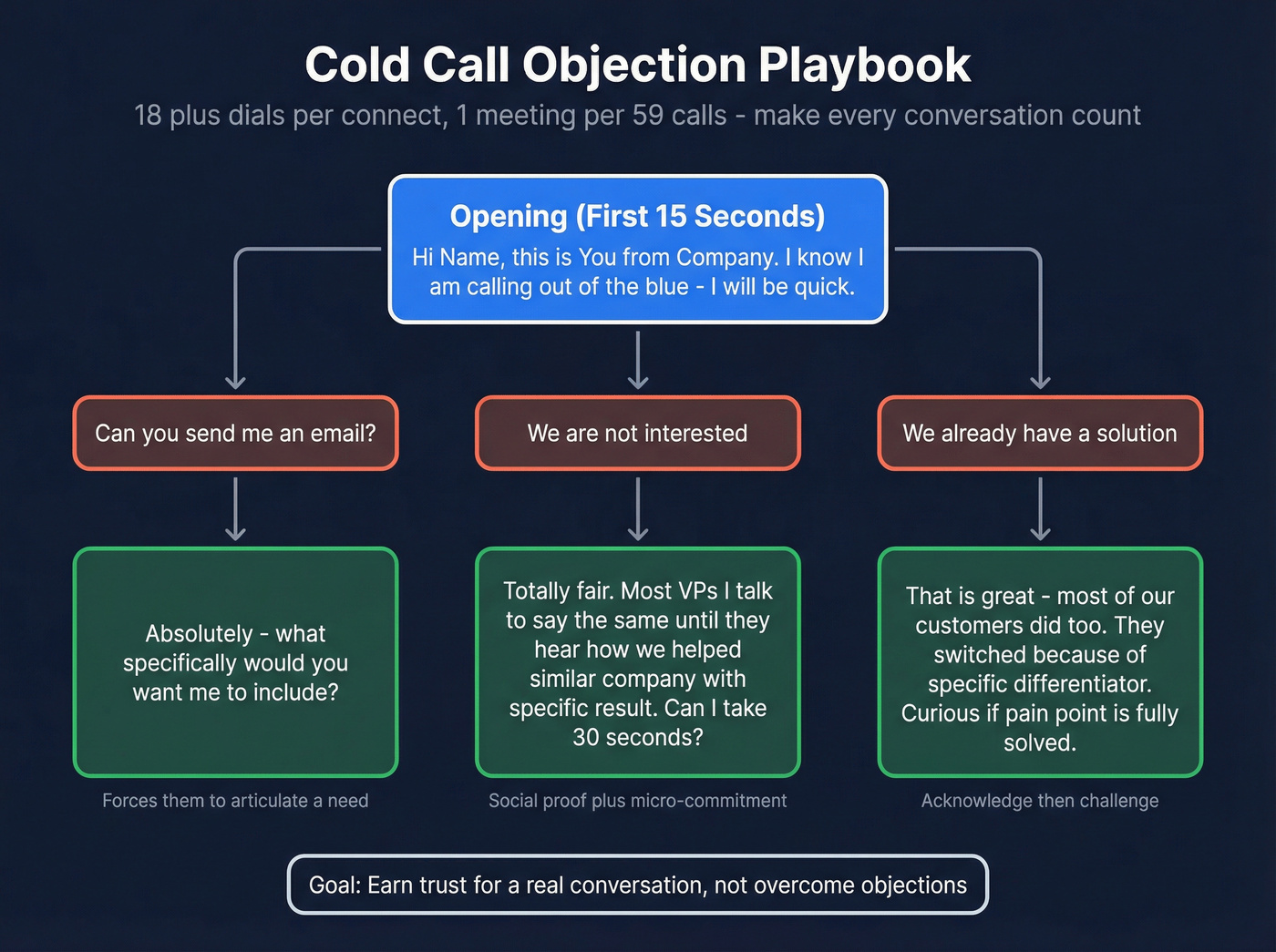
The first 15 seconds are the window where you earn another minute or get hung up on:
"Hi [Name], this is [You] from [Company]. I know I'm calling out of the blue - I'll be quick. We help [their role] at [company type] solve [specific problem]. Is that something you're dealing with right now, or am I off base?"
Acknowledge the interruption and get to relevance fast. Now the three objections you'll hear most:
"Can you send me an email?" Don't just say yes and hang up. Try: "Absolutely - what specifically would you want me to include?" This forces them to articulate a need, which reopens the conversation.
"We're not interested." "Totally fair. Most [VPs of Sales / Heads of Ops] I talk to say the same thing until they hear how we helped [similar company] with [specific result]. Can I take 30 seconds?"
"We already have a solution." "That's great - most of our customers did too. They switched because [specific differentiator]. Curious if [pain point] is something you've fully solved."
Average B2B buying groups have grown to 12 stakeholders, and 77% of buyers describe their last purchase as complex. Your job isn't to overcome objections - it's to earn enough trust to get a real conversation started. (For a tighter framework, see SDR rejection handling.)

You need 21 attempts across 3 channels to book a meeting - and every bounced email or dead number wastes one. Prospeo's 5-step verification delivers 98% email accuracy and 125M+ verified mobiles with a 30% pickup rate, so your 40-50 daily dials actually connect and your sequences stay under the 2% bounce threshold.
Stop burning touches on bad data. Verify your list before you hit send.
Social Selling - The Third Channel
The 6sense benchmark calls for 5 social touches per contact as part of the 21-attempt standard. Social isn't a nice-to-have anymore. It's a third of your cadence. (If you need a system, use this guide on social selling.)
When it works best: Your prospects are active on professional networks, you're selling to director+ titles, or your email reply rates are below 3%. A Highspot analysis found a 46% lift in InMail acceptance rates when sellers mention at least one commonality - shared connections, same school, mutual group membership.
Skip this if: Your ICP is in industries with low social adoption (manufacturing floor managers, for example) or you're running high-volume SMB outbound where the math favors email and phone.
Connect with a personalized note referencing something specific, engage with their content for a week before pitching, then send a short direct message that ties to your email cadence. Don't copy-paste your cold email into a DM - the format demands a conversational tone. Warm up the relationship on social before you ask for time on the calendar.
Use Intent Data to Prioritize
70% of the buyer journey happens before a prospect talks to a vendor. If you're reaching out blind, you're competing for attention with zero context. (Related: how to use intent signals in outbound.)
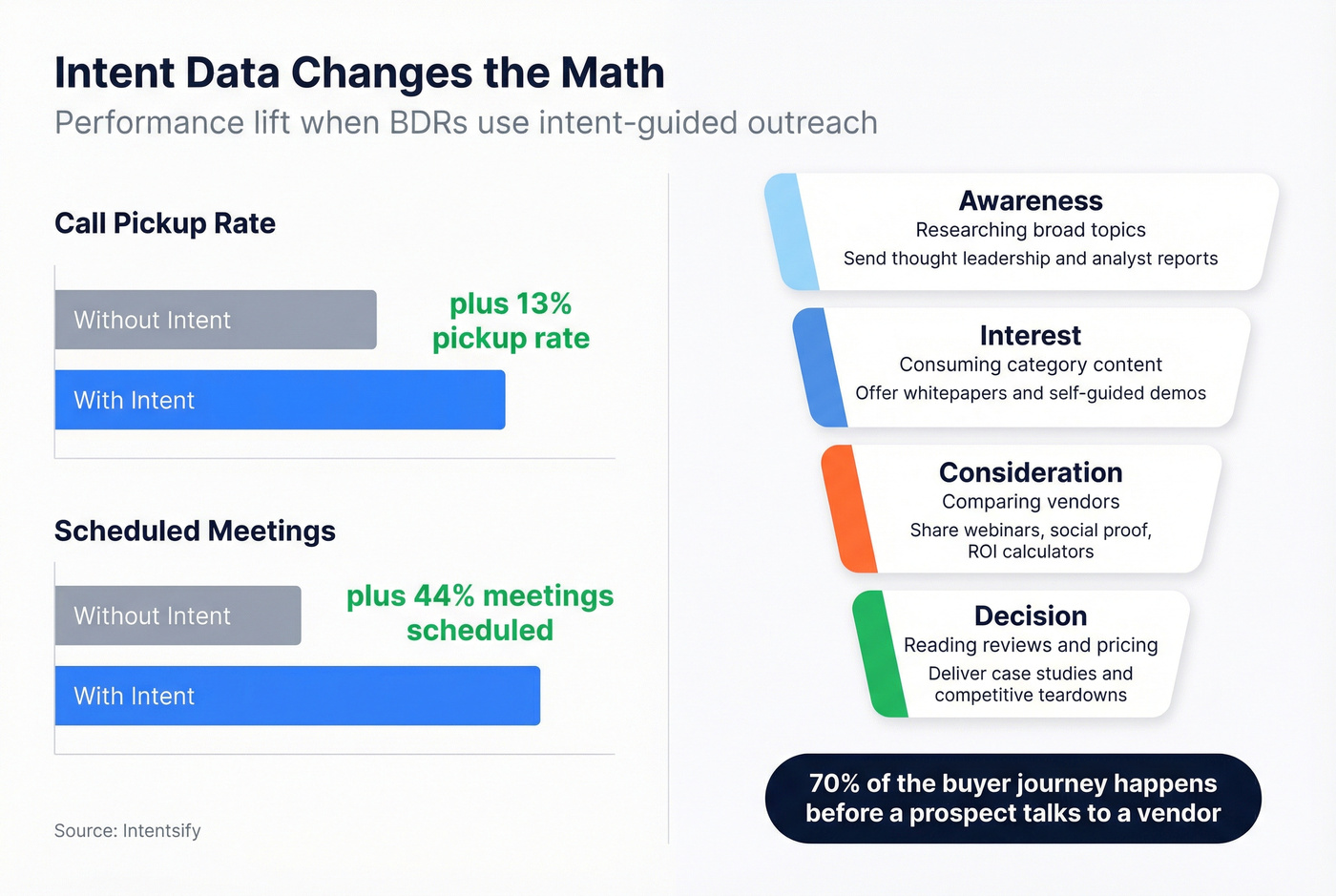
Intentsify reported a 13% increase in call pickups and a 44% increase in scheduled meetings when their team used intent-guided outreach. Those aren't marginal gains - that's the difference between hitting quota and missing it.
| Stage | Signal | Outreach Approach |
|---|---|---|
| Awareness | Researching broad topics | Thought leadership, analyst reports |
| Interest | Consuming category content | Whitepapers, self-guided demos |
| Consideration | Comparing vendors | Webinars, social proof, ROI calcs |
| Decision | Reading reviews, pricing | Case studies, competitive teardowns |
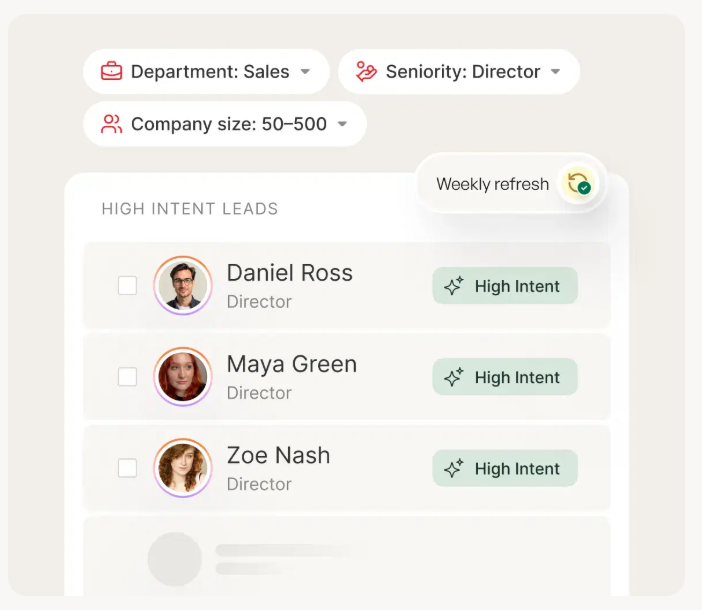
We've found that layering intent signals with firmographic filters - headcount growth, tech stack, recent funding - turns a cold list into a warm one before you ever pick up the phone. The reps on our team who adopted intent-based prioritization saw their connect-to-meeting conversion jump noticeably within the first month.
Mistakes That Kill Your Pipeline
We've seen teams burn months on outbound that never had a chance. Data quality matters more than script quality. Here are the mistakes that do the most damage:
Sending to unverified data. Bounce rates above 2% tank your sender reputation. Once it's gone, even good emails land in spam. Meritt went from 35% bounce rates to under 4% after switching their data source - and tripled their pipeline from $100K to $300K per week. The data layer is the foundation. (If you’re diagnosing issues, start with data quality.)
Single-channel outreach. Email-only cadences ignore the 21-touch, 3-channel benchmark. If you're not calling and engaging socially, you're leaving meetings on the table. (Use a copy-paste sales cadence example to fix this fast.)
Giving up too early. The average cadence runs 53 days. Stopping at Day 7 means quitting before most buyers are ready to engage. The consensus on r/sales is that most reps bail after 3-4 touches - which is exactly why persistence is a competitive advantage.
Showing up unprepared. Buyers say 58% of sales meetings aren't valuable. Book the meeting and wing it, and you've wasted everyone's time.
Ignoring compliance. GDPR fines run up to EUR 20M or 4% of global annual revenue. Use GDPR-compliant data sources and honor opt-outs. No exceptions. (Here’s a practical outbound playbook for GDPR for sales and marketing.)
Let's be honest: if your average deal size is under $15K, you probably don't need a $30K/year data platform. A self-serve tool with 98% accuracy and a solid sequencer will outperform an enterprise stack that your team barely uses. Spend the savings on headcount.
The BDR Tech Stack for 2026
BDR stacks typically cost $200-500/month per rep. You can cut that in half by choosing self-serve tools over enterprise platforms with annual lock-ins. (If you’re rebuilding from scratch, start with a lean B2B sales stack.)
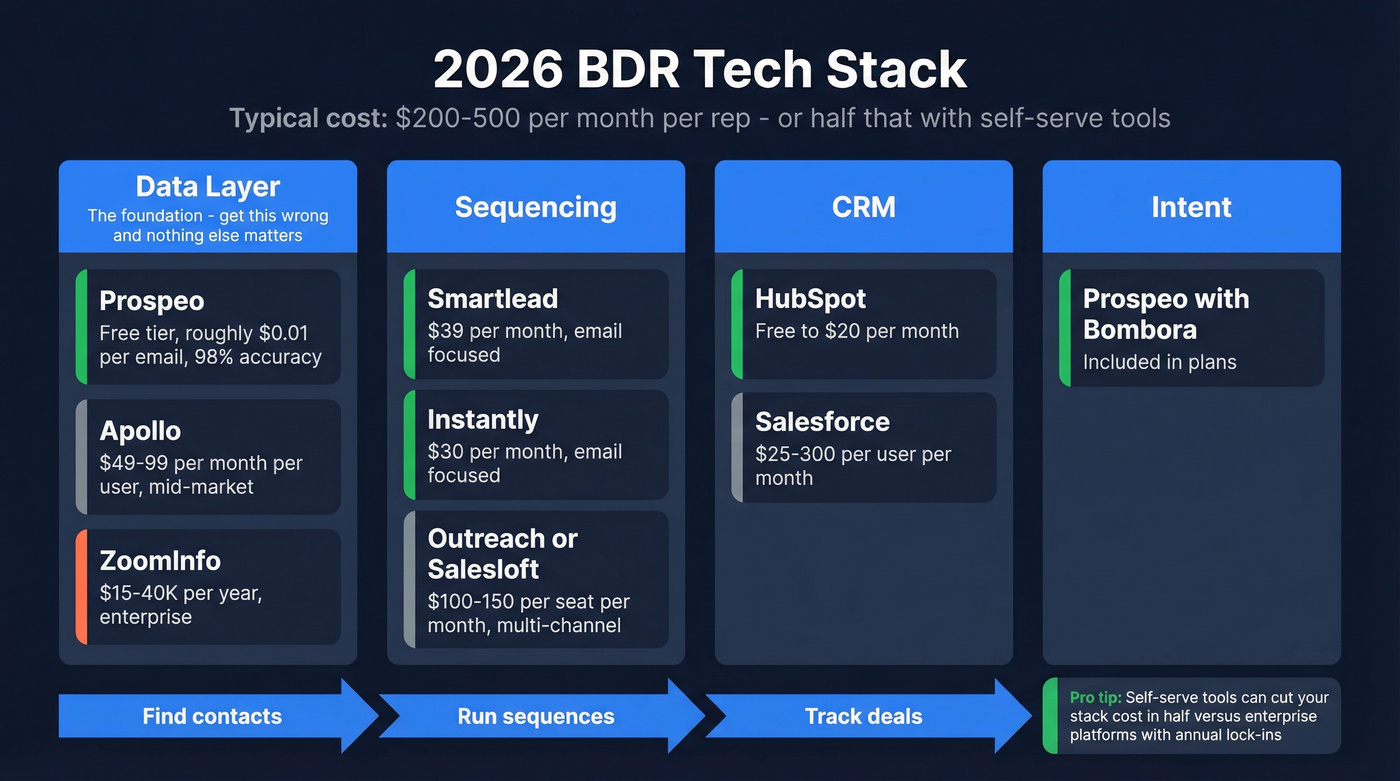
| Category | Tool | Price Range |
|---|---|---|
| Data (emails + mobiles) | Prospeo | Free tier; ~$0.01/email |
| Data (enterprise) | ZoomInfo | ~$15-40K/year |
| Data (mid-market) | Apollo | ~$49-99/mo per user |
| Sequencing (email) | Smartlead | ~$39/mo |
| Sequencing (email) | Instantly | ~$30/mo |
| Sequencing (multi-channel) | Outreach / Salesloft | ~$100-150/seat/mo |
| CRM | HubSpot | Free-$20/mo |
| CRM (enterprise) | Salesforce | ~$25-300/user/mo |
| Intent | Prospeo (Bombora) | Included in plans |
The data layer is where most teams either save or waste the most money. Get that wrong and no amount of clever copywriting saves you.
Top BDRs multithread into 9 contacts per account. That means you need accurate emails and direct dials for entire buying committees - not just one champion. Prospeo gives you 300M+ profiles with 30+ filters including job change, department headcount, and buyer intent across 15,000 topics, so you reach all 12 stakeholders.
Build multithreaded account lists in minutes, not hours.
FAQ
How many calls should a BDR make per day?
Target 40-50 calls as part of 80-100 total daily activities. Expect 18+ dials per connect and roughly 1 meeting per 59 calls. Reps who pair clean mobile data with a structured talk track consistently outperform those relying on switchboard numbers.
What's a good cold email reply rate?
Baseline is 1-5% for generic outreach. Optimized sequences with verified contacts and personalized messaging hit 12%. The biggest lever is list quality - keeping bounces under 2% protects deliverability and lifts reply rates across every sequence you run.
What are the most effective BDR sales tactics in 2026?
Multichannel cadences across email, phone, and social with 21 touches per contact, intent-based account prioritization, and verified data that keeps bounce rates under 2%. Structure beats volume every time - the 3-7-7 cadence framework outperforms both rapid-fire and slow-drip approaches.
How do BDRs use intent data for prospecting?
Layer intent signals - topics your ICP is actively researching - with firmographic filters like headcount growth and tech stack. Intentsify saw a 44% increase in scheduled meetings using this approach. The key is prioritizing accounts already in-market before you start dialing, so every touch has context behind it.