

Best Practices for Lead Generation: A Data-Backed Playbook for 2026
You're sending 500 cold emails a week and getting 10 replies. Your CPL is climbing. The SDRs are frustrated, marketing is pointing fingers, and the pipeline forecast looks like fiction. The gap isn't effort - it's process. Here are the actual best practices for lead generation, built on real benchmarks instead of recycled advice.
The Lead Gen Reality Check
A practitioner on r/b2bmarketing summed up what most teams experience: cold emails pulling a 2% reply rate, connection requests ignored, ads burning budget with nothing to show.
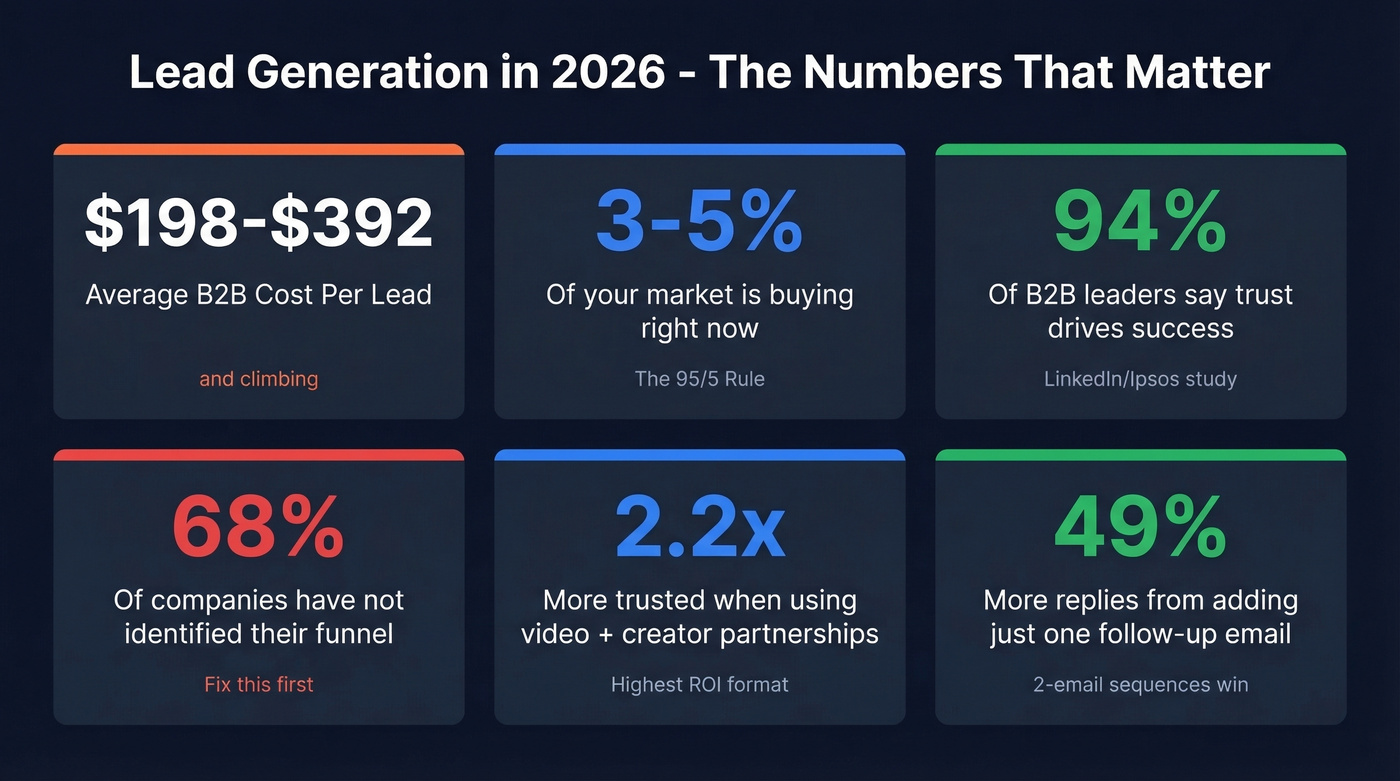
The average cost per lead across B2B sits at $198, though other compilations put average CPL closer to $392. When you're paying that much per name and half of them ghost after the first call, you don't have a volume problem. You have a quality problem. Everything that follows is about fixing quality at every stage of the funnel.
What Actually Works (Quick Version)
- Define your ICP ruthlessly. If you can't describe your ideal buyer in one sentence, stop everything else until you can (use an ICP one-pager if you need structure).
- Verify every contact before outreach. The average cold email bounce rate is 7.5%. Bad data kills sender reputation faster than bad copy (here’s a deeper email bounce rate breakdown).
- Measure lead quality, not lead volume. Only only 3-5% of your total addressable market is in-market at any given time. Chasing the other 95% with sales emails wastes everyone's time.
- Turn off open tracking. A dataset of 44M+ emails showed reply rates more than doubled - 2.36% vs 1.08% - when open tracking was disabled. Deliverability matters more than vanity metrics (see how email tracking pixels impact inboxing).
Why Most Lead Gen Fails (The 95/5 Rule)
The B2B Institute's research lands like a gut punch: only 3-5% of your total addressable market is actively buying at any moment. The other 95% aren't ignoring you because your subject line is weak. They just don't need what you sell right now.
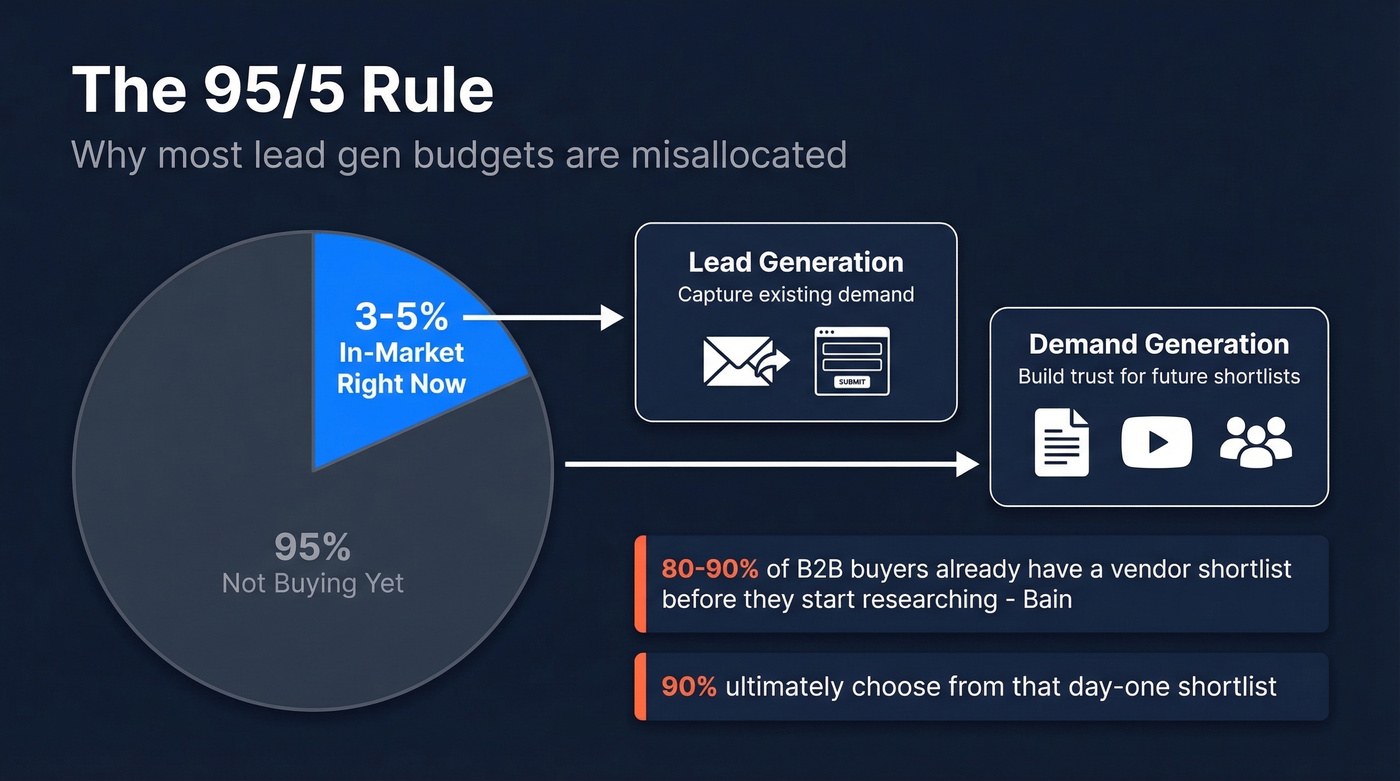
Bain research makes it worse. 80-90% of B2B buyers already have a shortlist of vendors in mind before they start researching, and 90% ultimately choose from that day-one list. If you're not on the shortlist before the buying window opens, your outbound is fighting uphill against brands the prospect already knows and trusts.
This is the core distinction between lead gen and demand gen. Lead gen captures the 3-5% who are ready now. Demand gen builds trust with the 95% so you're on the shortlist when their window opens. Most teams pour 90% of their budget into capturing that tiny in-market slice, then wonder why CAC keeps climbing. The teams winning in 2026 do both - but they're honest about which motion they're running and why.
Define Your ICP First
Here's the thing: 68% of companies haven't even identified their funnel. If you haven't nailed your ICP, everything downstream - your lists, your messaging, your scoring - is built on sand.
A real ICP isn't "mid-market SaaS companies." It's a combination of firmographics (industry, headcount, revenue), technographics (what tools they use), and intent signals (are they actively researching your category). The one-sentence test works: "We sell to VP-level ops leaders at 200-2,000 employee manufacturing companies that use Salesforce and are actively evaluating ERP solutions." If you can't get that specific, keep narrowing (this firmographic and technographic data guide helps).
Layer in trigger events for timing. Job changes, funding rounds, and new executive hires are the strongest signals that a company's buying window just opened. A VP of Sales who started three weeks ago is rebuilding their stack - that's your moment (more on how to track sales triggers). Prospeo's 30+ search filters cover buyer intent across 15,000 Bombora topics, technographic data, headcount growth, job changes, and funding signals, which makes turning that ICP sentence into a live prospect list straightforward.
Build Trust Before You Capture
A LinkedIn/Ipsos benchmark study of 1,500 senior B2B marketers found that 94% agree trust is the key driver of B2B success. Not features. Not pricing. Trust. Brands combining video content with creator partnerships are 2.2x more likely to be trusted and 1.8x more likely to be well known.
55% of B2B marketers now partner with creators, SMEs, and industry voices. Short-form video is the highest-ROI format, with video views on professional platforms up 36% year over year. Meanwhile, 46% of B2B marketers cite affiliate and partner marketing as their highest-ROI lead gen channel - a signal that peer-driven distribution consistently outperforms brand-driven distribution.
Most of this trust-building happens in dark social: Slack channels, group chats, podcast mentions, conference hallway conversations. You can't attribute it cleanly, which is why you need a workaround - add a free-text "How did you hear about us?" field to your forms. Only 52% of organizations even have a clearly defined differentiating value proposition. If you don't know what makes you different, neither does your market. Fix the message before you scale the distribution (see B2B brand positioning).
Outbound Lead Generation That Converts
The Reddit consensus on r/sales is blunt: most outbound infrastructure is broken, and most teams blame messaging when the real problem is data quality and deliverability. 97% of people ignore cold calls, which is why your call strategy needs to be surgical, not spray-and-pray.
Map Your Lead Generation Flow Chart
Before writing a single email, map your outbound process as a lead generation flow chart - a visual sequence that defines every step from ICP identification through qualification, outreach, follow-up, and handoff to sales. We've seen teams skip this step and end up with reps running different playbooks, inconsistent follow-up cadences, and leads slipping through the cracks. Once the flow chart is documented, the tactical workflow becomes repeatable (you can also standardize it as a lead generation workflow).
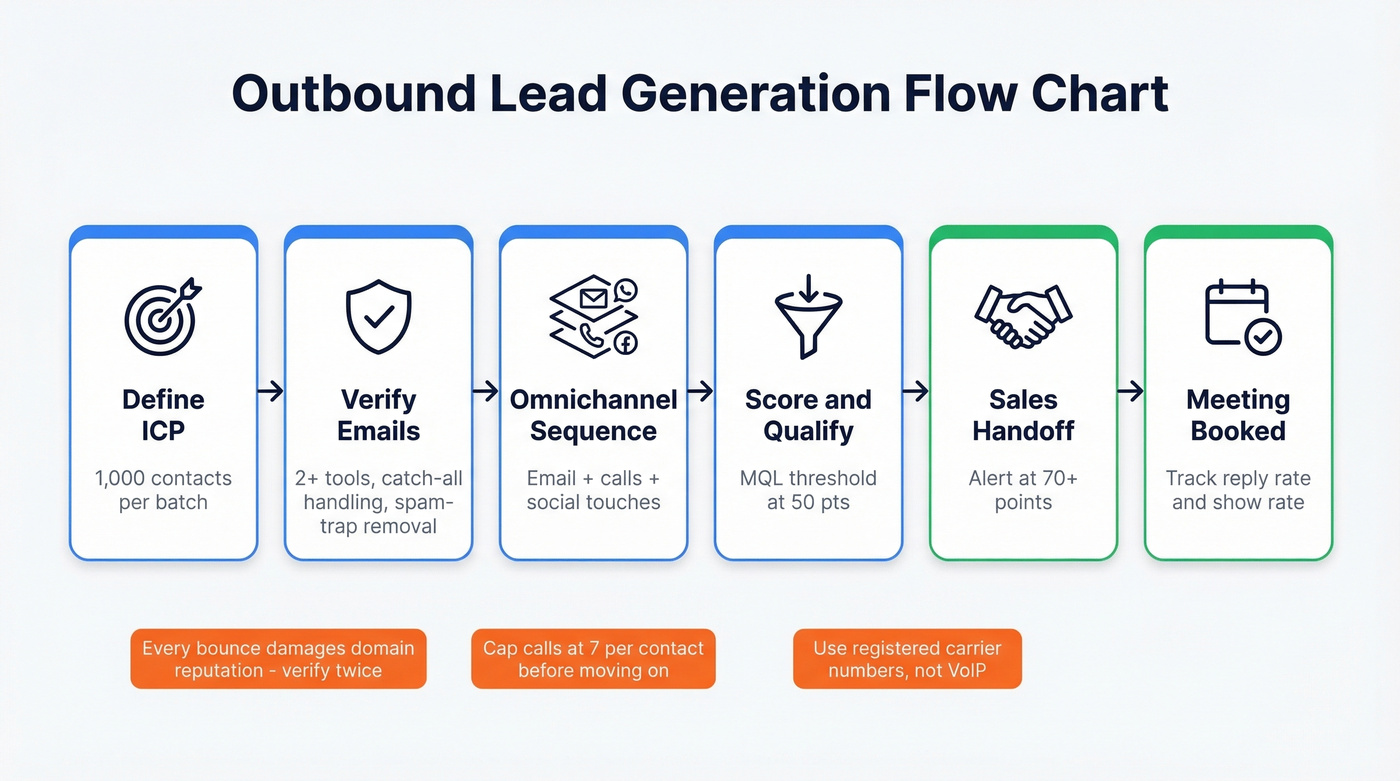
- Build a tight ICP list. Start with ~1,000 contacts per batch. Resist the urge to go wider (these sales prospecting techniques help keep targeting tight).
- Verify with at least two tools. Every bounce damages your domain reputation, and reputation compounds. Run every email through catch-all handling, spam-trap removal, and honeypot filtering, then cross-check with a second verifier. Be paranoid about this (use a dedicated email deliverability guide to avoid compounding issues).
- Run omnichannel sequences. Email alone isn't enough. Layer in calls and social touches. Cap calls at 7 per contact before moving on.
- Use registered carrier numbers for calls. VoIP numbers from platforms like Twilio get flagged as spam. If you're calling your best-fit prospects, use real numbers.
Cold Email Benchmarks
Here's what "normal" looks like in 2026, based on analysis of millions of campaigns:
| Metric | Benchmark |
|---|---|
| Reply rate | 5.1% avg |
| Open rate (B2B) | 27.7% avg |
| 2-email sequence | 6.9% reply |
| Bounce rate | 7.5% avg |
| Best send window | Wed, 7-11 AM |
Anything above 8% reply rate is strong. Below 3% means your list quality, targeting, or messaging needs serious work. A single follow-up email increases replies by ~49%, which is why the 2-email sequence outperforms single sends so consistently (keep a set of sales follow-up templates ready).
The Open Tracking Insight
This is the most counterintuitive finding in the data. An analysis of 44M+ emails found that turning off open tracking more than doubled reply rates - 2.36% vs 1.08%. Open-tracking pixels hurt deliverability. Remove them, and more emails land in the primary inbox.
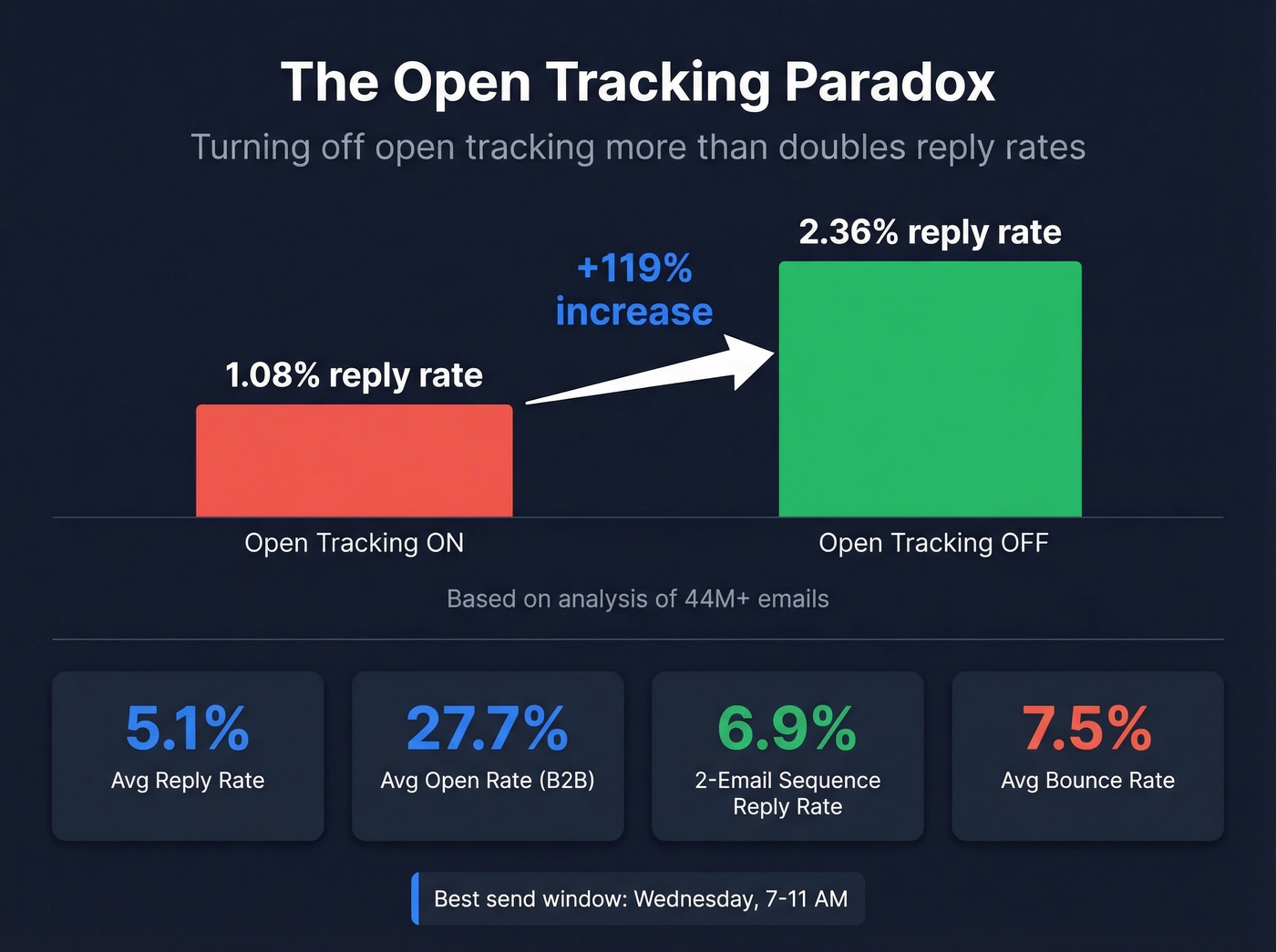
Warm-up discipline matters more than open-rate dashboards. If you're sending 30 emails per day from a domain, allocate 25 to real outreach and 5 to warm-up. Stop obsessing over open rates - they're unreliable anyway thanks to Apple Mail Privacy Protection. Focus on replies and booked meetings (and monitor email velocity so you don’t spike risk).
AI-Driven Prioritization
The biggest shift in outbound for 2026 isn't AI writing your emails - it's AI deciding who to contact and when. Signal-led outreach uses intent data, job changes, and technographic shifts to surface the 3-5% of your market that's actually in a buying window right now. AI agents handle sequencing logic, adjusting cadence and channel based on engagement signals rather than rigid timers (more on generative AI lead generation).
Let's be honest: most teams don't need an AI SDR. They need cleaner data and better timing signals fed into the sequencing tools they already own. The teams getting results from AI aren't replacing reps - they're giving reps a prioritized list instead of a phone book.

You just read that 7.5% is the average bounce rate - and that bad data kills sender reputation faster than bad copy. Prospeo's 5-step verification with catch-all handling, spam-trap removal, and honeypot filtering delivers 98% email accuracy. Teams using Prospeo cut bounce rates from 35%+ to under 4%.
Stop bleeding domain reputation. Verify every contact before you hit send.
Capture and Convert
Every form field you add is friction that kills conversion rates. If you're asking for company size, revenue range, and phone number on a whitepaper download, you're optimizing for your CRM, not your deal flow.
Specific CTAs outperform generic ones by a wide margin. "Download our free cold email template pack" converts better than "Learn more." Exit-intent popups work when they offer genuine value - a relevant resource, not a newsletter signup. Match the asset to the funnel stage: TOFU content like benchmark reports captures broad interest, while BOFU assets like ROI calculators qualify buyers who are close to a decision.
76% of marketers use content to generate leads, but the winners match content specificity to buyer readiness rather than gating everything behind the same six-field form.
Conversion Benchmarks by Industry
Set expectations based on your vertical. These are website visitor-to-conversion rates from FirstPageSage's 2026 report:
| Industry | Conv. Rate |
|---|---|
| B2B SaaS | 1.1% |
| IT & Managed Services | 1.5% |
| Manufacturing | 2.2% |
| Staffing & Recruiting | 2.9% |
| HVAC Services | 3.1% |
| Legal Services | 7.4% |
Even Salesforce converts less than 5% of its traffic into qualified leads. If you're at 1-2% in SaaS, you're normal. The lever isn't always conversion rate optimization - sometimes it's driving more of the right traffic.
Lead Scoring That Works
A Real Scoring Model
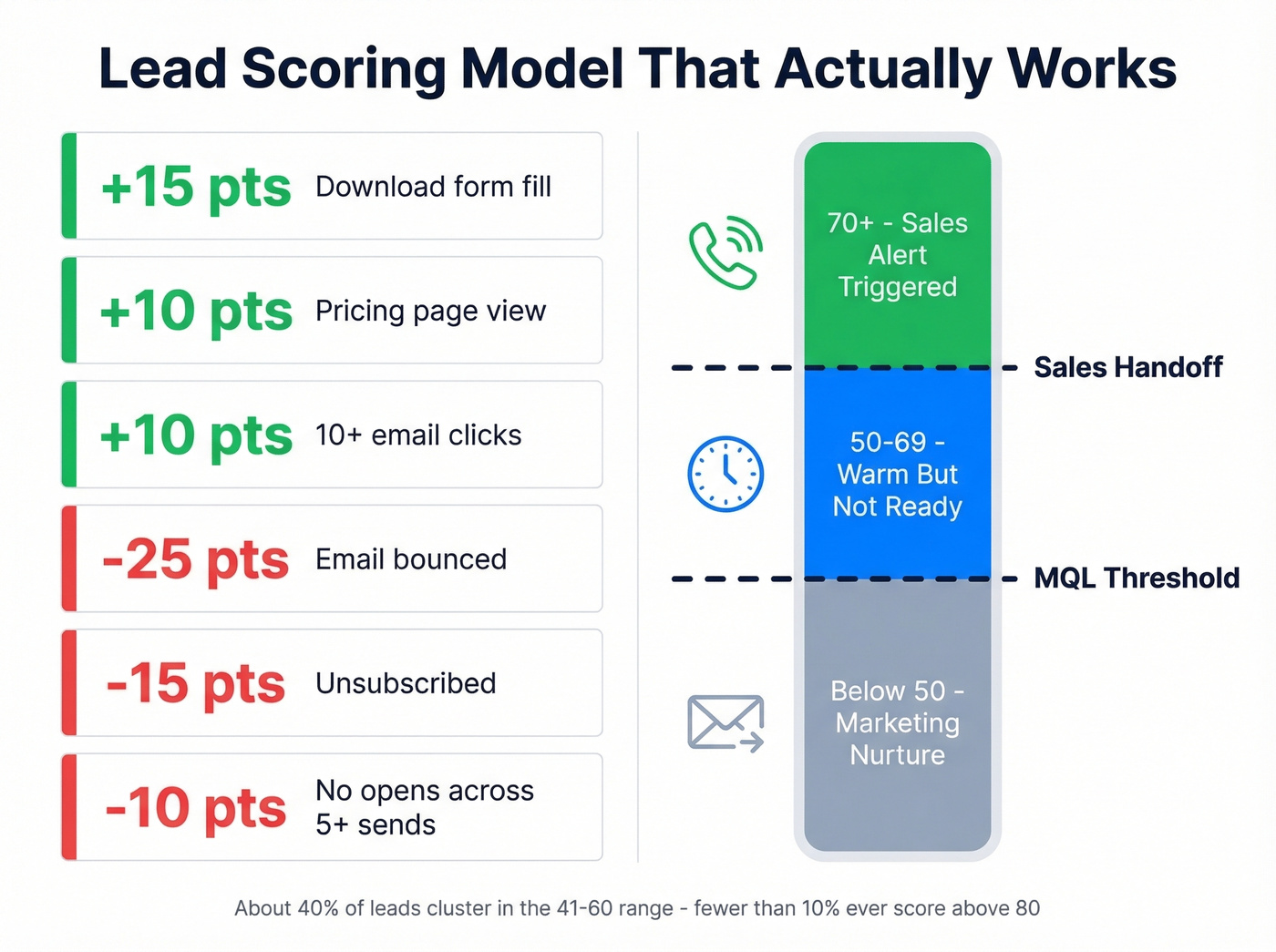
Most lead scoring articles give you theory. Here's an actual model, adapted from Belkins' HubSpot implementation:
| Signal | Points |
|---|---|
| Pricing page view | +10 |
| Download form fill | +15 |
| 10+ email clicks | +10 |
| Email bounced | -25 |
| Unsubscribed | -15 |
| No opens across 5+ sends | -10 |
Set your MQL threshold at 50 points. Trigger a sales alert at 70. Marketing nurtures everything below 50; sales prioritizes everything above 70. The 50-70 range is your "warm but not ready" bucket - keep nurturing with relevant content (full lead scoring setup here).
Score Distribution Reality
Don't expect a clean bell curve. Roughly 40% of leads cluster in the 41-60 score range. Fewer than 10% ever score above 80. That's normal - it means your scoring model is working, not that your leads are bad.
The bigger issue is signal reliability. Apple Mail Privacy Protection has made open rates essentially useless as a scoring input. We've seen teams weight email opens at +5 per open and end up with inflated scores across the board. Shift your scoring toward on-site behavior - pricing page visits, case study views, form submissions. These signals are harder to fake and far more predictive of actual buying intent.
Mistakes That Kill Your Pipeline
- Buying lead lists. Purchased contacts didn't opt in, don't know you, and rarely convert. Worse, they tank your sender reputation. One bad list can take months to recover from.
- Skipping verification. That 7.5% average bounce rate isn't a rounding error - it's thousands of wasted sends and compounding domain damage. Verify before every campaign, not after.
- Generic lead magnets. "Subscribe to our newsletter" isn't a value proposition. Targeted assets - templates, calculators, benchmark reports - convert because they solve a specific problem.
- No follow-up strategy. 50% of qualified leads aren't ready to purchase at first contact, and over 30% of B2B sales take one to three months to close. If you don't have a multi-touch nurture sequence, you're leaving qualified opportunities on the table.
- Trusting a single data source. Apollo offers a free tier with paid plans starting around $49/month, but its data is user-populated - the Reddit consensus is that they're "not verifying anything by themselves." Cross-reference with at least one verified source before you hit send.
Measure What Matters
The average CPL across B2B is $198. But CPL alone is a vanity metric. If you're paying $375 per lead and half ghost after the first call, you have a quality problem that no amount of volume will fix.
Track these instead: cost per qualified lead (not just cost per name), lead-to-opportunity conversion rate by channel, and time-to-close by source. Multi-touch attribution beats last-touch for most B2B motions - the SDR who booked the meeting gets credit, but the webinar that warmed the prospect three weeks earlier did the real work (more lead generation metrics to track).
61% of marketers say generating traffic and leads is their biggest challenge. But the teams that win aren't generating more leads - they're generating better ones and measuring quality at every stage. A 50-lead month where 20 convert to opportunities beats a 500-lead month where 8 do.
The Future of Lead Generation
The playbook is shifting fast. AI-powered intent signals, privacy-first data regulations, and buyer fatigue with generic outreach are reshaping how pipeline gets built. The future belongs to teams that combine verified first-party data with signal-led timing - reaching the right person during the narrow window when they're actually evaluating solutions. Teams still relying on bulk lists and spray-and-pray sequences will find their deliverability, reply rates, and pipeline shrinking year over year. These lead generation best practices aren't static; they'll keep evolving as buyer behavior and tooling change.
Build Your Lead Gen Stack
You don't need a $50k/year platform. A functional lead gen stack can run around $300/month if you choose wisely.
| Layer | Tool | ~Cost/mo |
|---|---|---|
| Prospecting + Verify | Prospeo | Free-$99 |
| Cold email | Instantly / Smartlead | $30-$97 |
| Sequencing | Lemlist | $59-$99 |
| Enrichment (optional) | Clay | $149+ |
| Automation | Zapier | $0-$20 |
| CRM | HubSpot (free) | $0 |
The key principle is specialization. Your CRM shouldn't be your email sender. Your prospecting tool shouldn't be your sequencer. Each layer does one thing well, and integrations connect them. The teams that try to do everything in one platform end up paying for features they never activate - we've seen that pattern repeat across dozens of implementations (if you’re comparing options, start with outbound lead generation tools).

You defined your ICP - now turn it into a live prospect list. Prospeo's 30+ filters cover buyer intent across 15,000 Bombora topics, technographics, job changes, funding rounds, and headcount growth. Build the exact 1,000-contact batch this article recommends, already verified, for about $0.01 per email.
Go from ICP sentence to verified prospect list in minutes, not days.
FAQ
What's a good cold email reply rate?
The average is 5.1%. A 2-email sequence pushes that to 6.9%, and anything above 8% is strong. Below 3% consistently means your list quality or targeting needs work - fix data before rewriting subject lines.
How much should a B2B lead cost?
Average CPL across B2B is $198, ranging from $100 to $390+ depending on channel and vertical. The metric that actually matters is cost per qualified opportunity, not cost per raw name in your CRM.
Should I buy lead lists?
No. Purchased contacts didn't opt in, rarely convert, and destroy your sender reputation. Build targeted lists from verified databases instead - 98% email accuracy means you protect your domain while reaching real buyers.
What's the difference between demand gen and lead gen?
Lead gen captures the 3-5% actively buying now through forms, outbound, and direct response. Demand gen builds trust with the other 95% through content, community, and brand so they shortlist you when their buying window opens.
What tools do I need to start generating leads?
Three essentials: a verified data source for prospecting and email verification, a sequencing tool like Instantly or Smartlead for cold email, and a CRM like HubSpot's free tier. Total cost: under ~$300/month for a lean setup.