

Cold Email Outreach Campaign: The Practitioner's Playbook for 2026
A founder posted on r/SaaS last year: 2,000 cold emails sent, six replies, zero customers. They declared cold email dead. That take is completely wrong about the channel - but it's right about how most people run a cold email outreach campaign.
Instantly's 2026 benchmark report puts the average reply rate at 3.43% across billions of interactions. Top-quartile campaigns hit 5.5%+. Elite campaigns exceed 10.7%+. Cold email isn't dead. Bad cold email is.
What You Need (Quick Version)
Three things matter, in this order:
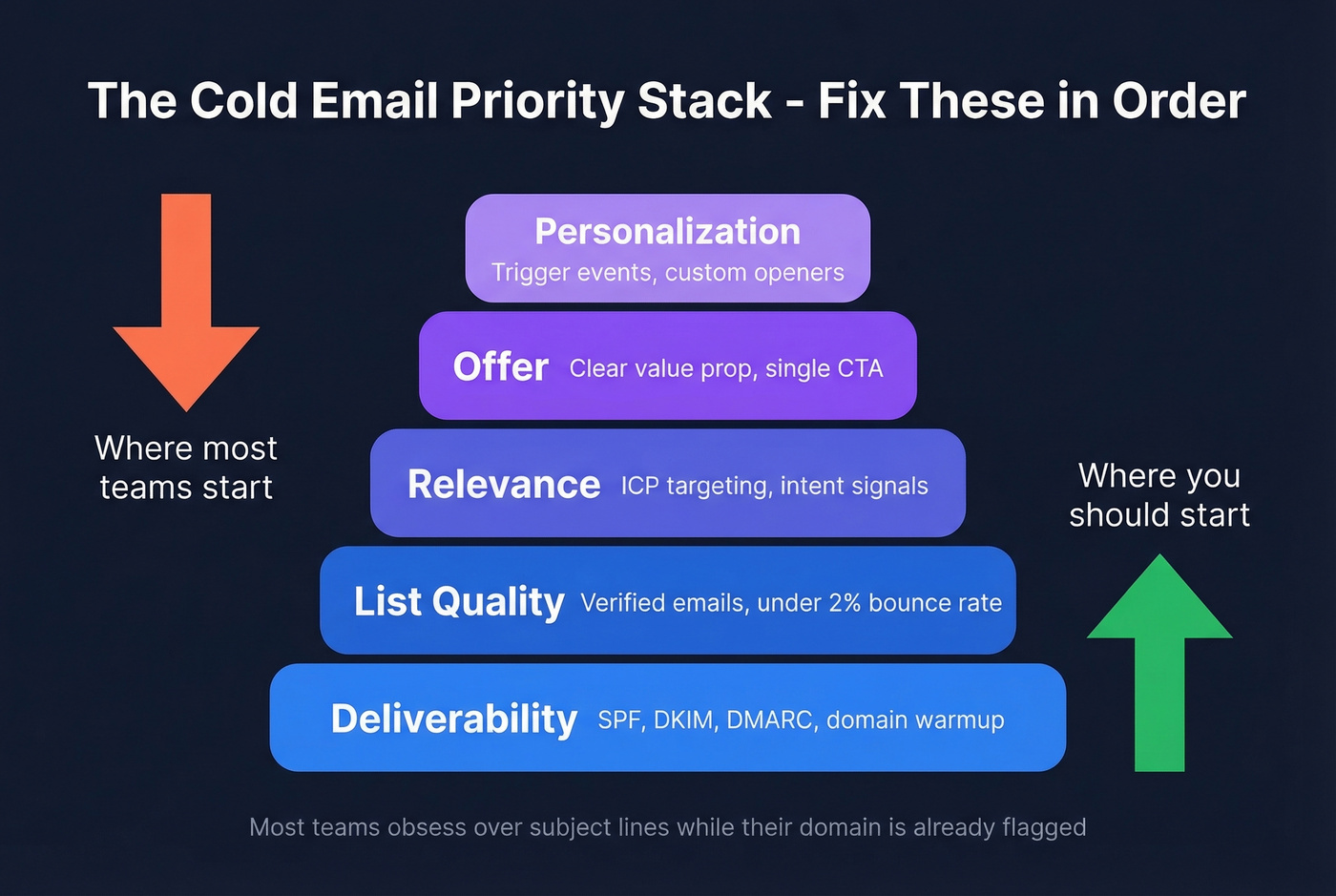
- Fix your infrastructure first. SPF, DKIM, DMARC on a secondary domain. Warm it up 2-4 weeks before you scale campaigns. (If you need the deeper technical checklist, start with an email deliverability guide.)
- Verify every email before you send. Bad data kills campaigns faster than bad copy. A 3% bounce rate sounds low until it destroys your sender reputation. (More on email bounce rate and what it does to reputation.)
- Write short emails with a single CTA. Under 80 words. Measure reply rate, not open rate. A/B test weekly. (If you want rules + examples, see email call to action.)
That's the priority stack: deliverability, then list quality, then relevance, then offer, then personalization. Most teams running cold outbound email campaigns get this backwards - they obsess over subject lines while their domain is already flagged.
Fix Your Infrastructure First
Skip this and nothing below matters. Your emails land in spam.
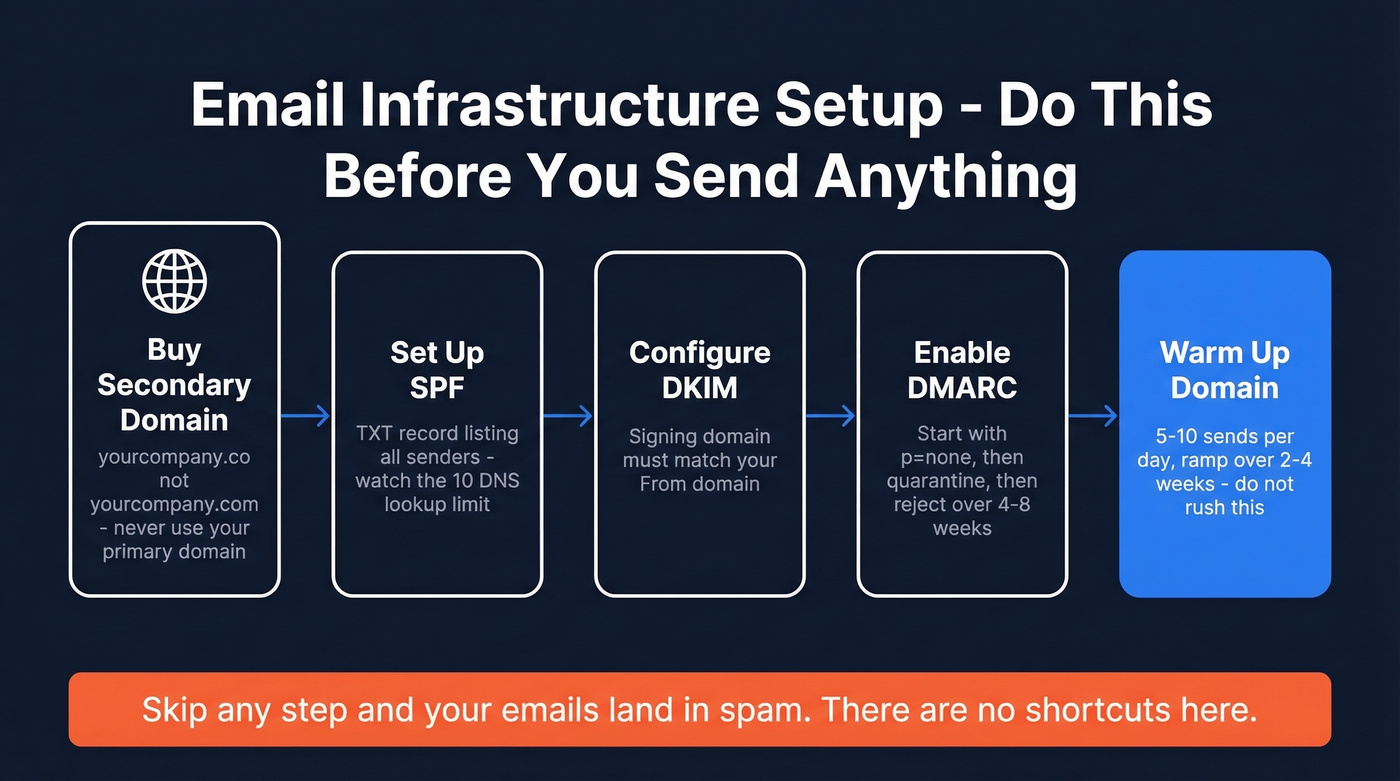
Use a secondary domain - yourcompany.co instead of yourcompany.com - dedicated to outbound. Never send cold email from your primary domain. Then set up authentication:
SPF record: Add a TXT record listing every service that sends on your behalf. Watch the 10 DNS lookup limit - exceed it and SPF silently fails, which is a nightmare to debug. (If you want syntax examples, use these SPF record examples.)
DKIM: Make sure the signing domain matches your From domain. Some shared SMTP providers sign with their own domain, which breaks DMARC alignment and you won't know until deliverability craters. (Here’s a quick way to verify DKIM is working.)
DMARC: Start with p=none to collect reports. After 2-4 weeks of clean data, move to p=quarantine, then p=reject. (If you’re troubleshooting, read up on DMARC alignment.)
Once authentication is live, warm up the domain. Start at 5-10 sends per day and ramp over 2-4 weeks. Most sending tools offer warmup features, including Instantly, Lemlist, and Smartlead. Don't rush this. We've seen teams blow through warmup in a week and spend the next month digging out of spam jail. (Also keep an eye on email velocity as you scale.)
Build a List Worth Emailing
Here's the thing: keep bounce rate under 2%. Above that, bounces damage your domain reputation, which tanks deliverability, which means even your good emails stop landing. It's a death spiral. Define your ICP before you source a single contact - job title, company size, industry, tech stack, geography. (Use an ideal customer profile template if you don’t have one.)
Prospeo is what we use for sourcing verified contacts. The database covers 300M+ professional profiles with 98% email accuracy on a 7-day refresh cycle, so you're not emailing someone who left the company six weeks ago. Meritt used it to drop bounce rate from 35% to under 4% and triple pipeline. There's a free tier to test, and native integrations with Instantly, Lemlist, Smartlead, and HubSpot so contacts flow straight into your sequences. (If you’re comparing vendors, start with data enrichment services or best sales prospecting databases.)

Write Emails That Get Replies
A Belkins study of 5.5M emails found personalized subject lines hit 46% open rates versus 35% without - and reply rates jumped from 3% to 7%. Keep subject lines to 2-4 words. Question-style outperformed everything else. Hype terms like "ASAP" and generic greetings like "Hello, friend" dragged open rates below 36%. (For more patterns, see cold email subject line examples.)
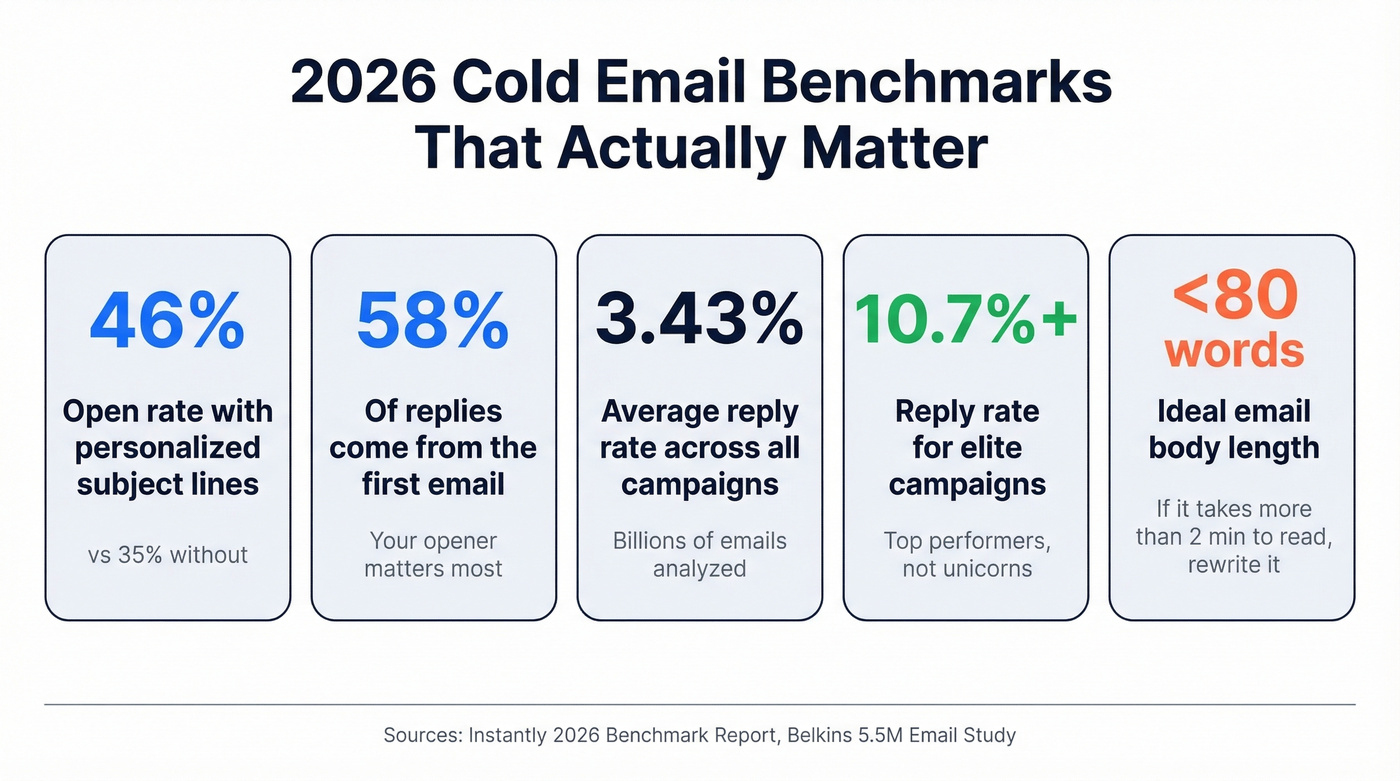
For body copy, 58% of replies come from the first email in a sequence. Your opener has to earn the rest of the conversation.
Structure every email as Problem, Agitate, Solve: lead with their pain, make it feel urgent, offer one clear next step. Keep it under 80 words. Skip links and images in your first email - add them in follow-ups once you've confirmed inbox placement. If it doesn't look like something a human typed in two minutes, rewrite it. (If you want a tighter framework, use this email copywriting guide.)

Bad data kills cold email outreach campaigns faster than bad copy. Prospeo's 300M+ profiles are verified every 7 days - not every 6 weeks - so you're never emailing someone who already left. At $0.01/email with 98% accuracy, one team dropped bounce rates from 35% to under 4% and tripled pipeline.
Stop burning your domain on stale data. Build your list on emails that actually land.
Sequence Structure and Timing
| Touchpoint | Timing | Purpose |
|---|---|---|
| Email #1 | Day 1 | Core value prop, single CTA |
| Email #2 | Day 3-4 | New angle, add proof |
| Email #3 | Day 7-8 | Different pain point |
| Email #4 | Day 14 | Case study or social proof |
| Email #5 | Day 21+ | Breakup or soft close |
The sweet spot is 4-7 touchpoints. Under four and you're giving up too early - 42% of replies come from follow-ups. Beyond seven, diminishing returns kick in hard. "Just checking in" isn't new value; it's inbox pollution. (If you need copy you can paste, use these cold email follow-up templates.)
We've seen the best results from 5-touch sequences where each email introduces a genuinely new angle or piece of evidence. Tuesday and Wednesday consistently produce the highest reply rates, with Wednesday edging ahead. (For a deeper breakdown, see best time to send cold emails.)
Measure Replies, Not Opens
Stop tracking open rates. Tracking pixels get flagged by spam filters, and measuring opens can actually push your emails into spam. It's a self-defeating metric. Forbes covered this well - focus on bounce rate and reply rate instead. Keep your spam complaint rate below 0.1%, or you'll trigger deliverability penalties that take weeks to recover from. (If you’re still using pixels, read up on the risks of an email tracking pixel.)
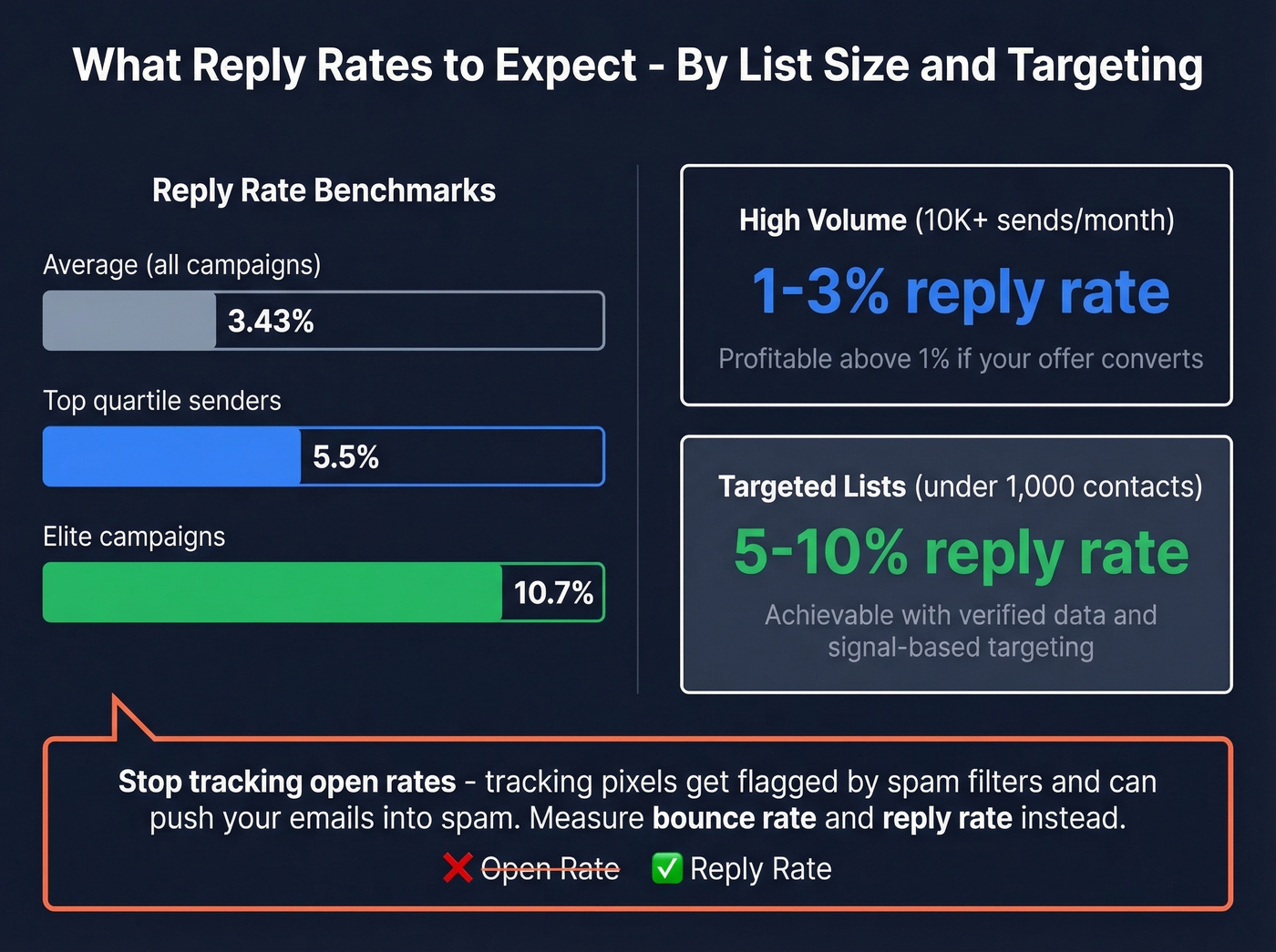
At high volume with 10K+ sends per month, expect 1-3% reply rates. For highly targeted lists under 1,000 contacts, 5-10% is achievable. Anything above 1% at scale is profitable if your offer converts. A/B test weekly and kill underperformers fast.
Let's be honest: if your average deal size is under $10k, you probably don't need a $15k/year data platform. A verified list from a credit-based tool and a well-written 5-email sequence will outperform an enterprise stack with dirty data every time.
Stay Legal in 60 Seconds
| CAN-SPAM (US) | GDPR (EU) | CASL (Canada) | |
|---|---|---|---|
| Applies to B2B? | Yes | Yes | Yes |
| Max penalty | $53,088/email | 20M EUR or 4% revenue | $10M CAD |
| Opt-out deadline | 10 business days | Immediate | Immediate |
| Key requirement | Physical address + opt-out | Legitimate interest docs | Express consent preferred |
You're legally responsible even if you outsource sending. Don't skip the unsubscribe link.
Signal-Based Personalization
Basic {first_name} personalization is table stakes now. The teams seeing roughly 3x response lifts are using trigger events: funding rounds, job changes, published content, expansion announcements. Scrape a prospect's recent activity, generate a custom opener with an LLM, and inject it as a variable in your sequence. (If you want a system for this, see personalized outreach.)
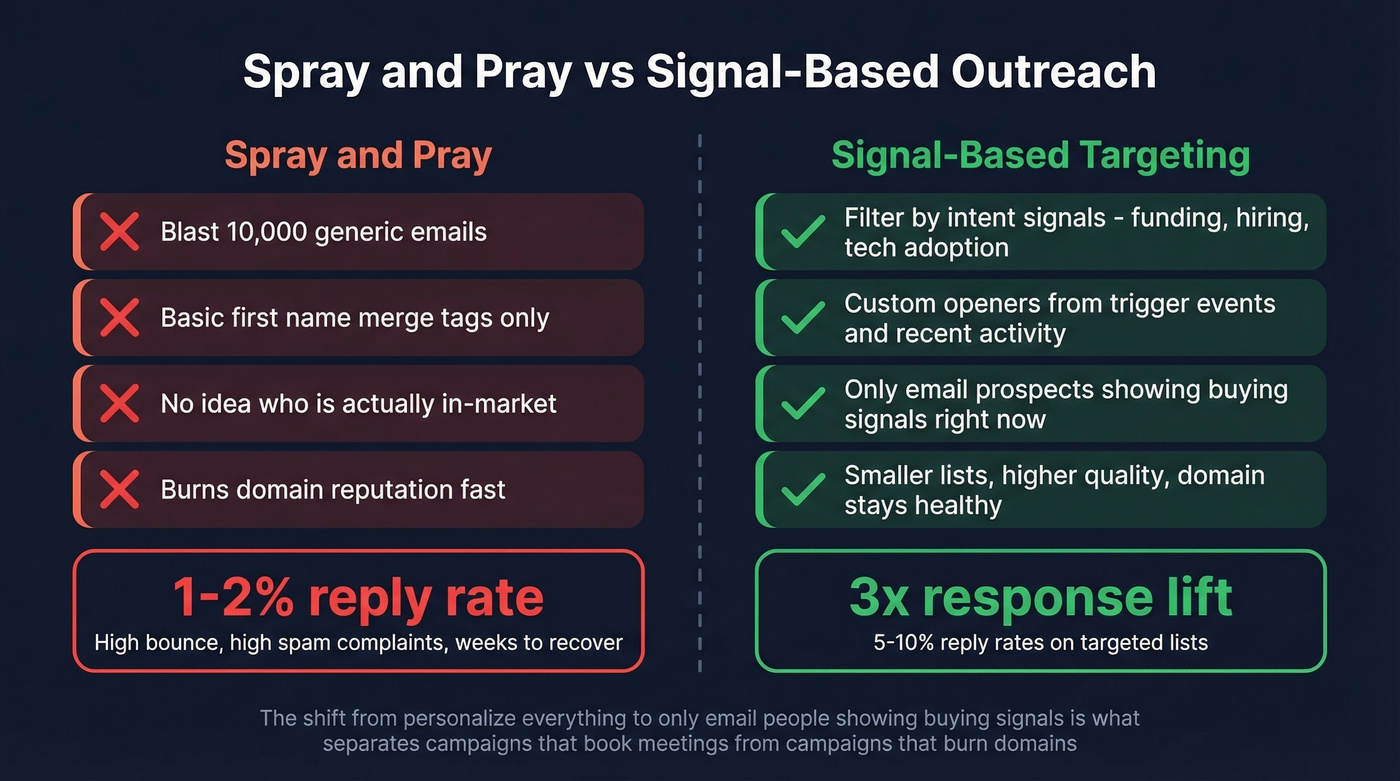
Layering intent signals with job role and company growth filters means you're not just personalizing - you're prioritizing who to email in the first place. That shift from "personalize everything" to "only email people showing buying signals" is what separates campaigns that book meetings from campaigns that burn domains. Prospeo tracks 15,000 intent topics via Bombora, so you can filter prospects who are actively researching your category before they ever hit your sequence. (To operationalize this, use identifying buying signals and intent based segmentation.)
Signal-based outreach only works if you know who's in-market before you hit send. Prospeo layers 15,000 Bombora intent topics with job role, tech stack, and company growth filters - so your cold email outreach campaign targets buyers actively researching your category, not cold contacts who'll never reply.
Email fewer prospects, book more meetings. Let intent data pick your list.
FAQ
How many cold emails should I send per day?
Start at 5-10 per day during warmup over 2-4 weeks. After warmup, scale to 50-100 per day per mailbox. Use multiple mailboxes to increase volume without triggering spam filters - most teams run 3-5 inboxes per sender.
What's a good reply rate?
The average across all cold email outreach campaigns is 3.43%. Top-quartile senders hit 5.5%+, and elite campaigns exceed 10.7%+. At high volume with 10K+ sends per month, 1-3% is normal. Anything above 1% at scale is profitable if your close rate supports it.
Is cold email legal for B2B?
Yes, in every major jurisdiction - with specific rules. CAN-SPAM requires a physical address, opt-out link, and honest subject lines. GDPR requires legitimate interest documentation for EU prospects. Always include an unsubscribe mechanism in every email.
What tools do I need to run outreach?
Three layers: a data tool for verified contacts, a sending platform for sequences and warmup like Instantly or Smartlead ($30-100/user/month), and a CRM to track replies. The data layer is where most teams underinvest - and it's the layer that determines whether everything downstream works.