

Email Marketing for B2B Lead Generation (2026 Guide)
You send 5,000 emails. 600 bounce. Your domain reputation craters. The next campaign - the one with the killer offer - lands in spam for everyone, including the 4,400 people with valid addresses. Email marketing for B2B lead generation returns roughly $36-$42 for every $1 spent, but that ROI assumes your emails actually arrive. Most campaigns fail before the prospect ever sees a subject line.
The Playbook in Three Bullets
- Fix your data first. Get your bounce rate under 2% or nothing else here matters.
- Build sequences of 3-5 emails, each adding a new angle. "Just checking in" isn't a follow-up - it's noise. (If you need examples, see these sales follow-up templates.)
- Authenticate your domain and respect the 0.3% spam complaint threshold. SPF, DKIM, DMARC aren't optional anymore.
Cold vs. Warm Email
Cold outreach means contacting someone who hasn't agreed to hear from you - the goal is starting a conversation. Email marketing means messaging people who opted in - the goal is nurturing them toward action through drip campaigns and targeted content. (For a deeper outbound breakdown, use this B2B cold email sequence guide.)
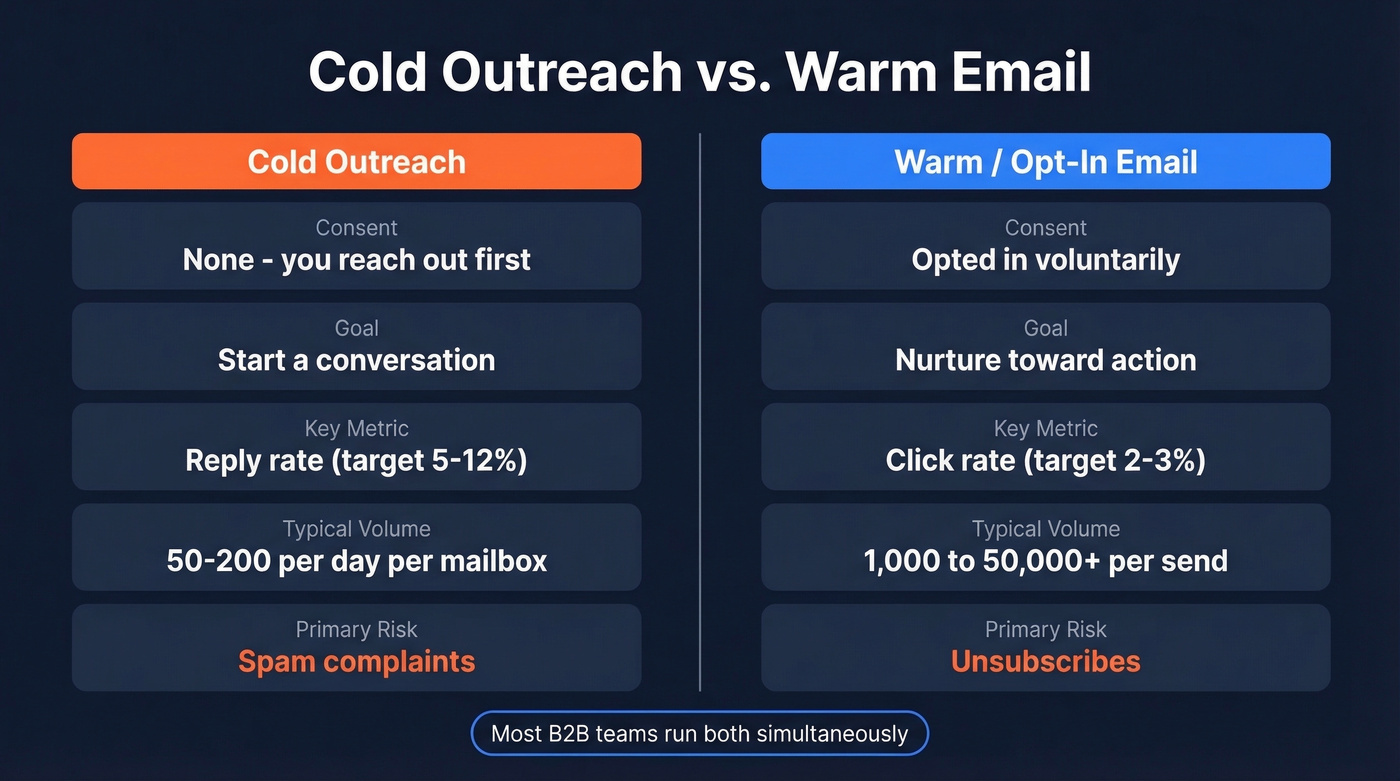
Inbound email generates 54% more leads than outbound and converts at roughly double the rate (12% vs. 6%). But cold email isn't dead. Across 16.5M emails analyzed by Belkins, cold outreach still pulls a 5.8% average reply rate. For teams selling into specific verticals with verified data, top performers hit 8-12%.
| Cold Outreach | Warm/Opt-In Email | |
|---|---|---|
| Consent | None | Opted in |
| Goal | Start a conversation | Nurture to action |
| Key metric | Reply rate | Click rate |
| Typical volume | 50-200/day per mailbox | 1,000-50,000+ per send |
| Primary risk | Spam complaints | Unsubscribes |
This guide covers both, because most B2B teams run both simultaneously.
Building Your Opt-In List
Cold email gets the attention, but your warm list is the compounding asset. The best B2B lead generation programs feed the warm list constantly through lead magnets: gated reports, ROI calculators, webinar registrations, and newsletter signups. A single well-promoted benchmark report can generate more marketing qualified leads in a month than three cold campaigns.
Match the lead magnet to the buyer's stage. Top-of-funnel content like industry reports attracts a broad audience. Mid-funnel assets like comparison guides and ROI tools attract prospects closer to a buying decision - these are the ones worth routing to sales as SQLs. If you're not building a warm list alongside your cold outreach, you're leaving the highest-converting channel on the table. This approach compounds over time as your opt-in list grows and your sender reputation strengthens. (If you’re building lists from scratch, here’s how to generate an email list without wrecking deliverability.)
Start With Clean Data
Here's the thing most teams get wrong: they treat "delivered" and "in the inbox" as the same number. They aren't even close. The industry delivery rate sits around 98.16%, but inbox placement - the number that actually matters - is only 84.3%. That 14-point gap is where campaigns go to die.
We've seen this play out dozens of times. A rep exports a list of 2,000 VPs from a database that hasn't been refreshed in months. 15% of those people have changed jobs. Another 5% have email addresses that were valid six weeks ago but aren't now. The rep launches a sequence, bounces spike to 12%, and the domain gets flagged. Now every email from that domain - including the CEO's - has deliverability problems. (If you’re diagnosing this, start with email bounce rate benchmarks and fixes.)
Prospeo runs a 5-step verification process with catch-all handling, spam-trap removal, and honeypot filtering - 98% email accuracy on 143M+ verified addresses, refreshed on a 7-day cycle. At roughly $0.01 per email, verification is the cheapest insurance in your entire stack. Meritt saw their bounce rate drop from 35% to under 4% after switching, and their pipeline tripled from $100K to $300K per week. (More on remediation: spam trap removal.)


Every deliverability rule above assumes your emails are real. Prospeo's 7-day data refresh cycle means you're never sending to addresses that expired weeks ago - unlike providers refreshing every 6 weeks. 98% email accuracy, catch-all handling, and spam-trap removal built in.
Stop fixing bounces. Start with data that doesn't bounce.
Deliverability Rules in 2026
The rules changed in May 2025 when Google and Yahoo started enforcing bulk sender requirements. Microsoft rolled out similar requirements shortly after. Your compliance checklist:
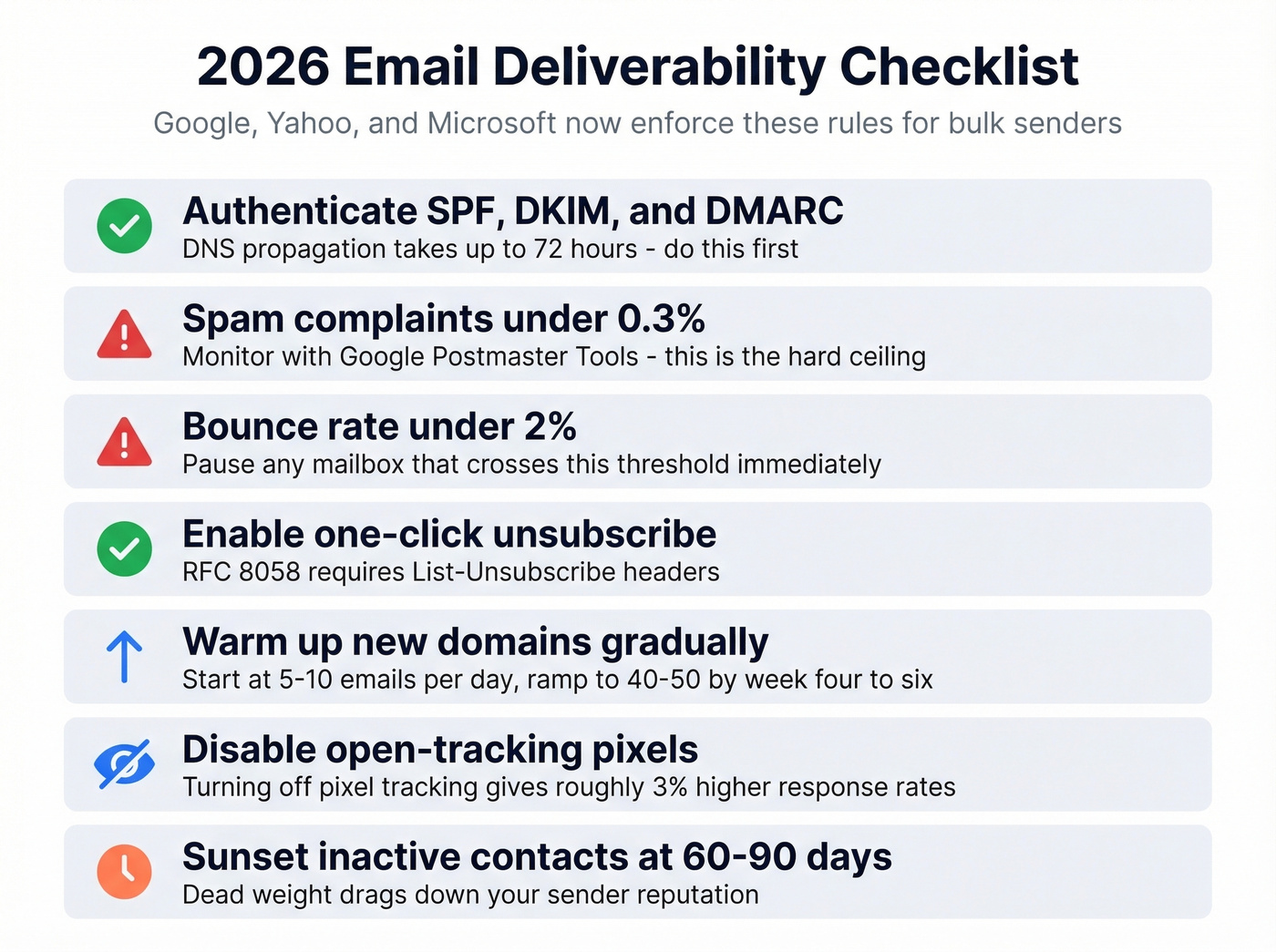
- Authenticate everything. SPF, DKIM, and DMARC alignment aren't suggestions. If you haven't set these up, stop reading and go do it now. DNS propagation takes up to 72 hours. (If you want a technical deep dive, use this email deliverability guide.)
- Keep spam complaints under 0.3%. This is the hard ceiling. Monitor via Google Postmaster Tools. (Also see: improve sender reputation.)
- Keep bounces under 2%. Pause any mailbox that crosses this threshold.
- Enable one-click unsubscribe. RFC 8058 requires List-Unsubscribe and List-Unsubscribe-Post headers.
- Warm up new domains gradually. Start at 5-10 emails per day. Ramp to 20-40 by week two, then 40-50 by week four to six. (Related: email velocity.)
- Disable open-tracking pixels. Belkins found that turning off pixel tracking produced ~3% higher response rates. Open rates are unreliable thanks to Apple MPP - track replies instead. (More detail: email tracking pixel.)
- Sunset inactive contacts. If someone hasn't engaged in 60-90 days, move them to a re-engagement segment or remove them. Dead weight drags down your sender reputation.
Blasting 10+ contacts at one company kills reply rates. Prospeo's 30+ search filters - buyer intent, job changes, headcount growth - let you target the 1-2 right people per account. Meritt tripled their pipeline to $300K/week with the same team by fixing targeting and data quality.
Reach fewer people, book more meetings. That's what verified data does.
Benchmarks That Matter
Cold Email
The best cold email dataset we've found comes from Belkins' analysis of 16.5M emails across 93 business domains:
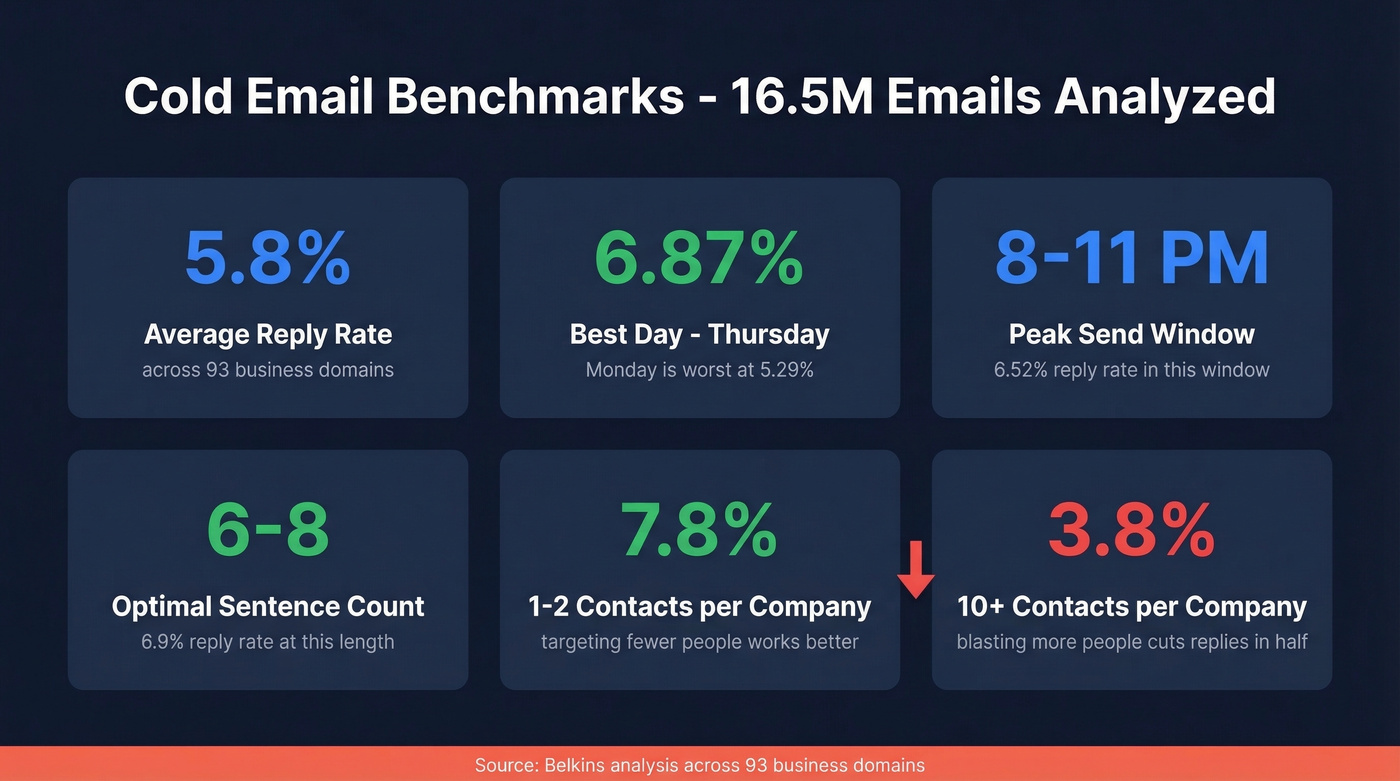
| Metric | Number |
|---|---|
| Avg reply rate | 5.8% |
| Best day | Thursday (6.87%) |
| Worst day | Monday (5.29%) |
| Peak send window | 8-11 PM (6.52%) |
| Optimal length | 6-8 sentences (6.9%) |
| 1-2 contacts/company | 7.8% reply |
| 10+ contacts/company | 3.8% reply |
That last row is critical. Blasting 10+ people at the same company doesn't double your chances - it cuts your reply rate in half.
Opt-In Email
Mailchimp's benchmark data across billions of sends:
| Industry | Open Rate | Click Rate |
|---|---|---|
| All users avg | 35.63% | 2.62% |
| Business & Finance | 31.35% | 2.78% |
| Education | 35.64% | 3.02% |
| Non-Profits | 40.04% | 3.27% |
Apple Mail Privacy Protection inflates open rates by pre-loading tracking pixels. Focus on click rate and reply rate as your north stars. Average B2B email conversion rate sits at 2.4%. (If you want to calculate and benchmark it properly, use this click rate formula in email marketing.)
Reply Rates by Industry
A practitioner on r/b2bmarketing shared results across 14 clients and 8 industries:
| Vertical | Reply Rate | What Worked |
|---|---|---|
| IT services to SMBs | 7-9% | Local + incident-based pain |
| SaaS to SaaS | 4-6% | Trigger-based (hiring/funding) |
| Commercial cleaning | 9-11% | Ultra-casual, ~51 words |
| Recruiting/staffing | 8-12% | Reference specific open roles |
| Marketing to ecommerce | 6-8% | Lead with a metric like CAC |
| Healthcare IT | 3-5% | Compliance-aware, institution-specific |
Universal templates don't work. The angle, the trigger, and the tone all need to match the vertical.
Who You're Actually Emailing
The average B2B purchase now involves 13 stakeholders across multiple departments. Gartner puts the core buying group at 6-10 decision makers, each bringing 4-5 pieces of independent research to the table.
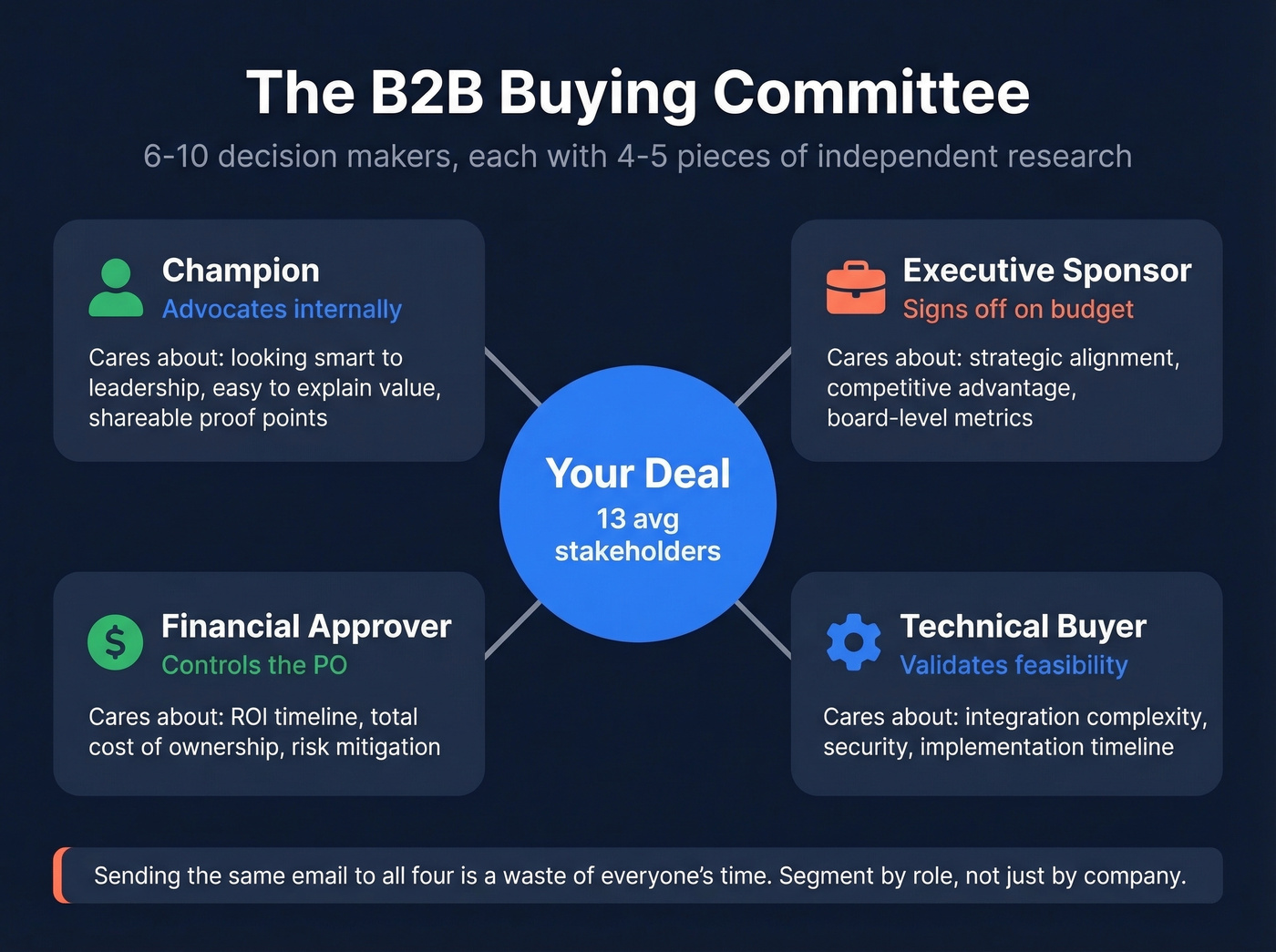
Your email isn't competing with other vendors' emails. It's competing with the four articles, two analyst reports, and one competitor case study that someone already shared in the team's Slack channel. Your message needs to be specific enough to earn a forward.
The roles that matter in most B2B deals: the champion who advocates internally, the executive sponsor who signs off on budget, the financial approver who controls the PO, and the technical buyer who validates feasibility. Each one cares about different things. Sending the same email to all four is a waste of everyone's time. Segment by role, not just by company. (If you’re building targeting rules, start with an ideal customer profile.)
How to Structure Your Sequence
The 5-Step Cold Cadence
The sweet spot is 3-5 emails. Three for warmer leads, five for fully cold outreach:
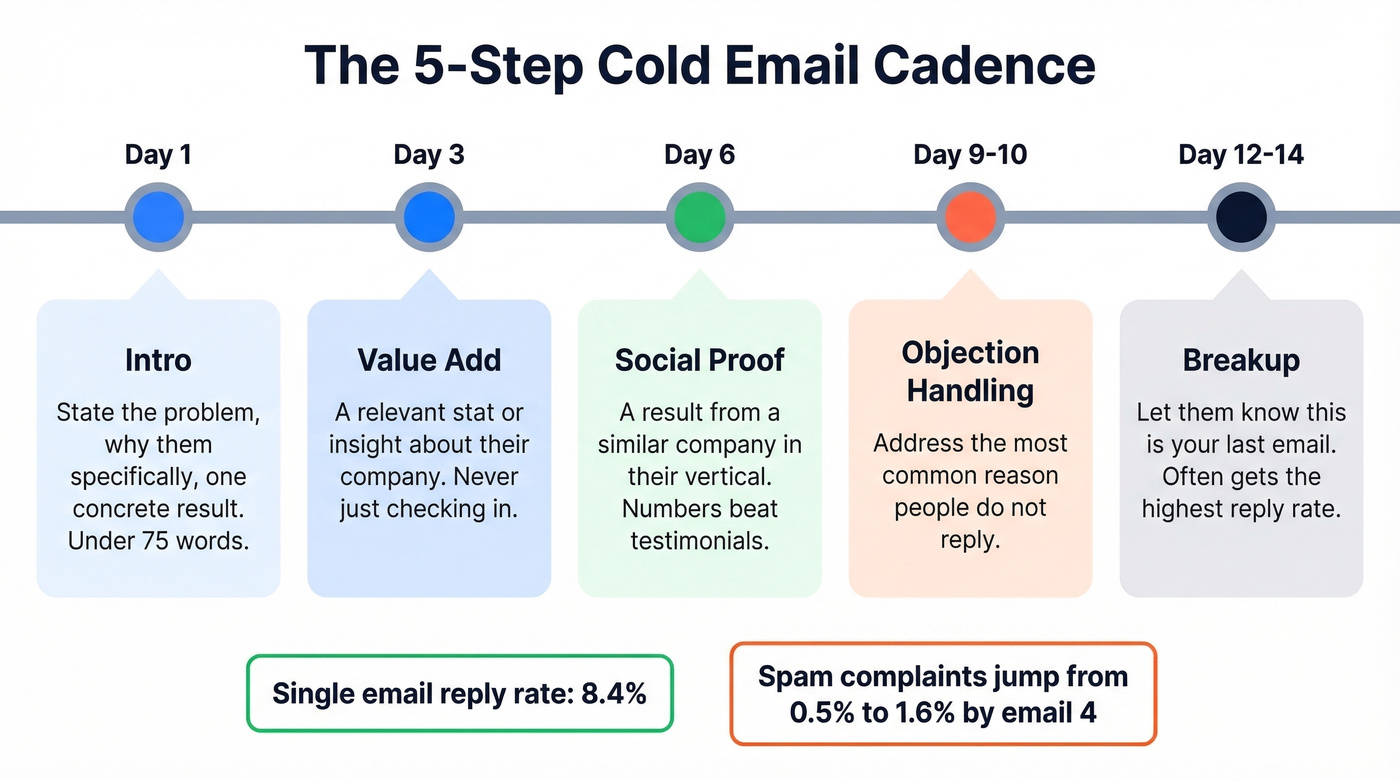
Day 1 - Intro. State the problem you solve, why you're reaching out to them specifically, and one concrete result. Under 75 words.
Day 3 - Value add. A relevant stat, a quick insight about their company, or a resource. Never "just checking in." (If you keep defaulting to that line, here’s how to say just checking in professionally.)
Day 6 - Social proof. A result from a similar company in their vertical. Numbers beat testimonials.
Day 9-10 - Objection handling. Address the most common reason people don't reply.
Day 12-14 - Breakup. Let them know this is your last email. Breakup emails often get the highest reply rates because they remove pressure.
Single-email sends pull the highest reply rate at 8.4%. By the third email, reply rates drop up to 20% from that peak. The tradeoff: spam complaints escalate from 0.5% on email one to 1.6% by email four. Every follow-up is a calculated risk.
Let's be honest: if your average deal size is under $15K, you probably don't need a 5-email sequence. Three emails with verified data and a sharp angle will outperform five generic touches every time. The teams obsessing over sequence length are usually the ones neglecting list quality.
Don't forget multi-channel context. The best-performing outbound teams layer email with one or two touches on other channels - a profile view, a brief phone call. Sopro's data shows top performers use an average of 2.8 channels. Email starts the conversation; other channels accelerate it.
Email Copy That Gets Replies
Six to eight sentences, under 200 words, plain text. That's the formula. The r/b2bmarketing thread backs this up - practitioners consistently report that short, plain-text emails with verified lists are the baseline for results. (If you want to go deeper on structure and wording, see email copywriting.)
Here's a template that follows the structure:
Subject: [Specific problem] at [Company]
Hi [Name],
Noticed [Company] just [trigger - new hire, funding round, expansion]. When that happens, most [role] teams run into [specific problem].
We helped [similar company] cut [metric] by [number] in [timeframe]. Happy to share how - takes 15 minutes.
Worth a look?
[Your name]
The commercial cleaning vertical hitting 9-11% reply rates? Their emails averaged ~51 words.
Quick self-audit before every send: count how many times you write "I," "we," or "our" versus "you" and "your." If the ratio skews toward you talking about yourself, rewrite.
Common Mistakes That Kill Campaigns
Sending the same email to everyone. Segmented emails drive 30% more opens and 50% more clickthroughs than unsegmented blasts. This is the single highest-leverage change you can make. (If you’re operationalizing this, use intent based segmentation.)
Prioritizing volume over value. Emailing 1-2 contacts per company pulls a 7.8% reply rate. Blasting 10+ drops you to 3.8%. Precision wins.
Never cleaning your list. Lists decay at roughly 2-3% per month. Clean at least yearly, and re-verify before any major campaign. One bad batch can tank your sender score for weeks.
Confusing personalization with mail merge. Dropping {{first_name}} into a template isn't personalization. Real personalization means referencing something specific about the prospect's company, role, or situation. If you can't do that at scale, narrow your list until you can.
Skip the "AI-personalized at scale" tools that scrape a prospect's About section and jam it into sentence one. Recipients can smell it instantly, and the consensus on r/sales is that these tools hurt reply rates more than they help.
Best Tools for the Job
You need three tools, not ten: a data source for finding and verifying contacts, a sending platform for executing campaigns, and a CRM for tracking everything. (If you’re evaluating stacks, start with these outbound lead generation tools.)
Data & Verification
| Tool | Starting Price | Best For |
|---|---|---|
| Prospeo | Free (75 emails/mo) | Verified emails + list cleaning |
| Apollo | Free tier, from ~$49/mo | Prospecting + basic sequences |
| Hunter.io | Free (25/mo), from ~$49/mo | Quick email lookups |
| ZoomInfo | ~$15-40K/year | Enterprise data needs |
Apollo's free tier is generous for early-stage teams, but email accuracy drops off compared to dedicated verification tools. ZoomInfo is the enterprise default, but expect $30-50K/year for a mid-market package with intent data - hard to justify unless you're running 10+ reps.
Email Sending Platforms
| Tool | Starting Price | Best For |
|---|---|---|
| Brevo | Free (300 emails/day), from $9/mo | Budget-friendly all-in-one |
| ActiveCampaign | From $19/mo | Deep automation + CRM |
| HubSpot | From $20/mo | Teams in HubSpot ecosystem |
| Mailchimp | Free (up to 500 contacts), from $13/mo | Simple campaigns |
Mailchimp charges you for unsubscribed contacts sitting in your list - a frustrating gotcha that catches a lot of teams off guard. ActiveCampaign's pricing ramps with contact count. HubSpot gets expensive fast once you add CRM features. Brevo is the Reddit favorite for small teams on a budget; the free tier alone handles a surprising amount. GetResponse ($19/mo) and MailerLite ($25/mo) are also worth a look for solid automation without enterprise pricing.
Cold Outbound Sending
| Tool | Starting Price | Best For |
|---|---|---|
| Instantly | From ~$30/mo | Multi-mailbox cold infra |
| Smartlead | From ~$39/mo | Deliverability-focused sending |
Both handle mailbox rotation, warmup, and sending limits automatically. Neither verifies emails - pair them with a dedicated verification tool for list building.
FAQ
Is cold email still effective in 2026?
Yes. Cold email averages a 5.8% reply rate across 16.5M emails analyzed. Top performers hit 8-12% with verified data and vertical-specific messaging. It's still one of the most cost-effective outbound channels for B2B teams.
How many follow-ups should I send?
Three for warm leads, up to five for cold. Each follow-up must add a new angle - a stat, a case study, or an objection reframe. Spam complaints jump from 0.5% to 1.6% by email four, so every touch is a calculated risk.
How do I avoid the spam folder?
Authenticate with SPF, DKIM, and DMARC. Keep bounces under 2% and complaints under 0.3%. Warm up new domains over 4-6 weeks. Verify your entire list before sending to catch invalid addresses, spam traps, and honeypots before they damage your domain.
What's a good click rate for B2B emails?
The all-industry average is 2.62%. Business and finance emails average 2.78%. Segmented campaigns consistently outperform unsegmented blasts by 50% on clickthroughs, making list segmentation the highest-leverage optimization you can make.
Can B2B email outperform paid channels on ROI?
At $36-$42 returned per dollar spent, email consistently outperforms paid social and display ads. The catch is that results compound slowly - you need clean data, authenticated domains, and consistent sending to build the sender reputation that makes those returns possible.
The Bottom Line
The fundamentals haven't changed: clean data, authenticated domains, and messages worth reading. Email marketing for B2B lead generation rewards the teams that get the boring stuff right - verification, segmentation, deliverability - before obsessing over subject lines and send times. Everything else is optimization.