How to Engage Buyers During Demos: A Data-Backed Playbook
It's minute 12. The VP has their camera off. Your champion is half-reading Slack. You're on your third feature walkthrough, and the energy in the room has flatlined. This isn't a presentation problem - it's a preparation problem. Learning how to engage buyers during demos starts with understanding why they disengage in the first place.
Win rates are trending downward. The largest cohort of sales teams now sits in the 21-25% win-rate bracket, down from 31-40% the year prior. The demo is where deals are won or lost, and most reps are losing them through preventable mistakes.
What Moves the Needle
Demo engagement is a data problem first and a presentation problem second. Three things matter:
- Pre-demo discovery that goes beyond qualification. AE discovery is often just qualification - not enough to build a relevant demo. (If you need a tighter structure, use these discovery benchmarks.)
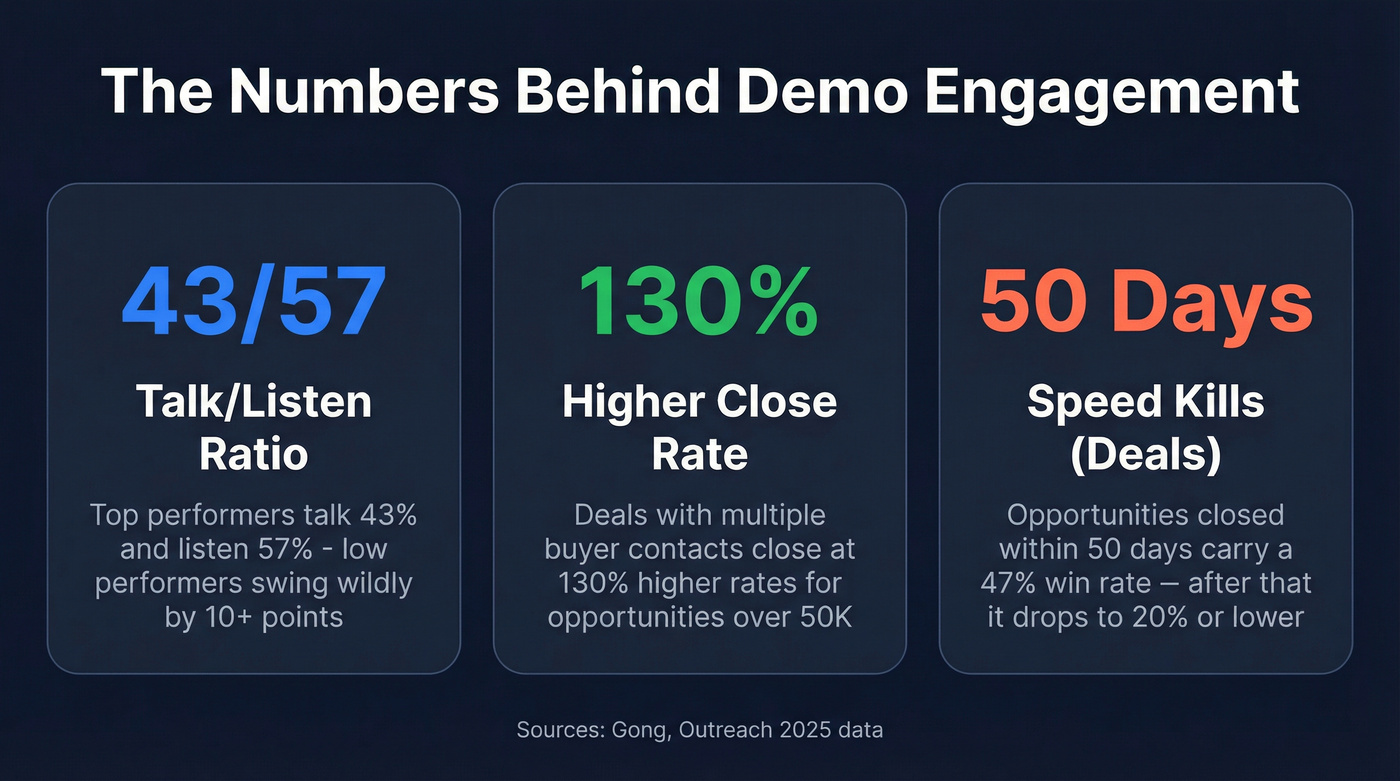
- Talk/listen discipline at 43/57 or better. Top performers talk 43% and listen 57%. Low performers swing wildly. (More on sales conversation science and what top reps do differently.)
- Multi-threading before and during the demo. Deals with multiple buyer contacts close at 130% higher rates for opportunities over $50K. (Here’s a deeper breakdown of multithreading in sales.)
One more number worth pinning to the wall: opportunities closed within 50 days carry a 47% win rate. After that, you're looking at 20% or lower.
Before the Demo
Most reps confuse qualification discovery with demo discovery. Your AE confirmed budget, authority, need, and timeline - great. But that tells you nothing about which workflow to show, which pain point to lead with, or who in the room cares about what. The 2Win framework calls this gap out directly: AE discovery and demo discovery are different jobs.
A pre-demo research checklist should cover titles and reporting lines, tech stack, recent funding or headcount changes, and the org chart around your champion. Here's where most teams trip up: the data they're working from is stale. The Director of RevOps on the invite got promoted two months ago and your CRM still shows the old title. You're personalizing to a person who doesn't exist anymore. (This is classic B2B contact data decay in action.)
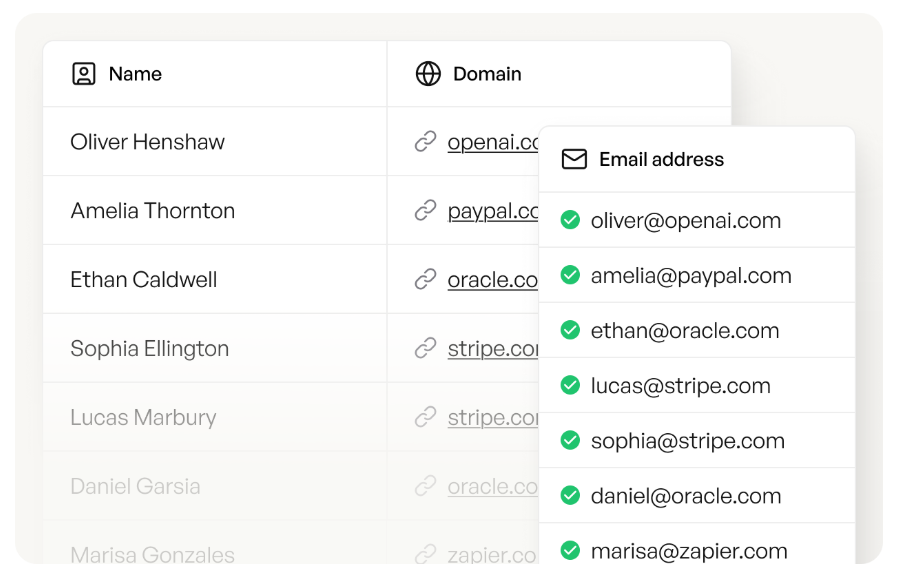
Prospeo refreshes contact data every 7 days - compared to the 6-week industry average - and returns 50+ data points per contact, including job title plus company-level firmographics and growth signals. When you walk into a demo with current titles and accurate org structure, personalization actually works instead of just sounding good on a slide. (If you want the benchmarks behind this, see prospect data accuracy.)
Speed matters too. Chili Piper's analysis of 4 million form submissions found that instant scheduling after form fill produces a 66.7% booking rate versus the ~30% industry average. If your demo request flow involves a 48-hour email chain, you're losing half your pipeline before the call happens.
Opening the Demo Right
The first five minutes set the tone for the entire conversation. Three moves make or break this window.
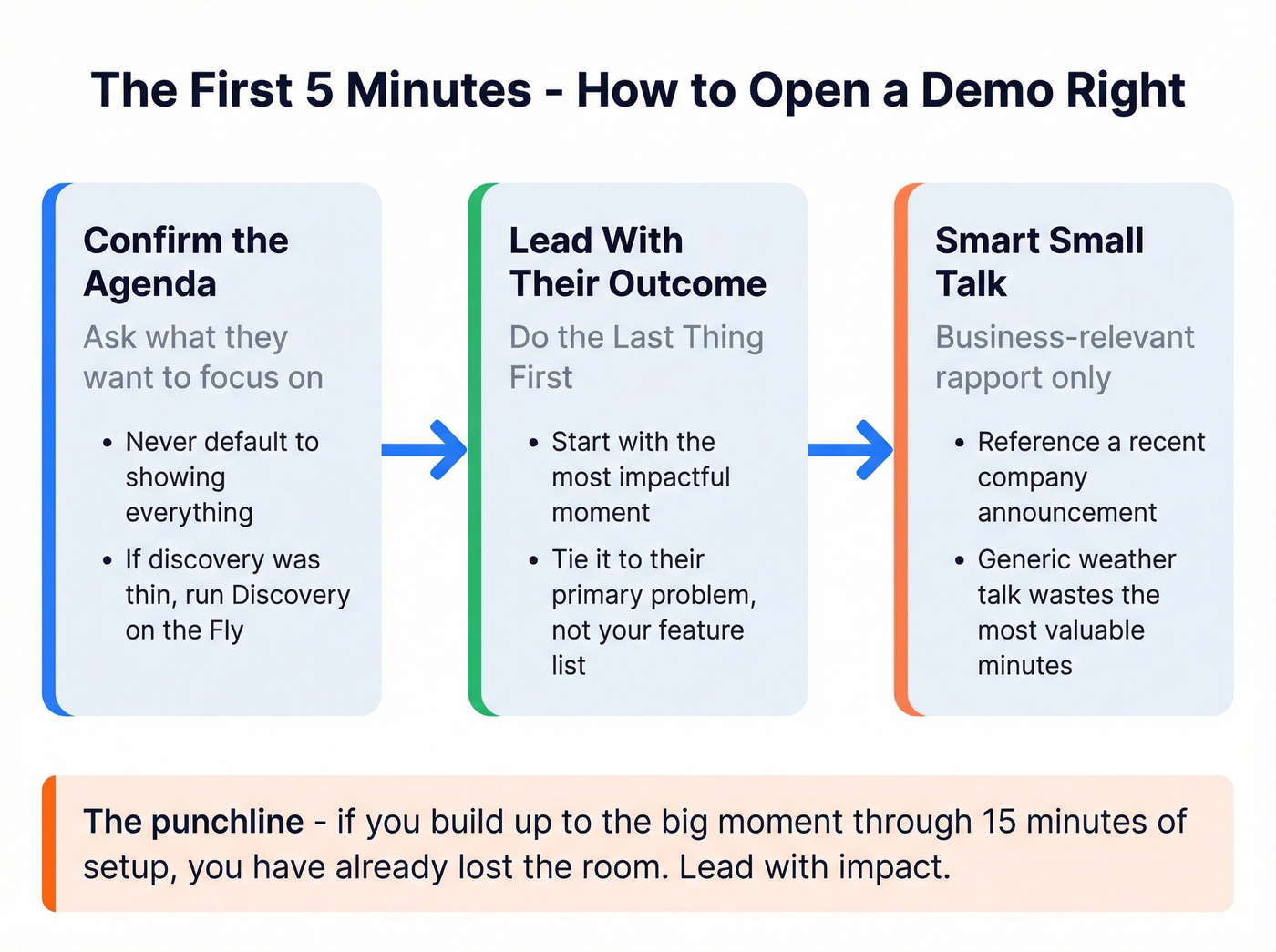
Confirm the agenda. Don't default to "I'll show you everything." Ask what they want to focus on. If discovery was thin, open with targeted questions and run an agile demo based on what you learn live - the 2Win approach calls this "Discovery on the Fly." Not ideal, but infinitely better than guessing. (If you need better prompts, pull from these open-ended sales questions.)
Lead with the outcome they care about. The Great Demo! methodology calls this "Do the Last Thing First" - start with the most impactful moment tied to the buyer's primary problem. Don't build up to the punchline through 15 minutes of setup. If you need an opener, lead with a case study from a similar company; it signals you've done your homework even when discovery was thin.
Build rapport through smart small talk - but make it business-relevant. Reference a recent company announcement or a shared connection. Generic "how's the weather" wastes the most valuable minutes of the call.

Personalizing a demo to a prospect who got promoted two months ago kills credibility before you open your mouth. Prospeo refreshes 300M+ profiles every 7 days and returns 50+ data points per contact - current titles, reporting lines, tech stack, and growth signals. Walk in prepared, not guessing.
Stop demoing to job titles that no longer exist.
Real-Time Engagement Tactics
This is where most demos go sideways. Six tactics that work, in order of impact.
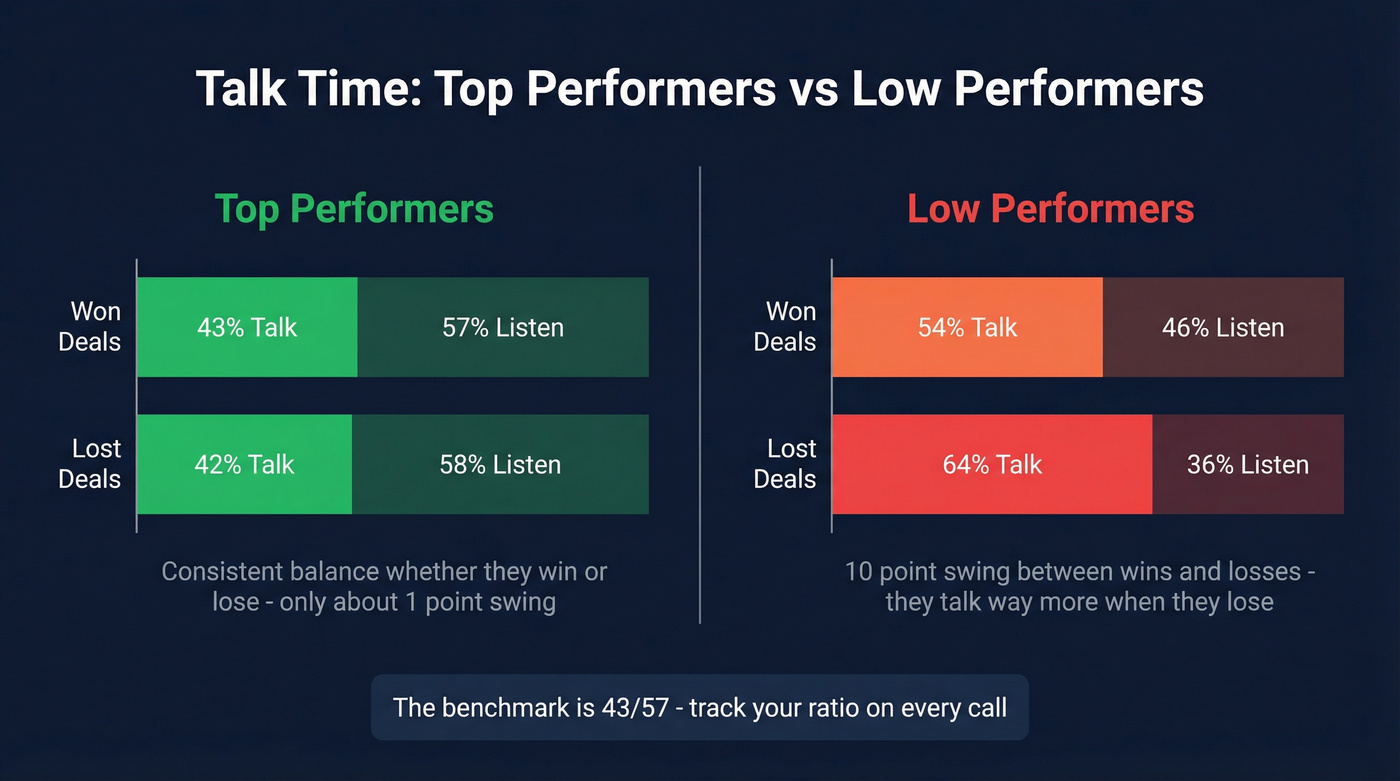
Hold the 43/57 line. The benchmark is 43% talk and 57% listen, and top performers keep a similar balance whether they win or lose. Low performers swing by about 10 points - 54% talk time in won deals versus 64% in lost deals. If you don't track your talk/listen ratio, start. Call intelligence tools make this trivial. (You can also tighten this with a simple sales coaching scorecard.)
Break the demo into short blocks. Every 2-5 minutes, pause and check in. "Does this match how your team handles it today?" A solid structure is a 35-minute agenda: 5 minutes intro, 15 minutes solution overview, 10 minutes interactive Q&A, 5 minutes next steps. Adjust proportions, but always have a clock.
Call on people by name. "Sarah, does your team handle this workflow today?" beats "Any questions?" every single time. Ask any SE community and they'll tell you the same thing: the named question is the single most underrated engagement tool in a group demo. We've watched this one change alone transform energy in rooms with 4+ attendees.
Tell stories, not features. "Our reporting module has 47 dashboard widgets" means nothing. "A RevOps team at a Series C fintech cut their pipeline review from 3 hours to 40 minutes using three of these dashboards" - now the buyer sees themselves in the story. Engaging prospects during demos is about making them the protagonist, not your product. (This is also a core persuasive sales talk skill.)
Use interactive elements where possible. Navattic's benchmark data shows ungated interactive demos get ~10% higher engagement than gated ones, and 70% of the top 1% of interactive demos aren't form-gated at all. Getting the buyer's hands on the product changes the dynamic from presentation to exploration.
Never switch into training mode. The moment you start explaining "click here, then here, then scroll down," you've become a help doc, not a seller. Show outcomes, not click paths.
One more thing: sellers using AI tools to prep call briefs and generate personalized talking points generate 77% more revenue than those who don't. If you're still manually assembling your demo prep, you're bringing a knife to a gunfight. Use AI for research synthesis and follow-up drafts - save your human energy for the live conversation. (Related: AI sales content generation workflows that don’t sound robotic.)
Engaging Multiple Stakeholders
Single-threaded demos are a coin flip you'll lose. Analysis of 1.8 million opportunities shows 77% of deals involve multiple contacts, and closed-won deals have roughly 2x as many buyer contacts as lost deals. Winning selling teams are 67% larger than losing ones - bring your SE, your manager, whoever adds credibility.
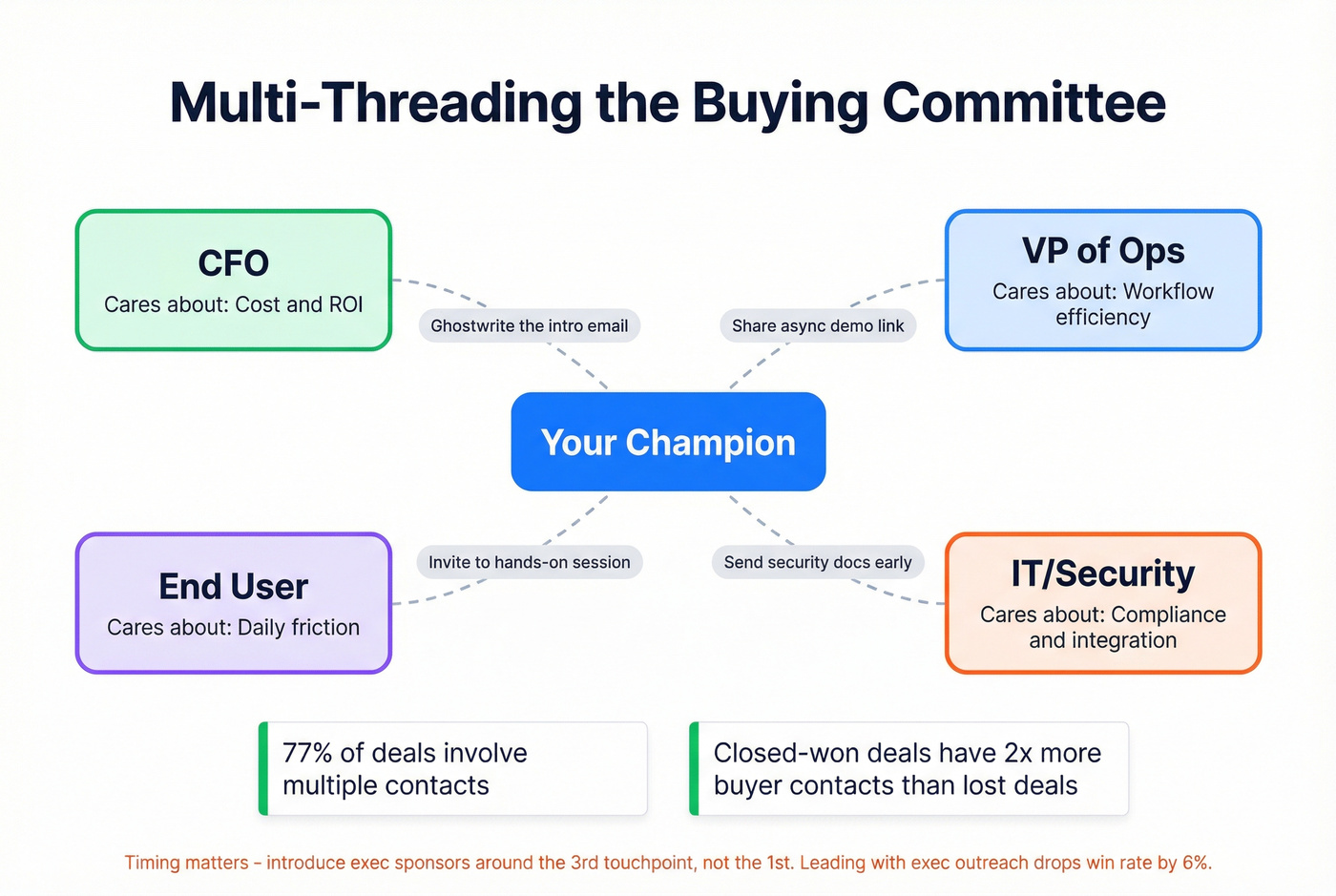
Most reps know this and still don't do it. Getting your champion to introduce you to other stakeholders feels awkward. So make it easy: ghostwrite the intro email for them. Draft a two-sentence email they can forward with one click. In our experience, the ghostwritten intro works about 70% of the time. Remove the friction and the introductions happen. (If you need a template, start with a referral introduction email.)
When running a multi-stakeholder demo, open with problem alignment, not product. The CFO cares about cost, the VP of Ops cares about workflow, the end user cares about daily friction. Acknowledge all three before you demo to any of them. And watch your timing on executive sponsors: introducing them around the third touchpoint increases win rate by ~5%, but leading with exec outreach actually drops win rate by 6%.
Mistakes That Kill Engagement
Let's be honest - we've all committed at least one of these.
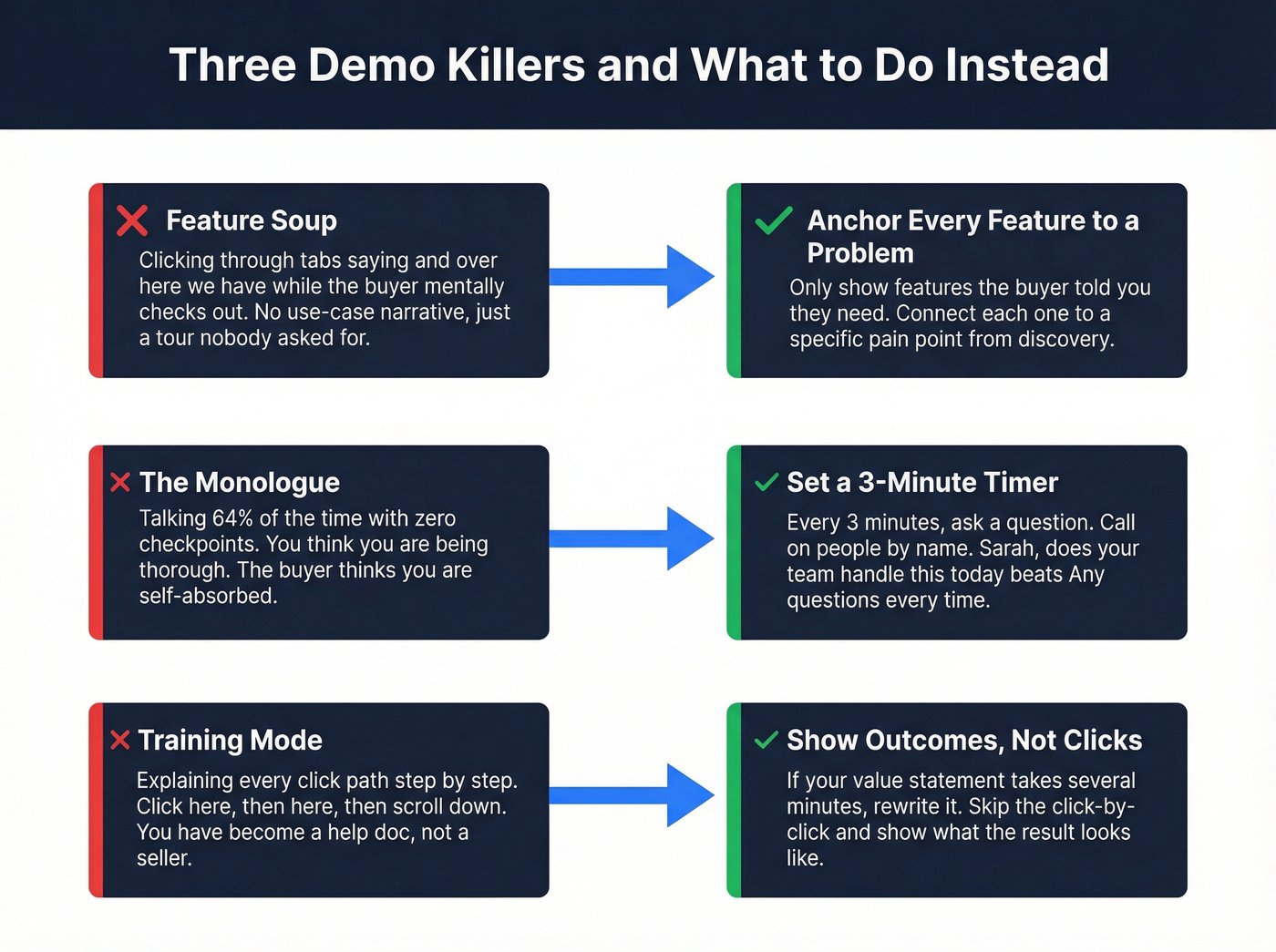
"Feature Soup" - no use-case narrative, just a feature tour nobody asked for. You're clicking through tabs saying "and over here we have..." while the buyer mentally checks out. Anchor every feature to a specific problem the buyer told you about.
"The Monologue" - talking 64% of the time with no checkpoints. You think you're being thorough. The buyer thinks you're self-absorbed. Set a timer. Every 3 minutes, ask a question.
"Training Mode" - explaining every click path instead of showing outcomes. If your value statement takes several minutes, it needs a rewrite. Skip this pattern entirely if you want anyone to remember what you showed them. (This is often triggered by a pitch slap opener.)
After the Demo
The demo ended well. Now don't blow it.
Verify your contact data before sending. Your recap email can't land if the address bounces. Prospeo's 98% email accuracy means your follow-up actually reaches the inbox - not a dead address your CRM cached three months ago. (If you’re auditing your list, use an email checker tool workflow.)
Send the recap within 2 hours. A same-day recap with clear next steps signals professionalism and keeps momentum alive. Waiting until the next morning is waiting too long; by then, the buyer has had two other vendor calls and yours is blurring into the noise.
Build a mutual action plan. Every next step needs an owner and a date. "Sarah will share the security questionnaire by Thursday; we'll schedule a technical deep-dive for the 15th" is how deals close. (More templates in our post-demo playbook.)
Leave something behind. An async video recap via Loom, an interactive demo link through Navattic or Consensus - give the champion something they can share internally without scheduling another call. This is especially critical for multi-stakeholder deals where half the decision-makers weren't on the original call and need to see the product before they'll sign off.
Multi-threading doubles your close rate, but only if you can actually find the other stakeholders. Prospeo gives you verified emails at 98% accuracy and 125M+ direct dials across the entire buying committee - so you can ghostwrite that intro email with real contact data behind it.
Reach every stakeholder in the room and the ones who should be.
FAQ
How long should a sales demo be?
SMB first demos should run 20-30 minutes; mid-market and enterprise calls land best at 30-45 minutes. Top performers spend less time talking and more time in dialogue. If you're consistently over 45 minutes, you're showing too much - cut features and focus on the buyer's top two pain points.
What's the ideal talk-to-listen ratio?
Aim for 43% talk and 57% listen. Low performers swing to 64% talk in lost deals. Track your ratio with call intelligence tools like Gong or Chorus and stay under 45% - even a few percentage points of improvement correlates with higher win rates.
How do you handle buyer questions mid-demo?
Welcome them - questions signal engagement, not disruption. Answer concisely, tie the response back to their use case, and use the question as a transition to the next relevant section. If a question falls outside scope, note it visibly and commit to a follow-up so the buyer feels heard without derailing the flow.
How do you personalize a demo with bad CRM data?
You don't - you fix the data first. Run your prospect list through an enrichment tool before the call. A 7-day refresh cycle and 83%+ enrichment match rate mean titles, tech stacks, and emails are current, not cached from weeks ago. Accurate data is the foundation of any personalized demo.