How to Scale Client Outreach Without Destroying Your Reply Rates
Reply rates dropped 15% year-over-year - from 6.8% in 2023 to 5.8% in 2024. That's the backdrop you're working against in 2026: prospects face 120+ emails a day, and the old "send more, book more" playbook doesn't just stop working at volume. It actively destroys your sender reputation and tanks future campaigns before they even launch.
We've spent the last year watching teams try to brute-force their way to pipeline growth. The ones who succeed don't send more emails. They send better ones, to better data, across more channels. Here's the framework that actually works.
Fix Your Data Before Anything Else
Most outreach failures happen before you send a single email.
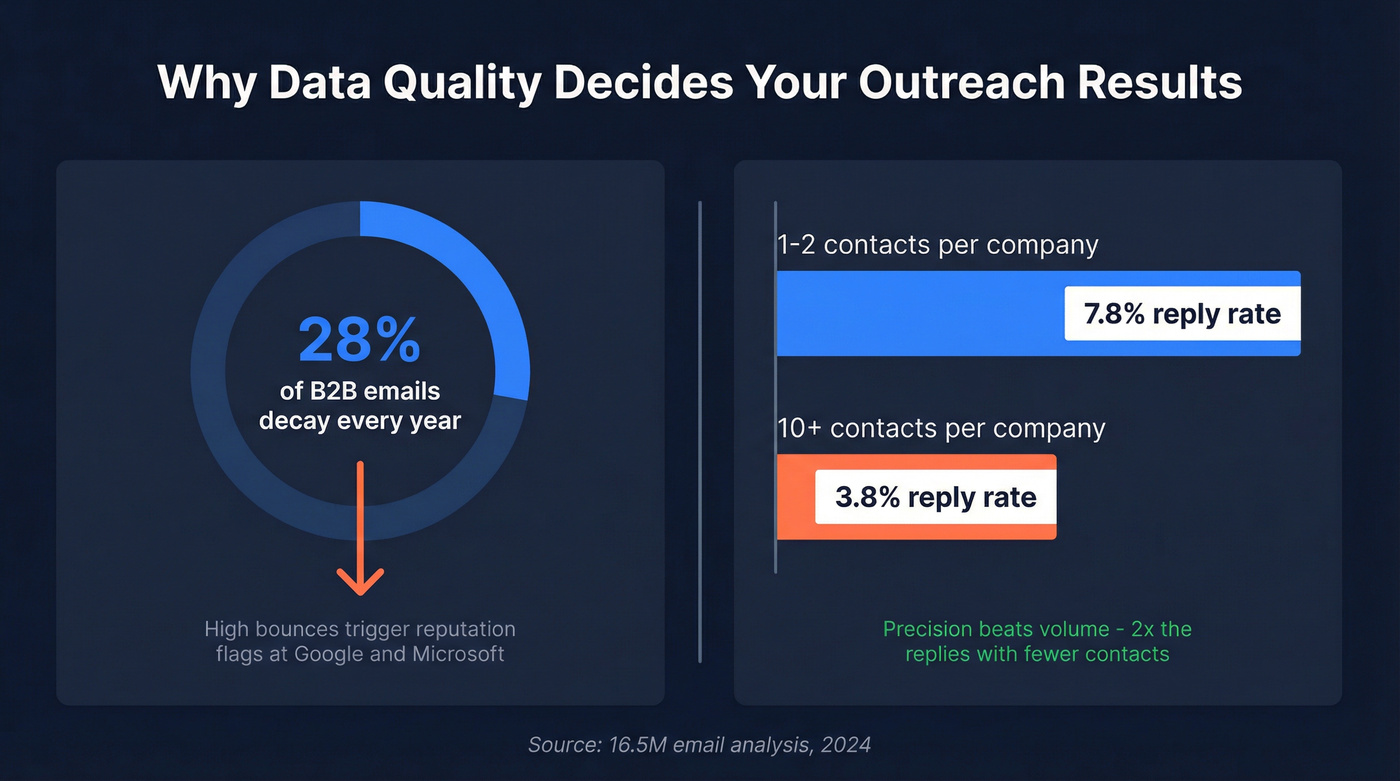
About 28% of B2B emails decay annually, which means roughly a quarter of your list is dead weight within twelve months. Send to those addresses and you're not just wasting sequences - you're training inbox providers to treat your domain as spam. The damage compounds fast: high bounce rates trigger reputation flags at Google and Microsoft, and even your emails to valid addresses start landing in junk folders.
There's also a targeting problem that doesn't get enough attention. Emailing 1-2 contacts per company yields a 7.8% reply rate; blast 10+ contacts at the same company and that drops to 3.8%. Precision beats volume every time, and the teams who ignore this end up wondering why their "scaled" outreach performs worse than when they were small.
Prospeo's 5-step verification process delivers 98% email accuracy across 300M+ professional profiles, with every record refreshing on a 7-day cycle compared to the 6-week industry average. One team using it dropped their bounce rate from 35% to under 4% and tripled their pipeline from $100K to $300K per week. The free tier gives you 75 verified emails per month to test the difference, with paid plans running about $0.01 per email.

Build Deliverability Infrastructure
Verified data is necessary but not sufficient. You need the technical plumbing in place before you ramp volume.
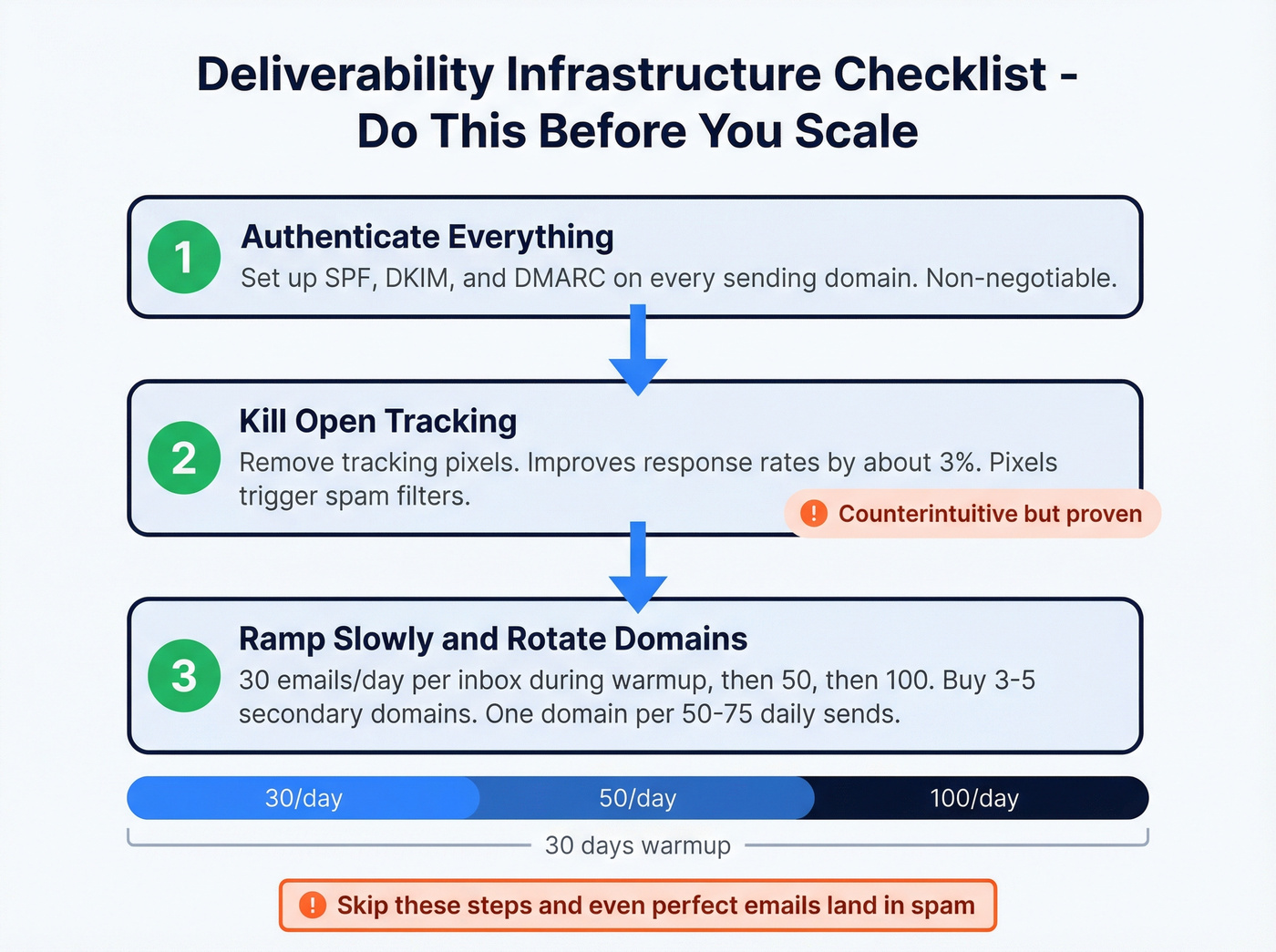
Authentication is non-negotiable. Set up SPF, DKIM, and DMARC records for every sending domain. These tell inbox providers your emails are legitimate. Skip this step and even perfectly written emails to verified addresses land in spam. (If you need the full setup, follow our deliverability checklist and SPF/DKIM/DMARC setup guide.)
Kill open tracking. Counterintuitive, but removing open-tracking pixels improves response rates by about 3%. The pixels trigger spam filters, and open rates are unreliable anyway since Apple's Mail Privacy Protection inflated them across the board. If you want the deeper why, see does open tracking hurt cold email.
Ramp slowly and rotate domains. Start around 30 emails per day per inbox during warmup, then move to 50, then 100 as deliverability stabilizes - most teams warm for about 30 days. Buy 3-5 secondary domains (variations of your primary), warm each independently, and distribute sends across them. One dedicated domain per 50-75 daily sends is a solid rule of thumb. If one domain gets flagged, the others keep running. We've seen teams lose months of momentum because they put all their volume through a single domain and got it burned in a week. (More detail: automated email warmup and email sending infrastructure.)
Personalize Without Manual Labor
An analysis of 12 million outreach emails found that personalized subject lines get 30.5% more responses, and personalized body content lifts reply rates by 32.7%. The challenge is doing this without spending 15 minutes per email.
Four frameworks make it scalable:
Prospect-centric. Reference the reader's role, recent activity, or a specific challenge someone in their position faces. Mention them more than you mention yourself.
Pain-centric. Lead with a problem you know their segment experiences. This works best when you have strong ICP data mapped to job titles or industries.
Value-centric. Answer "what's in it for me?" in the first two sentences. State the outcome, then explain how.
Company-centric. Use company signals - recent funding, hiring surges, tech stack changes. Prospecting tools with technographic and intent filters make this accessible at scale without manual research. (If you want examples, use these outreach email templates and this personalization framework.)
The sweet spot for email length is 6-8 sentences, under 200 words. That range hits a 6.9% reply rate.

Bad data doesn't just waste sequences - it burns domains and kills future campaigns. Prospeo's 5-step verification delivers 98% email accuracy across 300M+ profiles, refreshed every 7 days. One agency dropped bounce rates from 35% to under 4% and tripled pipeline to $300K/week. Plans start at $0.01/email.
Fix your data layer before you scale another campaign.
Go Multichannel
Single-channel outreach is leaving money on the table. Multichannel campaigns - email, phone, and social touchpoints combined - drive 20% higher close rates, 20% lower CAC, and 25% shorter sales cycles. The consensus on r/sales backs this up: the teams posting about strong pipeline numbers are almost always running at least two channels. (For a full playbook, see B2B omnichannel marketing.)
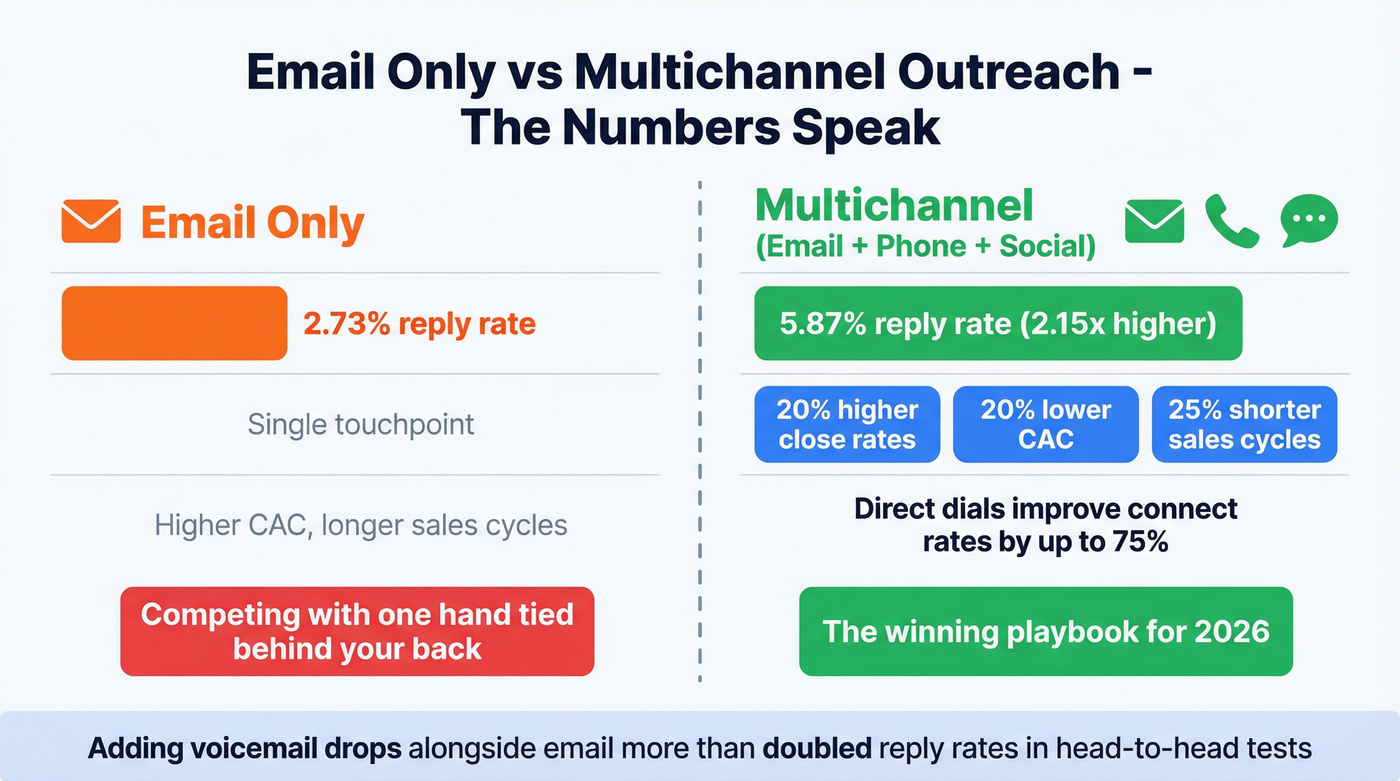
The phone channel deserves more attention than most teams give it. Using direct dials instead of switchboard numbers improves connect rates by up to 75%. One multichannel test tells the story clearly: a team running email-only saw a 2.73% reply rate, and adding voicemail drops alongside email pushed that to 5.87% - more than double, with minimal extra effort.
If you're still running email-only outbound in 2026, you're competing with one hand tied behind your back.
Design Sequences That Don't Burn Your List
Sequence design is where most teams over-engineer. The data is clear on what works and what backfires.
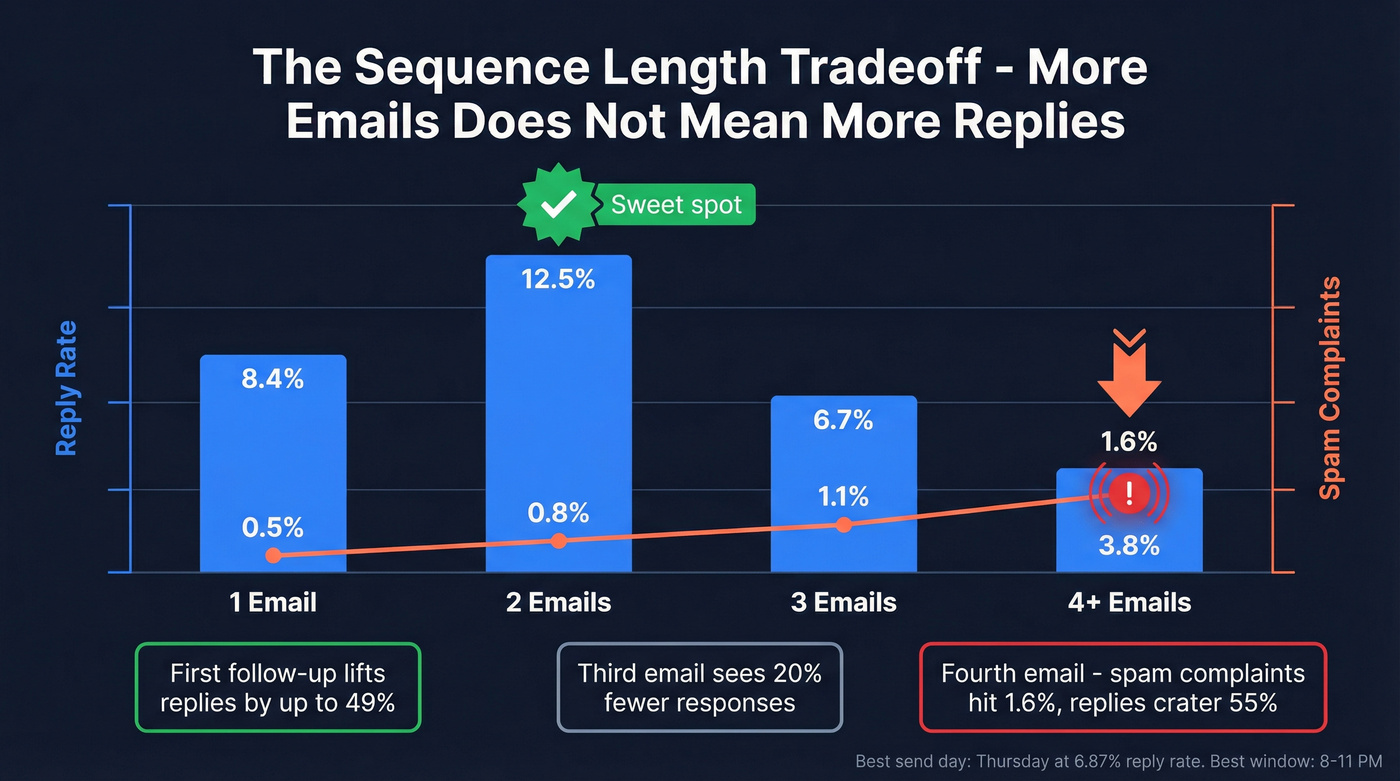
| # of Emails | Avg. Reply Rate | Spam Complaints | Recommendation |
|---|---|---|---|
| 1 | ~8.4% | 0.5% | Test for warm leads |
| 2 | ~12.5% | ~0.8% | Sweet spot for most |
| 3 | ~6.7% | ~1.1% | Max for cold lists |
| 4+ | ~3.8% | 1.6%+ | Avoid - burns list |
The first follow-up lifts replies by up to 49% in high-performing campaigns. By the third email, you're seeing 20% fewer responses. By the fourth, response rates crater 55% and spam complaints hit 1.6% - that's the point where you're actively damaging your domain for future campaigns. Let's be honest: most "5-touch sequences" exist because someone read a blog post from 2019, not because the data supports them. (If you want proven cadences, start with these best sales sequences.)
For timing, Thursday is the best-performing send day at 6.87% reply rate, while Monday lags at 5.29%. The 8-11 PM window peaks at 6.52%, likely because you're catching prospects during evening inbox triage when competition is lower. (More benchmarks: best time to send prospecting emails.)
Pick the Right Tools
Here's the thing: most teams trying to scale outreach don't need an all-in-one platform. They need clean data and a good sequencer. That's it. We've watched teams spend months optimizing subject lines while 15% of their list was bouncing. The stack matters, and it starts with the data layer. (If you're comparing options, see cold email marketing tools.)
| Tool | Function | Starting Price | Best For |
|---|---|---|---|
| Prospeo | Data + verification | ~$0.01/email (free tier) | Clean data at any scale |
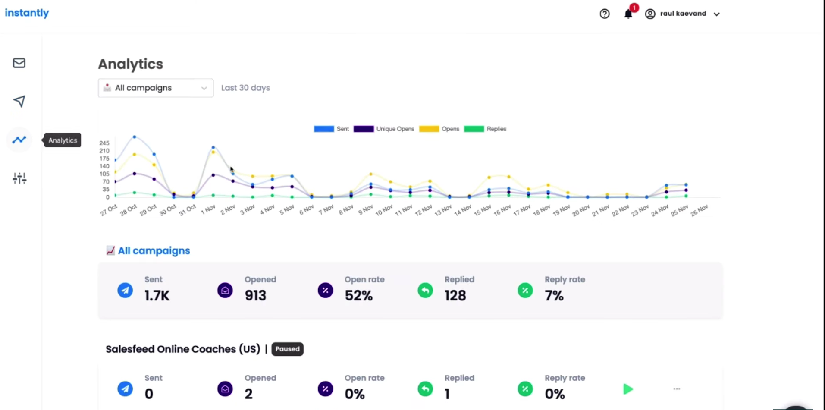
| Instantly | Cold email sequencing | From $30/mo | Agencies scaling volume across clients |
| Smartlead | Cold email sequencing | $39/mo | Teams wanting flat-fee pricing |
| Lemlist | Multichannel sequences | $69/user/mo | Email + social in one workflow |
| Apollo | Database + sequencing | Free tier; paid ~$49/user/mo | All-in-one for smaller teams |
| Klenty | Sales sequencing | $50/user/mo | Mid-market with strong CRM integrations |
| Outreach | Enterprise engagement | Custom pricing | Large orgs with dedicated RevOps |
Instantly is a go-to for agencies running high-volume cold email across multiple client accounts - unlimited email accounts and warmup on a flat-fee model, strong deliverability features, and a clean UI. Smartlead offers similar capabilities with flat-fee tiers rather than seat-based pricing, which makes it attractive when you're growing a team beyond 3-4 reps.
Lemlist stands out for teams that want email and social touchpoints in a single workflow without stitching tools together; the multichannel sequencing is genuinely well-designed. Apollo works as an all-in-one for smaller teams that want database access and sequencing without managing multiple vendors. Klenty is a solid mid-market option with good Salesforce and HubSpot integrations. Outreach is the enterprise standard - powerful but expensive, and it assumes you have RevOps to configure it properly. Skip it if you don't have a dedicated ops person.
Mistakes That Kill Outreach at Scale
Scaling volume without verifying data. Every unverified email is a small bet against your domain reputation. At scale, those bets add up fast - and the damage is expensive to reverse. I've seen a team burn through three domains in two months because they imported an unverified list from a data broker. (If you're auditing list quality, start with email ID validators.)
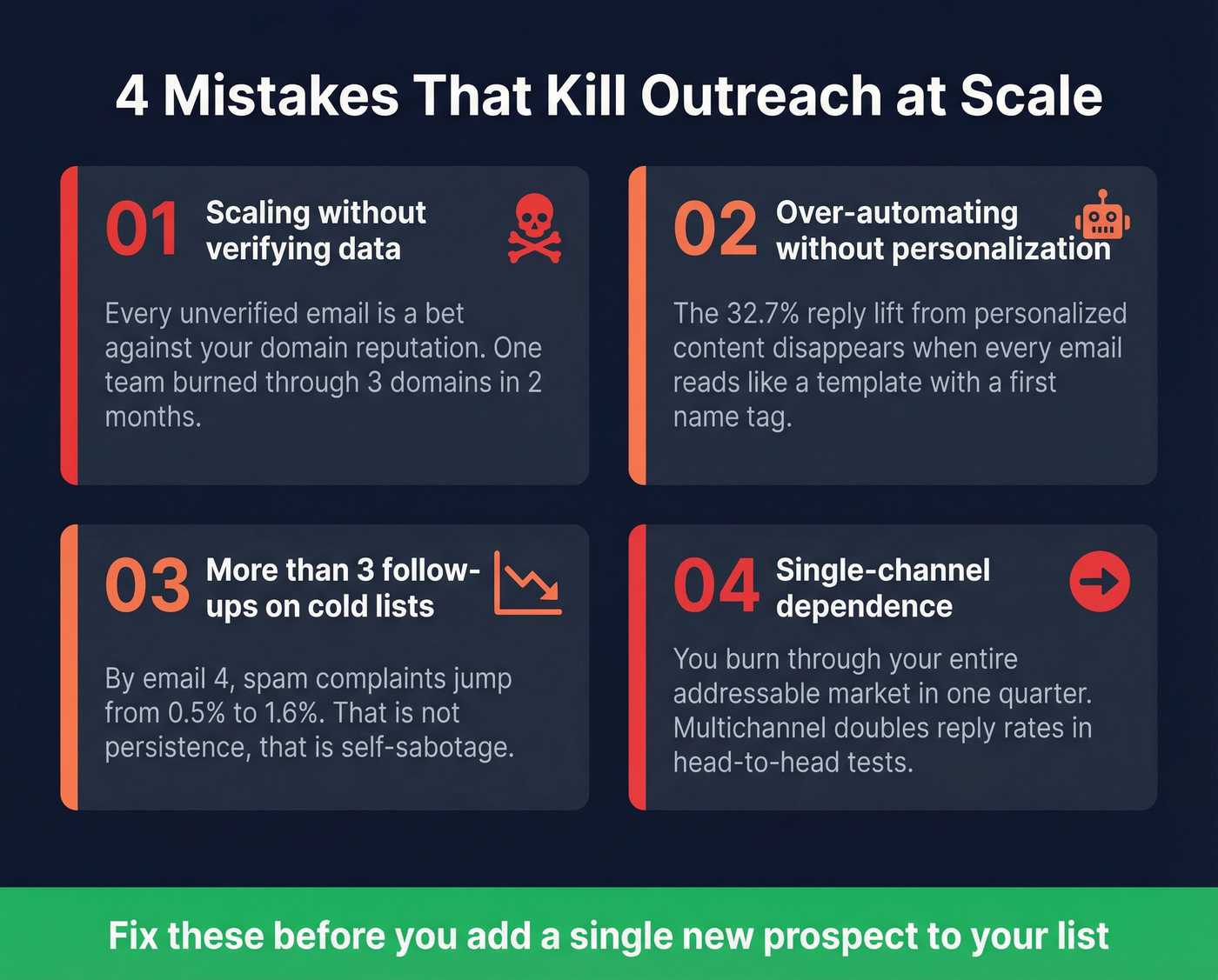
Over-automating without personalization. Automation should handle logistics. The 32.7% reply rate lift from personalized body content disappears when every email reads like a template with a {first_name} merge tag.
More than three follow-ups on cold lists. By email four, spam complaints rise from ~0.5% to ~1.6%. That's not persistence - it's self-sabotage.
Single-channel dependence. Adding voicemail drops alongside email can double reply rates in head-to-head tests. Multichannel is how you grow pipeline without burning through your entire addressable market in a quarter.
Scaling outreach across channels means nothing if your contact data decays every month. Prospeo gives you 143M+ verified emails and 125M+ direct dials with a 30% pickup rate - plus intent data across 15,000 topics so you reach buyers already in-market. No contracts, no sales calls.
Stop scaling on stale data - start with 75 free verified emails.
FAQ
How many cold emails can I safely send per day?
Start at 30 per inbox during warmup, then scale to 50 and 100 as deliverability stabilizes over roughly 30 days. Rotate 3-5 secondary sending domains - one domain per 50-75 daily sends - so a single flag doesn't kill your entire operation.
What's a good reply rate for cold outreach in 2026?
The most recent large-scale benchmark (16.5M emails analyzed across Jan-Dec 2024) puts the average at 5.8%. Campaigns with verified data, personalized copy, and multichannel touchpoints regularly exceed 7-8%.
How do I keep contact data clean as I scale?
Use a verification tool with a short refresh cycle - a 7-day refresh beats the 6-week industry average by a wide margin. Re-verify your list before every major send, and remove contacts who bounce or mark you as spam immediately. According to Validity's State of Email report, list hygiene is the single biggest predictor of long-term deliverability.